


Manufacturing has always been about precision, efficiency, and getting results. Your digital marketing strategy should be no different.
The landscape has shifted dramatically for manufacturers. Buyers now start their journey online. They research suppliers, compare capabilities, and vet potential partners before making any decisions. If your digital presence isn’t strong, you’re missing opportunities.
This guide breaks down the essential digital marketing strategies for small to medium-sized business (SMB) manufacturers. It covers topics like SEO, PPC, paid advertising, and content marketing. These tools can help you build visibility, generate qualified leads, and drive measurable revenue growth.
Why Digital Marketing Matters for Manufacturers
In manufacturing, deals can take months and involve multiple stakeholders. So, digital marketing bridges the gap between awareness and action. Buyers aren’t impulse shopping. They’re solving problems like supply chain disruptions or material shortages. Digital channels let you meet customers where they are—online, researching solutions.
Traditional tactics like cold calls or print ads cast a wide net in a vast ocean. Digital marketing is more like fishing with precision lures. It allows you to better target specific behaviors and needs. Our 2026 Manufacturing Survey highlights this shift. Manufacturing businesses are investing in owned digital properties to make a measurable impact on long-term growth.
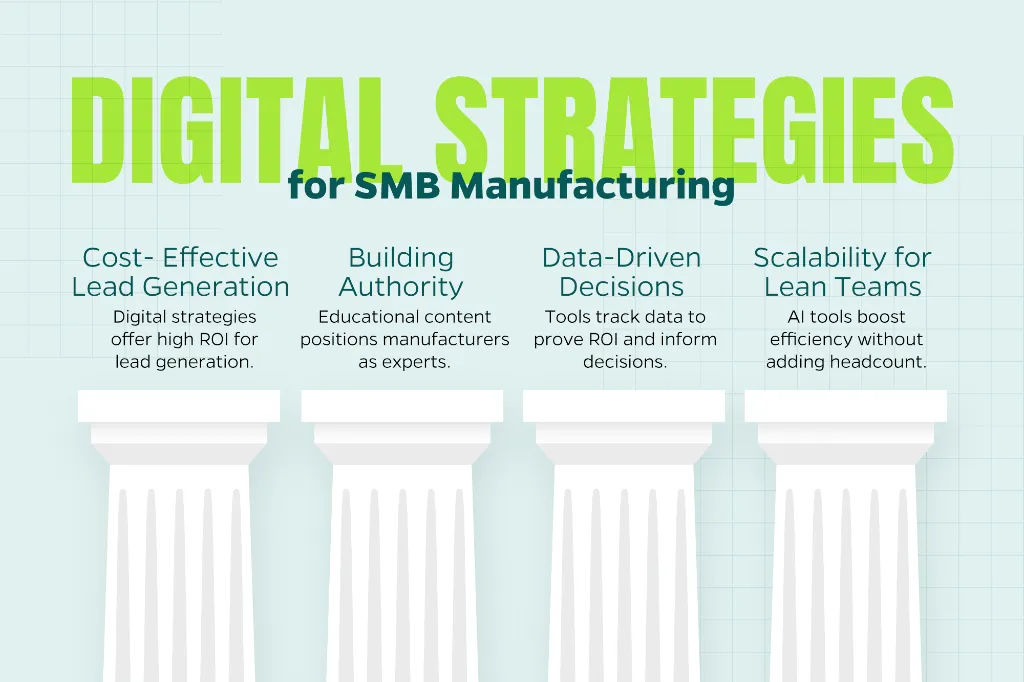
Key benefits for SMB manufacturers include:
- Cost-Effective Lead Generation: With budgets often stretched thin, digital strategies offer high ROI. For example, 46% of our survey respondents invest in SEO for its compounding results that lead to conversions on manufacturers’ own websites.
- Building Authority: In a technical field, educational content positions you as the go-to expert. This helps remedy the lead quality challenge that 25% of manufacturers noted in our survey.
- Data-Driven Decisions: Tools track everything from clicks to conversions to help prove ROI to stakeholders (a pain point for expressed by 16%).
- Scalability for Lean Teams: AI tools, adopted by 55% of our survey participants for content creation, boost efficiency without adding headcount.
If you are neglecting digital, you’re missing out. B2B buyers start with search. Poor online presence signals unreliability.
Building Your Foundation: SEO for Manufacturers
Search Engine Optimization (SEO) is essential. When a potential customer searches for “CNC machining services Chicago” or “custom metal fabrication near me,” they’re showing high purchase intent. They have a need, they’re researching solutions, and they’re ready to engage with qualified suppliers. If your website ranks for these searches, you’re capturing demand at exactly the right moment.
Understanding Search Intent in Manufacturing
Not all searches are created equal. In manufacturing, search intent patterns differ significantly from B2C industries. Your prospects conduct extensive research before reaching out, often spending weeks or months evaluating options. Here’s how your SEO strategy should address each intent type strategically:
Informational searches like “difference between MIG and TIG welding” or “tolerance requirements for CNC machining” come from early-stage researchers. These are often engineers or procurement managers gathering technical specifications. You should create detailed technical content that demonstrates your expertise: comparison guides, material selection charts, tolerance tables, and process explanation videos. This content builds trust during the 6–12-month research cycle typical in manufacturing purchases.
Navigational searches happen when someone searches for your company name or a competitor’s. Beyond ranking for your own brand terms, create comparison pages that address searches like “[Competitor] vs [Your Company]” or “alternatives to [Competitor].” These capture prospects already aware of solutions in your space.
Transactional searches signal immediate buying intent: “request quote metal stamping Ohio” or “custom aluminum extrusion supplier.” Optimize dedicated landing pages for these terms with clear CTAs, capability statements, certifications, and easy quote request forms. Include your geographic coverage, industries served, and minimum order quantities to qualify leads efficiently.
The bottom-funnel opportunity: Manufacturing buyers often search for highly specific combinations like “304 stainless steel stamping +/- 0.005 tolerance” or “FDA-approved medical device injection molding.” Create service pages that address these precise specifications. Detailed pages convert at 3-5x higher rates than top-funnel content because they capture prospects ready to engage.
The takeaway: Successful manufacturing SEO requires content at every stage of the buyer journey. Invest in technical educational content to build long-term authority, but don’t neglect the high-converting transactional searches where prospects are ready to request quotes. Map your content to the specific terms your ideal customers use—including technical specifications, certifications, and geographic modifiers—to capture qualified leads actively seeking your capabilities.
Technical SEO: The Foundation
Before worrying about content or keywords, your website should be technically sound. Search engines reward sites that are fast, secure, and easy to crawl.
Site speed matters. Manufacturing websites often suffer from bloated images and heavy PDFs that slow load times. Use Google PageSpeed Insights to identify issues. Try to compress images, enable caching, and minimize unnecessary scripts.
Mobile optimization is critical. More buyers research suppliers on mobile devices. Your site must be responsive with easy navigation, readable text, and forms that work on smaller screens.
Clean site architecture helps search engines navigate your content. Organize services and capabilities into logical categories. Use descriptive URLs like “yoursite.com/services/cnc-machining” instead of generic page IDs. Internal linking should guide visitors naturally from general information to specific service pages and contact forms.
Submit your XML sitemap through Google Search Console to ensure proper indexing and monitor your site’s technical health regularly.
Keyword Research for Manufacturing Services
Keywords are how you connect your capabilities with customer searches. The goal isn’t to rank for every possible term. You should rank for the specific searches that drive qualified leads to your business.
Start by listing your core services, industries served, and geographic markets. A precision machining company might target terms like:
- Precision CNC machining services
- Tight tolerance machining [city/region]
- Aerospace component manufacturing
- Medical device machining services
- Custom prototype machining
Use keyword research tools like Google Keyword Planner, SEMrush, BrightEdge or Ahrefs to evaluate search volume and competition for each term. Manufacturing keywords typically have lower search volumes than consumer products, but that’s expected. A term with 100 monthly searches might generate 5-10 high-value quotes per month. That’s meaningful revenue for most manufacturers.
Long-tail keywords often convert better than broad terms. “CNC machining” is competitive and vague. “Precision CNC machining for medical devices in Ohio” is specific, less competitive, and attracts exactly the prospects you want.
On-Page Optimization That Converts
Once you’ve identified your target keywords, on-page optimization begins. Every service page should be structured to satisfy both search engines and potential customers.
Your title tag is the clickable headline in search results. Keep it under 60 characters, include your primary keyword, and make it compelling. Instead of “CNC Machining,” try “Precision CNC Machining Services | Tight Tolerances | [Your Company].”
Meta descriptions don’t directly impact rankings, but they heavily influence click-through rates. You have about 160 characters to convince someone your page is worth clicking. Focus on benefits, capabilities, and differentiators: “ISO 9001 certified CNC machining with ±0.0002″ tolerances. Quick quotes, 2-week lead times. Serving aerospace & medical device manufacturers nationwide.”
Structure your content with clear headers (H1, H2, H3) that guide readers through your capabilities, processes, and value proposition. Your H1 should describe the page’s core focus. Subsequent headers can break down specific services, industries served, quality certifications, and equipment capabilities.
The content itself should be comprehensive and helpful. Don’t just list what you do. Explain how you solve specific manufacturing challenges, what sets your capabilities apart, and why customers should choose you. Include technical specifications, material options, industry certifications, and quality processes where relevant.
High-quality images of your equipment, facility, and finished parts add credibility and help visitors visualize your capabilities. Optimize image file names and alt text with descriptive, keyword-rich language: “5-axis-cnc-machining-aluminum-aerospace-component.jpg” instead of “IMG_1234.jpg.”
Local SEO for Regional Manufacturers
Many manufacturers serve specific geographic regions, making local SEO essential for dominating search results in your service area. Here’s how to build local visibility:
Optimize Your Google Business Profile
Claim and complete your Google Business Profile. This free tool controls how your business appears in Google Maps and local search results. Fill out every field: business name, address, phone number, website, hours, services, and photos. Encourage satisfied customers to leave reviews and respond to all reviews professionally. This signals credibility to both prospects and search engines.
Maintain Consistent NAP Information
Your NAP (Name, Address, Phone Number) must be identical across your website, directory listings, and citations. Even minor inconsistencies—like “Street” vs. “St.” or different phone number formats—confuse search engines and can hurt your local rankings.
Target Location-Specific Keywords
Optimize for searches like “injection molding services Dallas,” “sheet metal fabrication Phoenix,” or “precision grinding Los Angeles.” If you serve multiple markets, create dedicated location pages for each area with unique content highlighting local capabilities, case studies, and market-specific certifications.
Build Local Citations and Directory Listings
Get listed in manufacturing-specific directories, chamber of commerce sites, and industry association listings. These citations strengthen your local SEO authority and help prospects discover you through multiple channels beyond Google.
Pay-Per-Click Advertising for Immediate Visibility
While SEO builds long-term organic visibility, PPC delivers immediate results. When your campaigns go live, ads can appear at the top of search results, driving qualified traffic and leads.
For manufacturers, PPC excels at capturing high-intent searches. When someone searches “request quote CNC machining,” they’re ready to engage. A well-crafted PPC ad puts you in front of them before they see competitors.
Google Ads Essentials for Manufacturing
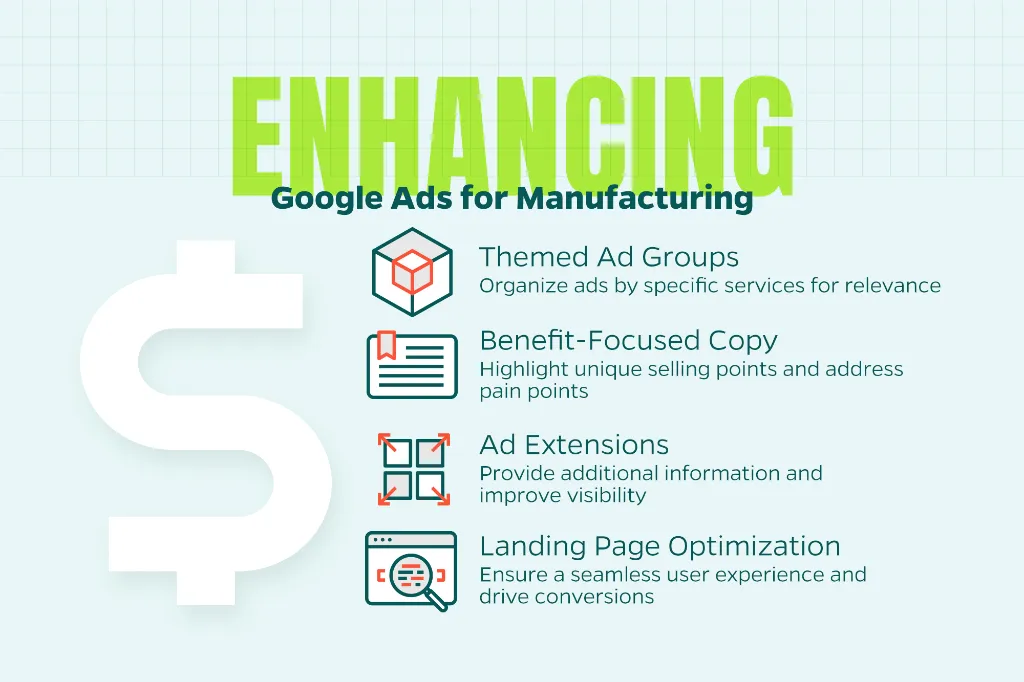
Build tightly themed ad groups around specific services. Don’t lump all offerings together. Create separate ad groups for CNC machining, metal stamping, or injection molding. This enables highly relevant ad copy and landing pages for each service.
Write benefit-focused ad copy. Lead with differentiators: “ISO 9001 Certified CNC Machining,” “2-Week Lead Times | Free Quotes,” “Precision Machining ±0.0002″ Tolerance.” Address pain points: “Need Rush Manufacturing? Quick Quotes in 24 Hours.”
Use ad extensions to expand your ads with additional information. Sitelink extensions direct users to specific service pages. Call extensions add clickable phone numbers for mobile searches. Location extensions display your address for local queries.
Landing pages must deliver on your ad’s promise. If your ad promotes quick quotes, feature a prominent quote form. Match messaging, maintain design continuity, and make conversion frictionless.
Managing Costs and ROI
Manufacturing keywords generally cost less than consumer services, but competitive terms can run $5-15 per click or more. Smart budget management is essential.
Start conservatively. Many manufacturers begin with $1,000-3,000 monthly budgets to test performance. As you identify what works, scale investment in high-performing campaigns while cutting underperformers.
Focus on conversion metrics, not vanity metrics. Track cost per lead, lead-to-customer conversion rates, and cost per acquisition. A $20 cost per lead means nothing without knowing conversion rates and customer value.
Quality Score impacts costs and ad position. Google assigns scores (1-10) based on ad relevance, expected CTR, and landing page experience. Higher scores mean lower costs and better placement. Improve scores by ensuring tight alignment between keywords, ad copy, and landing pages.
Use negative keywords to eliminate waste. Terms like “DIY,” “training,” “jobs,” or “salary” prevent clicks from people seeking education or employment rather than manufacturing services.
Display and Social Advertising for Manufacturers
Search advertising captures existing demand. Display and social advertising create awareness before prospects are actively searching.
Google Display Network
The Google Display Network reaches over 90% of internet users through millions of websites, apps, and YouTube. For manufacturers, display works best for:
- Brand awareness — keeping your company visible to potential customers as they browse industry publications and technical forums
- Remarketing — targeting people who visited your site but didn’t convert, following them with reminders of your capabilities
- Account-based marketing — narrowly targeting employees in specific industries or at particular companies
Display creative should be professional and clear. It should feature key capabilities, certifications, or differentiators with strong calls-to-action.
LinkedIn Advertising for B2B
LinkedIn’s professional audience makes it powerful for B2B manufacturers. Target decision-makers by job title (Purchasing Manager, Director of Operations), company size, industry, and seniority level.
Sponsored content appears natively in feeds and performs well when providing value. This includes case studies, technical insights, or industry trends. Lead gen forms native to LinkedIn capture information without forcing users off-platform, typically improving conversion rates.
Meta Platforms
Most manufacturers dismiss social media as B2C territory. Yet, Meta platforms such as Facebook and Instagram offer powerful B2B brand-building opportunities for manufacturers willing to approach it strategically.
Use Meta for maintaining visibility with engaging content: facility tours, equipment capabilities, project highlights, or industry insights. Video content — showing manufacturing processes, equipment in action, or quality procedures — performs particularly well.
Remarketing on Meta works exceptionally well, targeting website visitors with ads promoting services or sharing relevant case studies.
Content Marketing That Educates and Converts
According to the manufacturing survey, no single channel dominates. Success requires a multi-channel approach. Content marketing supports every other initiative you undertake.
Quality content improves SEO, feeds social media, provides email campaign substance, gives sales teams shareable resources, and positions you as an expert in your field.
Creating Content That Resonates
Manufacturing content doesn’t need to be dry. The best content addresses real challenges and demonstrates your expertise.
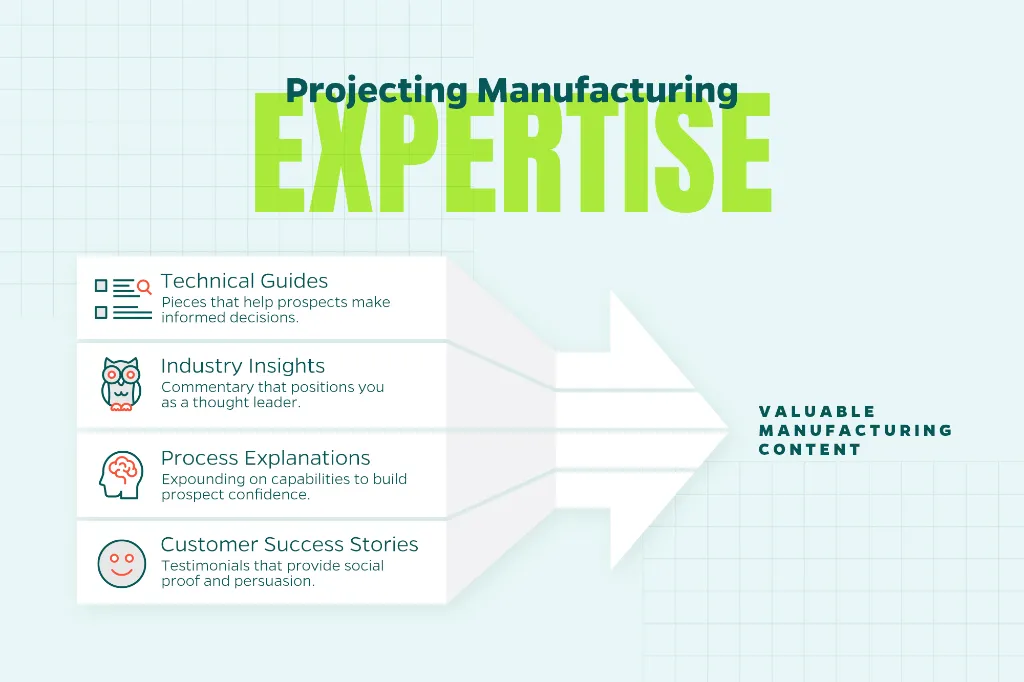
Technical guides help prospects make better decisions: “How to Select the Right Plastic Resin for Your Application” or “5 Common Mistakes in Sheet Metal Design.” These attract organic search traffic while demonstrating knowledge.
Industry insights position you as a thought leader. Comment on supply chain disruptions, new regulations, emerging technologies, or workforce challenges.
Process explanations demystify your capabilities. Many prospects don’t fully understand manufacturing processes. Clear explanations of techniques, equipment capabilities, and quality processes build confidence.
Customer success stories provide social proof. Include specifics about the application, solution provided, and business impact. Real examples are more persuasive than promotional language.
Distribution and Promotion
Creating content is half the battle. You need to get it in front of your audience.
Your website is home base. You should organize content logically and maintain an active blog. Email marketing keeps your audience engaged with new content. Social media amplifies reach, particularly on LinkedIn where B2B audiences are most active.
Industry publications provide third-party credibility. Guest posting on respected manufacturing publications gets your expertise in front of new audiences while earning valuable backlinks.
Paid promotion extends reach beyond organic audiences. Boost top LinkedIn posts, use PPC to drive traffic to pillar content, or consider sponsored placements in industry newsletters.
Measuring Success and Proving ROI
The manufacturing survey identified demonstrating ROI as the top challenge. The solution is proper tracking, clear metrics, and connecting digital marketing activities to actual business outcomes.
Essential Metrics for Manufacturing Marketing
Traffic volume tells you how many people are finding your site, but it’s a surface-level metric. More important is traffic quality. Are visitors to your site from the target industries, geographic markets, and job titles you are seeking attention from?
Conversion rate measures how effectively your site turns visitors into leads. Track form submissions, phone calls, chat conversations, and any other lead capture mechanism. A 2-3% conversion rate is typical for B2B manufacturers, though this varies by industry and traffic sources.
Cost per lead tells you how efficiently your marketing spend generates inquiries. Divide your total digital marketing investment by the number of qualified leads generated. This metric helps you compare channel effectiveness and optimize budget allocation.
Lead quality matters as much as quantity. Not every form submission is a viable opportunity. Some are students, competitors, or completely outside your capabilities. Implement lead qualification processes to separate serious prospects from noise.
Lead-to-customer conversion rate and customer acquisition cost connect marketing to revenue. Work with sales to track how many marketing-generated leads become customers and what you’re spending to acquire each new customer. This closes the loop and proves (or disproves) ROI.
Tools for Tracking and Analytics
Google Analytics provides the foundation for website measurement. Set up goal tracking for form submissions, phone click conversions, and key page views. Use UTM parameters to track which campaigns, channels, and content drive the most valuable traffic.
Google Search Console monitors your organic search performance. Track which queries drive traffic, your average positions for key terms, click-through rates, and technical issues affecting search visibility.
Call tracking platforms like CallRail connect phone inquiries back to their digital sources. When a prospect calls after finding you through Google search, you’ll know. When someone calls from a PPC ad, you can track that back to specific campaigns and keywords.
CRM integration completes the picture. Connect your marketing tools to your CRM so lead sources flow through to sales tracking and customer records. This enables true closed-loop reporting from initial website visit through closed sale.
Proving Value to Stakeholders
Raw data doesn’t convince stakeholders, but business outcomes do. Frame your reporting around revenue impact and ROI.
Show the pipeline. How many qualified leads did digital marketing generate? What’s their potential value? How many moved to proposals or quotes? How many closed as customers?
Calculate customer lifetime value. A $5,000 cost per acquisition might seem expensive until you show that the average customer is worth $50,000 over three years. Context matters.
Compare digital to traditional channels. If a trade show costs $25,000 and generates 30 leads while your annual SEO investment of $30,000 generates 200 leads, the ROI comparison is straightforward.
Highlight efficiency gains. As your SEO grows stronger and your PPC campaigns optimize, your cost per lead should decrease.
Getting Started: Your Digital Marketing Roadmap
Implementing a comprehensive digital marketing strategy can feel overwhelming. Start with these priorities:
Audit your current state. Where does your website stand technically? Are there glaring SEO issues? How do you rank for your most important keywords? What are competitors doing? A clear baseline helps you prioritize improvements and measure progress.
Fix critical technical issues. If your site is slow, not mobile-friendly, or has major crawl errors, address these first. Technical problems undermine everything else you do.
Choose your initial focus. You don’t need to execute every strategy immediately. Most manufacturers should start with SEO as the foundation, layer in PPC for immediate lead generation, and gradually expand to content marketing and other channels.
Set realistic goals and timeframes. SEO typically takes 3-6 months to show meaningful results. PPC can generate leads within days but requires testing and optimization. Content marketing builds momentum over time. Align expectations with these realities.
Build your team or find the right partner. Do you have internal resources with digital marketing expertise? If not, partnering with an agency that understands manufacturing can accelerate results and avoid costly mistakes. Look for proven experience in B2B manufacturing, not just general marketing services.
Commit to measurement and optimization. Digital marketing isn’t set-and-forget. Plan monthly reviews of performance data, quarterly strategy adjustments, and continuous testing of new approaches.
The Bottom Line
The manufacturers who invest strategically in SEO, PPC, content marketing, and paid advertising are the ones capturing qualified leads, building robust pipelines, and growing market share.
Start with the foundation: a technically sound website optimized for your target keywords. Layer on PPC for immediate visibility while your organic efforts build. Create content that demonstrates your expertise and supports the entire buyer journey. Track everything, optimize relentlessly, and connect your efforts to revenue.
Want assistance in the process? Contact Straight North. We can help you put together a full spectrum digital marketing plan to elevate your business to the next level.