


Small manufacturers face a crowded, competitive landscape. Larger players have bigger budgets, broader reach, and established reputations. So how does a small or mid-sized manufacturer carve out its own space and win the customers it wants?
Niche marketing is often the answer. Instead of trying to appeal to every potential buyer, niche marketing focuses your energy on a specific segment of the market. It targets an audience in which your capabilities, expertise, and offerings align closely with customer needs. While niche marketing sounds straightforward, executing it well requires honest self-assessment, clear messaging, and a consistent strategy across multiple channels. This article explores what small-to-medium-sized manufacturers need to know to be successful.
What Niche Marketing Means for Manufacturers
In a manufacturing context, niche marketing is about sharpening your focus. Instead of positioning yourself as a general-purpose company that can handle anything, you identify the specific types of customers, industries, or applications where you genuinely excel, and you speak directly to those audiences.
A good niche might be defined by:
Industry served — medical device components, aerospace assemblies, food processing equipment
Material or process expertise— precision CNC machining, custom injection molding, specialty metal fabrication
Customer size or type — OEMs requiring tight tolerances, startups needing low-volume prototyping
Geographic focus — regional manufacturers serving a specific metro area or industrial corridor
Why Niche Marketing Works for Smaller Manufacturers
Large manufacturers can afford to cast a wide net. Small manufacturers typically cannot, and even when they can, it often backfires. Spreading limited resources across too many audiences dilutes your message and makes it harder to stand out anywhere.
Niche marketing works because it lets you concentrate those resources where they’ll have the most impact. When your marketing speaks directly to a specific buyer’s challenges, they feel understood. That builds credibility faster than any broad promotional campaign.
There are other advantages. When you’re known as a specialist in a particular area, price becomes less of the primary decision factor. Buyers who need exactly what you offer are less likely to shop on cost alone. You also develop deeper industry knowledge over time, which strengthens your sales conversations and your ability to deliver on customer expectations.
Start with an Honest Assessment of Your Strengths
Before you can market your niche effectively, you need to define it clearly. That starts with an honest assessment of your company’s strengths and weaknesses. Ask yourself some fundamental questions. Where do we consistently perform at a high level? What types of jobs or customers generate the least friction and the most repeat business? Where do we have specialized knowledge that competitors in our market don’t?
Talk to your best customers. Find out why they chose you, what keeps them coming back, and how they’d describe your value to a colleague. Their language often reveals the positioning language you should be using in your marketing.
It’s also worth reviewing your recent project history. Patterns tend to emerge such as specific industries, certain part types, and particular order profiles. Those patterns point toward where your niche may already exist, even if you haven’t formally defined it.
Build a Website That Speaks to Your Niche
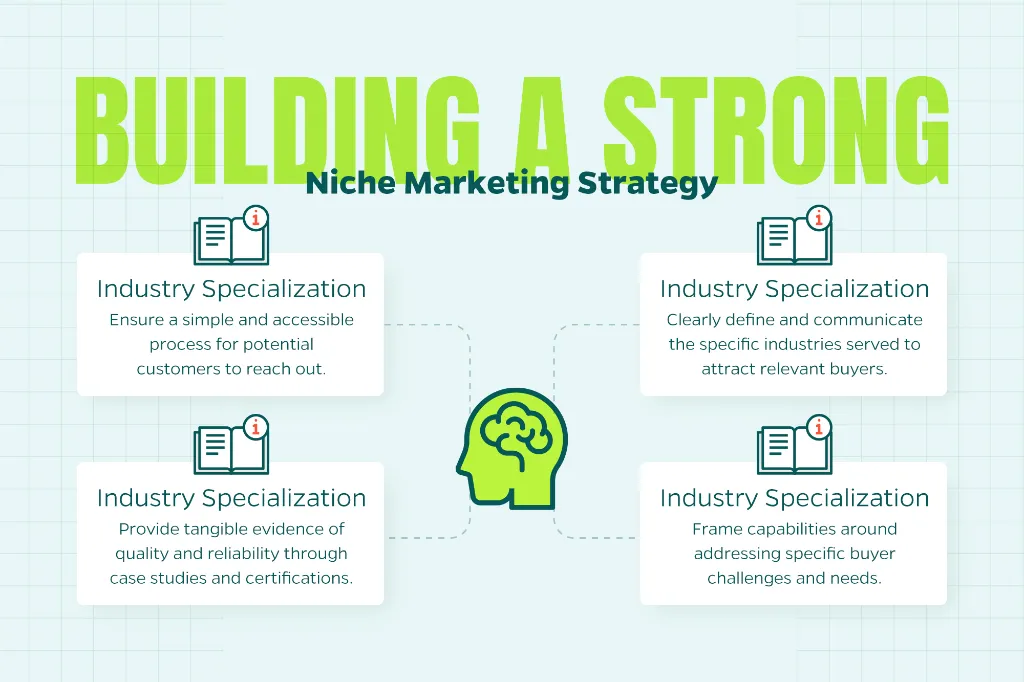
For most small manufacturers, the website is where niche marketing either comes together or falls apart. A generic site full of broad capability statements and stock imagery of factory floors won’t connect with a buyer who needs a highly specialized partner. Your site should do several things well:
Name the industries you serve — Be specific. If you specialize in components for the agricultural equipment market, say so clearly. Buyers in that space will instantly recognize that you understand their world.
Speak to their problems — Buyers aren’t just looking for a manufacturer; they’re looking for a solution to a supply chain challenge, a quality problem, or a capacity constraint. Frame your capabilities around those outcomes.
Show relevant proof — Case studies, industry certifications, photos of actual work, and client testimonials carry more weight than general claims about quality or reliability.
Make the next step easy — A clear, low-friction contact form or quote request process reduces the barriers for a potential customer to reach out.
A good SEO strategy also matters here. When you optimize your site around industry-specific and process-specific search terms, you’re more likely to appear when the right buyers are actively looking, not just browsing.
Use Content to Demonstrate Expertise
One of the most effective tools in a niche manufacturer’s marketing arsenal is content marketing. Not generic content about manufacturing trends, but content that demonstrates your specific knowledge in the areas where you compete.
This could mean blog posts that walk through common engineering challenges in your target industry. It might be a guide explaining how to evaluate vendors for a specific type of component. It could be a video showing your process for holding tolerances that most competitors can’t achieve.
Content like this accomplishes two things at once. It helps your site rank for relevant search terms, and it builds credibility with buyers who read it and think, “These people actually know what they’re talking about.”
That credibility is hard to put a price on. In a market where buyers are cautious and relationships matter, being the manufacturer that clearly understands their industry is a significant competitive advantage.
Don’t Overlook Social Media and Industry Channels
Niche marketing doesn’t live on your website alone. LinkedIn is increasingly important for manufacturers reaching B2B buyers, engineers, and procurement professionals. Sharing content, commenting on industry discussions, and maintaining an active company page all contribute to visibility among the people who make purchasing decisions.
Trade publications, industry associations, and niche directories are also worth considering. Being listed in the right places — or contributing an article to a publication your target customers read — puts your name in front of an audience that’s already relevant.
The goal with all these channels is consistency. Your messaging should reinforce the same positioning everywhere a potential customer encounters your brand.
Measuring the Right Metrics
Of courses, you should always track whether your strategy is reaching and converting the right buyers. Key indicators to monitor include website traffic from your target industries, lead quality (not just volume), and the conversion rate on quote requests. If you’re generating a lot of inquiries but few from your target niche, that’s a signal to revisit your content, your SEO targeting, or your channel strategy.
Over time, a well-executed niche strategy should produce a more qualified pipeline of buyers who fit well with what you do and are more likely to convert into long-term customers.
Specialization is Your Secret Weapon
Niche marketing asks small manufacturers to make a deliberate choice. Rather than trying to be everything to everyone, commit to being the best option for a specific set of customers. That focus, when backed by genuine expertise and consistent execution, is one of the most powerful competitive advantages available to a smaller operation.
The manufacturers who resist this approach often do so out of concern that narrowing their focus means leaving opportunities on the table. In practice, the opposite tends to be true. Clarity attracts customers. Specialization builds trust. And a well-defined niche gives your marketing something concrete to say.
Need Help?
If you’d like to explore how niche marketing could work for your manufacturing business, the team at Straight North is ready to help. Contact us today to start the conversation.