
Meta—formerly known as Facebook—is an indispensable resource for businesses looking to reach their ideal customers. With billions of active users across a host of platforms including Facebook, Instagram, Messenger, WhatsApp, and the Audience Network, Meta is a prime solution for targeting buyers based on demographics. Whether you’re a small business owner dipping your toes into paid social for the first time or a seasoned marketer refining your strategy, it is essential to understand Meta ads so you can drive awareness, generate leads, and boost sales.
Yet sometimes the Meta platform can feel overwhelming. In this comprehensive overview, we’ll break down everything you need to know about Meta Advertising in 2025. By the end, you’ll have the confidence to launch your first campaign (or optimize an existing one) and see real results. Let’s get started.
What Is Meta Advertising?
Meta Advertising enables businesses to reach highly targeted audiences across Meta’s family of apps — including Facebook, Instagram, Messenger, and Threads — using a unified ad platform. It’s no longer just about running ads on Facebook. Meta’s ecosystem integrates seamlessly with the broader marketing funnel, helping brands drive awareness, engagement, and sales through a data-driven approach.
At its core, Meta’s ad system operates on a real-time auction model, where your ads compete based on factors like bid amount, ad quality, and relevance to each user. This ensures that the most relevant ads reach the right audience at the right time. It maximizes performance while keeping costs efficient.
Why Meta Matters in 2025
The digital advertising landscape has changed dramatically. Privacy regulations such as Apple’s App Tracking Transparency (ATT) framework, evolving GDPR guidelines, and new U.S. privacy laws have limited traditional tracking and audience targeting methods. At the same time, consumers now favor short-form video, personalized recommendations, and seamless in-app shopping experiences. These trends continue to redefine how users interact with brands.
In response, Meta has embraced AI-driven automation to help advertisers adapt and perform in this new environment. Features like Advantage+ Shopping Campaigns, Advantage+ placements, and automated creative optimization use machine learning to test and refine audiences, creatives, and placements in real time. These tools simplify campaign management and make it easier to scale performance without constant manual adjustments.
When properly optimized, AI-powered Meta campaigns can deliver impressive results. Many advertisers reporting returns on ad spend (ROAS) in the range of 3–5x, depending on strategy and industry.
The Platforms: Where Your Ads Will Live
Meta’s advertising ecosystem spans multiple platforms, each offering unique audiences, content formats, and engagement opportunities. This multi-platform reach lets you connect with users wherever they spend time.
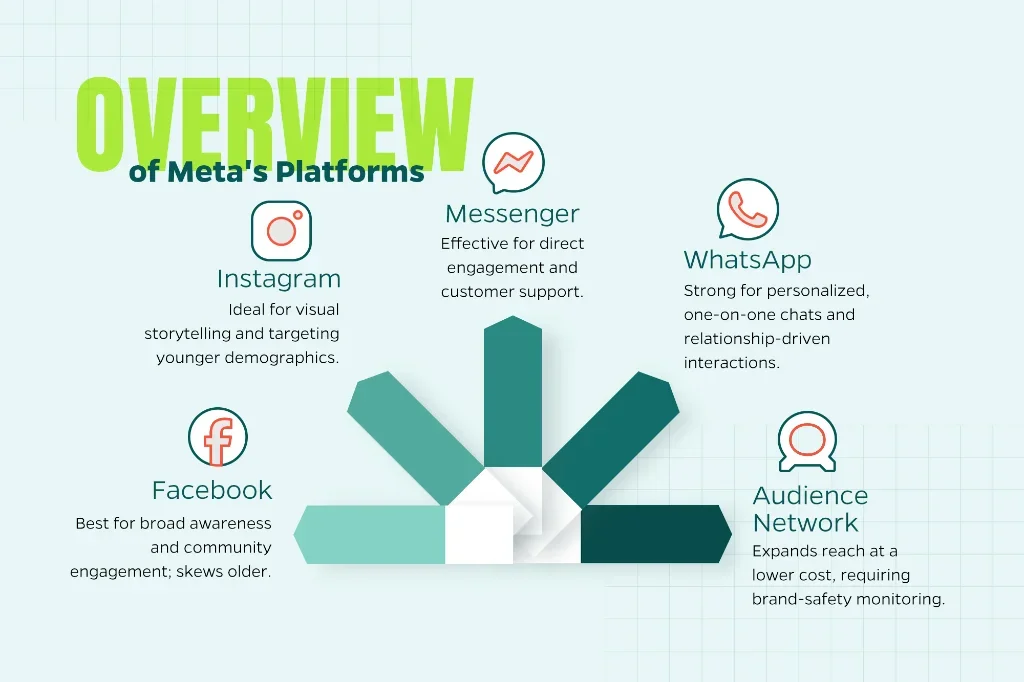
- Facebook: Still the largest social network with over 3 billion monthly active users, Facebook remains a cornerstone for broad awareness and community engagement. Ads perform well in the Feed, Marketplace, and Groups, offering ample space for storytelling and conversion campaigns. The platform appeals to a wide audience but skews slightly older (ages 35+).
- Instagram: With more than 2 billion users, Instagram thrives on visual storytelling. Ads run across the Feed, Stories, Reels, and Explore, making it ideal for lifestyle and e-commerce brands targeting younger demographics (18–34). Creative, high-quality visuals and short-form video are key to success here.
- Messenger: Perfect for direct engagement, Messenger supports inbox ads, sponsored messages, and click-to-message campaigns. It’s especially effective for lead nurturing, customer support, and conversational CTAs—often powered by chatbots or automated responses.
- WhatsApp: This platform is growing rapidly as a business messaging tool, particularly across Europe, Asia, and Latin America. WhatsApp allows advertisers to drive users into personalized, one-on-one chats. It’s a strong choice for service-oriented businesses or brands that rely on relationship-driven interactions.
- Audience Network: Extending beyond Meta’s apps, the Audience Network places your ads on vetted third-party apps and websites. It can significantly expand reach at a lower cost, though ongoing brand-safety monitoring is essential.
In 2025, Meta’s Advantage+ placements automatically distribute ads across all available surfaces for optimal performance, using AI to identify where each creative piece performs best. This automation reduces manual setup while improving efficiency. The key takeaway: tailor your creative to each environment to boost engagement and ROI. That means vertical videos for Stories and Reels, carousels for Feeds, and conversational CTAs for messaging platforms.
Getting Started: Setting Up Your Meta Business Account
Before you launch your first campaign, you’ll need to set up a solid foundation.
Start by creating a Meta Business Suite account at business.facebook.com. This free platform centralizes everything—your Facebook Page, Instagram profile, and ad management tools—so you can oversee campaigns, assets, and permissions from one place. If you don’t already have a Facebook Page, create one. It serves as your business identity and is required for ad verification.
Next, connect your assets. Link your Instagram account, install the Meta Pixel (or the newer Conversions API), and verify your domain to improve data accuracy and targeting. Then, open Ads Manager. This is your command center for campaign creation and performance tracking. It is where you’ll set objectives, define audiences, manage budgets, and analyze results in real time.
Once your account is ready, customize your Ads Manager dashboard. Adjust columns to highlight key performance metrics such as CTR (Click-Through Rate), CPC (Cost per Click), and ROAS (Return on Ad Spend).
If you’re new to the platform, take advantage of Meta’s built-in onboarding tutorials and guided learning tools. They provide quick, practical walkthroughs on essentials like A/B testing, audience setup, and pixel configuration. You can typically get a thorough overview in less than 10 minutes.
Campaign Structure: The Blueprint for Success
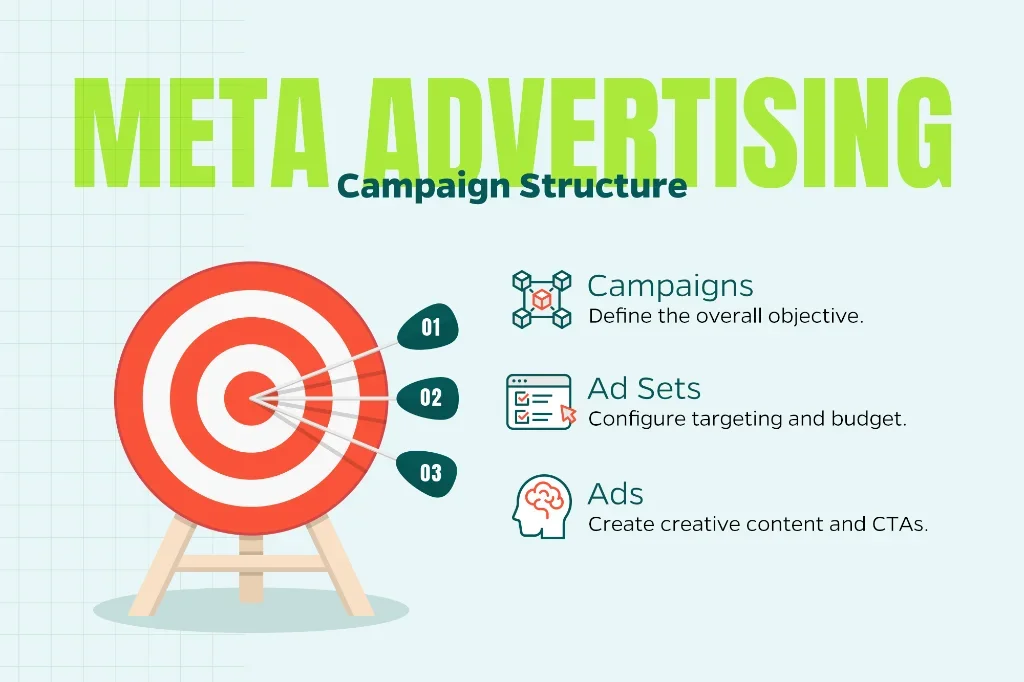
Meta campaigns follow a three-tiered structure: Campaigns > Ad Sets > Ads. Think of it as a pyramid—broad goals at the top, hyper-specific executions at the bottom.
- Campaigns: The top level, where you define your objective. Choices include Awareness (brand recall), Traffic (website visits), Engagement (likes/shares), Leads (form fills), App Promotion, and Sales (conversions). Pick one per campaign to let Meta’s algorithm optimize accordingly. In 2025, Sales and Leads remain top performers for ROI-focused marketers.
- Ad Sets: Here you configure targeting, placements, budget, and schedule. One ad set might target urban millennials for Instagram Reels, while another hits suburban parents on Facebook Feed. This granularity allows for precise testing.
- Ads: The creative layer like images, videos, copy, and CTAs. Multiple ads per set enable A/B testing without overcomplicating things.
This structure isn’t rigid; it’s scalable. Start simple with one campaign, then expand as data rolls in. A clean setup prevents “learning phase” disruptions, where Meta’s AI recalibrates after changes.
Ad Formats and Creatives: Crafting Content That Converts
Your ad’s creative is its soul. Meta offers a buffet of formats. Each is suited to different goals and platforms.
- Single Image/Video: Simple and versatile. Use eye-catching photos (1080×1080 pixels recommended) or short videos (under 15 seconds) that hook in the first three seconds. Vertical orientation (9:16) dominates for mobile.
- Carousel: “Swipeable” multi-image ads perfect for showcasing products or storytelling. E-commerce brands love this for driving 10-30% higher click-through rates.
- Collection: Shoppable catalogs that open a full-screen experience. Ideal for dynamic product ads, where AI pulls in items based on user behavior.
- Stories and Reels Ads: Immersive, full-screen formats. Quick, authentic videos perform best, such as user-generated content or behind-the-scenes clips.
- Instant Experience: A lightweight landing page within the ad, reducing load times and boosting conversions.
Leverage AI tools like Meta’s Creative Hub for testing variations. Keep copy concise (under 125 characters for headlines). Use strong CTAs like “Shop Now.” Ensure mobile optimization (90% of Meta users are on phones). User-generated content and UGC-style ads see 4x higher engagement, so incorporate testimonials wherever possible.
Remember, relevance scores matter. High-quality, non-salesy creatives win the auction more often, lowering your cost per result.
Targeting: Reaching the Right Audience
Targeting is Meta’s secret sauce, powered by an unrivaled array of first-party data. In this post-cookie world, it’s more important than ever to target the right audience without violating privacy.
Core options include:
- Demographics: Age, gender, location, language, education, and job title. Start broad (e.g., 25-44-year-olds in the U.S.) to gather data.
- Interests and Behaviors: Based on likes, pages followed, and actions like purchases or travel. Niche it down. For example, “fitness enthusiasts who shop online” beats “fitness.”
- Custom Audiences: Upload your email lists, website visitors (via Pixel), or app users to retarget warm leads. This is gold for remarketing.
- Lookalike Audiences: Meta’s AI finds “lookalikes” of your best customers, expanding reach by 1-10% similarity seeds. Aim for 1-2% for precision.
- Advantage+ Audiences: Let AI expand your targeting automatically. It’s like set-it-and-forget-it for scaling.
Budgeting and Bidding: Spending Smart in the Ad Auction
Budgeting doesn’t have to be a headache. Meta offers daily (consistent spend) or lifetime (campaign total) options, with no hard minimum. Start at $10-50/day per ad set for reliable data.
Bidding strategies include:
- Lowest Cost: Meta auto-optimizes for efficiency. This is great for beginners.
- Cost Cap/Bid Cap: Set limits to control spend. This is ideal for lead gen.
- Value Optimization: For e-commerce, prioritize high-value conversions.
Run campaigns for at least 7 days to exit the learning phase, where Meta gathers 50+ events per ad set. Scale by 20-50% weekly to avoid resets.
AI bidding tools like Advantage+ Campaigns handle much of this, predicting performance and adjusting bids in real-time. Track your cost per acquisition (CPA) against benchmarks. Under $5 for leads is solid in most industries.
The Meta Pixel: Your Secret Tracking Weapon
Before we go further, let’s talk about the Meta Pixel, which is a small piece of code that lives on your website and tracks visitor actions. Think of it as your silent observer, reporting back to Meta about what people do after clicking your ad.
Installing the Pixel (it takes about 10 minutes) unlocks:
- Conversion tracking: Did that click turn into a sale?
- Retargeting: Show ads to people who visited specific pages
- Lookalike audiences: Find more people like your converters
- Optimization: Meta learns who’s likely to convert and finds more of them
In Ads Manager, get your Pixel code and drop it in your website header, or use integrations with Shopify, WordPress, or Wix. Test it with the Meta Pixel Helper Chrome extension to confirm it’s firing.
Set up events for key actions: page views, add to cart, initiate checkout, and purchase. The more granular your tracking, the smarter your campaigns become.
Launching Your Campaign: From Draft to Delivery
With everything in place, it’s time to launch. In Ads Manager, review for errors, preview on devices, and schedule if needed. Meta’s review process takes 24 hours max, flagging issues like prohibited content.
After you have launched, monitor progress daily. Pause underperformers early but give winners time to learn. Use split testing for headlines, images, and audiences. Meta’s built-in tool makes it easy.
Measuring and Optimizing: Data-Driven Decisions
Successful advertising on Meta isn’t guesswork. It’s driven by data. Understanding key performance metrics allows you to make informed adjustments and continually improve campaign results.
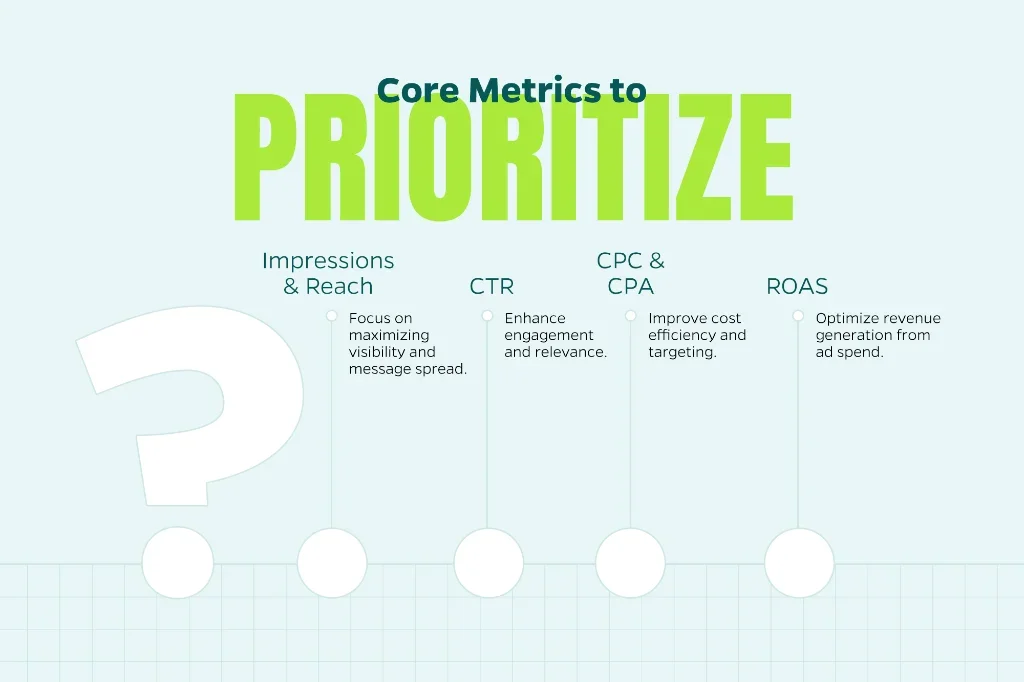
Core Metrics to Track:
- Impressions & Reach: Measure how many users see your ads and how far your message spreads.
- CTR (Click-Through Rate): Gauges engagement and relevance. A typical benchmark ranges from 1–2%, depending on industry and creative quality.
- CPC (Cost per Click) & CPA (Cost per Acquisition): Indicate cost efficiency and the effectiveness of your targeting strategy.
- ROAS (Return on Ad Spend): Compares revenue generated to advertising spend; a strong campaign often delivers 3x or higher.
To track these metrics accurately, install the Meta Pixel (or better yet, implement the Conversions API for improved data reliability in a privacy-first world). These tools help measure actions like purchases, form fills, or sign-ups, and attribute conversions across devices. Meta’s standard attribution settings—such as 7-day click or 1-day view—allow you to assess true campaign impact over time.
Compliance and Best Practices: Playing by the Rules
Meta enforces strict advertising policies to protect users and maintain trust across its platforms. Violating these rules can result in ad rejections, account restrictions, or even permanent bans. So, it’s essential to know what’s allowed before you launch.
Prohibited content includes discriminatory targeting, misleading claims, and unsafe or restricted products such as tobacco, weapons, adult content, or illegal substances. Ads in special categories—including housing, employment, credit, politics, and cryptocurrency—require pre-approval and follow limited targeting options to ensure compliance with anti-discrimination and transparency standards.
To stay compliant and maximize performance, follow these best practices:
- Test methodically: Make one change at a time (e.g., a new headline or image) to identify what truly impacts results.
- Leverage automation: Use Dynamic Ads and Advantage+ tools to personalize experiences while staying within policy guidelines.
- Prioritize first-party data: Build your own customer lists through lead forms, email sign-ups, or purchases. Avoid using purchased or third-party data.
- A/B test consistently: Experiment with different creatives, audiences, and placements. Aim for a minimum budget of $50 per variant to reach statistically reliable conclusions.
- Maintain message integrity: Ensure your landing page accurately reflects your ad promise. Clickbait or misleading claims can quickly get flagged.
- Understand special ad categories: Before promoting content related to housing, employment, credit, politics, or financial services, review Meta’s requirements to avoid compliance issues.
Meta’s policies evolve regularly, especially around health claims, political content, and social issues. To avoid disruptions, stay current by reviewing the Meta Advertising Policies page and subscribing to platform updates.
Common Mistakes to Avoid
Let’s talk about the face-palm moments we see constantly (so you can avoid them):
Over-targeting: Too narrow audiences limit scale. Yes, precision matters, but “35-37-year-old female yoga instructors in Denver who like green smoothies” is probably too specific. You’ll never exit the learning phase with 5,000 people in your audience.
Ignoring mobile: Always preview on phones. An ad that looks great on your desktop monitor but gets cut off on mobile is wasted spend. Design for mobile first, then check desktop.
Neglecting testing: Continually test new creatives, audiences, and offers. What worked last quarter might flop today.
Poor landing pages: Your landing page is part of the ad experience. Fast load times, clear headlines, and frictionless checkout matter as much as the ad itself.
Chasing trends and hacks: Focus on data over shortcuts. Build on fundamentals: good offer, compelling creative, smart targeting, and continuous optimization.
Pausing too early: Meta’s learning phase needs time and data. Unless you’re hemorrhaging money, give campaigns 5-7 days minimum before making major changes.
Spreading budget too thin: Running 10 ad sets at $5/day each instead of 2-3 at $20/day each. Consolidate for faster learning and better optimization.
Future Trends in Meta Advertising
Meta’s advertising landscape is evolving rapidly, driven by advances in AI, shifts in user behavior, and increasing privacy demands. Looking ahead, several trends are shaping how marketers will connect with audiences across Meta’s platforms.
AI-Powered Advertising
Artificial intelligence is becoming central to every stage of campaign management—from creative generation to predictive analytics. Generative AI tools are making it easier to produce high-quality ad variations, while predictive modeling helps allocate budgets and optimize performance automatically. The result is less manual work and more data-driven precision.
The Rise of Short-Form Video
Short-form video, especially through Reels and Stories, will continue to dominate engagement. Consumers favor quick, authentic content, and Meta’s algorithms prioritize it in feeds. Expect more use of vertical video, user-generated-style content, and AI-assisted editing to keep creatives fresh and platform-native.
Privacy-First Personalization
As privacy regulations tighten, Meta is refining tools like the Conversions API and Aggregated Event Measurement to deliver accurate insights without compromising user data. Advertisers who focus on building first-party data and transparent consent-based targeting will maintain a competitive edge.
Full-Funnel Integration
Meta’s platform is increasingly designed to support a seamless customer journey from awareness to purchase. AI automatically shifts spend across funnel stages, while features like Instagram Shops and Facebook Checkout help convert interest into direct sales.
Immersive and Values-Based Experiences
Emerging technologies such as augmented reality will enable interactive “try-on” ads, while sustainability and ethical brand messaging are becoming more influential in consumer decision-making.
In short, the future of Meta Advertising will be smarter, more visual, and grounded in transparency. Brands that adapt early to these shifts will be best positioned to succeed.
Wrapping Up
Meta Advertising is a growth engine when wielded wisely. From setup to scaling, you’ve now got the roadmap to build campaigns that resonate and deliver.
Ready to put this into action but short on time? At Straight North, we specialize in crafting Meta strategies that align with your goals. Whether it’s auditing your current setup or launching a full-funnel campaign, our experts can help. Contact us today for a free consultation and let’s turn your ad spend into serious revenue.