

Pay-per-click (PPC) advertising can be one of the fastest and most measurable ways to attract qualified leads. With the right strategy, PPC puts your business in front of customers at the exact moment they’re searching for what you offer. But without a clear plan, your budget can evaporate quickly with little to show for it.
That’s where a solid PPC checklist becomes a “must have.” Whether you’re launching your first paid search campaign or fine-tuning an existing one, following a structured approach ensures no critical detail gets overlooked. Below, we’ll walk through eight essential components every PPC advertiser should cover before, during, and after launching a campaign.
1. Define Your Goals and KPIs
Every successful PPC campaign starts with crystal-clear, measurable goals. Ask yourself “what does success look like?” before diving into any platform. Are you aiming to drive more website traffic, increase sales, generate qualified leads, or build brand awareness? Each objective requires a different strategy — and nailing down your goals upfront will guide everything from campaign type selection to ad format and budget allocation.
Once your goals are locked in, identify the key performance indicators (KPIs) that will help you measure real progress. Consider tracking metrics like:
- Click-through rate (CTR): Shows how compelling and relevant your ads are to searchers
- Conversion rate: Measures how effectively your landing pages turn visitors into customers or leads
- Cost per lead (CPL): Helps you gauge efficiency in your lead generation efforts
- Return on ad spend (ROAS): Reveals how much revenue your ads generate compared to what you’re spending
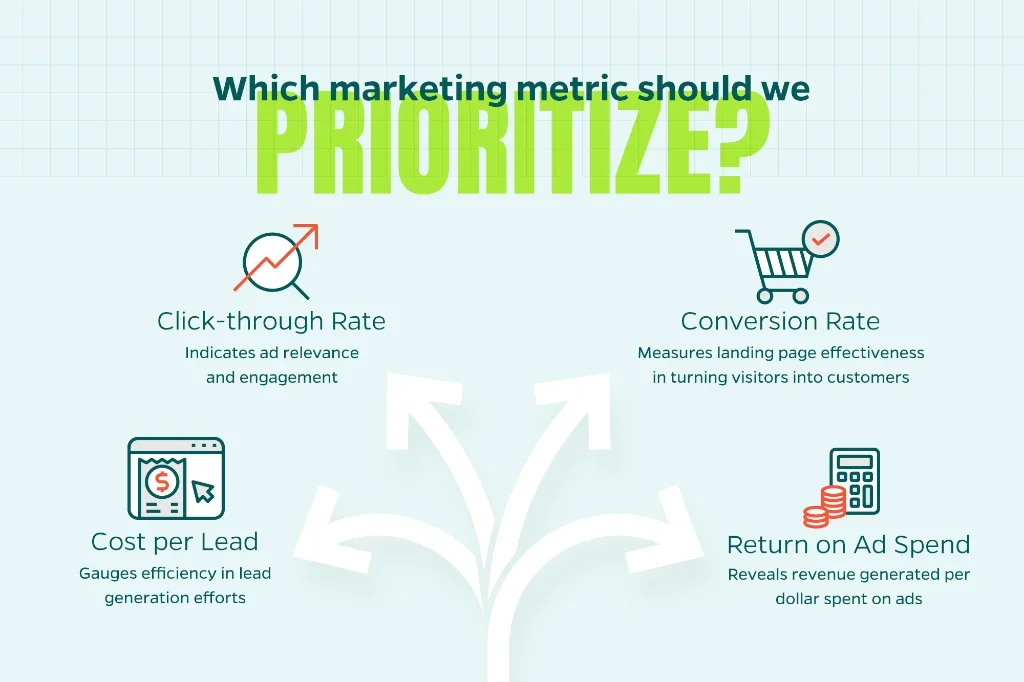
These metrics are the foundation of your reporting and optimization work. Without them, you’re essentially guessing your way through campaign management.
2. Know Your Audience
Understanding your audience is essential to PPC success. The deeper you know your ideal customer, the more effectively you can craft ads that capture attention and drive action.
Start by developing detailed buyer personas that capture demographics, pain points, and buying behaviors. Dig into questions like:
- What specific problems are they trying to solve?
- Which devices do they primarily use when searching?
- What motivates them to finally make a purchase decision?
Just as importantly, think about where your audience sits in the buyer’s journey. Someone in the early research phase might respond better to educational content and informative ad copy, while a ready-to-buy user needs a compelling offer and an unmistakable call to action. When your targeting aligns with user intent, you’ll see higher conversion rates without wasting ad spend.
3. Conduct Keyword Research
Keyword research isn’t dead. It’s the engine that powers PPC success. Choosing the right keywords ensures your ads appear in front of users who are actively searching for your products or services.
Leverage keyword research tools like Google Keyword Planner, BrightEdge, SEMrush, or Ahrefs to uncover terms that balance relevance, search volume, and manageable cost-per-click (CPC). Build your keyword list with a strategic mix of:
- High-intent keywords: Phrases that signal readiness to act (terms like “buy,” “hire,” “get a quote”)
- Long-tail keywords: More specific, lower-competition phrases that capture highly targeted search intent
- Negative keywords: Terms you’ll exclude to avoid paying for irrelevant, low-quality clicks
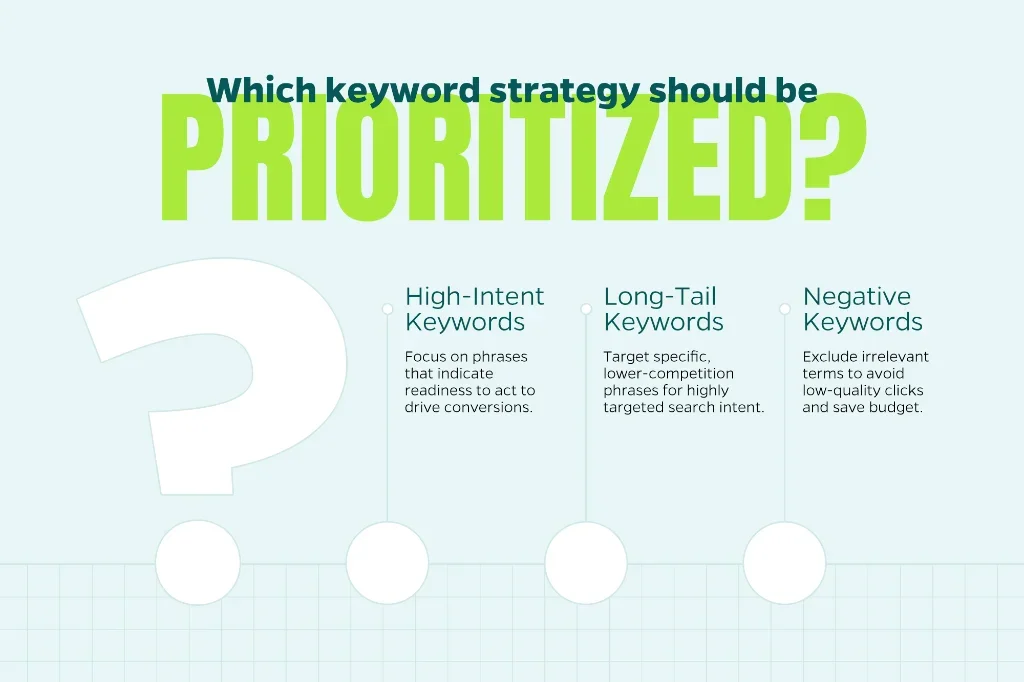
A well-organized keyword list also makes structuring your ad groups much easier, which keeps your ads highly relevant to each search query. That relevance is crucial. It directly impacts your Quality Score and can significantly lower your overall costs.
4. Write Compelling Ad Copy
In the PPC world, your ad copy serves as your elevator pitch. You’ve got mere seconds to make a lasting impression. A strong ad immediately connects the searcher’s intent with your unique value proposition.
Clarity and relevance should always come first. Incorporate your target keyword naturally in both the headline and description, and speak directly to what the user is looking for. Spotlight your unique selling points such as free consultations, limited-time offers, guaranteed results, or fast shipping. Always wrap up with a clear, action-driven CTA like “Get Started,” “Schedule Your Demo,” or “Request a Free Quote.”
Don’t shy away from experimentation, either. Even minor adjustments to phrasing, tone, or emphasis can dramatically improve your click-through rates. The best PPC ads don’t feel like ads at all. They read like natural, helpful answers to real questions.
5. Optimize Your Landing Pages
Earning the click is only half the battle. Once visitors arrive on your site, your landing page needs to deliver an experience that converts. Unfortunately, this is where many advertisers lose potential customers. The page often doesn’t match the ad’s promise, loads too slowly, or fails to guide users toward action.
A high-converting landing page should:
- Match the ad’s message and offer precisely: No surprises, no bait-and-switch
- Load quickly on both desktop and mobile: Aim for under 3 seconds
- Feature a clear, singular call to action: Guide visitors toward one specific conversion goal
- Use clean, scannable design with persuasive copy: Make it easy for visitors to understand your value
- Build trust with social proof: Include testimonials, reviews, case studies, or industry certifications
Keep distractions to an absolute minimum. Every element on the page should move visitors closer to converting, whether that means filling out a form, completing a purchase, or picking up the phone.
6. Set Up Conversion Tracking
PPC success is measured in outcomes. Setting up conversion tracking allows you to see exactly what happens after someone engages with your ad, which is where the real value lies.
Using tools like Google Ads Conversion Tracking, Google Analytics 4, or platform-specific pixels, you can monitor critical actions such as form submissions, phone calls, live chat inquiries, and completed purchases. This data becomes invaluable for understanding which keywords, ads, and audience segments are generating genuine business results (not just traffic).
Accurate conversion tracking also powers smart bidding strategies, enabling you to optimize campaigns for conversions or ROAS automatically over time. Without proper tracking in place, you’re left guessing about what’s working and where your budget should go.
7. Monitor and Adjust Regularly
PPC requires ongoing attention to stay efficient, competitive, and profitable. Make it a practice to review your campaigns at least weekly or biweekly, depending on your spend levels and traffic volume.
Keep a close eye on:
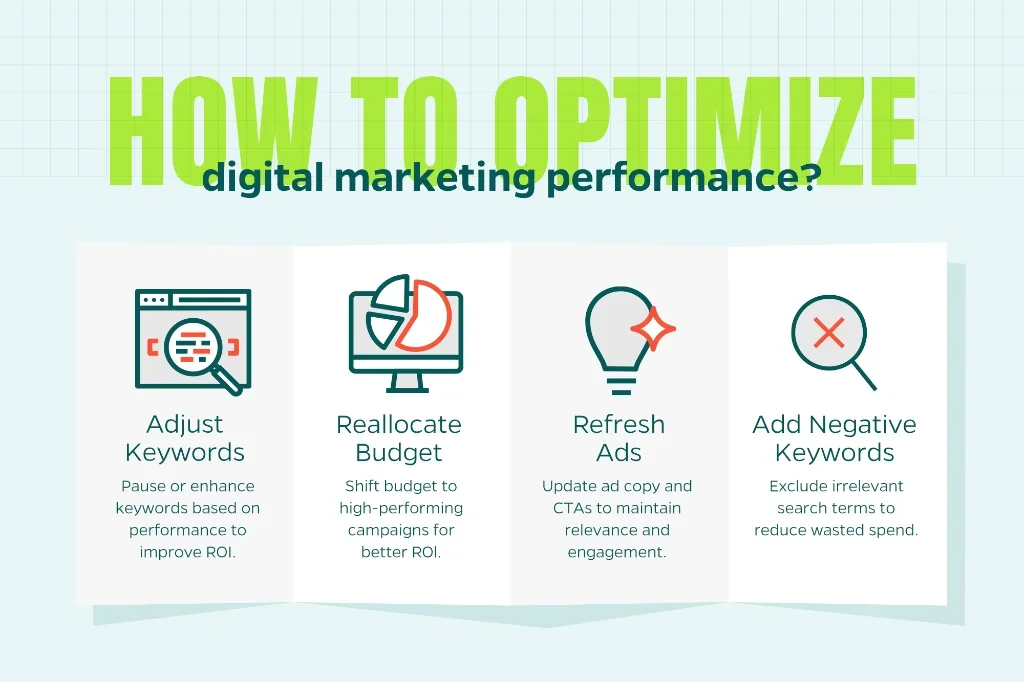
- Keyword performance: Pause or adjust underperforming terms and double down on winners
- Budget allocation: Redirect spend toward campaigns and ad groups delivering the best ROI
- Ad performance metrics: Refresh stale ads with new copy, headlines, or CTAs
- Search terms report: Continuously add negative keywords to eliminate wasted spend on irrelevant queries
Small, consistent adjustments can compound into significant performance gains over time. PPC is a living, breathing strategy that rewards regular attention and care.
8. Test, Learn, and Refine
PPC optimization is never truly “done.” The most successful advertisers treat their campaigns as ongoing experiments, constantly testing new hypotheses to discover what resonates best with their audience.
Embrace A/B testing for different ad headlines, descriptions, display URLs, and landing page layouts. Experiment with various ad extensions, bidding strategies, and audience segments to see how each variable impacts performance. Document your findings carefully and apply those insights to future campaigns and iterations.
Even seemingly minor discoveries — like which specific CTA language drives higher engagement or which ad format performs best on mobile — can translate into substantial improvements in conversion rates and overall ROI.
Final Thoughts
A high-performing PPC campaign doesn’t happen by accident. It’s the result of strategic planning, meticulous execution, continuous testing, and relentless optimization. By following this checklist, you’ll keep your paid search efforts focused, efficient, and aligned with your broader business goals.
If you’re ready to elevate your PPC campaigns and drive measurable growth, Straight North can help. Our team specializes in creating data-driven PPC strategies that attract qualified leads, maximize ROI, and deliver results you can measure.