


At Straight North, we’ve worked as a digital marketing partner to hundreds of manufacturers. That means that over the years we have had a front-row seat in witnessing which marketing strategies move the needle for manufacturers—and which ones fall short.
Today, the landscape is rapidly evolving. Buyer habits and expectations are shifting, marketing tactics that worked six months ago might already be considered passé, and AI tools are becoming mainstream. This raises an important question: how are manufacturing marketers keeping pace?
That question inspired our second annual Manufacturing Marketing Survey. We heard from 245 marketing professionals across the industry—our clients, their peers, and other leaders in the space—to understand what’s happening in the trenches and share real-world insights with everyone navigating this shift.
Ready to see what we found? Let’s go through the results.
Who We Surveyed—and Why It Matters
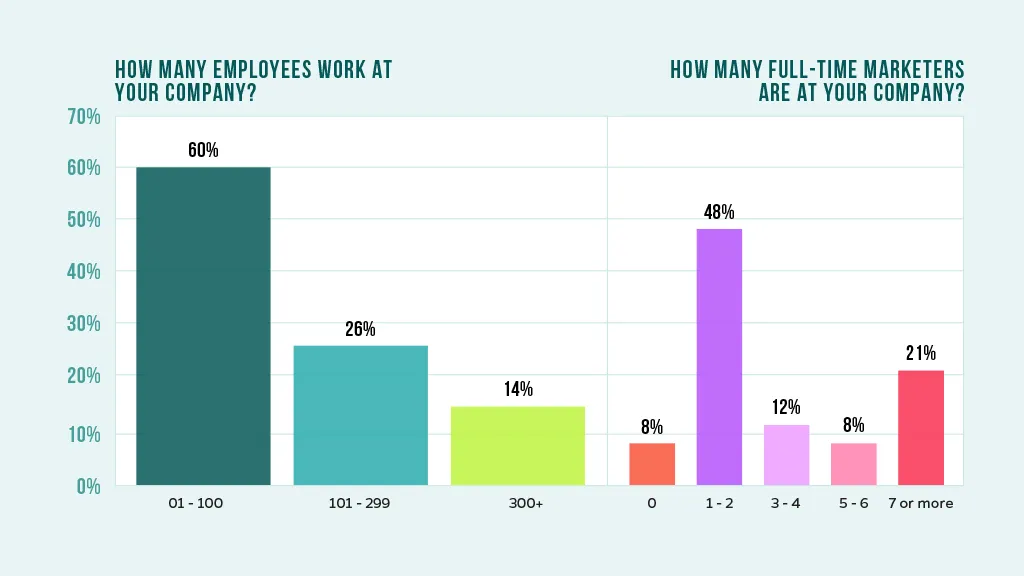
A total of 245 marketing professionals participated in this year’s survey, representing a broad cross-section of the manufacturing sector. A few data points stand out:
- 60% work at small-to-medium-sized companies with fewer than 100 employees
- Only 14% represent large enterprises with more than 300 employees
- 48% operate on lean marketing teams of just 1-2 people
What This Tells Us
These findings reinforce a reality we see every day when working with manufacturing marketers: many are operating with lean teams and limited resources. With nearly half of respondents managing marketing efforts in departments of one or two people, it’s likely these professionals are responsible for everything from strategy and content to lead generation, analytics, and technology decisions.
That breadth of responsibility gives this group a uniquely practical perspective. Rather than focusing on narrow, specialized roles, these marketers must prioritize what delivers the greatest organizational impact with the least downside. As a result, their responses offer a grounded, real-world view of which tactics are sustainable, which strategies are worth the investment, and where challenges tend to arise.
In short, this participant mix makes the survey especially valuable for manufacturers facing similar constraints—and those who want to maximize efficiency.
Marketing Channel Investments and Success
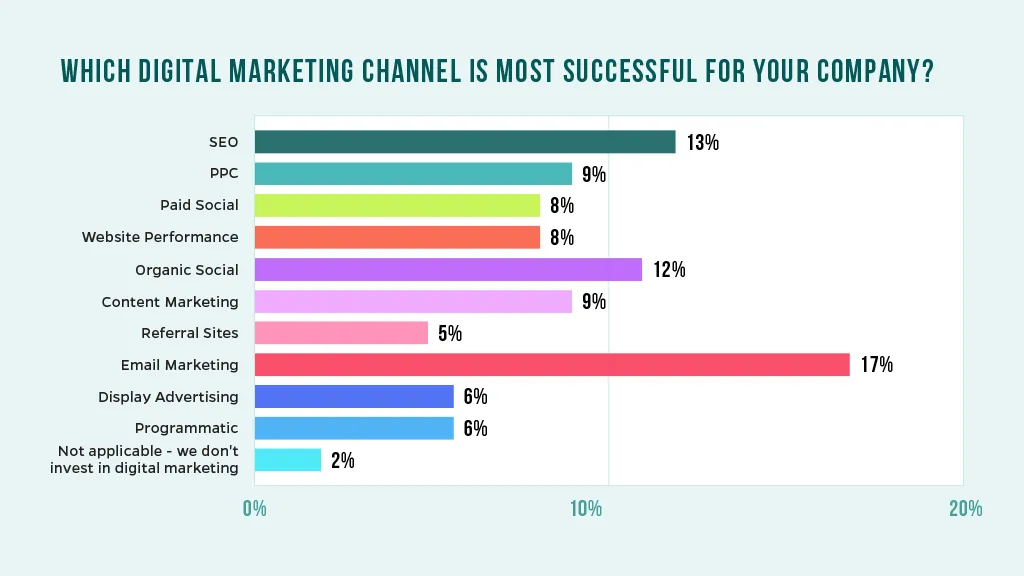
Manufacturing marketers continue to favor channels they can control, optimize, and tie directly to performance. While email marketing ranks as both the most widely invested channel and the most successful one, the more revealing story lies just beyond the top line. Channels like SEO, website performance optimization, content marketing, and organic social consistently appear across current investments, recent expansions, and perceived effectiveness. This pattern suggests a strategic shift toward owned, long-term digital assets rather than purely paid acquisition.
The Foundation: SEO, Websites, and Content
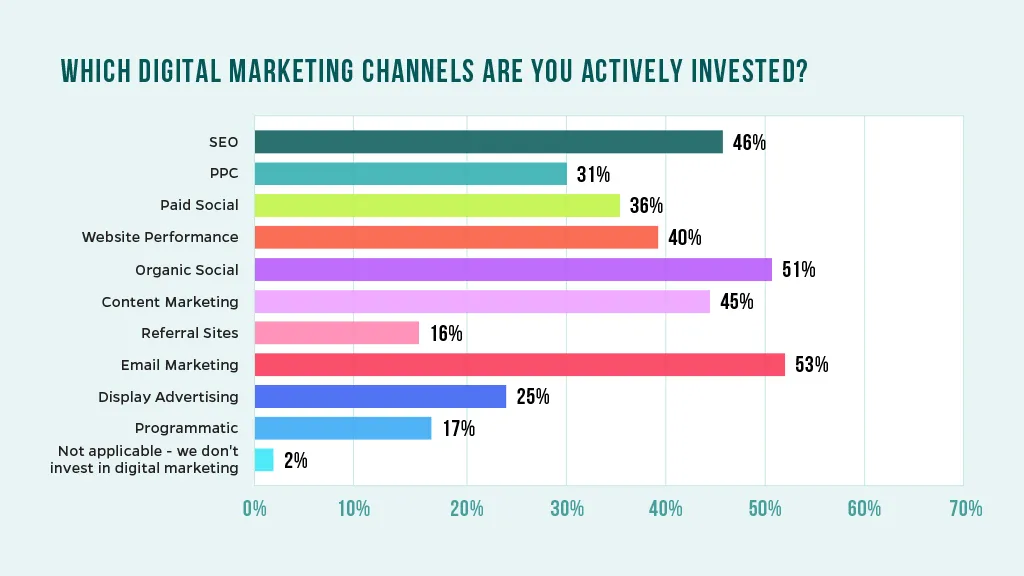
SEO stands out as a foundational investment. In our survey, 46% of respondents are actively investing in it, and 13%—the second-highest number—cite it as their most effective marketing channel. This aligns perfectly with manufacturing buying cycles, which tend to be longer, more research-intensive, and involve multiple stakeholders. When buyers are conducting early-stage research, visibility matters. SEO delivers that visibility when it counts most.
Website performance and content marketing follow a similar pattern. A significant share of respondents report ongoing investment in site optimization, UX, and CRO, as well as content formats like blogs, technical guides, case studies, and videos. These channels rarely deliver overnight results, but they compound over time—building equity that pays dividends. The data reveals that manufacturing marketers increasingly view their websites not as static brochures, but as dynamic sales and lead-generation engines that demand continuous refinement.
Year-Over-Year Consistency
This isn’t a flash-in-the-pan trend. Our 2025 manufacturing survey showed remarkably similar results. Email marketing, SEO, social media, content marketing, and website performance dominated the investment landscape. SEO was cited as an active investment by 62% of respondents and ranked as the most successful channel at 20%. Content marketing was an investment for 49% of our participants while website performance was embraced by 45% of our respondents.
The takeaway is clear: marketers know what delivers results and are reinforcing proven fundamentals.
What’s Old is New
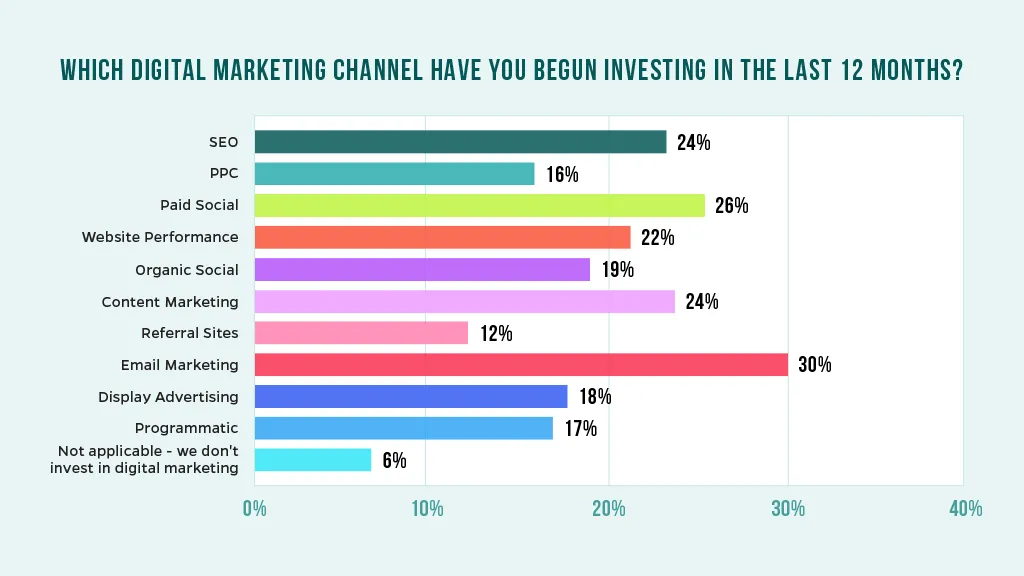
When we examine newer investments over the past 12 months, a practical, ROI-focused mindset emerges. Rather than launching entirely new initiatives, many teams are deepening their commitment to existing channels—expanding SEO efforts, strengthening content libraries, refining paid social campaigns, and enhancing website performance.
What’s Getting Cut
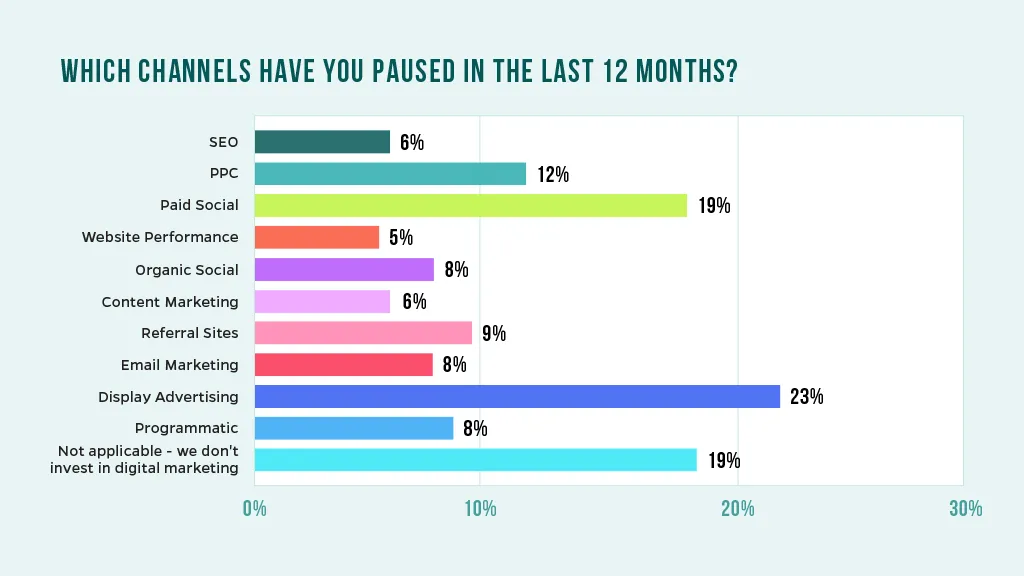
Just as revealing are the channels marketers have paused. Display advertising and paid social appear more frequently among abandoned efforts, suggesting heightened scrutiny of channels that can be difficult to measure or justify. This is especially true in niche B2B manufacturing markets where audience targeting can be challenging.
This pullback doesn’t necessarily mean these channels are ineffective. Rather, it signals that marketers are becoming more selective, prioritizing investments with clearer attribution and stronger alignment to their buyers’ actual research and decision-making behavior.
Conversely, SEO, website performance, and content marketing were the least likely to be paused. This underscores their fundamental importance, especially in an era when AI is reshaping how buyers discover and evaluate information.
The Content Mix That Works
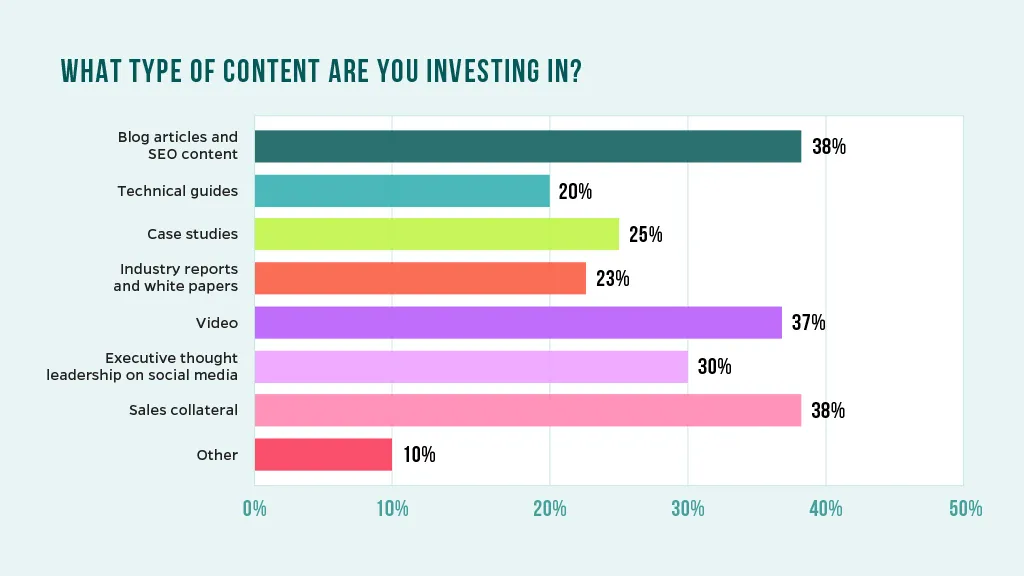
The data on content investment adds crucial context. Blog and SEO-driven content leads the pack, closely followed by video, technical guides, case studies, and substantive assets like white papers and industry reports. This diverse mix reflects the dual role manufacturing content must play: educating technically sophisticated buyers while simultaneously building trust and authority.
In this space, surface-level content doesn’t cut it. Buyers need proof, depth, and real-world application as they consider high-stakes, complex purchases. The most effective content strategies balance accessibility with expertise, meeting buyers wherever they are in their research journey.
The Bigger Picture
Taken together, these findings point to a maturing approach within manufacturing marketing. The days of experimentation for its own sake are fading. In their place, we’re seeing more intentional strategies centered on durability, measurability, and buyer alignment.
Email remains the workhorse, but it’s supported by a robust ecosystem of SEO, content, and website optimization efforts that work in concert to attract, educate, and convert prospects over time. For manufacturing marketers, success isn’t coming from any single silver-bullet channel. Instead, it’s coming from building a connected digital foundation—one that compounds value, supports lengthy sales cycles, and adapts as buyer behavior continues to evolve.
What Marketers Find Most Challenging Today
Lead generation and demonstrating ROI remain pillars of concern for manufacturing marketers. In last year’s survey, demonstrating ROI topped the list at 36%, with generating quality leads close behind at 22%. This year, these two challenges were still prominent, accounting for about 42% of all responses. But when we dig deeper, a more nuanced picture emerges.
Lead Quality Reigns Supreme
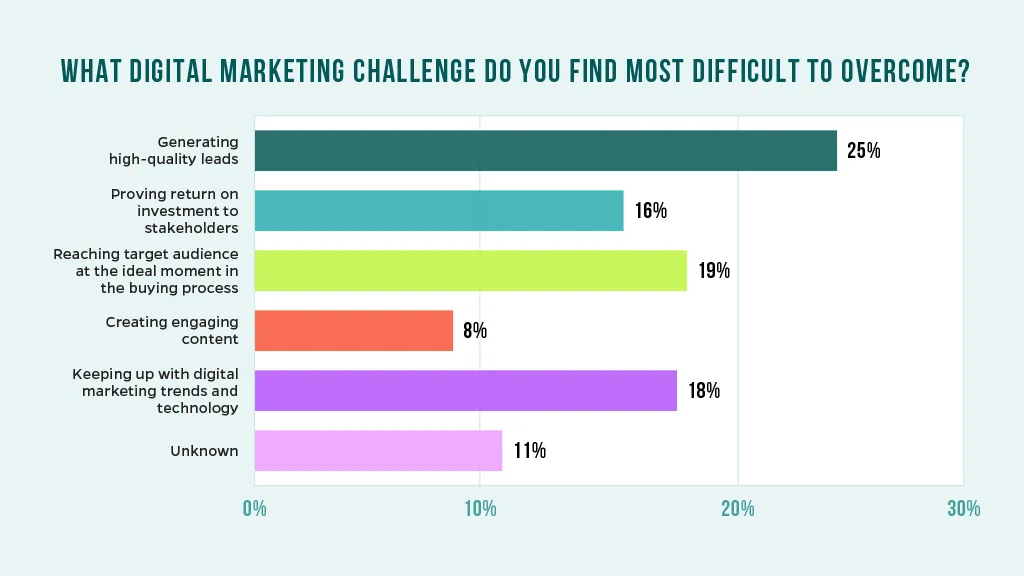
Generating high-quality leads was cited as the top challenge by 25% of respondents. This reinforces a persistent truth in manufacturing marketing: volume alone doesn’t move the needle. Many marketers successfully attract traffic and inquiries, but those leads often lack buying intent, technical fit, or budget authority.
For manufacturers with extended sales cycles and highly specialized audiences, low-quality leads create costly friction between marketing and sales teams. When sales reps spend their time chasing unqualified prospects, it erodes confidence in marketing programs and wastes everyone’s most valuable resource: time.
Timing Is Everything
Closely related, 19% of respondents cited reaching the target audience at the ideal moment in the buying process as their biggest hurdle. This highlights a few things:
- Challenges in aligning marketing efforts with buyer journeys—such as identifying intent signals or using tools like retargeting effectively.
- Combined with lead generation, these two related areas account for nearly 45% of responses, highlighting a core inefficiency in converting awareness to action.
- Implication: Manufacturing marketers might benefit from advanced analytics, automation tools (e.g., marketing automation platforms), or intent-based marketing strategies to better time their outreach.
The ROI Pressure Cooker
Another 16% struggle with proving return on investment to stakeholders. While this number was significantly lower than last year (36%), it underscores the pressure marketing teams face internally. In many manufacturing organizations, leadership demands clear revenue attribution, yet marketing’s influence is often indirect and plays out over months or even years.
Without robust reporting infrastructure, tight CRM alignment, and closed-loop attribution models, marketers find themselves constantly defending their results rather than scaling what works. This defensive posture can drain energy and resources that could be better spent on optimization and growth.
Keeping Up with Technology
Nearly 18% reported difficulty keeping up with digital marketing trends and technology. For smaller teams, this is especially relatable. New platforms, AI-driven tools, analytics changes, and evolving search behavior demand a constant learning curve, often without additional headcount or budget. This challenge compounds others, as outdated tactics can directly affect lead quality, targeting precision, and performance measurement.
Content Creation isn’t a Problem
Interestingly, only 8% identified creating engaging content as their primary challenge. This suggests that most manufacturing marketers have figured out how to produce content. The struggle isn’t in creation. It’s in distribution, targeting, and conversion.
In other words, content isn’t failing because it doesn’t exist. It’s failing when it doesn’t reach the right people at the right time, or when it can’t be tied back to measurable business outcomes. This distinction matters because it shifts the focus from “make more content” to “make content work harder.”
The Strategic Implication
Collectively, these findings reveal that today’s manufacturing marketers have moved beyond basic executional challenges. They’re now grappling with efficiency, precision, and accountability. Success increasingly depends on aligning strategy, technology, and measurement into a cohesive system—not just launching more campaigns.
The organizations that can connect lead quality, buyer intent, and ROI into a unified approach will be best positioned to transform digital marketing from a cost center into a predictable growth engine.
How Manufacturing Marketers are Using AI
AI has rapidly evolved from an experimental curiosity to a practical, everyday tool in the manufacturing marketer’s arsenal. This year’s survey reveals both the breadth of adoption and growing confidence in AI’s value.
Widespread Adoption is Here
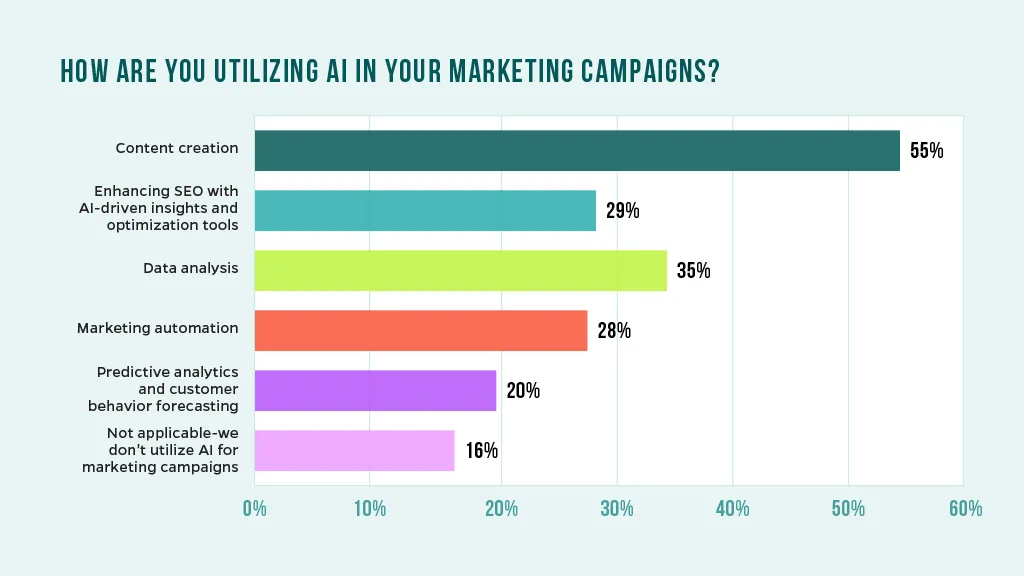
Content creation emerged as the most common and comfortable use case, with 55 % of respondents using AI to help produce written content. That figure closely mirrors last year’s 53%, but the more dramatic shift is happening in overall adoption rates.
Last year, 39% of respondents reported not using AI at all. This year, that number dropped to just 16%. This sharp decline tells us that AI adoption is no longer the domain of early adopters or particularly tech-forward teams. AI has crossed into the mainstream for manufacturing marketing, becoming a mainline practical solution with a clear benefit.
Quality Perceptions are Positive
Equally important is how marketers assess the results. A majority—55%—believe AI has somewhat or significantly improved the quality of their content. This perception signals growing confidence in AI as a support tool rather than a threat to quality or authenticity.
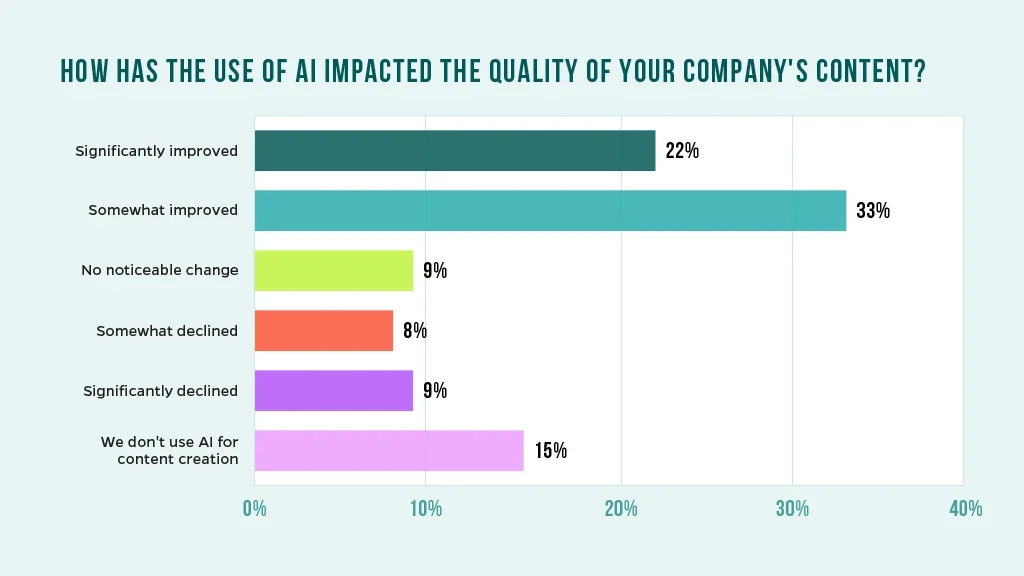
Manufacturing marketers appear to be deploying AI strategically, using it where it delivers the most immediate value: producing content and accelerating production without sacrificing clarity or technical accuracy. The technology is being embraced as an efficiency multiplier, not a replacement for human expertise and industry knowledge.
A Maturing Relationship
These findings suggest we’ve reached an inflection point in how marketers and AI interact. AI is increasingly viewed as an enhancement tool—one that helps teams accomplish more with limited resources while maintaining quality standards.
As adoption continues to grow, the conversation is shifting. The question is no longer whether marketers should use AI, but how strategically they can integrate it into workflows, governance frameworks, and quality control processes.
AI Proficiency: Confidence and Perception Gaps
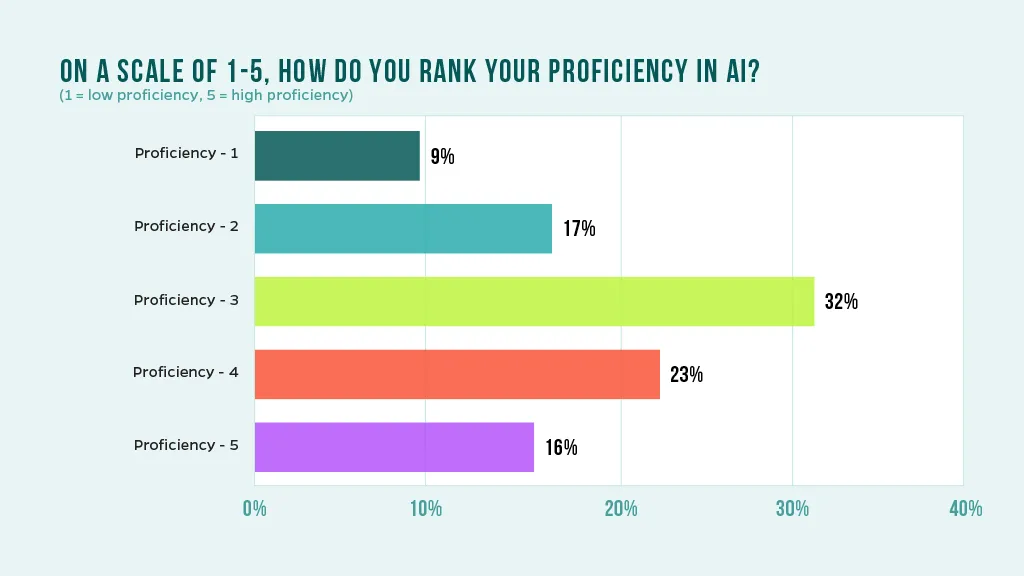
Most manufacturing marketers now consider themselves capable AI users. Nearly three-quarters of respondents (72%) report being at least moderately proficient with AI tools. This level of self-reported confidence suggests using AI is no longer viewed as intimidating or overly technical, but as a commonplace skill.
The Perception Gap
Interestingly, respondents were less confident in the industry as a whole. Only 61% believe other marketers in the industry possess similar proficiency in AI. While the 11-point difference may seem modest, it reveals an important shift in mindset.
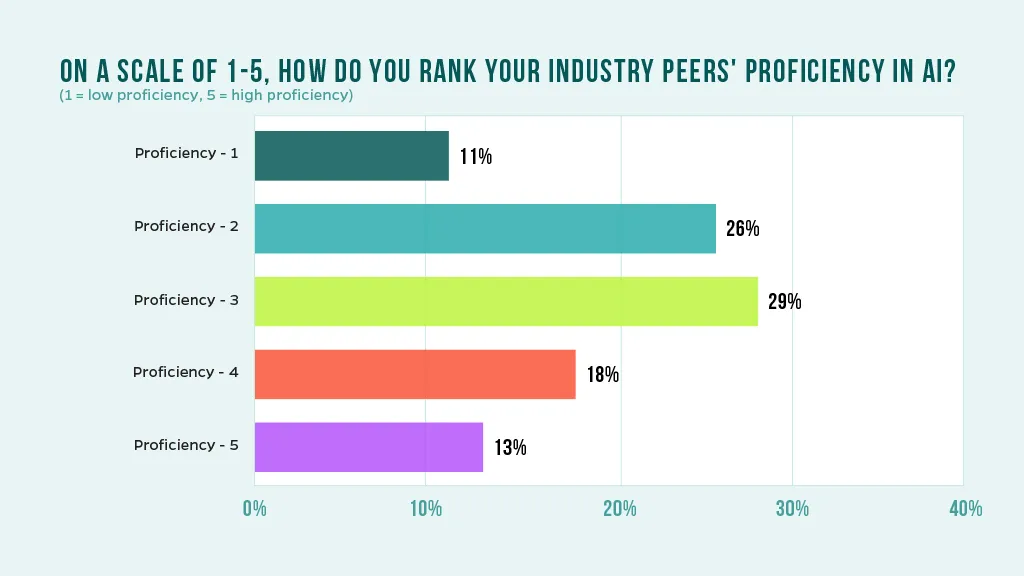
Traditionally, professionals tend to assume “everyone else knows something I don’t.” But when it comes to AI adoption, we’re seeing the opposite. Many manufacturing marketers believe they’re ahead of the curve rather than behind it. This reversal likely stems from hands-on experience—once teams start using AI regularly, the learning curve often feels manageable, and progress can happen quickly.
What This Means
This confidence could be a positive sign of healthy adoption and skill development. Or it could mask uneven progress across the industry, where some organizations are advancing rapidly while others remain in the experimentation phase.
Either way, these findings point to a transitional moment. AI proficiency is becoming a competitive differentiator, but it hasn’t yet become a universal baseline. Marketers who continue refining their AI skills—through deliberate training, structured experimentation, and clearly defined use cases—may gain meaningful advantages over competitors who remain less confident or less systematic in their approach.
Investing in Generative Engine Optimization (GEO)
Generative Engine Optimization represents one of the newest frontiers in search marketing, and the survey results reflect an industry actively exploring its potential even as many marketers are still determining how to respond.
Defining GEO
Since many marketers aren’t yet familiar with the term, let’s start with a clear definition. Generative Engine Optimization (GEO) is the practice of optimizing content so it’s more likely to be selected, accurately summarized, and cited by generative AI systems—such as large language models (LLMs) and AI-powered search assistants—when they produce answers to user queries. Unlike traditional SEO’s focus on keyword rankings, GEO emphasizes clarity, structured information, authoritative signals, and semantic relevance.
Current Investment Patterns
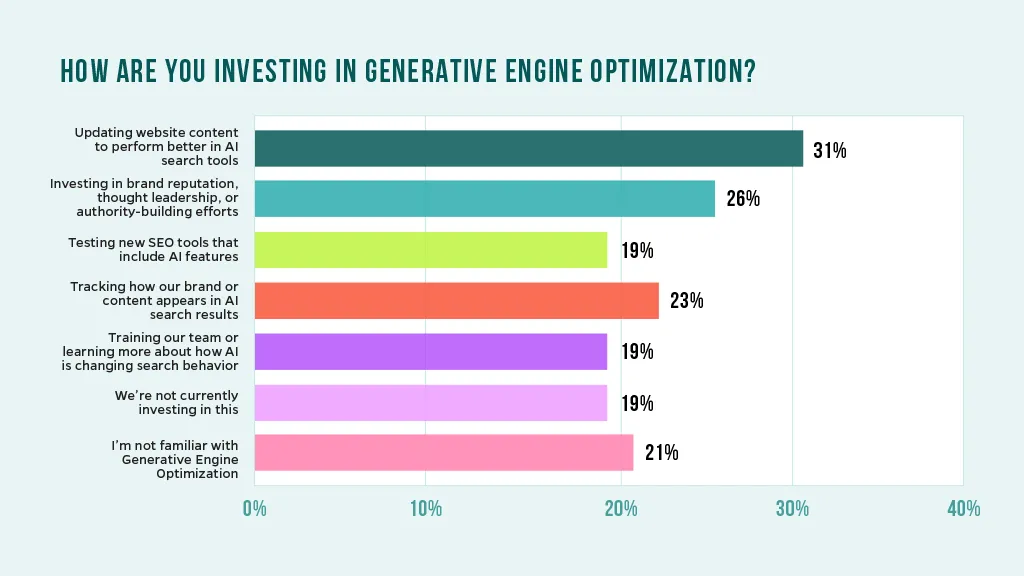
The most common GEO investments focus on foundational activities that will feel familiar to experienced marketers. A meaningful portion of respondents are updating website content to perform better in AI-powered search tools and investing in brand authority through thought leadership, PR, and credibility-building initiatives.
This approach indicates that many marketers are treating GEO as an evolution of traditional SEO rather than a complete reinvention. They are leaning into high-quality content, demonstrated expertise, and trust signals that have always mattered in search, but may now carry even greater weight in AI-generated results.
Early-Stage Experimentation
Fewer respondents are engaging in more advanced tactics, such as actively tracking how their brand appears in generative search responses or testing newer SEO tools with AI-specific capabilities. This suggests that while interest is growing, measurement frameworks and specialized tooling for GEO are still maturing.
Many teams appear to be laying groundwork first, prioritizing content quality and authority before diving deeper into sophisticated optimization and performance tracking.
The Knowledge Gap
Perhaps most telling is the sizable share of respondents who are either not currently investing in GEO or remain unfamiliar with the concept altogether. This reinforces that GEO sits early in its adoption curve within manufacturing marketing. Awareness is spreading, but education remains a key barrier. This is particularly true for teams balancing limited resources, extended sales cycles, and traditionally conservative buying audiences.
The Opportunity Ahead
The data points to a transitional phase. Manufacturing marketers recognize that AI-driven search is reshaping visibility and influence, but many are still translating awareness into concrete action. As generative search becomes more prominent in how buyers discover vendors and solutions, those who invest early in understanding how their brand is surfaced may be better positioned to adapt as GEO evolves from an emerging concept to a core component of search strategy.
Final Thoughts: Practical Progress, Not Flashy Change
The results of this year’s Manufacturing Marketing Survey tell a consistent story: manufacturing marketers are evolving thoughtfully, not impulsively. They’re prioritizing strategies that are measurable, durable, and aligned with how buyers research and make purchasing decisions.
Across channel investments, content strategy, and AI adoption, we see a clear emphasis on fundamentals executed well—SEO, website performance, authoritative content, and email—rather than chasing every new platform or trend. At the same time, marketers are beginning to thoughtfully adapt to meaningful shifts in the landscape. In particular, they are on the pulse of the expanding role of AI in content creation and search discovery, even as many remain in the early stages of formalizing those efforts.
As we move deeper into 2026, the opportunity for manufacturing marketers lies in integration: connecting channels, content, technology, and measurement into a cohesive system that supports long sales cycles and drives predictable growth. Those who invest in building that foundation now will be better positioned to adapt—no matter how quickly the digital landscape continues to change.
Want help navigating your digital marketing efforts? Contact Straight North. We have a proven record of helping companies achieve success across the broad spectrum of digital marketing strategies and tactics.