


Website security used to be viewed as a purely technical concern—something IT teams handled behind the scenes. That’s wrong. Security, trust, and search visibility are of the utmost importance to business success. If you rely on organic search to drive leads and revenue, HTTPS is no longer optional. It’s a foundational requirement for technical SEO, user experience, and brand credibility. In this article, we’ll break down what HTTPS really is, why Google cares about it, and how it directly impacts your website’s search performance.
What is HTTPS?
HTTPS stands for Hypertext Transfer Protocol Secure. In simple terms, it’s the secure version of HTTP, the protocol used to transfer data between a user’s browser and your website.
HTTPS works by encrypting data through an SSL or TLS certificate. That encryption ensures that any information exchanged (form submissions, login credentials, payment details) cannot be intercepted or altered by third parties.
From a user’s perspective, HTTPS is easy to recognize:
- A padlock icon in the browser address bar
- A URL that begins with “https://” instead of “http://”
While this may seem like a small visual cue, it plays a significant role in how users and search engines perceive your site.
How Google Uses HTTPS as a Ranking Factor for SEO
Google officially confirmed HTTPS as a ranking signal back in 2014. At the time, it was considered a lightweight factor. Since then, its importance has steadily increased.
While HTTPS alone won’t catapult a low-quality site to the top of the search results, it does contribute to stronger overall SEO performance in several ways:
- It helps establish trust and credibility
- It supports safer crawling and indexing
- It aligns with Google’s broader focus on user experience
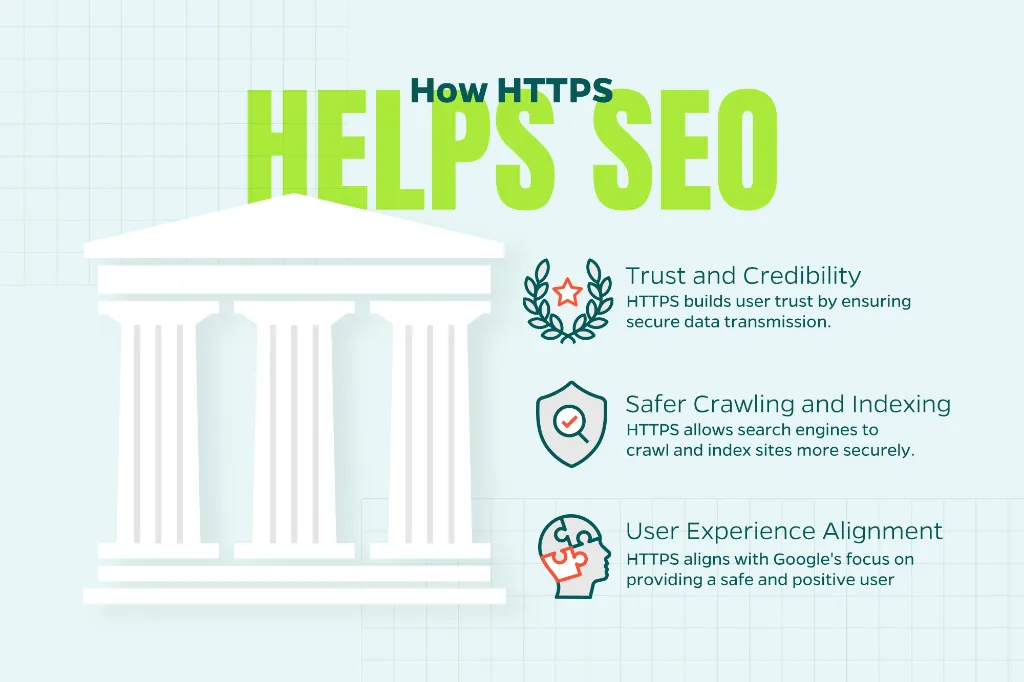
More importantly, Google has made it clear that insecure websites create friction for users. That friction is something Google actively works to reduce in its search results. In other words, if your website isn’t secure, Google will penalize it.
Browser Warnings and User Trust
One of the most visible consequences of not using HTTPS comes directly from modern web browsers.
Sites running on HTTP are now flagged as “Not Secure” in Chrome, Safari, and other major browsers. These warnings appear prominently, especially on pages with forms or login fields.
From a user’s point of view, this creates instant doubt:
- Is this site safe?
- Will my information be compromised?
- Should I trust this brand?
Even if your website doesn’t collect sensitive data, the perception of risk is enough to drive users away. Higher bounce rates, shorter session durations, and lower engagement all send negative signals that can indirectly affect SEO performance.
When visitors see a “Not Secure” warning, many won’t stick around long enough to explore what you have to offer.
HTTPS and User Experience Signals
SEO today is about far more than keywords and backlinks. Google increasingly evaluates how users interact with your site, and those behavioral signals matter.
HTTPS supports better user experience in several key ways:
- Users feel safer browsing and converting
- Secure sites are less likely to be blocked or restricted by browsers
- HTTPS is required for many modern web features
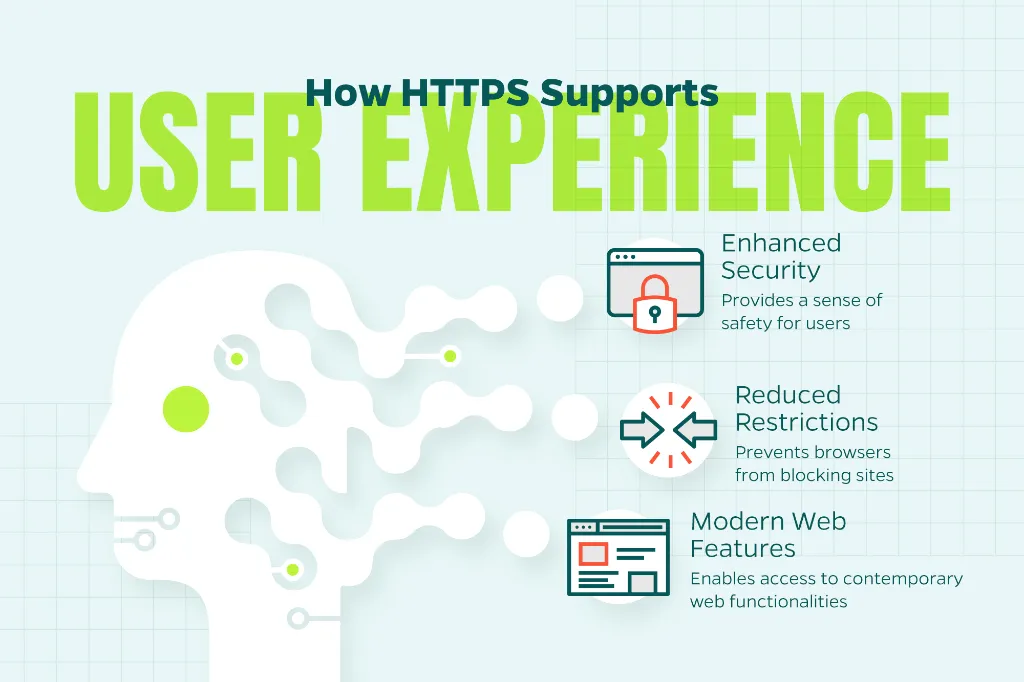
Metrics like bounce rate, time on site, and conversion behavior are influenced by trust. When users feel confident, they’re more likely to stay, explore, and act. While Google doesn’t use all behavioral metrics as direct ranking factors, these engagement signals often correlate with stronger organic performance.
Think of it this way: if your site feels unsafe, users leave quickly. And when users consistently leave quickly, Google takes notice.
Core Web Vitals and HTTPS Compatibility
Core Web Vitals have become an established part of Google’s page experience evaluation. While HTTPS is not a Core Web Vital itself, it supports technologies that improve performance and stability.
For example:
- HTTP/2 and HTTP/3 require HTTPS and offer faster, more efficient data transfer
- Secure sites are better positioned to optimize loading speed
- Many performance enhancements depend on encrypted connections
In short, HTTPS creates the technical foundation needed to meet modern performance expectations. Without it, you’re limited in how much you can optimize your site’s speed and responsiveness.
Security Issues Can Hurt SEO Fast
One of the fastest ways to lose organic visibility is through a security breach.
Websites that are hacked, injected with malware, or used for phishing can be:
- Removed from search results entirely
- Flagged with security warnings in Google Search
- Blacklisted by browsers and security tools
Recovering from these issues can take weeks or even months, depending on severity. HTTPS doesn’t guarantee immunity from attacks, but it significantly reduces risk and demonstrates to search engines that your site meets baseline security standards.
The stakes are high. A single security incident can wipe out months or years of SEO progress in a matter of days. We recommend adjusting your approach accordingly.
HTTPS and Referral Data Accuracy
There’s another SEO benefit that often goes overlooked: data integrity.
When traffic passes from an HTTPS site to an HTTP site, referral data can be lost. That traffic may appear as “direct” instead of organic or referral traffic in analytics platforms.
This makes it harder to:
- Accurately measure SEO performance
- Attribute leads and conversions
- Understand user behavior
Migrating fully to HTTPS preserves referral data and gives marketers cleaner, more reliable insights. When you can’t trust your data, you can’t make informed decisions about where to invest your marketing budget.
HTTPS as a Trust Signal for Conversions
SEO doesn’t exist in a vacuum. Organic traffic only delivers value when it converts.
HTTPS plays a direct role in conversion rate optimization:
- Users are more likely to submit forms on secure pages
- Trust badges and padlock icons reduce hesitation
- Secure checkout experiences are essential for ecommerce
For lead generation sites, even a small increase in trust can translate into meaningful gains in form submissions and phone calls. If you’re driving traffic but not seeing conversions, the absence of HTTPS might be part of the problem.
Common HTTPS Migration Concerns
Despite the clear benefits, some businesses delay HTTPS adoption due to fear of SEO disruption. These concerns are understandable, but they’re largely avoidable with proper planning.
Key best practices include:
- Implementing 301 redirects from HTTP to HTTPS
- Updating internal links to point to HTTPS URLs
- Resubmitting XML sitemaps in Google Search Console
- Monitoring crawl errors and index coverage
When handled correctly, HTTPS migrations typically result in stable or improved rankings over time. The temporary disruption is minimal compared to the long-term benefits.
HTTPS is the New Baseline
It’s important to frame HTTPS correctly. It’s not an advanced optimization or a competitive edge anymore. It’s the minimum standard for any credible website.
Search engines expect it. Browsers enforce it. Users notice when it’s missing.
From an SEO standpoint, failing to adopt HTTPS creates unnecessary risk and limits your site’s ability to compete in search results.
Conclusion
HTTPS is about far more than encryption. It’s about trust, performance, data accuracy, and long-term search visibility.
For businesses investing in SEO, secure infrastructure is not a technical afterthought. It’s a strategic requirement. Whether you’re launching a new site or optimizing an existing one, HTTPS should be treated as a foundational element of your digital marketing strategy.
Want a hand through this transition? Straight North can help. Reach out to learn more about how we help businesses across the full spectrum of digital marketing tactics and strategy.