

Pay-per-click (PPC) campaigns offer a compelling value proposition: you only pay when potential customers engage with your ads. That said, you must budget strategically to avoid draining your resources without delivering ROI. This guide gives you a practical framework to develop a PPC budget that aligns with your business objectives and maximizes profitability.
Understanding PPC Fundamentals and Strategic Budgeting
PPC advertising lets you reach your audience by a process called bidding. You bid on keywords or segments across search engines, social platforms, and partner sites. When your targeting aligns with a user’s search or profile, your ad appears in top positions. Yet, you only pay when someone clicks through. This is known as cost-per-click, or CPC.
Strategic budgeting serves several critical functions in PPC campaign management. Most advertising platforms allow you to set daily or monthly spending caps. But these limits alone don’t guarantee efficient resource allocation. Without a comprehensive budget strategy, businesses often overspend on low-intent clicks that rarely convert or underinvest in high-value opportunities that can drive significant growth. An effective budget bridges the gap between your available resources and business objectives. Examples of this include increasing sales, generating qualified leads, or building brand awareness.
Looking to build an effective budget? Here are some proven best practices to get you started.
Step 1: Establish Clear, Measurable Campaign Objectives
Effective budget development begins with defining precisely what you want to accomplish. Vague objectives such as “increase website traffic” lack the specificity needed for meaningful budget calculations. Instead, adopt the SMART framework—ensuring your goals are Specific, Measurable, Achievable, Relevant, and Time-bound.
A well-defined objective might be: “Generate 75 qualified leads from prospective customers searching for enterprise software solutions within the next 90 days.” This level of specificity enables you to work backward from your desired outcome to estimate the required investment. For lead generation campaigns, you’ll focus on high-intent keywords that indicate purchase readiness, even if they command higher CPCs, because they’re more likely to convert.
Your PPC budget should exist within the context of your broader marketing strategy. Industry benchmarks suggest allocating between 7 and 10 percent of gross revenue to overall marketing activities, though this varies by sector and growth objectives. Within that marketing allocation, PPC’s share depends on your business model. E-commerce businesses often dedicate 20 to 30 percent of their marketing budget to paid search and shopping campaigns, while B2B service providers might allocate a smaller percentage but focus on higher-value conversions.
Understanding your customer acquisition cost (CAC) tolerance is equally important. Calculate the maximum amount you can afford to spend acquiring a new customer while maintaining profitability. This figure, combined with your conversion rate expectations, will help determine whether your budget is sufficient to meet your goals.
Step 2: Conduct Thorough Keyword Research and Competitive Analysis
Keywords form the foundation of search-based PPC campaigns, and understanding their cost is essential to accurate budgeting. Google Keyword Planner provides valuable baseline data at no cost. It offers insights into search volume, competition levels, and estimated CPC ranges for your target terms.
The relationship between keyword specificity and cost follows predictable patterns. Broad, high-volume keywords like “jeans” or “insurance” attract significant competition and often cost several dollars per click, but they also draw users at various stages of the buying journey. Long-tail keywords—more specific phrases like “women’s waterproof hiking boots size 8″—typically have lower search volumes and CPCs, but users searching these terms often have clearer intent and convert at higher rates.
Your competitive environment significantly influences budget requirements. Industries with high customer lifetime values, such as legal services, financial products, and healthcare, often see CPCs ranging from five to fifty dollars or more. Competitive intelligence tools like SEMrush, BrightEdge, Arefs, or SpyFu can reveal what competitors are bidding on and their estimated traffic, helping you understand the investment required to compete effectively.
When conducting initial keyword research, identify 10 to 20 high-potential terms that align with your objectives. For each keyword, estimate monthly costs using available data. If a keyword receives 1,000 monthly searches with an average CPC of $2.50 and you can expect a 4 percent click-through rate (CTR), you’d receive approximately 40 clicks at a cost of $100. Aggregate these estimates across your keyword list to develop a preliminary budget range.
Step 3: Calculate Your Initial Budget Based on Performance Expectations
With objective and keyword research complete, you can develop a more precise budget estimate using fundamental PPC economics. Start with this basic formula: Budget = (Desired Conversions) ÷ (Expected Conversion Rate) × (Average CPC).
Let’s work through a practical example. Suppose you want to generate 100 conversions monthly, your website historically converts 2 percent of PPC clicks into sales or leads, and your research indicates an average CPC of $3.50. You would need 5,000 clicks (100 ÷ 0.02) at a total cost of $17,500. While this might seem substantial, evaluate it against customer lifetime value. If each new customer generates $600 in profit over their relationship with your business, the $175 acquisition cost yields positive returns.
This calculation should also account for several refinements:
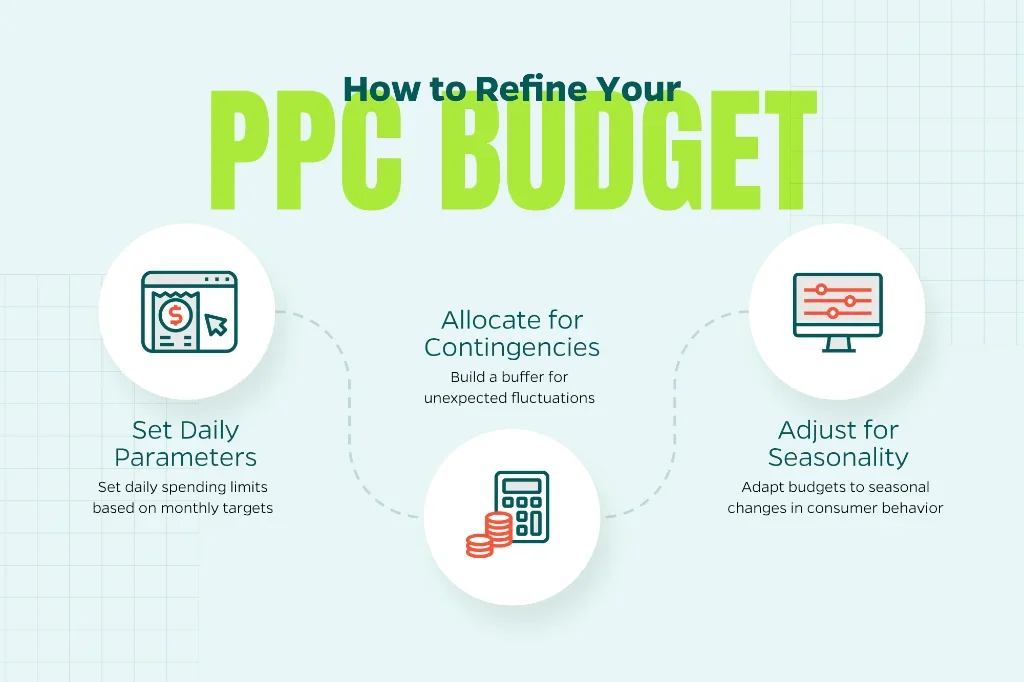
- Daily Budget Parameters: Most platforms operate on daily budget settings. Divide your monthly target by 30.4 (the average number of days per month) to establish daily limits. Be aware that Google Ads may spend up to twice your daily budget on high-traffic days while staying within monthly caps.
- Contingency Allocation: Build in a 10 to 20 percent buffer to accommodate bid fluctuations, seasonal variations, and testing initiatives. This flexibility prevents campaigns from going dark when conditions change.
- Seasonal Adjustments: Consumer behavior and competition levels vary throughout the year. Retail businesses see elevated CPCs during the holiday shopping season, while other industries have their own peak periods. Review historical trends to anticipate these fluctuations.
For businesses new to PPC, it is probably wise to start with a test budget—for example, $1,000 to $3,000 for the first month, depending on your industry’s CPC ranges. This testing period generates actual performance data specific to your offers and market conditions, allowing you to refine projections before committing larger sums.
Step 4: Strategically Allocate Budget Across Campaigns and Channels
Not every campaign deserves equal investment, and strategic allocation based on expected performance is crucial to overall efficiency. Consider segmenting your budget across several dimensions:
- Product or Service Categories: If your business offers multiple product lines or services, create separate campaigns for each. This structure enables performance tracking at a granular level, revealing which offerings generate the strongest returns and allowing you to shift resources toward top performers.
- Geographic Markets: Businesses serving multiple locations should consider geographic campaign segmentation. Local service providers might allocate more budget to high-value metropolitan areas, while national businesses can test new markets with limited budgets before scaling successful expansions.
- Campaign Types and Networks: Different campaign types serve distinct strategic purposes. Search campaigns capture high-intent traffic from users actively seeking solutions. Display campaigns build awareness and can retarget previous visitors. Shopping campaigns showcase products directly in search results. Each channel has different cost structures and performance characteristics that should inform budget allocation.
- Funnel Stages: Consider allocating budget according to where prospects are in their buying journey. Top-of-funnel campaigns might use more cost-effective display ads for awareness, while bottom-of-funnel campaigns focus on high-intent keywords and retargeting, often justifying higher CPCs due to superior conversion rates.
Google’s Quality Score provides a 1-10 rating of your ad relevance and landing page experience. Higher Quality Scores (7 or above) can reduce your actual CPC by 20 to 50 percent while improving ad positions. This effectively multiplies your budget’s impact.
Step 5: Implement Continuous Monitoring and Budget Optimization
PPC budget management is an ongoing discipline to help you succeed in PPC. Establish a cadence of weekly performance reviews, examining key metrics such as clicks, CTR, conversion rate, cost per conversion, and return on ad spend. Use these insights to identify optimization opportunities:
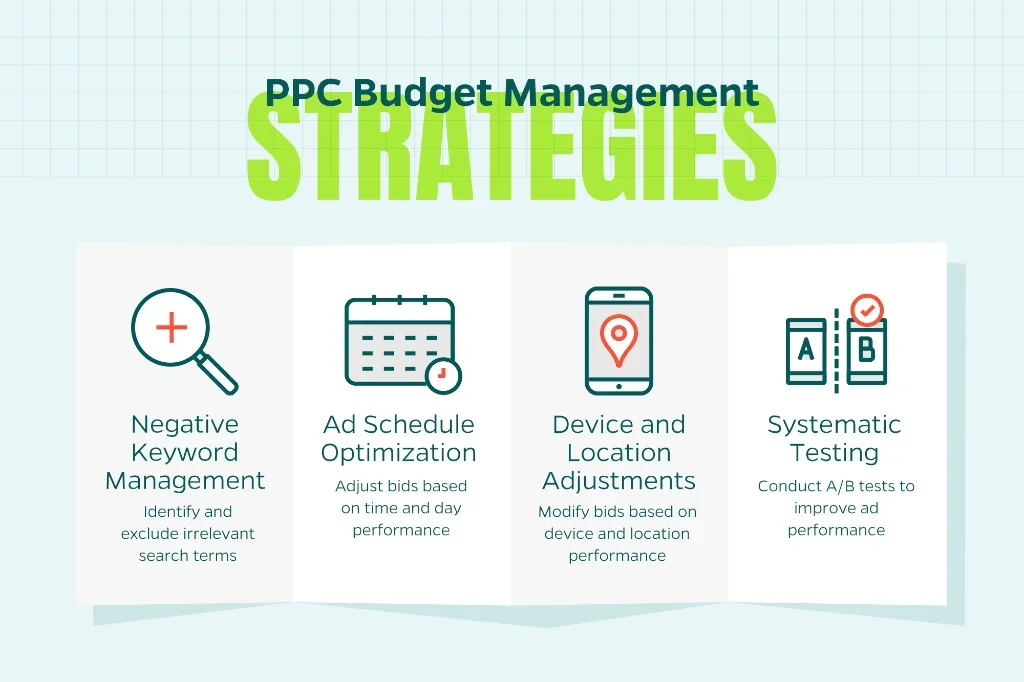
- Negative Keyword Management: One of the most effective cost-control tactics involves adding negative keywords—terms that trigger your ads but rarely convert. If you’re selling premium software, adding “free” or “pirated” as negative keywords prevents wasted clicks. Review search term reports weekly to identify and exclude irrelevant queries.
- Ad Schedule Optimization: Performance often varies significantly by time of day and day of week. Many B2B services see better conversion rates during business hours on weekdays, while some consumer businesses peak during evenings or weekends. Analyze performance by time segment and adjust bids accordingly. Potentially pause ads during consistently low-performing periods.
- Device and Location Adjustments: Different devices and geographic locations often show varying performance. If mobile traffic converts at half the rate of desktop, consider reducing mobile bids by 30 to 50 percent to maintain target CPAs across devices.
- Systematic Testing: Regular A/B testing of ad copy, headlines, calls-to-action, and landing pages identifies improvements that boost CTR and conversion rates. Even modest improvements compound over time—increasing your conversion rate from 2 percent to 2.4 percent reduces your cost per conversion by 17 percent without additional budget.
Establish clear performance thresholds that trigger action. If a keyword or campaign falls below acceptable ROAS (many businesses target 4:1 or higher), pause it and reallocate budget to better performers. Conversely, when campaigns exceed targets, consider gradual budget increases—typically 20 to 30 percent monthly—to capture additional volume without drastically altering auction dynamics.
Building a Sustainable PPC Budget Strategy
Remember that PPC proficiency develops through iteration and learning. What works in your first month provides data for improvement in the second month. This begins a cycle of continuous refinement to propel you towards further growth. Successful advertisers view budgeting as a strategic tool for directing resources toward their best use.
At Straight North, we guide businesses through the complexities of PPC budget development and campaign management—consistently delivering measurable improvements in efficiency and results. Whether you’re launching your first campaign or optimizing an established program, we can provide the expertise and support to accelerate your success. Contact us to discuss how strategic PPC budgeting can advance your business objectives.