


Your URL is often the first piece of information users and search engines see for your page. It appears in search results, social shares, email links, and even on business cards. A clean, logical URL can improve click-through rates, boost SEO performance, and make your site easier to navigate.
At Straight North, we’ve seen first-hand how small URL improvements lead to measurable lifts in traffic and conversions. This article explores what works best as we head into 2026.
Why URLs Still Matter
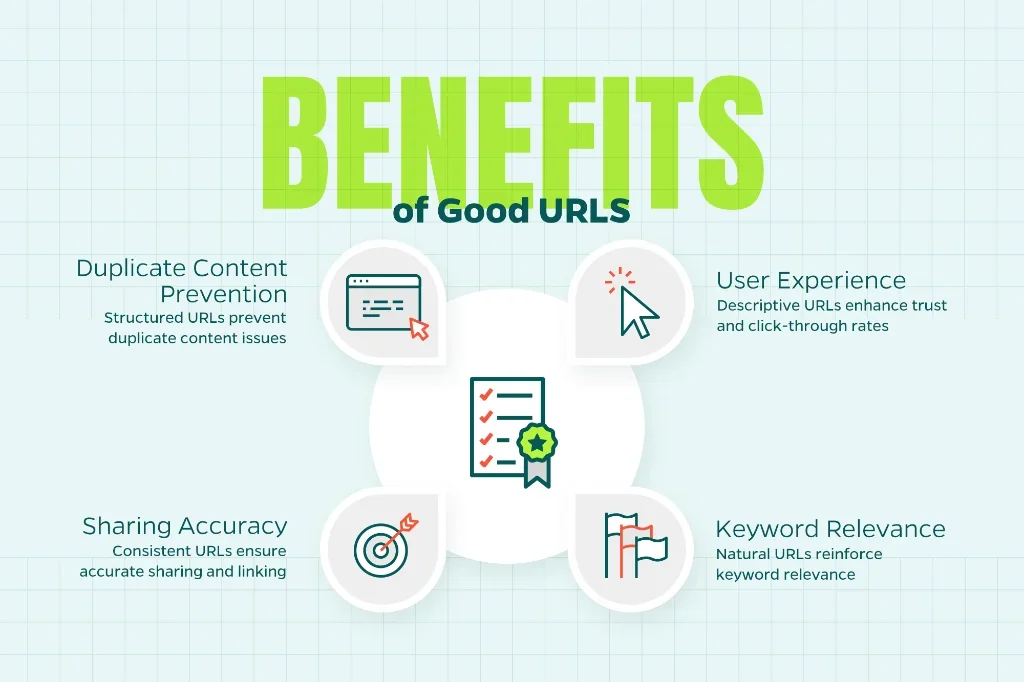
Google has repeatedly confirmed that URLs are a ranking factor—though they are a relatively light one compared to content quality and backlinks. That said, good URLs help in indirect but meaningful ways:
- Good URLs improve user experience (people trust and click descriptive URLs more often than unclear or “sketchy” ones)
- Good URLs reinforce keyword relevance when done naturally
- Good URLs make sharing and linking more accurate
- Good URLs prevent duplicate content issues when structured consistently
Think of your URL as a mini headline for the page. If it’s confusing or unappealing, you’re starting the visitor relationship on the wrong foot.
Ideal URL Structure: Keep It Simple and Hierarchical
The most effective URLs mirror your site’s architecture and read like plain English.
Good example:
straightnorth.com/blog
Bad examples:
straightnorth.com/index.php?page_id=123&cat=services
straightnorth.com/09/25/2025/ppc-management-chicago-il/
Best practices for structure:
- Use a logical hierarchy
Show where the page lives in your site:
youragency.com/services/seo-services/technical-seo - Separate words with hyphens (not underscores)
Google treats hyphens as spaces but underscores as joiners. So best-practices.html is read correctly, while best_practices.html becomes one word. - Use lowercase letters only
URLs are case-sensitive on some servers. Stick to lowercase to avoid 404 errors and duplicate content. - Remove unnecessary parameters whenever possible
Session IDs, tracking codes, and sorting parameters (?sort=price-desc) should be handled with cookies or canonical tags instead of bloating the URL. - Include the focus keyword naturally
If the page targets “PPC management Chicago,” a URL like straightnorth.com/ppc-management/chicago makes perfect sense. Just don’t stuff keywords—ppc-management-chicago-illinois-2025-best-agency looks spammy.
How Long Should a URL Be?
Shorter is almost always better, but not at the expense of clarity.
Google displays about 60 to 70 characters of a URL in search results before truncating with “…”. Anything vital after that point gets hidden.
Recommended length guidelines:
- Ideal: under 60 characters
- Acceptable: under 100 characters
- Proceed with caution: over 115 characters
Examples:
Too long (163 characters):
straightnorth.com/blog/digital-marketing-tips-for-small-business-owners-who-want-to-grow-online-presence-in-2025-with-tips-from-the-best-gurus-in-digital-marketing
Just right (62 characters):
straightnorth.com/blog/digital-marketing-tips-small-business
Even better (48 characters):
straightnorth.com/blog/small-business-marketing-tips
Remember: every folder level and word adds length. Ask yourself, “Does this word or folder truly help the user or search engine understand the page?” If not, cut it.
Folder vs. Flat Structure: Which Wins?
Should your URLs nest content several layers deep (/services/seo/on-page) or keep things simple (/on-page-seo)?
In most cases, a simpler structure with just one or two folder levels works best because it:
- Keeps URLs shorter and cleaner
- Avoids looking overly complex or keyword-stuffed
- Makes it easier to reorganize your site later
- Grows more gracefully as you add content
The exception is e-commerce sites with thousands of products. These sites often need multiple category levels (like /clothing/mens/shirts) to help both shoppers and search engines navigate efficiently.
Dates in URLs: Just Say No (Almost Always)
Including the publication date in blog post URLs used to be common practice. Today it’s largely unnecessary and sometimes harmful.
Problems with dates:
straightnorth.com/blog/2025/12/10/seo-trends
- Makes content look outdated in two years
- Encourages duplicate content when you update an evergreen post
- Adds unnecessary characters
- Hurts click-through rate in SERPs (users often skip “old” content)
Only use dates if timeliness is part of your strategy for things like news sites, annual reports, and event recaps.
HTTPS: Non-Negotiable in 2026
If your site still uses HTTP, fix it today. Google Chrome and other browsers mark HTTP sites as “Not Secure.” This tanks trust and click-through rates. Plus, HTTPS is a confirmed ranking signal.
Subdomains vs. Subdirectories: The SEO Verdict
Search engines generally consolidate authority better when content lives in subdirectories:
Preferred:
straightnorth.com/blog/url-best-practices
Less ideal:
blog.straightnorth.com/url-best-practices
Use subdomains only when the content is truly separate (e.g., support.straightnorth.com or shop.straightnorth.com).
Special Characters, Accents, and International URLs
Avoid ampersands (&), spaces, commas, and most special characters. They either get encoded (%26, %20) or break links entirely.
For non-English sites:
- Use UTF-8 encoding
- Consider transliterating accented characters (café → cafe) for simplicity
- Or keep accents if your audience expects them (common in French, Spanish, etc.)
Redirects and Canonical Tags: Clean Up the Mess
Legacy URLs don’t have to haunt you forever.
- 301 redirect old or ugly URLs to the new clean versions
- Use canonical tags to tell Google which version of similar URLs is preferred
- Update internal links over time (don’t rely solely on redirects)
Quick Checklist: Does Your URL Pass the Test?
- All lowercase
- Words separated by hyphens
- Under 100 characters (ideally under 60)
- Contains focus keyword naturally
- No unnecessary parameters or session IDs
- Uses HTTPS
- Logical and readable to a human who’s never seen your site
- Matches the page title (roughly)
Final Thoughts
Great URLs won’t skyrocket your rankings on their own, but bad ones can hold you back. Take an hour this week to audit your most important pages. Run your URLs through Google Search Console, check click-through rates on poorly performing pages, and start cleaning house. The payoff compounds over time as users trust your site more, share links more accurately, and search engines understand your content better.
Ready to clean up your URLs and boost performance? Straight North is a full-service digital marketing agency specializing in SEO, PPC, and web design for mid-size B2B and B2C companies. Reach out for more help improving URLs and all your digital marketing efforts.