





Only two or three years ago, “search visibility” described where your website link landed on a results page. Today a growing share of buyers never even see that page. They ask ChatGPT, Google’s AI Overviews, Perplexity, or Gemini a question, and the engine hands back a synthesized answer instead of ten blue links.
Generative engine optimization (GEO) is also called AI SEO, and sometimes LLMO or answer engine optimization (AEO). GEO is the practice of structuring content and managing your brand’s presence so those AI systems retrieve, cite, and recommend you when they build that answer.
The stakes behind it are not theoretical. In a recent Straight North survey of 101 marketers, 73% said AI-search visibility already has a place in their marketing strategy: 45% said they have a documented plan and defined goals, while 29% are pursuing it more informally. Only 11% said they are doing nothing yet.
This guide is written by an agency that has adjusted its playbook through every major shift in search since 1997, from the rise of mobile-first indexing to the arrival of voice search. It is built for B2B companies whose buyers now ask AI for a shortlist before they ever type a query into Google. Here is what the rest of the page covers:
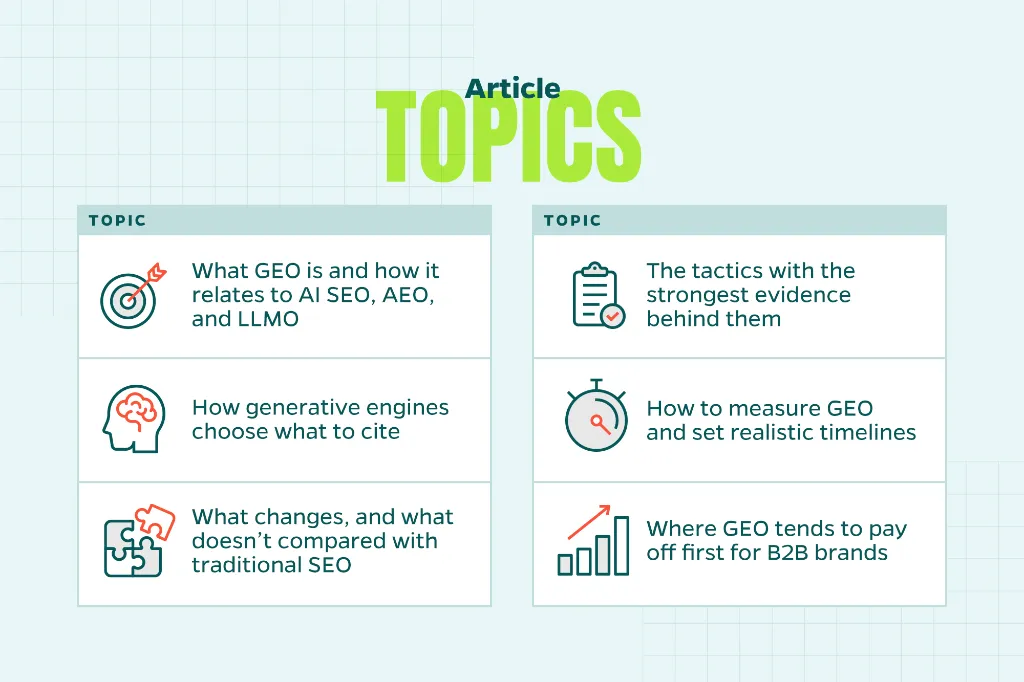
- What GEO is and how it relates to AI SEO, AEO, and LLMO
- How generative engines choose what to cite
- What changes, and what doesn’t, compared with traditional SEO
- The tactics with the strongest evidence behind them
- How to measure GEO and set realistic timelines
- Where GEO tends to pay off first for B2B brands
Ready? Let’s dive in.
GEO, AI SEO, AEO, LLMO: One Discipline, Many Names
Search marketers have settled on at least five names for the same discipline, and mixing them up is normal. Here is the short glossary:
Term | What it means |
Generative Engine Optimization (GEO) | The research-derived name for optimizing content and brand presence for AI-generated answers |
AI SEO | The umbrella phrase most buyers search for; often used interchangeably with GEO |
Answer Engine Optimization (AEO) | Focused on answer engines and answer-box formats; heavily overlapping with GEO |
LLM Optimization (LLMO) | Emphasis on visibility inside large language model outputs specifically |
AIO (Artificial Intelligence Optimization) | A broader, newer label some teams use to cover all the above |
GEO and AEO are close enough that most practitioners use them interchangeably, though AEO leans a bit more toward classic answer boxes and featured snippets, while GEO leans toward the newer generative layer built on top of them. Straight North’s full GEO vs. AEO comparison covers that distinction in depth. For this guide, treat the two as pointing at the same target: getting your brand into the answer.
One disambiguation worth a moment: if you landed here searching for “geo targeting” or “geographic SEO,” meaning content optimized for a specific city, region, or service area, you are in the wrong place. This GEO is not about location; it is about generative engines. Straight North’s local SEO resources cover that other discipline.
None of the label debate changes what the engines are doing underneath. Whether you call it GEO, AI SEO, AEO, or LLMO, the retrieval behavior is identical. Pick whichever term matches how your team searches for it and put your energy into the tactics below.
How Generative Engines Work
To optimize for something, it helps to understand what is happening on the other side of the query.
“AI search is collapsing what used to be a much longer research process. Instead of visiting five websites, reading reviews and comparing companies themselves, customers can ask AI to do much of that work for them, which means businesses increasingly need to influence the answer before a customer ever reaches their website,” says Frank Fornaris, Straight North’s president.
“AI search is collapsing what used to be a much longer research process. Instead of visiting five websites, reading reviews and comparing companies themselves, customers can ask AI to do much of that work for them, which means businesses increasingly need to influence the answer before a customer ever reaches their website.”

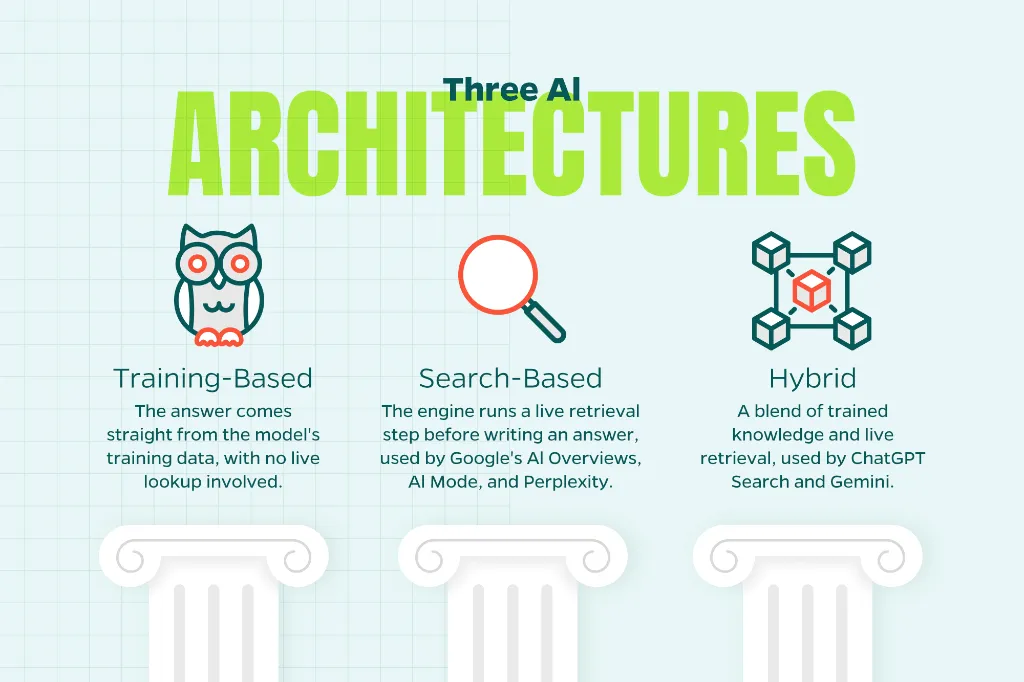
The names to know today are ChatGPT, Google AI Overviews, Google AI Mode, Perplexity, Gemini, and Claude, and each retrieves information a bit differently; Section 7 breaks those down individually. But nearly all of them fall into one of three architectures:
- Training-based: The answer comes straight from the model’s training data, with no live lookup involved. This is fast, but limited to what the model learned before its training cutoff.
- Search-based: The engine runs a live retrieval step before writing an answer. Google’s AI Overviews, AI Mode, and Perplexity work this way.
- Hybrid: A blend of trained knowledge and live retrieval. ChatGPT Search and Gemini fall here.
The search-based and hybrid engines rely on a process called retrieval-augmented generation, or RAG. In plain terms, the engine searches the web (or an index of it), pulls a short list of the most relevant sources, reads them, and writes an answer grounded in what it found. GEO is the work of getting onto that shortlist and staying there.
One layer makes this more complicated than a single search: query fan-out. Rather than answering one question directly, an engine often breaks it into several sub-queries behind the scenes and retrieves sources for each. “The biggest change with contextual understanding is embracing query fan out,” says Tom Lustina, Straight North’s director of SEO and GEO. A page that answers a narrow question completely has a better shot at getting pulled into one of those sub-queries than a page that tries to cover everything at once but commits to nothing.
“The biggest change with contextual understanding is embracing query fan out.”

None of this is mystical. It is retrieval, reading, and writing, applied at a scale no one clicks through by hand. That mechanical view is why the tactics later in this guide work the way they do: they make your content easier for a machine to find, trust, and quote.
GEO vs. Traditional SEO: What Changes and What Doesn’t
The easiest way to think about GEO is as SEO’s next chapter, not its replacement.
“Ranking means Google thinks your page deserves visibility. Citation means the system thinks your page is useful evidence for a specific answer,” explains Bob Hand, Straight North’s senior SEO and GEO strategist. Ranking and citation are not the same signal, but they are not unrelated either. A page still must be crawlable, technically sound, and authoritative before an AI engine will consider it as evidence at all.
“Ranking means Google thinks your page deserves visibility. Citation means the system thinks your page is useful evidence for a specific answer.”

What stays the same:
- Crawlability and technical health still gate everything. An engine cannot cite what it cannot access or parse.
- Content quality and topical authority still matter. Thin, generic pages do not win citations any more than they win rankings.
- Backlinks and mentions from credible sources still build the trust signals engines lean on.
What changes:
- The unit of competition shifts from ranking a page to being cited inside an answer. You can outrank a competitor and still lose the citation to them.
- Success metrics shift from clicks and positions toward citations, mentions, and share of voice in AI answers.
- Content structure matters more: answer-first, self-contained passages retrieve better than pages that build slowly toward a conclusion.
| Traditional SEO | GEO |
Goal | Rank pages on a results page | Earn citations inside a generated answer |
Primary metric | Position, click-through rate | Citations, mentions, share of voice |
Unit of optimization | The page | The answer |
Success signal | Rankings and clicks | Being retrieved and quoted |
Is GEO replacing SEO? No. GEO is built on SEO fundamentals; you cannot GEO a site that cannot rank in the first place. Straight North has seen this pattern before: the shift toward GEO is not causing most organizations to abandon SEO. According to our survey data, 68% of respondents have increased their traditional SEO investment, while 64% increased their combined investment in both SEO and AI-search visibility.
Why GEO Matters Now: The Data
If you want evidence rather than theory, a few data points carry the argument.
Adoption is already mainstream, not experimental. As noted above, 73% of the marketers Straight North surveyed said AI-search visibility already has a place in their strategy. Separately, 72% said their organization has increased its use of internal subject matter experts in content specifically because of AI search: 33% “significantly,” 40% “somewhat,” a direct response to how much these engines seem to reward named, credentialed voices.
The research behind GEO is peer-reviewed, not agency folklore. The paper that named the field, Aggarwal et al., “GEO: Generative Engine Optimization” (arXiv 2311.09735), found that adding citations, statistics, and quotations from credible sources could lift a source’s visibility in AI-generated answers by as much as 40% in the paper’s test settings. The tactics section below builds directly on that finding.
Third-party trackers back up how fast this shifted. Industry estimates put Google AI Overview coverage somewhere in the 40%-to-48% range of searches by mid-2026. More telling for GEO specifically: one large-scale citation analysis found that only 17% of AI Overview citations came from pages ranking in Google’s organic top ten, down from about 76% in mid-2024. That is hard evidence that ranking well and getting cited are increasingly separate games. It also aligns with Straight North’s own Citation Gap study, which found AI engines regularly cite competitors that do not outrank a brand in traditional search.
None of this comes with a guarantee. AI citations shift as engines re-crawl, retrain, and adjust their retrieval logic, sometimes week to week. Treat GEO as an ongoing visibility program, the way you would treat SEO or PR, rather than a one-time project with a fixed finish line.
The Core GEO Tactics That Move Citations
Start with the tactics that have research behind them, then layer in what agency practice has added since. The Princeton paper referenced above tested several content-optimization methods and found three carried the most weight:
- Cite authoritative sources. Referencing credible, third-party sources signals your content is grounded in something bigger than an opinion.
Example: Instead of writing “AI search is growing quickly,” write “A peer-reviewed GEO study found that specific optimization methods increased visibility in generative-engine responses by up to 40%,” and link to the study.
Quick tip: When making a factual claim, link the key phrase to the original research, government report, standards body, or other primary source — not a page that merely summarizes it. - Include statistics. Numbers give AI engines concrete, quotable evidence to lift into an answer.
Quick tip: Add one specific, relevant number near the claim it supports, and include the source and date so readers can evaluate it quickly. - Quote credible experts. A named expert’s point of view is exactly the kind of passage a generative engine can pull into a cited answer.
Example: Ask a subject-matter expert one focused question, then publish a two-sentence quotation with the person’s full name, title, and organization.
Practice has built on that research base with a few tactics that consistently move the needle in the field:
- Original data. “You don’t want to overlook the power of original data collection, because your surveys, your polls, your customer insights can really help transform a piece from informative to authoritative,” says Adam Rosenbaum, an SEO and GEO manager at Straight North. A survey or proprietary dataset hands engines something no competitor’s page can offer: a number nobody else has.
Quick tip: Start small: review 20 customer calls, support tickets, or sales records, identify one recurring pattern, and publish the finding with the sample size and method. - Answer-first structure. Front-load the direct answer, then explain. Self-contained passages that make sense out of context retrieve better than paragraphs that build slowly toward a point.
Example: Open with “GEO is the practice of making content easier for AI engines to retrieve and cite.” Follow with the explanation, evidence, and caveats. - Entity clarity. Use the same brand name, description, and details everywhere: your site, your schema, your directory listings, your social profiles, so engines have no ambiguity about who you are.
Quick tip: Create a one-line approved company description and a master sheet for your name, address, services, founding year, and leadership; use them consistently across every profile. - Structured data. JSON-LD schema markup helps engines parse what a page is about. llms.txt is a newer, debated file meant to tell AI crawlers what to prioritize; treat it as a signal, not a guarantee, while the standard matures.
Quick tip: Begin with one schema type that clearly matches the page, such as Article, Organization, Product, or FAQ, and confirm that every marked-up detail also appears visibly on the page. - E-E-A-T signals. Named authors, visible credentials, and first-hand experience continue to function as the trust layer AI systems appear to weigh, much the way human quality raters always have.
Example: Add an author box that lists the writer’s relevant role, years of experience, reviewed-by expert, and links to a detailed biography. - Semantic completeness. Cover a topic’s full question space instead of chasing a single keyword. This guide, for what it’s worth, is built on that same principle.
Quick tip: Before publishing, list the reader’s five likely follow-up questions and answer each with a short subsection, example, comparison, or FAQ entry.
Optimizing Per Engine: ChatGPT, Perplexity, AI Overviews, and Gemini
Not every engine retrieves the same way, and not every engine matters equally for every business. B2B buyers currently skew toward ChatGPT and Google’s AI Overviews, so prioritize there if you must choose.
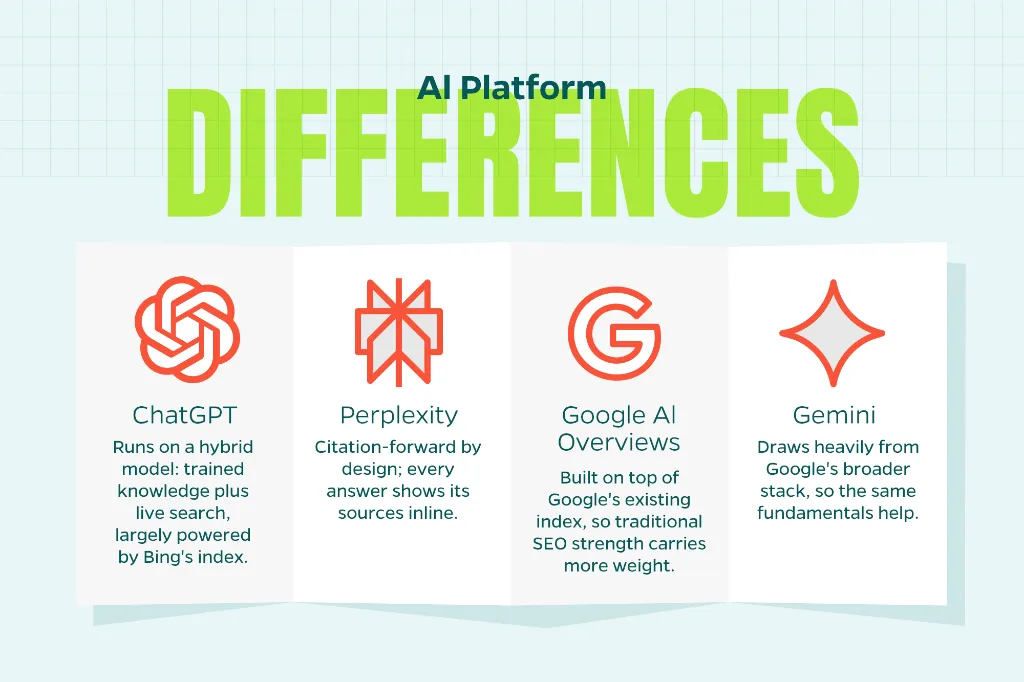
- ChatGPT: Runs on a hybrid model: trained knowledge plus live search, drawing on OpenAI’s own crawler (OAI-SearchBot) and third-party search providers. Being mentioned in sources ChatGPT was trained on matters nearly as much as ranking well today.
- Perplexity: Citation-forward by design; every answer shows its sources inline. It tends to favor fresh, clearly sourced, authoritative pages over older, thinner ones.
- Google AI Overviews and AI Mode: Built on top of Google’s existing index, so traditional SEO strength carries more weight here than anywhere else on this list; ranking still feeds retrieval directly.
- Gemini: Draws heavily from Google’s broader stack, so the same fundamentals that help AI Overviews tend to help Gemini.
Each engine deserves a deeper playbook of its own. This section is meant as a starting map; per-engine guides will be covered in a future article.
Off-Site GEO: Visibility Beyond Your Website
GEO does not stop at your own domain. Generative engines synthesize answers from the whole web: Reddit threads, YouTube videos, review platforms like G2, Capterra, and Trustpilot, industry directories, and press coverage all feed into what an engine believes about your brand.
That makes digital PR a GEO tactic. Earned mentions in sources an engine already trusts carry weight that your own website cannot generate alone. The survey shows how broadly organizations are approaching this work: 42% are placing more emphasis on news and media websites because of AI search, followed by industry publications at 36%, social media at 35%, customer-review platforms at 33%, Reddit and other online communities at 28%, and “best of” or comparison articles at 27%.
The range of sources matters. Off-site GEO is not simply about earning more press coverage; it is about building a credible and consistent presence wherever an AI engine might look for supporting evidence. It also means consistency matters well beyond your homepage. The same entity facts (name, services, differentiators) need to match everywhere they appear. A mismatch between how your site describes you and how a directory or review platform describes you dilutes the entity clarity engines rely on.
For B2B companies, this is where niche industry directories and trade publications punch above their weight. A manufacturer’s listing in a sector-specific directory, or a professional-services firm’s mention in a trade publication, often carries more retrieval value for a specialized query than a mainstream press hit would.
Measuring GEO: KPIs, Tools, and Timelines
Start with the free, native tools before shopping for a platform: Bing Webmaster Tools’ AI Performance report and Google Search Console’s generative-AI reporting both surface real citation and impression data at no cost. From there, a growing set of third-party AI-visibility trackers can monitor mentions across multiple engines at once.
Whichever tools you use, track KPIs across two tiers:
- Leading indicators: AI citations and mentions, share of voice against competitors in AI-generated answers, and AI-referral sessions to your site.
- Outcome indicators: validated leads and revenue that trace back to an AI-touched journey.
In Straight North’s survey, marketers who track AI-search outcomes report the clearest visibility around specific prompts and topics (38%), brand mentions (35%), and website citations (33%), followed at some distance by harder outcome metrics like leads or conversions influenced by AI (24%) and revenue influenced by AI (20%). That gap is the industry’s current growing edge: most organizations can see that they are being mentioned before they can prove what it is worth.
“GEO introduces new metrics like AI visibility, mentions, citations, and share of voice, but those are ultimately leading indicators. The true measure of a successful GEO strategy is the same as any marketing investment: its impact on qualified leads, customers, revenue, and growth,” says David Duerr, Straight North’s CEO. Closing that gap is exactly what Straight North’s proprietary GoNorth! reporting is built for: tying AI search-generated traffic back to qualified leads instead of stopping at vanity mentions.
“GEO introduces new metrics like AI visibility, mentions, citations, and share of voice, but those are ultimately leading indicators. The true measure of a successful GEO strategy is the same as any marketing investment: its impact on qualified leads, customers, revenue, and growth.”

Set timeline expectations honestly. Engines re-crawl and re-synthesize on different schedules, so early movement can show up within weeks, while durable visibility tends to build over months, much like traditional SEO.
GEO for B2B: Where It Pays Off First
B2B buying already involved long research cycles and technical questions before generative engines existed, which makes it exactly the kind of query buyers now hand to AI instead of running five separate searches themselves. Spec’ing engineers, procurement teams, and founders increasingly ask AI for a shortlist before they ever contact a vendor.
That plays out differently by vertical:
- Manufacturers see it in supplier-discovery prompts: “find suppliers that can do X within Y tolerance.”
- Professional and engineering services see it in capability questions: “which firms handle this type of project.”
- SaaS companies see it in comparison and alternatives prompts: “best alternatives to [competitor] for [use case].”
Picture a real prompt: “Which manufacturers can produce custom aluminum extrusions with tight tolerances for aerospace parts?” A manufacturer with a GEO-ready page, one that names exact capabilities, tolerances, and certifications, and backs them with original data or a named expert, gets pulled into that shortlist. A manufacturer whose site buries the same information inside a generic capabilities PDF does not, even when its actual capabilities are identical.
This is also where specialization matters. GEO strategies built for considered-purchase B2B funnels, with multiple stakeholders and a long sales cycle, look different from GEO built for e-commerce impulse buys where a single click-through tells the whole story.
GEO for B2C: A Different Set of Queries
This guide leans B2B, but generative engines field consumer queries constantly, and the mechanics shift in a few ways worth naming.
- Query shape. B2C prompts tend toward quick comparisons and near-term purchase decisions, such as “best running shoes for flat feet under $150,” rather than the multi-stakeholder research questions common in B2B buying.
- Reviews and user-generated content carry more weight. Engines lean heavily on review platforms, Reddit threads, and video content from YouTube and TikTok when synthesizing consumer recommendations, often more than they lean on brand-owned pages.
- Product data accuracy matters more. Price, availability, and specifications need to stay current and consistently structured, through product schema and merchant feeds, since consumer answers are often transactional and time sensitive.
- Volume and velocity run higher. Consumer categories see far more query volume and faster trend cycles, so B2C GEO tends to be an always-on content and monitoring effort rather than a periodic push.
- The trust signal shifts. Where B2B GEO leans on named experts and proprietary data, B2C GEO leans on breadth of authentic mentions across the web: the more places a product is discussed accurately and consistently, the more likely it surfaces in a recommendation.
None of the fundamentals change. Crawlability, structured data, and entity clarity still matter regardless of audience. What shifts is where the effort goes: B2C GEO invests more in review generation, off-site presence, and product-data hygiene, while B2B GEO invests more in expert content and proprietary research.
Common GEO Mistakes to Avoid
Most GEO programs that fail were never really GEO programs: they were failed SEO programs wearing a new name. The specific mistakes tend to fall into three buckets.
Content mistakes:
- Publishing thin pages labeled “optimized for AI” instead of substantive, well-sourced content
- Stripping out SEO fundamentals to chase AI mentions, as if the two were in competition
- Keyword-stuffing answers instead of writing naturally for the question being asked
Technical mistakes:
- Blocking AI crawlers indiscriminately, which removes a brand from consideration entirely
- Publishing schema markup that contradicts what is on the page: a fast way to lose trust with a system built to catch inconsistencies
Strategic mistakes:
- Treating GEO as a separate silo instead of an extension of an existing SEO and content program
- Expecting guaranteed citations, when even well-optimized pages get displaced as engines retrain
- Measuring nothing, and finding out a year later that no one can say whether the effort worked
The fix is less a checklist than a mindset. Keep GEO connected to the SEO and content program already in place, and treat measurement as part of the work from day one, not an afterthought.
Generative Engine Optimization FAQ
What is AI SEO, and is it the same as GEO?
Close enough for most purposes. AI SEO is the umbrella term most people search for, while generative engine optimization is the more precise, research-grounded name for the same discipline. Both are about making content and brand presence retrievable, citable, and quotable by AI-generated answers.
What is GEO in SEO?
Within a broader SEO strategy, GEO is the layer focused on how content performs inside AI-generated answers rather than traditional rankings alone. It borrows SEO’s foundation: crawlability, quality, authority, and adds tactics aimed at citation and mention rather than position. If you searched expecting geographic or local SEO, that is a separate discipline worth looking up on its own.
What are the basics of GEO?
At minimum GEO should answer questions completely and directly, back claims with credible sources and statistics, name real experts and credit them, keep brand facts consistent everywhere online, and track citations and mentions the same way rankings are already tracked.
Do I need a GEO agency, and what does GEO cost?
Organizations with strong existing SEO and content operations can sometimes build early GEO habits in-house. Better-sourced content and cleaner entity consistency do not require an agency. Costs and complexity climb once cross-engine tracking, structured data implementation, digital PR, and revenue-tied reporting enter the picture; that is usually where an agency earns its keep. Also, if you are looking for help getting started, an agency is invaluable.
How is GEO different from Answer Engine Optimization (AEO)?
The two overlap enough that most practitioners use them interchangeably. AEO leans toward classic answer boxes and featured snippets, while GEO leans toward the newer generative layer built on top of them. See Straight North’s full GEO vs. AEO comparison for the complete breakdown.
Where to Go Next: More GEO Content
This guide anchors Straight North’s GEO educational content. Here are a few places to go next, depending on what you need:
- Sorting out the terminology? Read GEO vs. AEO — What’s the Difference?
- Want the proof? Read Zero-Click Marketing: Straight North’s Survey of 100 Marketers.
- Rankings and citations not matching up? Read The Citation Gap: Why AI Search Cites Competitors That Don’t Outrank You.
- Auditing your own trust signals? Read How to Conduct an E-E-A-T Audit in the AI Era.
- Curious about the technical file? Read What Is llms.txt, and Does It Matter for SEO and AI Search?
More spokes, including a dedicated “Is GEO Replacing SEO?” article and per-engine optimization guides, are on the way, and this page will stay current as they publish.
Need Help?
Ready to make sure your brand shows up when buyers ask AI instead of Google? Contact Straight North to build a GEO strategy tied to real leads, not just mentions.