




Optimizing for AI search means creating content that platforms such as ChatGPT, Google AI Overviews, Google AI Mode, and Perplexity can confidently use in their answers. In practice, success with AI search rests on five foundations: authority built through connected content, passages designed to be cited, clear evidence of authorship and expertise, a site AI crawlers can access, and a reliable way to measure results.
You may know this discipline as generative engine optimization (GEO), LLM SEO, or AI engine optimization. The labels differ, but the objective is the same. Straight North’s full guide to generative engine optimization explains how the terminology evolved. In this article, we will use AI search optimization and focus on how to put it into practice.
How AI Search Works, and Why Your Google Rankings Still Matter
Most AI engines that matter for search — Google’s AI Overviews and AI Mode, Perplexity, and, to a large extent, ChatGPT — rely on retrieval-augmented generation. Before writing an answer, the engine retrieves a short list of live web pages, reads them, and synthesizes a response grounded in what it found. To be on that retrieved shortlist, your article should be written clearly enough to quote.
One wrinkle makes this trickier than a single search: query fan-out. Instead of answering a broad question directly, engines often break it into several narrower sub-queries behind the scenes and retrieve sources for each one. A page that thoroughly answers one specific sub-question has a better shot at citation than a page trying to cover everything and committing to nothing.
So, do your Google rankings still matter? Yes, more than most marketers realize. Ranking well signals that a page is trustworthy and well structured. These are the traits AI retrieval systems look for first. But ranking is not sufficient on its own. Straight North’s own citation-gap analysis has found AI answers citing competitors that do not outrank the client in traditional search results, which means visibility in AI answers has become its own competition, layered on top of the one you are already running.
Think of AI search optimization and SEO as sharing the same foundation: crawlability, quality content, and authority. What changes is the success metric, from clicks and rankings to citations and share of voice in generated answers.
Step 1: Build Topic Authority With Clusters, Not One-Off Posts
AI engines work with meaning and entities, not just keyword strings. A single high-ranking page tells an engine you wrote about a topic once. A cluster of interlinked pages, covering a pillar topic and the sub-questions branching off it, tells the engine you are an authority on the subject.
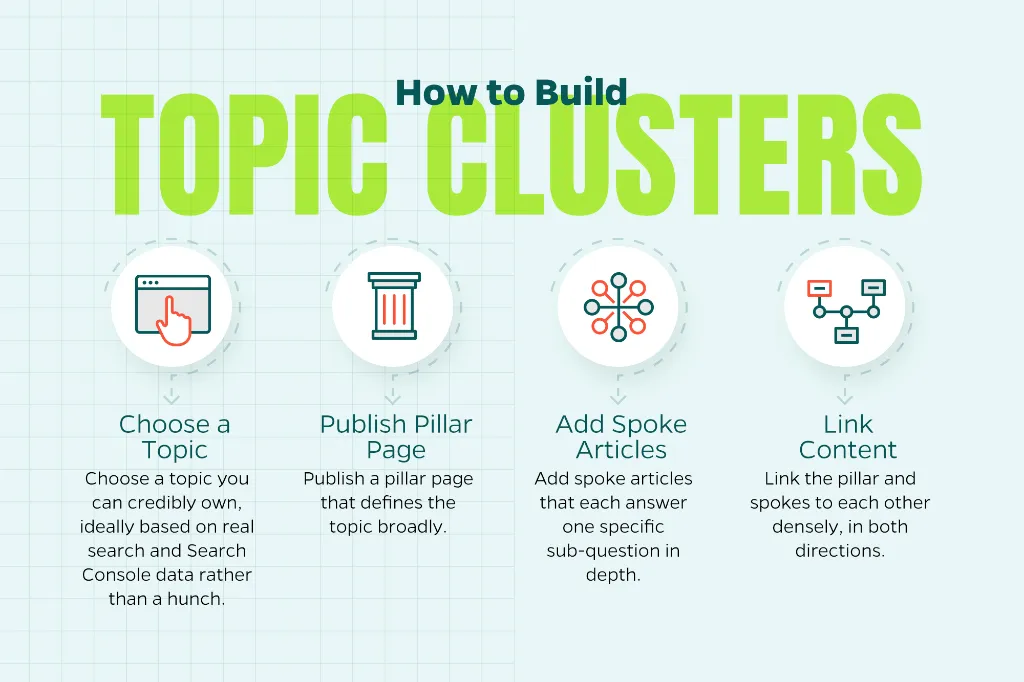
The build is straightforward, even if the execution takes real effort:
- Choose a topic you can credibly own, ideally based on real search and Search Console data rather than a hunch
- Publish a pillar page that defines the topic broadly
- Add spoke articles that each answer one specific sub-question in depth
- Link the pillar and spokes to each other densely, in both directions
Depth consistently beats breadth here. Five deep, well-linked pages on a topic you understand will outperform twenty scattered posts, for classic rankings and AI citations alike. Pair that structure with entity clarity. That means your company name, description, and details stay consistent everywhere they appear online. That way you give AI systems an unambiguous picture of who you are and what you are an authority on.
Step 2: Write Answer-First, Citable Content
Every section should open with a direct answer to its heading and a deeper explanation of that answer. Engines lift self-contained passages that make sense without any surrounding context.
“AI answers need building blocks,” says Bob Hand, Straight North’s senior SEO and GEO strategist. “That means definitions, examples, statistics, comparisons, warnings, steps, recommendations.” Write each section as one of those building blocks, and give it a conversational, question-based heading that mirrors how someone would ask an AI assistant, rather than how they would type a search query.
“AI answers need building blocks. That means definitions, examples, statistics, comparisons, warnings, steps, recommendations.”

The content itself needs to earn the citation, not just format well. The peer-reviewed research that coined the term GEO found that adding citations, statistics, and quotations from credible sources could lift a page’s visibility in AI-generated answers by up to 40%. Every one of those tactics is available to you right now:
- Link key claims to primary sources, not summaries of them
- Attach a specific number to every claim you can, with a source and date
- Quote a named expert with their title, rather than paraphrasing a vague consensus
Use decisive, specific language while you are at it. Engines cite sources willing to commit to a claim; copy that hedges everything is easy to skip over. Nearly 59% of marketers in Straight North’s recent survey said their organization has changed or created website content specifically to increase visibility in ChatGPT, AI Overviews, or other AI-generated results. If your content still reads like it was written purely for a Google crawler in 2019, you are behind that group, not ahead of it.
Here is one caution worth flagging. Chunking content into short, choppy fragments purely to look “AI-friendly” does not work. Google has been explicit that artificial fragmentation is not a ranking or citation lever. Write self-contained, well-organized passages because they are clearer, not because you are trying to game a system.
Step 3: Prove Who’s Talking — E-E-A-T, Authors, and Off-Site Trust
AI systems evaluate authorship the way a skeptical reader would: who wrote this, what makes them qualified, and can I verify it anywhere else? Displaying that proof overtly, through named authors with real credentials, visible bylines, updated dates, and an authoritative About page, gives engines a reason to trust a page enough to cite it.
That trust does not stop at your own website. “An authoritative brand can make credible claims and support them with evidence, and have those claims reinforced outside its direct control,” says Adam Rosenbaum, an SEO and GEO manager at Straight North. Unlinked brand mentions in trusted publications, industry lists, and comparison roundups feed both AI training data and live retrieval, which makes earned media and digital PR a visibility lever rather than a vanity metric.
“An authoritative brand can make credible claims and support them with evidence, and have those claims reinforced outside its direct control,”

Subject matter expertise is already showing up as a deliberate tactic, not a nice-to-have. Just over 26% of organizations surveyed by Straight North said they have specifically added more subject matter expert input to their content because of AI search, separate from broader SME use across their marketing. Reviews and third-party sentiment round out the picture. Engines lean on that outside signal to characterize your brand. So, monitoring and actively cultivating reviews belongs on this step’s task list, not just the customer service team’s.
Step 4: Make Your Site Technically Readable to AI Crawlers
None of the content and authority work above matters if AI crawlers cannot reach your pages in the first place. Start by confirming you are not blocking the crawlers that power AI search, such as OAI-SearchBot (ChatGPT search), PerplexityBot, and Googlebot (Google’s AI Overviews and AI Mode). Blocking GPTBot or Google-Extended only limits AI model training and Gemini’s use of your content; it doesn’t affect whether you can be cited in ChatGPT search or Google’s AI Overviews. Also, make sure your key pages render in clean, fast, semantic HTML rather than depending entirely on client-side JavaScript.
From there, structured data helps machines resolve entities and context faster. Organization, Article, and FAQ schema are the most directly useful types for AI search. However, schema should support understanding rather than serve as a magic ranking lever, and every marked-up detail must appear on the page.
Then there is llms.txt, a proposed standard that allows websites to suggest which content AI crawlers should prioritize. It is inexpensive to implement, but Google has said its systems do not currently use it. Treat llms.txt as an optional signal, not a shortcut. More broadly, no special markup or content-formatting tactic can replace the essentials: accessible pages, authoritative content, clear expertise, and credible third-party signals.
Step 5: Measure Your AI Search Visibility
AI search requires a broader measurement framework than traditional SEO. Track citations and brand mentions in AI-generated answers, share of voice across buyer-relevant prompts, referral traffic from AI platforms, and the conversions those visits influence. Begin with a focused set of questions your buyers are likely to ask, then monitor them monthly instead of trying to track every possible variation.
This type of focused prompt monitoring is quickly becoming standard practice. Straight North’s survey found that 46% of organizations have identified specific questions or prompts where they want their brand to appear in AI-generated answers and are actively tracking them. Google Search Console provides a useful free starting point, especially when paired with landing-page analytics segmented for AI referrers such as chatgpt.com and perplexity.ai.
Interpret those results with appropriate caution. Prompt-tracking platforms capture samples rather than every AI interaction, and personalization can produce different answers to the same question. No single dashboard provides a complete view, so use trends across tools and over time rather than treating any one data point as definitive.
Keep these leading indicators tied to business outcomes. “GEO introduces new metrics like AI visibility, mentions, citations, and share of voice, but those are ultimately leading indicators,” says David Duerr, Straight North’s CEO. “The true measure of a successful GEO strategy is the same as any marketing investment: its impact on qualified leads, customers, revenue, and growth.”
“GEO introduces new metrics like AI visibility, mentions, citations, and share of voice, but those are ultimately leading indicators. The true measure of a successful GEO strategy is the same as any marketing investment: its impact on qualified leads, customers, revenue, and growth.”

Your AI Search Optimization Checklist: What to Do First
If you are staring at five steps and wondering where to start, work in this order:
- Fix crawlability blockers first. They gate everything else, so nothing downstream matters until AI crawlers can reach your content.
- Rewrite your highest-intent pages with answer-first structure. Start where the revenue is, not where it is easiest.
- Layer in authority signals: named authors, updated dates, and a push for earned mentions in trusted third-party sources.
- Start measuring from day one. Do not wait until step four is “done” to begin tracking.
“Our prospects are seeking action items and a clear path to measurable results, not high-level strategy jargon,” says Matt Lane of Straight North, and that is the standard this checklist is built to meet.
Platform priority follows your buyers. B2B researchers lean toward ChatGPT, Copilot, and Google’s AI Overviews, while consumer and local searches skew more heavily toward Google’s own surfaces. For a manufacturer, this framework’s authority and citability steps are what get you into the shortlist when an engineer or procurement buyer asks an AI assistant for qualified suppliers. If you are a local business, weight your Google Business Profile hygiene and review volume alongside this framework, since AI assistants draw local recommendations heavily from maps data and review corpora.
AI Search Optimization FAQs
Are GEO, AEO, and LLM SEO different disciplines? Not meaningfully. They are overlapping names for the same practice of earning visibility in AI-generated answers.
How long does AI search optimization take to show results? Technical fixes, like unblocking crawlers or adding schema, can surface within weeks. Authority and share-of-voice gains build over a quarters-long curve, closer to how traditional SEO compounds than to a paid-media campaign.
How does ChatGPT decide which local businesses to recommend? Largely from maps and Google Business Profile data, review volume and sentiment, and locally cited sources like directories and press. Local businesses should treat GBP hygiene and review generation as their starting point, not an afterthought.
Do I need separate budgets for SEO and GEO? No. It is one budget. AI search optimization is SEO work viewed through a citation lens, built on the same fundamentals, aimed at an additional outcome.
Need Help?
Ready to make sure AI engines are citing your business instead of your competitors? Contact Straight North to build an AI search optimization plan around real leads, not just mentions.