



AI visibility measures how often, where, and in what context a brand appears in AI-generated answers. Traditional search rankings place a webpage at a numbered position. AI visibility is measured inside the answer itself.
Generative engine optimization (GEO) is designed to improve a brand’s presence in AI answers. But a GEO program needs its own metrics. Straight North’s GEO guide explains the broader discipline of GEO. This article focuses on determining whether your GEO efforts are producing measurable visibility.
“Prospects are most concerned about losing visibility as buyers increasingly use AI platforms and Google AI Overviews instead of traditional search results, says Anthony Ciango, Straight North’s VP of Sales. “They want to know how their brand can appear in AI-generated answers and, more importantly, how that visibility can be measured.” The practical concern is not simply whether AI search is growing. It is whether a company can establish a baseline, track change, and connect that change to meaningful business activity.
“Prospects are most concerned about losing visibility as buyers increasingly use AI platforms and Google AI Overviews instead of traditional search results. They want to know how their brand can appear in AI-generated answers and, more importantly, how that visibility can be measured.”

AI Visibility and Search Rankings Measure Different Things
“A brand can rank without being cited, a brand can be mentioned without being trusted as a source, a brand can influence the answer without getting obvious traffic, says Bob Hand, Senior SEO and GEO Strategist at Straight North. “SEO reporting needs to start separating these, because clicks alone do not capture the full value of search visibility anymore.” Traditional SEO and AI visibility overlap, but they do not describe the same outcome. A page can rank well and still fail to appear in an AI answer, while a brand can shape an AI response without producing a measurable click.
“A brand can rank without being cited, a brand can be mentioned without being trusted as a source, a brand can influence the answer without getting obvious traffic. SEO reporting needs to start separating these, because clicks alone do not capture the full value of search visibility anymore.”

Search rankings measure where a page appears in a list of results. AI visibility measures whether a brand or source appears within a generated response and what role it plays there. There is no equivalent of “position seven” in a ChatGPT answer. You are either cited in an AI answer or not. Likewise, the old metrics of average position, click-through rate, and organic sessions cannot serve as stand-ins for AI visibility.
The right approach is to keep both SEO and GEO scoreboards. SEO metrics remain useful for measuring search performance, while GEO metrics measure presence inside the answer channel. Strong SEO can support AI visibility because crawlable, useful, authoritative content gives AI systems more material to retrieve. Still, rankings are an input to AI visibility — not a substitute for measuring it.
The AI Visibility Metrics That Matter
“GEO introduces new metrics like AI visibility, mentions, citations, and share of voice, but those are ultimately leading indicators,” says David Duerr, Straight North’s CEO. “The true measure of a successful GEO strategy is the same as any marketing investment: its impact on qualified leads, customers, revenue, and growth.” That hierarchy is important: visibility metrics tell you whether your brand is entering AI answers, while business metrics tell you whether that visibility is worth anything.
“GEO introduces new metrics like AI visibility, mentions, citations, and share of voice, but those are ultimately leading indicators. The true measure of a successful GEO strategy is the same as any marketing investment: its impact on qualified leads, customers, revenue, and growth.”

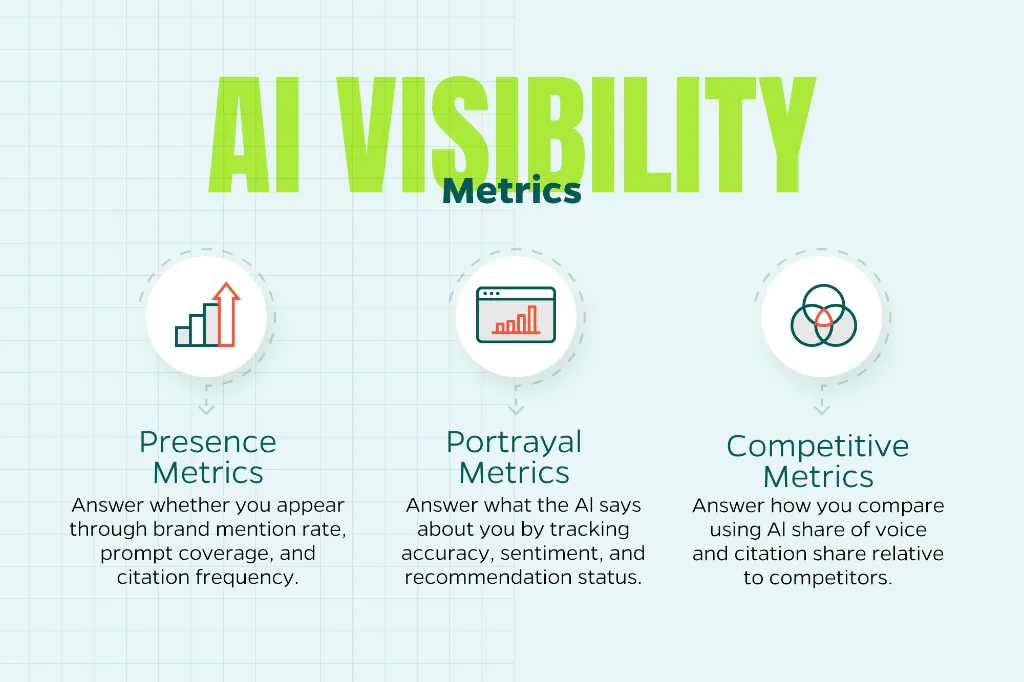
A useful AI visibility framework separates metrics into three categories: presence, portrayal, and competitive performance. Keeping these categories distinct prevents a single “visibility score” from hiding the information marketers need to act.
- Presence metrics answer whether you appear. Brand mention rate equals answers mentioning your brand divided by total answers tested, multiplied by 100. Prompt coverage tracks how much of your prompt set produces at least one appearance. Citation frequency counts how often your website or another brand-owned source is linked or cited.
- Portrayal metrics answer what the AI says about you. Track whether descriptions are accurate, whether sentiment is favorable or problematic, and whether the brand is merely named or explicitly recommended.
- Competitive metrics answer how you compare. AI share of voice measures your share of brand mentions across a prompt set relative to competitors, while citation share measures your share of cited-source appearances.
ChatGPT, Perplexity, Gemini, and Google’s AI experiences can produce different answers to the same underlying question. So, a blended score can hide a weakness on a platform your buyers use. That’s why model-specific visibility and volatility should sit alongside those core metrics. A composite score can be useful for a trend line, but it should always be accompanied by the component metrics behind it.
In Straight North’s September 2026 GEO survey, 38 of 101 respondents (37.62%) said their organization could connect AI-search visibility efforts to visibility for specific prompts or topics.
How to Track AI Visibility: A Six-Step Workflow
Reliable AI visibility tracking starts with a consistent prompt set and repeated observations. One-off searches are useful for exploration, but they are too unstable to serve as a measurement program.
- Build a baseline prompt set from real buyer language. Use sales questions, RFQ language, customer interviews, on-site search behavior, and search queries to represent how prospects ask for information at different funnel stages.
- Choose the platforms that matter to your audience. A practical starting group is Google AI Overviews/AI Mode, ChatGPT, Gemini, and Perplexity, but the weighting should reflect where your buyers are most likely to ask questions.
- Run a manual baseline before buying software. For every prompt and platform, record whether the brand is mentioned, recommended, and cited; how it is portrayed; which page is cited; and which competitors appear.
- Repeat the same tests before trusting a result. More prompts generally produce a more representative picture than adding platforms indiscriminately, and repeated runs help separate a pattern from normal answer variation.
- Benchmark competitors in the same runs. Share of voice only has meaning when your brand and competitors are measured against the same prompt set at the same time.
- Establish a cadence. A monthly full run with weekly spot checks on high-value decision prompts is a workable starting point for many B2B organizations.
“And so, then you look at that and say, if 5 people asked ChatGPT the exact same question in the exact same manner, they’re likely to get different outputs,” says Aaron Wittersheim, COO of Straight North. The point is methodological: repeated observations reduce the risk of treating one response as a stable fact about your visibility.
“And so, then you look at that and say, if 5 people asked ChatGPT the exact same question in the exact same manner, they’re likely to get different outputs.”

In Straight North’s September 2026 GEO survey, 37 of 99 respondents (37.37%) said their organization regularly tracks defined GEO metrics and reports the results.
Free Ways to Measure AI Visibility Before Buying a Tool
You can achieve a useful baseline without paying for AI visibility software. The strongest free method is still a controlled manual prompt panel because it lets you see the exact answers, citations, competitors, and portrayal details behind the numbers.
GA4 can measure traffic that arrives from AI platforms when referral information is passed to your site. Use Traffic Acquisition and session-source dimensions to isolate recognizable AI referrers, then compare engagement, conversions, and qualified lead behavior with other channels. This does not measure answers that never produce a click, so AI referral traffic should be treated as an outcome signal rather than a complete visibility metric.
Google Search Console now provides a generative AI performance report that includes impressions from AI Overviews and AI Mode. That gives marketers a native way to monitor how often their pages are shown in Google’s generative experiences, although it still does not replace cross-platform prompt tracking for ChatGPT, Perplexity, Gemini, and other systems.
Other no-cost signals include branded-search lift, server-log activity from known AI crawlers, and changes in leads that mention an AI assistant as part of the discovery process. Each signal captures a different stage of the journey, which is why no single free dashboard should be treated as the whole measurement system.
What AI Visibility Tools Can and Cannot Measure
AI visibility platforms automate the same basic job a manual prompt panel performs. They run prompt sets, collect responses, identify mentions and citations, compare competitors, and summarize trends. Enterprise platforms such as Profound, SEO-suite extensions such as Semrush’s AI visibility products and Ahrefs Brand Radar, and lower-cost trackers such as Otterly and Peec differ mainly in scale, platform coverage, prompt methodology, reporting depth, and workflow features.
Before trusting any tool’s visibility score, ask what is behind the number. How many prompts are being tested? How often are they rerun? Are the prompts based on your real buyer questions or a synthetic library? Can you inspect the underlying answers? Does the platform show variation between runs? A polished score is not useful if its sampling method does not represent the market you care about.
What is a Good AI Visibility Score?
There is no universal “good” AI visibility score. The most useful benchmarks are your own baseline over time and direct competitors measured on the same prompts, platforms, and dates. Industry averages may provide context, but they cannot account for differences in prompt selection, category size, model behavior, or buyer journey.
Visibility volatility is normal, so a single decline in visibility should not trigger a strategy change. Re-run the prompt set and look for a sustained pattern across multiple observations. A three-run downward trend on important prompts deserves investigation. One weak run may simply reflect normal output variation.
How to Report AI Visibility to Leadership
“You want to separate outputs from outcomes,” says Adam Rosenbaum, SEO and GEO Manager at Straight North. “Publishing 3 articles is an output. Earning repeat editorial interest and qualified traffic is the outcome.” The same distinction improves GEO reporting. Content production and mention counts are useful context, but leadership ultimately needs to see whether visibility is moving toward demand, leads, and revenue.
“You want to separate outputs from outcomes. Publishing 3 articles is an output. Earning repeat editorial interest and qualified traffic is the outcome.”

A leadership-ready GEO report should be short enough to scan and detailed enough to explain movement. Instead of presenting every available metric here are a few good ones to report: presence trend, competitive position, one or two portrayal issues, and business signals such as branded-search lift, AI referral conversions, or qualified leads that indicate an AI-assisted journey.
- Baseline versus current mention rate by major platform
- AI share of voice versus the most relevant competitors
- Notable citation gains, losses, or portrayal problems
- Business signals, including AI referral conversions and branded-search trends
- The next month’s measurement or optimization priority
Report awareness and decision-stage prompts separately. Appearing for a broad question such as “best industrial marketing agencies” is useful, but visibility for comparison and vendor-selection prompts sits closer to revenue and deserves its own line in the report.
In Straight North’s September 2026 GEO survey, 20 of 101 respondents (19.80%) said their organization could connect AI-search visibility efforts to revenue influenced by AI. That figure should be read as reported capability, not proof of causation. AI visibility currently has softer attribution than many mature SEO and paid-media metrics, so the most credible reporting connects leading indicators to validated downstream outcomes without claiming more certainty than the data supports.
What to Do After Measuring GEO
Measurement is useful only if it changes what you do next. If a baseline shows weak visibility, the next step is to identify the reason: thin topical coverage, weak authorship and trust signals, limited third-party validation, technical access problems, or an off-site brand footprint that does not support the claims on your website.
The improvement loop is simple. Choose a visibility problem, make a targeted change, and rerun the same prompt set. Keeping the prompts and measurement method consistent gives you a defensible before-and-after comparison instead of a moving target.
AI Visibility Measurement FAQs
How long does it take to establish a useful baseline? A stable baseline usually requires several weeks of repeated runs rather than one measurement day. The goal is to understand normal variation before interpreting movement as improvement or decline.
Is AI visibility measurement worth it for a small B2B company? Yes, if the company has enough content and marketing activity to act on what it learns. If resources are limited, a quarterly manual benchmark may be more useful than paying for a platform while leaving the underlying visibility problems untouched.
Do you need to measure every AI platform? No. Start with the major platforms your buyers are likely to use and expand only when the audience or opportunity justifies it. Model-specific visibility matters, but comprehensive coverage is not the same as useful coverage.
Is AI visibility part of SEO or a separate discipline? It shares many SEO inputs, including crawlability, authority, content quality, and entity clarity, but it uses a different scoreboard. SEO measures search-result performance; GEO measurement focuses on presence, portrayal, citations, and competitive visibility inside AI-generated answers.
AI visibility is still an evolving measurement discipline, but the core principle is already clear: track what appears in the answer, repeat the observation, compare it fairly, and connect leading indicators to real business outcomes.
Need Help?
Want help building an AI visibility measurement plan? Contact Straight North to discuss a GEO strategy grounded in measurable results.