


Traditional SEO helps you get cited in AI search, but it will not get you there on its own. Ahrefs’ analysis of nearly two million AI Overview citations found that 76% of cited pages already ranked in Google’s top 10 for the underlying query. So, ranking well is often a prerequisite for AI visibility.
While traditional SEO earns you a seat at the table, AI citations require a different strategy. Your buyers may ask ChatGPT, Google’s AI Overviews, Perplexity, or Gemini before they ever use a traditional search box. So, the practical question is simple: does the SEO you already invest in improve your visibility in AI-generated answers? The data below shows where traditional SEO helps, where it falls short, and how to build one program that works across both search and AI.
What’s the Difference Between Traditional SEO and AI SEO?
Traditional SEO is the practice of improving a page’s visibility on a search engine results page through technical health, content quality, and earned authority. It is measured by rankings, clicks, and traffic. AI SEO applies many of the same fundamentals toward a different goal. It helps your content get retrieved and cited inside an AI-generated answer.
You’ll also hear AI SEO called Generative Engine Optimization (GEO), Answer Engine Optimization (AEO), or LLM Optimization (LLMO). The terms overlap enough that most practitioners use them interchangeably. Straight North’s guide to GEO covers the family tree in full if you want the deeper breakdown.
It’s worth naming the engines up front, since it explains a lot of what follows. Google’s AI Overviews run on Google’s own index. ChatGPT search draws on OpenAI’s own crawler and third-party search providers. Perplexity and Gemini each run their own retrieval stacks. That difference in plumbing is the reason the data in the next section splits so sharply by engine.
Here’s where the two disciplines diverge:
| Traditional SEO | AI SEO |
What you win | Rankings and clicks | Citations and mentions |
Where you’re chosen | A results page | A synthesized answer |
Unit of competition | The page | The passage |
Authority signal | Backlinks | Entities and corroboration |
Visibility trigger | Query match | Fan-out retrieval |
Feedback loop | Search Console data | Citation testing |
The passage-versus-page line matters more than it looks. AI engines quote paragraphs, not entire pages, so ranking authority built at the page level doesn’t automatically transfer to the sentence an engine decides to lift. The bottom line is that AI search and SEO diverge at the point of selection, not the point of retrieval, which is exactly why rankings still matter.
“Ultimately, [companies] want GEO/AI visibility to contribute to qualified leads, opportunities, and revenue,” not brand exposure alone, says Straight North Vice President of Sales Anthony Ciango. That’s why it’s important to not only be noticed by AI, but receive clicks from SEO that lead to revenue.
“Ultimately, they want GEO/AI visibility to contribute to qualified leads, opportunities, and revenue.”

What the Data Shows
The strongest overlap between rankings and citations shows up on Google’s own surfaces. Domain-level overlap between AI Overview citations and top-ranking domains runs close to 92%, according to the same Ahrefs data set referenced above, because AI Overviews are built directly on top of Google’s retrieval stack.
The picture changes the moment an engine isn’t grounded in Google’s index. In a separate Ahrefs study of roughly 3,300 keywords, only 10% of ChatGPT’s citation URLs matched Google’s top 10 results, and about 79% of the pages ChatGPT cited didn’t appear anywhere in Google’s top 100. Perplexity landed in the middle of that range, matching Google’s top 10 about 65% of the time in the same analysis.
In other words, “does SEO help me get cited?” doesn’t have one answer. It depends on which engine your buyer happens to be using.
There’s also a commercial reason to care that goes beyond visibility for its own sake. Seer Interactive’s analysis of roughly 3,100 queries found that organic click-through rates drop about 61% when an AI Overview appears on the page, but brands cited inside that AI Overview earn roughly 35% more organic clicks than average. Being the citation is starting to look like the new position one.
Why the Correlation Exists: Retrieval Comes Before Citation
It helps to think of an AI-generated answer as a two-stage process. First, the engine retrieves a set of candidate pages from a search index, using a technique called query fan-out: breaking one question into several sub-queries behind the scenes and retrieving sources for each independently. Traditional SEO wins that first stage. Pages that rank well are pages that got found. Then comes stage two, extraction, where the engine reads what it retrieved and decides which specific passages are worth quoting. That stage plays by different rules.
A Similarweb study of more than 1,300 fan-out queries across ChatGPT, Gemini, and Perplexity found that models tend to extract specific paragraphs rather than reading a page end to end, and they favor claims that are corroborated across multiple independent sources rather than asserted once.
“You still have to focus on having the best singular, unique answers within traditional search,” says Tom Lustina, Straight North’s direct of SEO and GEO. Trust signals carry through both stages — entity clarity, named authorship, and demonstrated expertise shape what gets pulled into the candidate set and what gets quoted once it’s there.
“You still have to focus on having the best singular, unique answers within traditional search.”

When Rankings Aren’t Enough: The Citation Gap
“Ranking means Google thinks your page deserves visibility,” says Bob Hand, Straight North’s senior SEO and GEO strategist. “Citation means the system thinks your page is useful evidence for a specific answer.” Those are two different tests, and passing the first doesn’t guarantee you pass the second. Straight North’s own Citation Gap study documents this pattern directly: AI search regularly cites competitors who don’t outrank the brand doing the asking, which is proof that ranking gets you into the room but doesn’t decide who gets quoted.
“Ranking means Google thinks your page deserves visibility. Citation means the system thinks your page is useful evidence for a specific answer.”

The mechanics behind that gap are specific. Similarweb research found that 44.3% of ChatGPT citations come from the first 30% of a page’s text. This means a tight 400-word answer with a clear, self-contained point can beat a sprawling 3,000-word page that buries its conclusion. Extractability is a distinct measure of content quality; authority alone does not guarantee it.
Traditional SEO is necessary but not sufficient. Structure, corroboration, and extractability decide who gets quoted.
One Workflow, Two Surfaces
“Good SEO is good GEO, and SEO is the foundation,” says Tom Lustina. In other words, you shouldn’t think of your efforts as two different programs. You should keep the traditional foundation in place — like crawlability, site speed, internal linking, and link authority — then layer citation-focused work on top of the same pages.
“Good SEO is good GEO, and SEO is the foundation.”
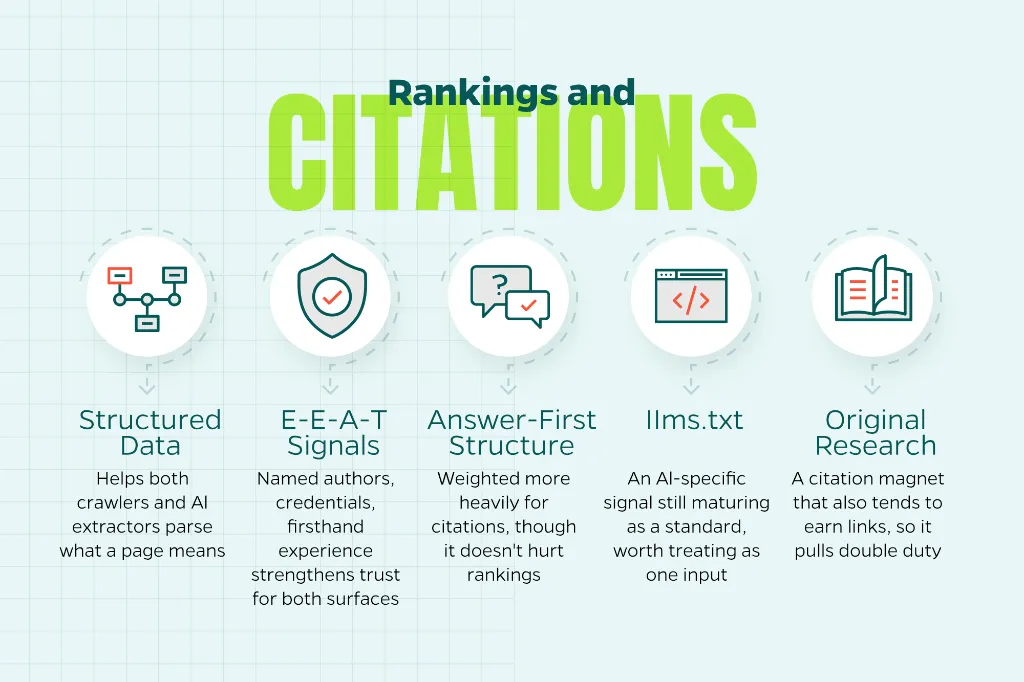
That citation layer includes a handful of specific tactics, each pulling different weight for each surface:
- Structured data and schema markup — helps both crawlers and AI extractors parse what a page means
- E-E-A-T signals (named authors, credentials, first-hand experience) — strengthens trust for both surfaces
- Answer-first passage structure — weighted more heavily for citations, though it doesn’t hurt rankings
- llms.txt — an AI-specific signal still maturing as a standard, worth treating as one input, not a guarantee
- Original research and proprietary data — a citation magnet that also tends to earn links, so it pulls double duty
Structured data clarifies meaning for every machine reader that touches your page. AI surfaces re-crawl and re-synthesize continuously, so stale pages tend to decay faster in citations than they do in rankings. Whichever surface sends the visit, the number that matters in terms of validated leads, not vanity mentions.
Where Should You Start?
Where you start depends on where you’re standing today:
- Weak organic foundation — start with traditional SEO. Retrieval is the floor, and you can’t skip it.
- Strong rankings, but absent from AI answers — you likely have a citation gap. Add the extraction layer described above to pages that already rank.
- Starting fresh — build both into the same content from day one rather than treating AI search as a separate project.
In Straight North’s survey of 101 marketers, 68% said their organization’s investment in traditional SEO increased over the past year, and 65% separately reported an increase in their combined SEO and AI-search investment.
“GEO introduces new metrics like AI visibility, mentions, citations, and share of voice, but those are ultimately leading indicators,” says David Duerr, Straight North CEO. The outcome that matters is the same one it’s always been: qualified leads, customers, and revenue.
“GEO introduces new metrics like AI visibility, mentions, citations, and share of voice, but those are ultimately leading indicators.”

AI SEO vs. Traditional SEO: FAQ
Is SEO still relevant now that AI answers questions?
Yes, 76% of pages cited in AI overviews already ranked in the top 10 for the underlying query, according to an Ahrefs study. AI surfaces are still built largely on top of traditional search infrastructure, so the fundamentals still carry weight.
Is SEO dead?
No. The data throughout this article shows AI systems retrieving from the same indexes traditional SEO has always targeted. What’s changed is what happens after retrieval, not whether retrieval still matters.
Can I get cited by AI without doing any SEO?
It’s possible on some engines, but unreliable as a strategy. There are plenty of citations from pages outside Google’s top 100, but that’s the exception, not a repeatable plan.
Does “AI SEO” mean using ChatGPT to do my SEO work?
No — that’s AI-assisted SEO, a different topic covered elsewhere. This article is about optimizing for AI engines, not optimizing with them.
Do I need to keep investing in SEO if my buyers use ChatGPT?
Yes. Even ChatGPT, the engine least tied to Google’s rankings, still rewards corroborated, retrievable, well-structured content. The investment split just shifts by situation, as covered above.
Need Help?
Want help building a program that earns citations without abandoning the rankings you’ve already built? Contact Straight North to talk through where your content stands today.