
AI brand monitoring is the recurring process of checking how tools such as ChatGPT, Google AI Overviews, Gemini, and Perplexity describe your company. It examines factual accuracy, tone, competitive positioning, and cited sources, not merely whether your name appears. Correcting misleading answers usually begins with the information those systems encounter across the web.
This guide explains how to:
- Audit the questions your buyers ask, including questions that never mention your brand.
- Interpret AI sentiment and identify the sources behind inaccurate claims.
- Prioritize practical corrections, third-party validation, and ongoing monitoring.
What AI Brand Monitoring Covers (and What It Doesn’t)
AI brand monitoring examines the substance of AI-generated descriptions. A brand may appear frequently but be presented as serving the wrong customers, offering discontinued products, or falling behind a competitor. Monitoring captures those problems so a team can investigate them.
Discipline | Question it answers | What to record |
AI visibility tracking | How often do we appear? | Mentions, citations, and share of voice |
AI brand monitoring | What does AI say about us? | Claims, accuracy, tone, comparisons, and sources |
Social listening | What are people posting about us? | Public conversations, comments, and trends |
Share of voice compares your presence with competitors across a defined set of prompts; it does not establish whether the answer is correct. For visibility metrics, see Straight North’s AI visibility guide.
Why Accuracy Matters More Than Mentions
A mention can influence a buying decision even when it generates no click. An AI answer might repeat an outdated service list, portray a resolved complaint as current, or recommend a competitor as the safer option without explaining why.
In Straight North’s September 2026 survey, 74 of 101 marketers (73%) said a customer or prospect had told them they used ChatGPT or another AI platform to discover or research their company in the previous 12 months.
“A brand can rank without being cited, a brand can be mentioned without being trusted as a source, a brand can influence the answer without getting obvious traffic” — Bob Hand, Straight North’s Senior SEO & GEO Strategist. The distinction is why monitoring should evaluate the message, not simply count appearances.
“A brand can rank without being cited, a brand can be mentioned without being trusted as a source, a brand can influence the answer without getting obvious traffic.”

How to Check What AI Says About Your Brand
Start with a repeatable audit rather than a single search for your company name.
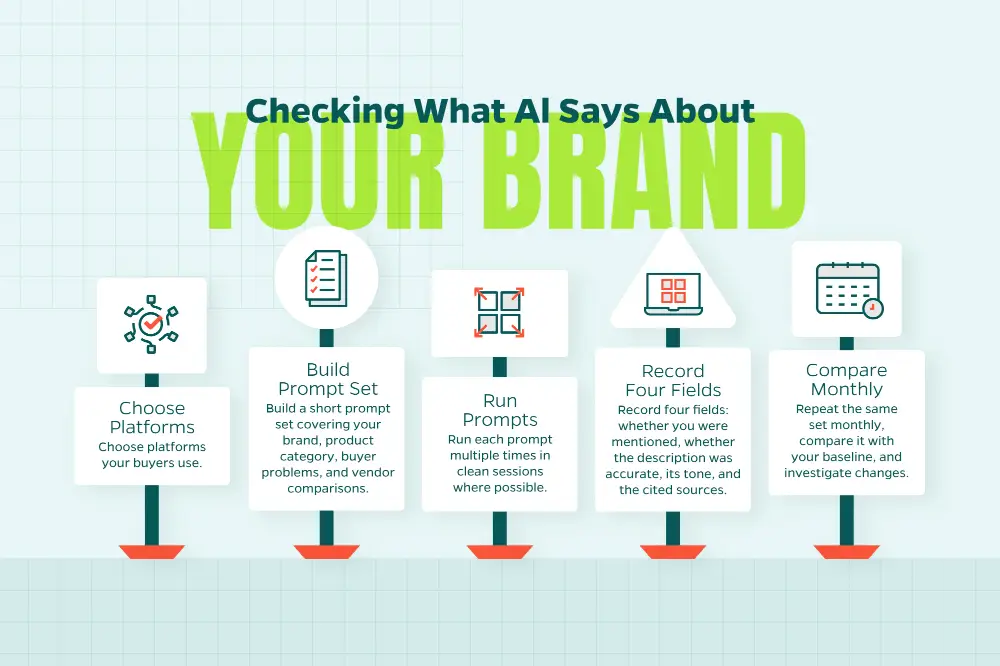
- Choose platforms your buyers use. In Straight North’s survey of 100 marketers, 57% prioritized ChatGPT, 42% Gemini, 34% Google AI Mode, and 33% Google AI Overviews; respondents could select multiple platforms.
- Build a short prompt set covering your brand, product category, buyer problems, and vendor comparisons.
- Run each prompt multiple times in clean sessions where possible. Note the platform, date, and any location or personalization settings.
- Save the full answer and record four fields: whether you were mentioned, whether the description was accurate, its tone, and the cited sources.
- Repeat the same set monthly, compare it with your baseline, and investigate changes rather than assuming one answer represents every user.
Audit the Prompts Your Ideal Customers Actually Ask
The most consequential prompts may never include your brand name. Buyers begin with a production problem, investigate solutions, compare vendors, and only then verify a shortlist. An audit limited to “What is [company]?” misses how AI frames the market before your company enters the conversation.
Build prompts around your ideal customer profile (ICP): industry, purchasing role, use case, service geography, and the problem the buyer wants solved. A manufacturer serving original equipment manufacturers (OEMs), for example, should test whether AI mistakenly describes it as a consumer retailer.
Buying stage | Example B2B manufacturing prompt | What to check |
Problem-aware | How can an OEM reduce precision-part sourcing delays? | Are relevant supplier types and requirements described? |
Solution research | Which contract manufacturers handle low-volume precision assemblies? | Does your company appear in the right category? |
Vendor comparison | Compare suppliers for ISO-certified precision assembly. | Are strengths, limitations, and competitors framed fairly? |
Brand validation | Does Acme Components serve OEMs or consumers? | Are customer type, capabilities, and credentials accurate? |
For each prompt, record not only whether the brand appears but also whom the answer says it serves. Flag incorrect industries, minimum order sizes, certifications, locations, or buyer roles. Then group errors by the stage at which they occur. A wrong customer profile at the solution-research stage can keep your company off a shortlist altogether.
In Straight North’s September 2026 survey, 46 of 100 marketers (46%) said they had a defined set of AI prompts they actively tracked, while 22% had a set they did not actively track.
How AI Sentiment Analysis Works (and Where It Falls Short)
AI sentiment analysis typically labels a brand mention positive, neutral, or negative, then combines those labels into a favorability measure. This can help surface a shift, but it is not an objective verdict on your reputation. Vendor scoring rules may be opaque, and a “neutral” answer can still contain a costly factual error.
An identical prompt can yield different wording, recommendations, and sources across runs. A score calculated from one response is therefore a sample, not a stable measurement of what all customers see. Differences across ChatGPT, Gemini, and Google’s AI features may also reflect differences in the information retrieved or emphasized.
“If 5 people asked ChatGPT the exact same question in the exact same manner, they’re likely to get different outputs,” says Aaron Wittersheim, Straight North COO. That variability makes repeated sampling and careful interpretation essential.
“If 5 people asked ChatGPT the exact same question in the exact same manner, they’re likely to get different outputs.”

When a dashboard flags negative sentiment, read the underlying answer before reacting. Ask:
- Which exact sentence is negative or misleading?
- Is it a verifiable claim, a dated complaint, or an opinion?
- Which pages are cited, and do they support the wording?
- Does the pattern recur across runs, prompts, and platforms?
Treat sentiment as an alert that directs human review. An answer describing a supplier as “expensive” may be fair for a commodity buyer but misleading for a purchaser prioritizing specialized quality controls. The appropriate response depends on the claim, the buyer, and the evidence.
Choosing an AI Brand Monitoring Tool
Choose a tool for the questions it can help you answer, not the number of prompts it advertises. Straight North’s September 2026 survey found that 80 of 100 marketers (80%) used a paid, free, or internally built tool to monitor AI-search visibility.
- Coverage of the AI platforms your customers use
- Custom prompts mapped to buying stages and ICPs
- Repeat runs to expose answer variability
- Reporting on cited pages and domains
- Exports of full answer text, not just aggregate scores
“The same information that we get from asking a very small collection of prompts is just as meaningful to us as asking every single prompt” — Tom Lustina, Straight North’s Director of SEO & GEO. A focused, representative set can be more useful than indiscriminate volume.
“The same information that we get from asking a very small collection of prompts is just as meaningful to us as asking every single prompt.”

For product options, see https://www.straightnorth.com/blog/top-11-ai-visibility-and-geo-tools/.
Trace Every Bad Answer Back to Its Source
When AI gets your brand wrong, investigate the evidence behind the answer before changing your homepage. Open the citations shown with the response, save screenshots or URLs, and check whether each page contains the claim. Not every answer exposes its sources, and a citation is not proof that a particular sentence came from that page.
What AI got wrong | Possible source | First fix |
Outdated services | Old directory or partner profile | Update the listing and verify the new copy |
Past complaint treated as current | Review site or forum discussion | Address the issue and add a dated, factual response |
Competitor called the better choice | Comparison article or industry roundup | Review criteria and offer verifiable updated evidence |
Wrong customer type | Third-party company profile or stale site copy | Clarify target industries in influential profiles |
Wrong location or company details | Business directory or legacy page | Correct consistent names, addresses, and locations |
Compare the same prompts against competitors described more favorably. Which industry publications, directories, review sites, or partner pages appear for them but not for you? In Straight North’s survey, 68 of 100 marketers (68%) said they compared AI-answer visibility with competitors regularly or occasionally.
“The goal is not to make every old page appear brand new, but to keep influential information accurate and trustworthy,” says Adam Rosenbaum, Straight North SEO & GEO Manager. Prioritize material that still shapes purchasing decisions and AI descriptions.
“The goal is not to make every old page appear brand new, but to keep influential information accurate and trustworthy.”

Keep a correction log linking each inaccurate sentence to the prompt, platform, source URL, responsible owner, requested edit, and next test date. If no citation appears, search for the distinctive wording and inspect likely public sources, while recognizing that the model may have produced the claim without a directly traceable page. Learn more about citation differences in our article on AI search references.
Fix It With Third-Party Validation, Not Self-Promotion
Correcting your website matters, but it may not resolve a misleading AI description if influential external pages still repeat the old story. Brand questions can draw on third-party coverage, directories, reviews, and discussions. Consistent, independent evidence gives buyers and AI systems more reliable context.
“Traditional search is more reliant on a brand for brand queries, brand questions,” says Tom Lustina, Straight North’s Director of SEO & GEO. He adds: “AI platforms are more likely to consider the rest of the web when it’s answering that question. It’s more third-party validation.”
“Traditional search is more reliant on a brand for brand queries, brand questions. AI platforms are more likely to consider the rest of the web when it’s answering that question. It’s more third-party validation.”
In Straight North’s September 2026 survey, 73 of 101 marketers (72%) said their organizations had increased efforts to earn third-party mentions or coverage because of AI search.
Among 101 respondents asked which external sources they were emphasizing because of AI search, the most frequently selected were news and media websites (42%), industry publications (36%), social media (35%), and customer review platforms (33%).
Other selections were Reddit or online communities (28%), comparison articles (27%), industry associations (23%), business directories (19%), partner or vendor sites (18%), and academic or research sites (13%); respondents could choose more than one source.
Use the flagged answers to prioritize repairs in this order:
- Correct facts at the source. Update inaccurate directory entries, partner pages, and your own stale pages; request corrections from publishers when appropriate.
- Earn relevant coverage. Offer original data, expert commentary, and proof of capabilities to publications your buyers already trust.
- Improve review evidence. Resolve recurring customer problems, respond professionally, and invite authentic, detailed reviews without scripting sentiment.
- Participate where customers ask questions. Contribute useful, transparent answers in appropriate industry communities rather than planting promotional claims.
“The best PR for E-E-A-T is not generic awareness,” says Bob Hand, Straight North’s Senior SEO & GEO Strategist. He continues: “It’s coverage that reinforces what the brand is actually qualified to talk about.” Relevance and substantiation matter more than mention volume.
“The best PR for E-E-A-T is not generic awareness. It’s coverage that reinforces what the brand is actually qualified to talk about.”
These actions cannot guarantee a specific AI answer. They improve the underlying public record and create material that future searches and model updates may encounter. For a fuller approach, see our article on how external validation influences AI visibility.
Set a Monitoring Cadence and an Owner
Run a consistent prompt set at least monthly, with additional checks after product launches, rebrands, major publicity, or sudden review activity. Assign one accountable owner who can coordinate SEO, PR, content, and web updates. In Straight North’s September 2026 survey of 100 marketers, digital marketing was the most frequently named individual owner of AI search at just 14%, illustrating how dispersed responsibility can be.
FAQ
What is an AI brand monitoring service?
It is a tool or agency process that repeatedly tests brand, category, and comparison prompts, then reports mentions, accuracy, sentiment, competitive framing, and cited sources.
What are the best AI brand monitoring tools?
The best fit depends on platform coverage, custom prompts, repeated sampling, citation reporting, and access to answer text. Compare those capabilities before buying.
Can you get ChatGPT or Google to correct wrong information about your company?
There is no universal edit button for AI answers. Correct public sources and your own pages, then retest. Google also provides feedback options for some AI Overviews, though interface details can change.
Why does a Google AI Overview show negative reviews about my business?
It may summarize critical reviews or forum discussions that appear relevant to the query. Address the underlying issue, respond factually where appropriate, and encourage authentic recent reviews; do not assume every negative summary reflects the current customer experience.
Need Help?
Want to understand and improve how AI describes your company? Contact Straight North about AI search (GEO) services.