



Let’s rewind to a time before Google used intent, AI, or context. You’re shopping for new running shoes, so you type “best running shoes” into Google, and you’re hit with pages of blue links. No summaries. No hints. Just endless results.
You click through article after article, comparing lists and reviews, trying to figure out which one helps. It’s all on you to sift, sort, and decide.
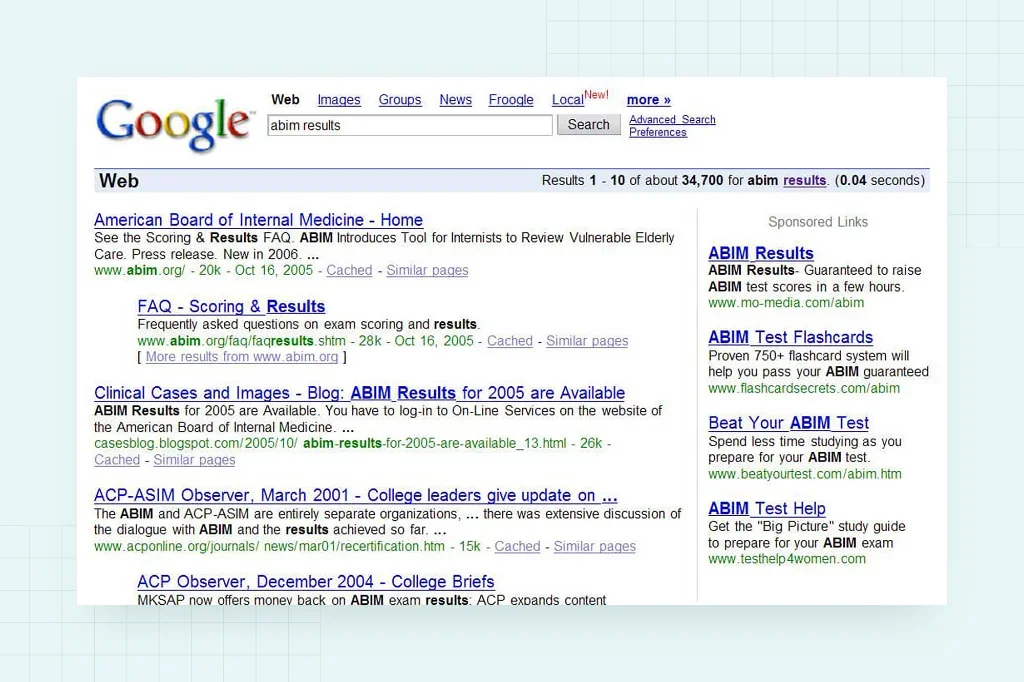
That was search without context. You entered a keyword, and Google returned pages stuffed with that keyword, without featured snippets, local results, related searches, or an AI overview. Just pages of links waiting for you to dig through.
AI and Search SEO Expert Tom Lustina took me through the evolution of search starting with no context, contextual understanding within the query, and contextual understanding beyond the query. Continue on this journey to learn how each shift changed user behavior and what marketers need to do to stay effective in building helpful content ecosystem. Ultimately, the core of SEO is remaining genuinely useful to your audience.
Search With No Context
Early on, search engines only understood exact keywords. Users typed simple words based on what they were looking for and the search engines returned pages where those keywords appeared the most.

Searchers understood that their best chance at getting meaningful results back to them was being as simple as possible and just using a very simple keyword or a simple concept. And part of the bargain as well was, okay, search engines are going to give back what the pages that they know are about that keyword. And then the user would have to go through all results to come up with the answer. It wasn’t, hey, here’s my exact question, here’s my exact answer. It was, alright, here’s pages that are about what you’re interested in, now you go to all of those. So back then, it was common for results on page 1, 2, and 3 to get clicks, because it was up to the user to really dig deep and find the answer based on just the starting point of a keyword.
How Searchers Behaved
People kept the queries short to maximize their chance of matching results. They also accepted that they’d be doing the leg work to click, read, refine their search, and then repeat it. Back then a lot more was required of the user and search was the starting point. Now, search is the finishing point.
Marketers Optimized for Search
When Google started out, it would discern that the page with the most links pointing back at it is the best answer, or more authoritative. To get more visibility and ranking with Google, marketers:
- Focused heavily on keywords and keyword stuffing
- Created a page based on these keywords and pointed as many links back to that page as possible
Everything started to shift when Google started reading queries differently.
Search With Contextual Understanding Within the Query
Search transitioned from matching keywords to interpreting meaning. Google started using AI and algorithms to focus more on the exact context within the search query. Rather than picking up simple keywords, Google started treating every query as a question and searched the web for the best answer.
Google increasingly focused on understanding user questions and identifying genuinely helpful content while filtering out link spam. In the early days of search, sites could rank well simply by having the most links, even if those links came from low-value sources. As Google becomes better at understanding context and intent, it relies less on links as a primary ranking factor. Links still matter, but more as a secondary filter. Today, the best answer, not the site with the most links, is what ultimately ranks highest.
How Searchers Responded
As Google adapted, so too did searchers. They became more confident in using natural language and asking longer, more specific questions to get the answers they needed. Increasingly, searchers were using voice search, which made for more conversational queries.
“Users are searching in their own language, and they’re asking very specific questions with the confidence that Google is going to return with an exact answer.”
As the answers became more precise, it took the onus off the searcher. They could ask a specific question and get a direct answer in return.
How Marketers Optimized for It
To keep up with the changes, marketers shifted from worrying about specific keywords to addressing themes and audience questions. They started focusing more on answering the main questions an audience asks around a question.
Instead of totally relying on links, we also pushed back on that. We said, okay, links are still important, we’re still going to provide links, but most importantly, we are going to answer the questions that your audience is asking. So, instead of looking at search volume in terms of exact keywords with high volume, we looked at it in terms of themes. And said, okay, this is your most important theme, we’re gonna answer all the questions that your audience is asking about that theme. And that’s not only going to help us rank for that keyword if somebody still searches the keyword, but we know search is moving towards exact questions and exact answers.
In this way, content becomes more user centric. It doesn’t just rank for a term, but it also must answer the question well.
As Google grew more sophisticated, this theme-driven approach laid the groundwork for the next major shift.
Contextual Understanding Beyond the Search Query
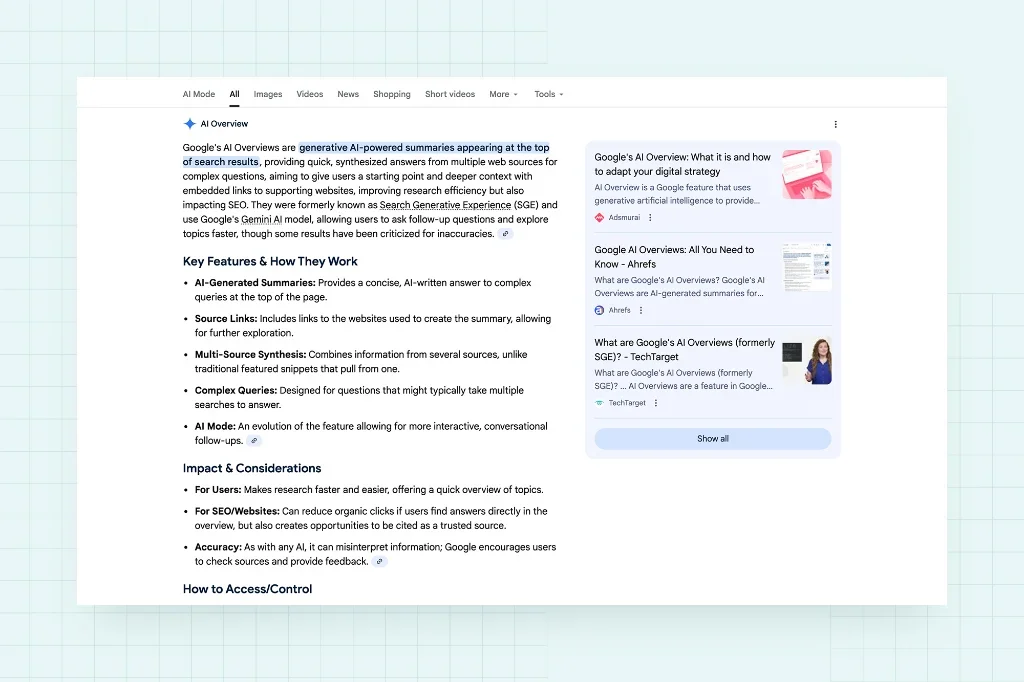
Then came the next leap: AI began thinking beyond the query. Instead of analyzing the question alone, search systems now consider dozens of related questions behind the scenes. This process is known as query fan-out.
It synthesizes a new deeper answer that may not exist verbatim online anywhere else. The result you now receive looks more like AI overviews or long paragraphs, with citations to multiple sources rather than a single quoted snippet.

The biggest jump now is contextual understanding beyond the search query. And what we mean by that, and the term that gets thrown around now is query fan out, meaning the AI platform or Google is taking your exact question, and then thinking about all of the questions that relate to that answer, and conducting all of those searches on your behalf, and then coming back with a synthesized answer. So, instead of context within the question providing a quoted answer that’s found on the web. It’s thinking beyond that, thinking of all of the questions that are relevant, asking those questions on your behalf, and then coming back with a synthesized answer. It’s a brand new answer that doesn’t exist exactly on the web, based on all of those searches.
How Searchers Responded
Because AI now does the heavy lifting, users feel confident giving more context: goals, constraints, background, and more. They expect systems like Google or ChatGPT to interpret that context and return a comprehensive, synthesized answer instead of a list of links to investigate.
When you enter a query, the system performs many searches in the background (query fan-out) and then returns a synthesized answer rather than quoting text directly from individual pages. Instead of pulling exact excerpts, it blends information from multiple sources and provides citations to the main sites it used. This reflects a shift from listing quoted text to generating an aggregated, citation-based response.
How Marketers Will Optimize For It
This evolution requires marketers to think more holistically. Instead of producing isolated answers, they need to address the entire journey:
- What questions lead users to the main topic?
- What follow-up questions will they have?
- What supporting information helps deepen understanding?

But today, links are about what they always should have been about. Meaning, it’s evidence that your audience likes you, because Google ChatGPT ultimately wants to respond with data that’s meaningful to the audience. And certainly, within search, when you’re ultimately going to go to a website, they want to send you to a site that you like, that you want to go to. So, links today, instead of being, ‘hey, I have the most links, show my site’, it’s what it always should have been. It’s just… it’s like, it is the vote that people always talked about. And more important than having the most links, Google is smart enough to know where your audience lives online, where they live and breathe, you know where are they going to spend the time outside of Google? So today, link building is more about engaging with your audience where they live and breathe. And Google can see that, and that’s evidence that you should be a part of their results. You should be figured into answers, because you are clearly a site that’s engaging with this audience, so I’m going to cite you when I answer questions for this audience.
With links evolving, a marketer can find success by being present wherever their audience lives and breathes online. Link building becomes audience engagement and participation, not buying and placing links.
Why Search Is Still the Same Game
Despite how much technology has advanced, the core of SEO remains surprisingly consistent:
- A technically sound, crawlable site
- Content that answers audience questions
- A helpful, valuable user experience for an exact audience
“We were always, as marketers, very focused on what draws the biggest impact within Google, rather than what’s best for the audience. But today, you need a site that’s crawlable, and you need to answer questions, and you have to deliver this content experience that’s valuable to your audience.”
The tech has advanced, but the right strategy was always to be genuinely helpful, not to chase loopholes.
Main Factors for Optimizing in the Contextual, AI Era
Successful SEO still relies on the same core foundations: making sure your site is technically sound and crawlable, clearly answering your audience’s questions, and showing up helpfully wherever they spend time online. These timeless principles ensure search engines can access your content and users can trust it.
What’s changed is the need to align with query fan-out behavior. Instead of focusing only on high-volume keywords, you now must address the full spectrum of user intent:
- The initial question
- The questions leading up to it and follow-up questions
- The format users prefer (text, video, interactive, etc.)
The main factors for optimizing, in addition to what search always should have been, just be crawlable, answer all of your, all the questions that your audience is asking, and engage your audience. Be helpful to your audience. That’s always what it should have been. So, in addition to all of that, the biggest change with contextual understanding is embracing query fan out. So, not just answering high-volume questions, it’s answering all of those questions that are associated with the question, and going deeper with it. So, it’s answer that exact question, but it’s also, answer the last question that that’s going to lead to, and then answer the next question that’s going to be a part of their next session as well. And everything in between there.
Link building has also evolved: Today, links are earned by meaningfully engaging real communities, serving as authentic proof that your brand is relevant and trusted in its niche.
Key Takeaways
- Early search matched keywords only; modern search understands full questions and intent.
- Google’s evolution moved from keyword matching → contextual understanding → query fan-out with synthesized answers.
- Links now matter less for volume and more as signals of real audience engagement.
- Marketers have shifted from keyword stuffing to creating theme-based, comprehensive content that supports the full user journey.
- Modern optimization means providing deeper, multi-format answers, understanding user context, and showing up where your audience engages online.