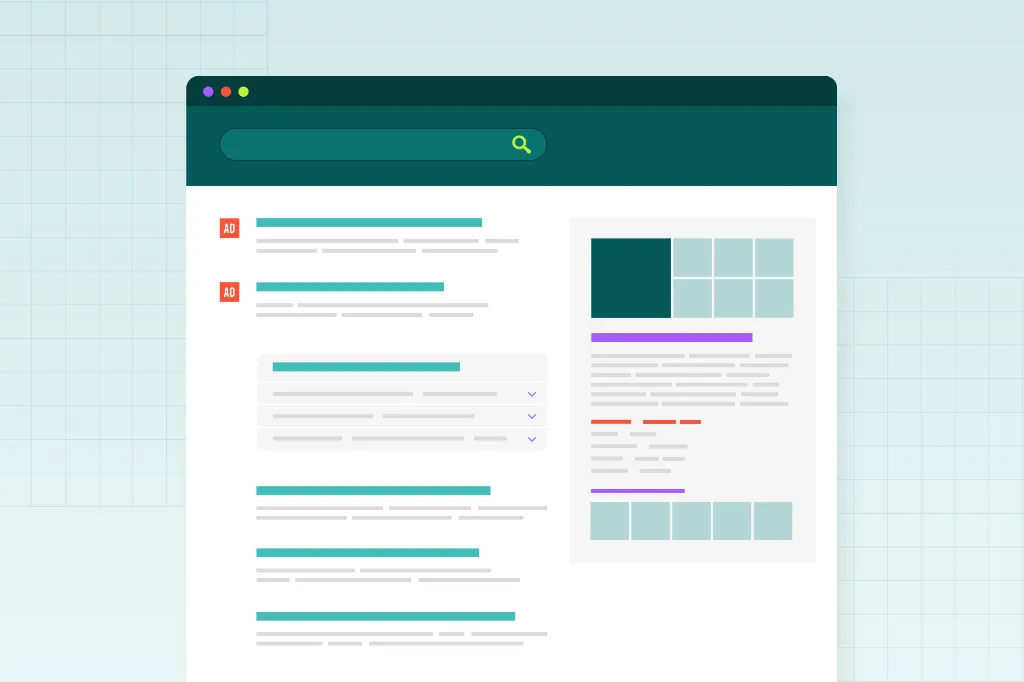


Answer Engine Optimization (AEO) is the practice of structuring content so AI-powered answer engines can find, understand, select, and cite it when they generate direct answers for users.
AEO marketing matters because search behavior is moving into an “answer economy,” where people increasingly ask ChatGPT, Perplexity, Google AI Overviews, Gemini, Copilot, and other tools to summarize options before they visit a website. The goal is not to abandon SEO. It is to make strong SEO content easier for answer engines to retrieve and use.
AEO and Generative Engine Optimization (GEO) overlap heavily. AEO focuses most directly on earning visibility inside answers, while GEO is often used more broadly for visibility across generative AI systems. Different practitioners draw the boundary differently, but both disciplines rely on clear content, strong authority signals, and sound technical SEO.
What are Answer Engines?
Answer engines are platforms that respond to a question with a synthesized answer instead of only presenting a list of links. Today that includes ChatGPT and ChatGPT Search, Perplexity, Google AI Overviews and AI Mode, Microsoft Copilot, Gemini, and voice assistants such as Siri and Alexa.
“AI search is collapsing what used to be a much longer research process,” Frank Fornaris, Straight North President, explains. “Instead of visiting five websites, reading reviews and comparing companies themselves, customers can ask AI to do much of that work for them, which means businesses increasingly need to influence the answer before a customer ever reaches their website.” That shift changes where brands compete for attention. The answer itself can become part of the buyer’s research process, even when no click happens immediately.
“AI search is collapsing what used to be a much longer research process. Instead of visiting five websites, reading reviews and comparing companies themselves, customers can ask AI to do much of that work for them, which means businesses increasingly need to influence the answer before a customer ever reaches their website.”

AEO did not begin with generative AI. Featured snippets, voice search, and voice assistants were earlier forms of answer-oriented search because they rewarded concise, well-structured responses to specific questions. Today’s AEO extends those same habits into AI-generated answers that can synthesize multiple sources at once.
How Does Answer Engine Optimization Work?
Answer engines generally retrieve candidate sources, evaluate which passages appear useful and trustworthy, and then synthesize an answer from that material. The exact systems differ by platform, but the practical requirement is consistent: content needs to be accessible, clear, relevant, and easy to extract at the passage level.
An extractable passage is a self-contained block of content that answers one question without forcing the system to reconstruct meaning from several unrelated paragraphs. Clear headings, direct opening sentences, definitions, examples, statistics, comparisons, and step-by-step explanations all make content easier to interpret.
Authority still matters. Named authors, first-hand expertise, citations to credible sources, consistent brand information, and broader topical coverage can help an answer engine distinguish between multiple pages that all appear to answer the same question. AEO is therefore not just a formatting exercise; it depends on the same trust and quality foundations that support good SEO.
AEO vs. SEO: What is the Difference?
SEO and AEO optimize for different visibility outcomes, but they share the same foundation. SEO is primarily concerned with earning rankings and clicks in search results. AEO is concerned with earning citations, mentions, and inclusion inside generated answers.
Area | Traditional SEO | AEO |
Primary goal | Rank pages and earn clicks | Earn citations, mentions, and answer visibility |
Unit of optimization | The page | The passage or answer block |
Common metrics | Rankings, CTR, organic traffic | Citation share, mentions, AI visibility, assisted leads |
Core skills | Technical SEO, content, authority | The same foundation, plus extractability and answer-focused structure |
AEO will not replace SEO because answer engines still depend on discoverable, crawlable, authoritative web content. A practical strategy treats AEO as an extension of SEO: keep the technical and authority fundamentals, then make important answers easier for machines and people to identify.
In short, SEO earns search visibility, AEO earns answer visibility, and GEO covers the broader effort to improve visibility across generative AI experiences.
Why AEO Matters for Businesses Now
AEO matters because prospects are already using AI systems as research tools, including for company discovery and evaluation. For B2B companies, manufacturers, and service businesses, appearing in those answers can influence shortlists before a prospect reaches a traditional search-results page.
In Straight North’s September 2026 survey of 101 respondents, 74 of 101 (73.27%) said a customer or prospect had told someone at their organization that they used ChatGPT or another AI platform to discover or research the company at least once in the previous 12 months.
That does not mean AI traffic will immediately rival traditional organic search in volume. The stronger business case is that answer visibility can reach high-intent prospects earlier in a research process and influence later actions that may show up as branded search, direct traffic, or sales conversations rather than an easily labeled AI referral.
How to Optimize for Answer Engines: 7 Core AEO Tactics
“AI answers need building blocks,” says Bob Hand, Straight North’s Senior SEO and GEO Strategist. “That means definitions, examples, statistics, comparisons, warnings, steps, recommendations.” AEO works best when useful information is broken into clear components that can stand on their own and still fit naturally into a readable article.
“AI answers need building blocks. That means definitions, examples, statistics, comparisons, warnings, steps, recommendations.”

- Lead with the answer. State the main point at the beginning of a section or paragraph, then explain it. This answer-first structure helps readers scan and gives AI systems a clear passage to retrieve.
- Use question-based headings. Build sections around the questions customers ask in search, sales calls, support conversations, and tools such as People Also Ask. FAQ blocks can also provide concise answers to long-tail questions.
- Use structured data where it fits. Schema markup can clarify page type and entities. Article, Organization, Product, and other relevant schema types should match visible page content; adding multiple compatible types is sometimes called “schema stacking.”
- Build entity clarity and topical authority. Use consistent brand names, services, authorship, and company details across your site and reputable third-party profiles. Cover related questions across a topic cluster so the brand demonstrates depth rather than one-off keyword coverage.
- Keep important content current. Review high-value pages, refresh outdated facts, and make update dates visible when appropriate. Freshness will not guarantee citations, but stale information creates an avoidable reason for an answer engine to prefer another source.
- Maintain technical readiness. Make sure important pages are crawlable, indexable, fast, and easy to parse. llms.txt is an emerging convention for communicating preferred AI-access information, but adoption and practical impact remain unsettled, so it should be treated as supplemental rather than foundational.
- Earn off-page corroboration. Reviews, industry mentions, citations, directory profiles, community discussions, and other third-party references can reinforce what your own site says. You cannot control those sources, but you can earn accurate mentions by publishing useful expertise and building a credible brand presence.
In Straight North’s September 2026 survey, 40 of 101 respondents (39.60%) said their organization was prioritizing subject matter expert content specifically to improve its chances of being cited or referenced in AI-generated answers.
How to Measure AEO Success
AEO measurement should track answer visibility first, then connect that visibility to business outcomes wherever possible. Useful leading indicators include brand mentions, website citations, share of voice across priority prompts, AI-referred traffic, and changes in how frequently a brand appears for important questions.
In Straight North’s September 2026 survey, 33 of 101 respondents (32.67%) said their organization could currently connect its AI-search visibility efforts to website citations.
“GEO introduces new metrics like AI visibility, mentions, citations, and share of voice, but those are ultimately leading indicators,” says David Duerr, CEO of Straight North. “The true measure of a successful GEO strategy is the same as any marketing investment: its impact on qualified leads, customers, revenue, and growth.” The same principle applies to AEO: citations matter most when they support qualified demand, not when they become a vanity metric.
“GEO introduces new metrics like AI visibility, mentions, citations, and share of voice, but those are ultimately leading indicators. The true measure of a successful GEO strategy is the same as any marketing investment: its impact on qualified leads, customers, revenue, and growth.”

matter most when they support qualified demand, not when they become a vanity metric.
Measurement is still imperfect. A prospect may see a brand in an AI answer, remember the name, and return later through branded search or direct traffic. That influence is real even when analytics cannot assign the journey neatly to an AI platform.
What AEO Cannot Guarantee
“Formatting makes strong content more usable, but it doesn’t turn generic content into authoritative content,” Bob Hand, Straight North’s Senior SEO and GEO Strategist, cautions. Clear structure can improve extractability, but it cannot substitute for original expertise, useful evidence, accurate information, or a trustworthy brand presence.
“Formatting makes strong content more usable, but it doesn’t turn generic content into authoritative content.”
No one can guarantee a permanent placement in ChatGPT, AI Overviews, Perplexity, or another answer engine. Generated answers can vary by prompt wording, user context, available sources, platform updates, and retrieval behavior. AEO improves the conditions for visibility; it does not create a fixed ranking position.
Citation volatility is normal. A source that appears this week may disappear later as engines refresh their indexes, change retrieval logic, or find different evidence. For that reason, AEO should be measured over a set of priority questions and over time rather than judged from a single prompt on a single day.
Simple Steps to Building an AEO Strategy
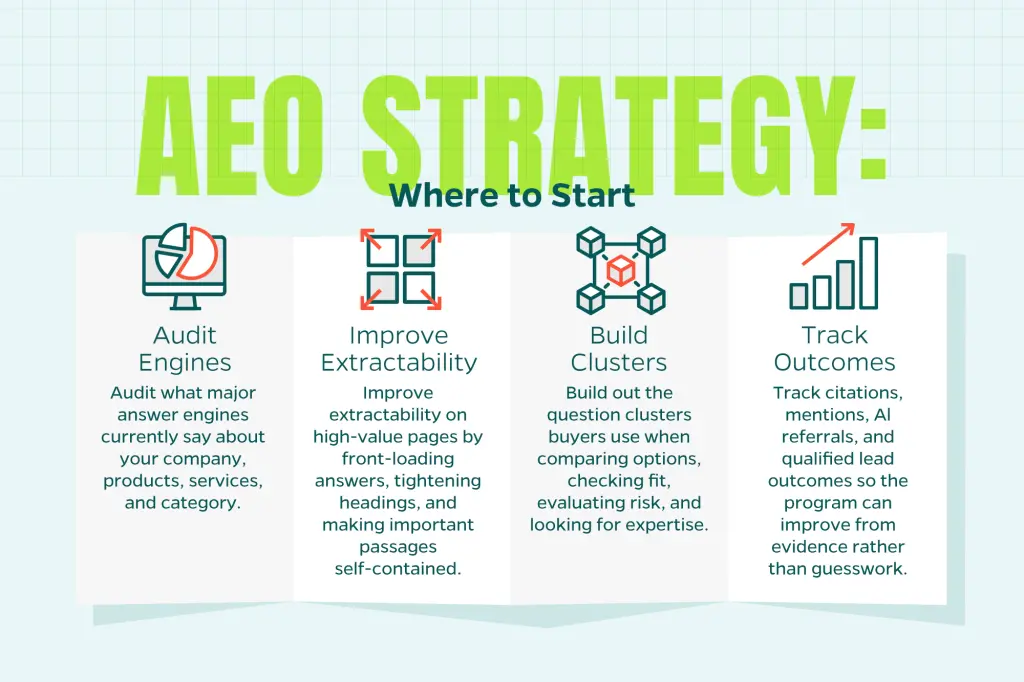
A sensible AEO program starts with the questions that matter most to buyers, not with a separate pile of “AI content.” A focused first 90 days can follow four steps:
- Audit what major answer engines currently say about your company, products, services, and category.
- Improve extractability on high-value pages by front-loading answers, tightening headings, and making important passages self-contained.
- Build out the question clusters buyers use when comparing options, checking fit, evaluating risk, and looking for expertise.
- Track citations, mentions, AI referrals, and qualified lead outcomes so the program can improve from evidence rather than guesswork.
Strong in-house SEO and content teams can execute many AEO basics themselves. Outside support becomes more useful when the work involves technical implementation, structured measurement across multiple platforms, content strategy at scale, digital PR, or integration with lead tracking and broader SEO programs.
For example, an industrial equipment manufacturer may not need dozens of generic AI-focused articles. It may get more value from a clear comparison page that answers the exact questions buyers ask about retrofit options, specifications, compatibility, installation risk, and vendor selection.
Answer Engine Optimization FAQ
What does AEO stand for in marketing? AEO stands for Answer Engine Optimization, the practice of improving content and brand signals so answer engines can retrieve, understand, and cite them in generated responses.
Is answer engine optimization the same as Authorized Economic Operator? No. Authorized Economic Operator is a customs and supply-chain designation; in digital marketing, AEO means Answer Engine Optimization.
What is the difference between AEO and GEO? AEO focuses on visibility inside direct answers, while GEO is often used more broadly for visibility across generative AI experiences. The two overlap significantly, and both build on SEO fundamentals.
How long does AEO take to show results? There is no fixed timeline because answer engines refresh and retrieve sources on different schedules. Early citation changes may appear relatively quickly, but durable visibility depends on ongoing content quality, authority, technical health, and topic coverage.
Do backlinks still matter for AEO? Yes. Backlinks can still contribute to authority and discovery, but answer visibility also depends on content usefulness, entity clarity, expert signals, third-party mentions, and the strength of the specific passage being retrieved.
AEO is an Extension of Strong Search Marketing
Answer Engine Optimization is best understood as a new visibility layer built on proven search fundamentals. Brands still need crawlable websites, useful content, authority, and consistent information. AEO adds a sharper focus on direct answers, passage-level clarity, and measuring whether AI systems are citing and mentioning the brand when buyers ask important questions.
Need Help?
If you want help building AEO into your SEO and content strategy, contact Straight North to discuss the next steps.