

A growing number of B2B buying journeys now begin with a question to an AI platform instead of a traditional search. A procurement manager might ask ChatGPT or Perplexity to recommend qualified contract manufacturers, while a marketing leader might ask for agencies that specialize in a particular service. If your brand is absent from the answer, you may never make the shortlist.
“Our prospects and their leadership team are already adopting AI and they’ve embraced the future is now, so they’re coming to Straight North seeking a playbook: how do we get cited, how do we structure content, how do we measure winning.” says Matt Lane, Vice President of Sales at Straight North. That playbook is becoming a practical extension of SEO, not a separate experiment.
“Our prospects and their leadership team are already adopting AI and they’ve embraced the future is now, so they’re coming to Straight North seeking a playbook: how do we get cited, how do we structure content, how do we measure winning.”

In this guide, we will be talking about “ChatGPT SEO.” This means improving the odds that your brand is cited, mentioned, or recommended inside AI-generated answers. It does not mean using ChatGPT to perform ordinary SEO tasks. Getting cited in ChatGPT is also different from ranking in Google: there is no fixed list of ten blue links. The goal is to become a source the system can retrieve, understand, trust, and use in an answer.
This topic is highly relevant. Straight North’s September 2026 survey found that 57% of respondents said their organizations are currently prioritizing ChatGPT among AI-search platforms.
The practical path to getting your brand cited by ChatGPT has four parts: make your site retrievable, write passages that are easy to quote, build credible off-site corroboration, and publish information worth citing. Then measure whether those efforts are producing citations, mentions, recommendations, traffic, and business results.
How ChatGPT Chooses Which Brands and Sources to Cite
ChatGPT can answer from model knowledge, live web retrieval, or a combination of the two. That distinction matters because live-search visibility can change as pages are crawled and retrieved, while model knowledge changes on a slower schedule that publishers do not control.
For live web results, OpenAI says websites should allow OAI-SearchBot if they want their content to be included in summaries and snippets in ChatGPT search. GPTBot is different. It is used for crawling content that may be used to improve OpenAI’s foundation models. In other words, OAI-SearchBot is the important crawler for search visibility, while GPTBot relates to training.
Bing visibility is still worth checking as part of a broad search strategy, but it should not be treated as the only gate to ChatGPT citations. OpenAI currently states that ChatGPT search can use external search providers and its own search crawler; it does not describe Bing as the exclusive source of live results.
Generative engine optimization, or GEO, is the practice of improving content and brand presence so AI systems can retrieve, cite, and recommend it. The underlying logic overlaps heavily with SEO, but citation selection can favor a page that provides clearer evidence even when another page ranks higher in traditional search.
Step 1: Make Your Brand Retrievable
Retrievability is the pass/fail requirement for AI visibility. A useful page cannot be cited in a live answer if the system cannot access or parse it.
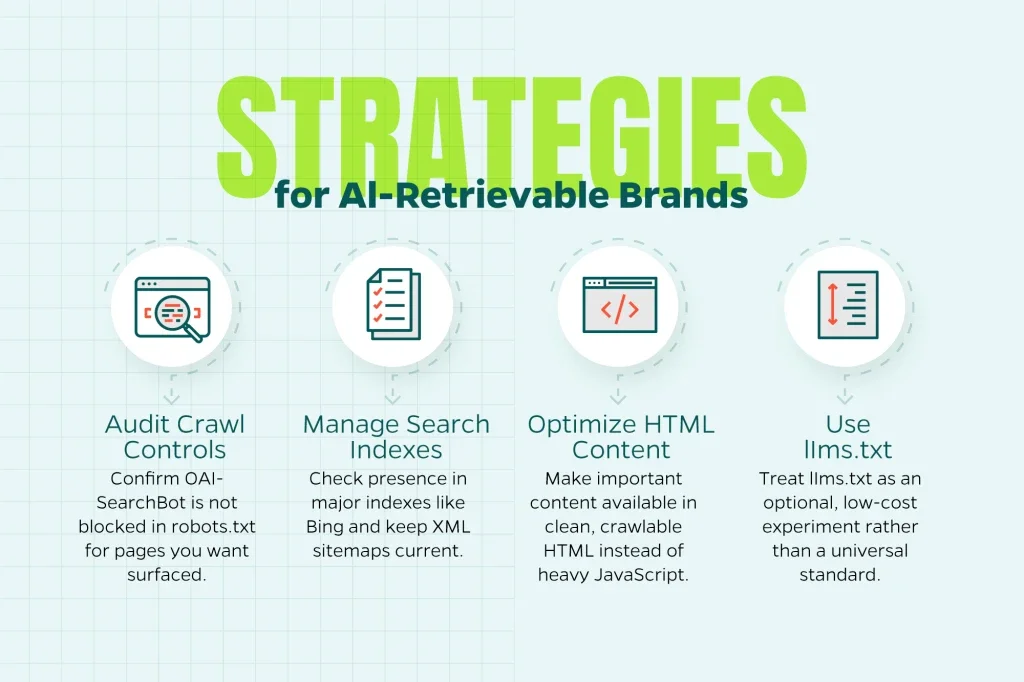
- Audit robots.txt and other crawl controls. If ChatGPT search visibility matters, confirm that OAI-SearchBot is not blocked on the pages you want surfaced.
- Check your presence in major search indexes, including Bing, and keep XML sitemaps current. IndexNow can also help participating search engines discover updates faster.
- Make important content available in clean, crawlable HTML. Sites that hide key information behind heavy client-side JavaScript can make extraction harder for crawlers and other machine readers.
- Use llms.txt as an optional, low-cost experiment, not a shortcut. It is an emerging convention rather than a universal ranking or citation standard.
The technical goal is simple: make sure a machine can reach the page, identify its main content, and understand what entity or topic it describes without depending on a fragile rendering path.
Step 2: Write Content AI Wants to Quote
Citation-friendly writing leads with the answer and then explains it. A strong section typically starts with a clear statement that can stand on its own, followed by evidence, examples, qualifications, or practical details.
“If a page only repeats what every other site says, there’s no strong reason to cite it,” says Bob Hand, Senior SEO & GEO Strategist at Straight North. AI systems have many possible sources for generic information, so distinctive evidence and clear passages give a page a better reason to be selected.
“If a page only repeats what every other site says, there’s no strong reason to cite it.”

Each section should be understandable on its own because AI systems often retrieve passages rather than entire pages. Question-shaped headings, direct opening sentences, precise entity names, and concrete facts all make a passage easier to use outside the context of the full article.
Compare these two styles:
- Weak: “Businesses today may want to consider several different approaches that could potentially improve visibility in emerging AI experiences.”
- Stronger: “Brands improve AI visibility by making their content retrievable, specific, well-supported, and corroborated by trusted third-party sources.”
Structured data can also reduce ambiguity. Organization, Article, Product, Service, and other appropriate schema types can clarify what a page represents, although schema alone cannot force an AI platform to cite the page.
Step 3: Build the Off-Site Signals AI Trusts
A large share of AI visibility is shaped by third-party websites. When buyers ask for “best,” “top,” “recommended,” or “alternatives” lists, AI platforms can draw from trade publications, comparison pages, directories, reviews, community discussions, and other third-party sources. While you do not control these sites, you can contribute to them to help your brand get noticed.
This is why digital PR and brand mentions are relevant to GEO even when a mention does not include a backlink. Independent references help establish that other sources recognize the same company, expertise, products, services, or claims that appear on your own site.
For B2B brands, useful third-party surfaces can include industry associations, trade publications, niche directories, conference sites, Clutch or G2-style review platforms, and credible “best of” roundups. Reddit and other communities may also influence AI answers, but authentic participation matters; manufactured praise or astroturfing can damage trust with both readers and platforms.
E-E-A-T is useful as a quality framework. Named experts, relevant credentials, strong author pages, consistent company information, real reviews, and independent coverage make it easier for both people and machines to connect claims with a credible source. Wikipedia can reinforce entity understanding for organizations that legitimately meet its notability standards, but it should never be treated as a marketing placement.
Step 4: Publish Research Worth Citing
Original research gives AI systems something that cannot be found on every competing page. Surveys, benchmarks, internal trend data, pricing studies, failure analyses, and other proprietary findings create quotable facts and give third parties a reason to reference the original source.
“Editors love publishing and linking to data that can’t be found elsewhere.” says Adam Rosenbaum, SEO & GEO Manager at Straight North. The same principle applies to AI citations. Unique evidence creates a natural reason to trace a claim back to the publisher that produced it.
“Editors love publishing and linking to data that can’t be found elsewhere.”

The research paper that introduced the term “generative engine optimization” found that GEO methods could increase source visibility in generative-engine responses by up to 40% in its experimental settings, with tactics involving citations, statistics, and quotations among the tested approaches.
Straight North’s September 2026 survey found that 44 of 101 respondents, or 43.56%, said their organizations are prioritizing original research or data specifically to improve the chances of being cited or referenced in AI-generated answers.
For B2B companies, the most useful research is usually close to operations. A manufacturer might publish defect or lead-time benchmarks. A software company might analyze usage patterns. A professional-services firm might publish a pricing or buyer-behavior survey. The best data is specific enough to be useful and transparent enough that another publisher can evaluate it.
How to Monitor Your Brand in ChatGPT Answers
AI visibility should be tracked as a recurring measurement program, not a one-time spot check. Start with a series of questions that help you understand your brand’s visibility, opportunity, and sentiment.
Track three different outcomes because they are not interchangeable:
- Cited: your page is linked or identified as a source.
- Mentioned: your brand is named but not linked as a source.
- Recommended: your brand is included in a shortlist or proposed as an option.
“Prospects want their brand to be mentioned, cited, and recommended in AI-generated results for high-value searches, especially alongside or ahead of competitors,” says Anthony Ciango, Vice President of Sales at Straight North. “Ultimately, they want GEO/AI visibility to contribute to qualified leads, opportunities, and revenue, not just brand exposure.” That is why citation counts should be treated as leading indicators rather than the final business outcome.
“Prospects want their brand to be mentioned, cited, and recommended in AI-generated results for high-value searches, especially alongside or ahead of competitors. Ultimately, they want GEO/AI visibility to contribute to qualified leads, opportunities, and revenue, not just brand exposure.”

Straight North’s September 2026 survey found that 40% of 100 respondents said their organizations regularly compare their visibility in AI-generated answers with competitors.
Manual testing is enough to establish an early baseline for AI visibility. Dedicated AI-visibility tools become more useful when you need to monitor dozens or hundreds of prompts across ChatGPT, Perplexity, Gemini, and other platforms. In analytics, also watch for referral traffic from AI platforms and connect those visits to leads and revenue where attribution is possible.
ChatGPT SEO vs. Traditional SEO
ChatGPT SEO is an added layer on top of strong SEO, not a replacement for it. Crawlability, useful content, topical depth, authority, and links still matter. GEO adds more emphasis on answer-first structure, passage-level clarity, independent corroboration, and original evidence that an AI system can cite directly. The same overall playbook can improve visibility in ChatGPT, Google AI Overviews, Gemini, and Perplexity because every platform must find, interpret, and select information before generating an answer. The details differ by engine, especially around indexing, retrieval, and citation presentation, but brands do not need four completely separate content strategies.
Answer Engine Optimization, or AEO, is another closely related label. In practice, AEO and GEO overlap heavily. Both focus on helping systems select your information for direct answers rather than relying only on traditional result-page rankings.
ChatGPT SEO FAQs
How long does it take to show up in ChatGPT responses?
There is no guaranteed timeline. Live-search visibility can change after a page is crawled and retrieved, sometimes much faster than model-level knowledge changes. Durable visibility usually requires repeated publishing, technical accessibility, and off-site authority rather than a single update.
Can you pay to appear in ChatGPT answers?
You can buy advertising in ChatGPT where ads are available, but sponsored placements are separate from organic answers. OpenAI states that ads are clearly labeled and do not influence the answers ChatGPT gives, so paying for an ad is not the same as earning an organic citation.
Can I use ChatGPT to do my SEO work?
Yes. ChatGPT can assist with research, ideation, drafting, analysis, and other SEO workflows, but that is a different topic from getting your brand cited by ChatGPT. Human review, source verification, strategy, and subject-matter expertise remain important when AI is used as an SEO assistant.
Does getting cited by ChatGPT help Google rankings?
A ChatGPT citation is not a known direct Google ranking factor. However, many of the practices that improve citation potential, such as crawlable pages, strong topical coverage, original research, expert content, digital PR, and authoritative links, can also strengthen traditional SEO.
Build for the Answer, Not Just the Click
The brands most likely to earn durable AI visibility are not chasing a single trick. They are making their information easy to retrieve, writing clear passages worth quoting, earning independent validation, publishing distinctive evidence, and measuring the results over time. Those are familiar SEO and content principles, adapted to a search experience where the answer itself has become the new results page.
Need Help?
Want help building an SEO & GEO strategy that improves your visibility across ChatGPT and traditional organic search? Contact Straight North to discuss the next steps.