



Key Takeaways:
- Ranking isn’t the same as being cited. AI prioritizes the sources that best answer a question, not necessarily the pages that rank highest.
- Citation-worthy content is built on clarity and trust. Direct answers, supporting evidence, expert insights, and logical structure make content easier for AI to reference.
- Authority extends beyond your website. Third-party validation, original research, media mentions, reviews, and expert authorship all strengthen AI trust.
- Quality beats quantity. Fewer, more comprehensive resources with unique value are more effective than publishing large volumes of generic content.
- Measure trends, not snapshots. Track citation frequency, competitor visibility, AI referrals, and branded search over time to understand your true AI search performance.
You’ve been working for months to get your company up higher on Google’s results page, and the time has paid off. Your company is now ranked number 1, and your closest competitor is ranked 5. Yet despite your top ranking, your competition is the one getting cited on ChatGPT, Gemini, or Google’s AI Overview, not you.
Oftentimes, marketers assume rankings equal visibility, but AI has introduced an entirely new layer of search where citations determine whether your expertise becomes part of the answer.
High rankings do not guarantee inclusion in AI-generated answers. Straight North Senior SEO & GEO Strategist Bob Hand explains how AI systems choose sources differently than traditional search engines. They may favor pages that are clearer, better supported, easier to summarize, and backed by stronger trust signals. Brands that understand the citation gap will be far better positioned for AI search visibility.
Rankings and Citations Are Not the Same Thing
While traditional SEO asks which page deserves to rank, AI asks which source helps answer this specific question.
I frame it this way. Ranking means Google thinks your page deserves visibility. Citation means the system thinks your page is useful evidence for a specific answer. It’s perhaps easier for the AI to parse it, to understand it, and to synthesize it into what information they’re providing the user. So that gap often shows up when a page is strong from an SEO standpoint, but weak in maybe clarity, proof, structure or external validation signals elsewhere on the web that that speak about your brand or the author related to that content.
Even with strong authority and backlinks, your page may be missing the elements that make it easy to cite. Keep the most important, useful parts near the top that include specific evidence, examples, original data, or expert attribution. Ranking is only part of the job; the page also needs a clear answer, credible support, and information that can be used confidently in a generated response.
Why Lower Ranking Pages Get Cited
A lower-ranking page may win the citation because it gives AI a clearer, more specific, or better-supported answer to one part of the query.
AI-generated answers are assembled differently from traditional organic rankings. An AI system may break a prompt into smaller questions, gather information from multiple sources, and assemble an answer. Along the way, the system may pull from pages that clearly support a specific point with facts, examples, or evidence. A page that thoroughly answers one supporting question can be more valuable than a page that covers a broad topic but never provides the specific information AI is searching for.
“In AI search, being useful as a source is not always the same thing as being strong as a ranking result. It’s a matter of whether you’re helping answer questions that people are actually using AI tools to ask.”
Senior SEO & GEO Strategist | SEO & GEO Authorship Expert
For years, SEO has focused on earning visibility in traditional search results. That hasn’t changed, but AI has introduced another layer of discovery. As AI Overviews and AI-powered search experiences become more common, it’s no longer enough to rank well. You also need content that AI can confidently cite and incorporate into its answers.
AI doesn’t cite content simply because it ranks well for a keyword. Instead, it assembles answers from many different sources, selecting the pages that best explain each piece of the puzzle. A definition might come from one site. A statistic from another. A comparison table from a third. The goal isn’t to be the highest-ranking page, but to become the best building block for the answer.
What Makes Content Citation-Worthy?
Citation-worthy content is built for clarity. It answers questions directly, uses clear headings and logical structure, and makes information easy to scan with summaries, tables, definitions, and other helpful formats. Rather than burying the answer in long paragraphs, it helps both people and AI quickly understand the key points.
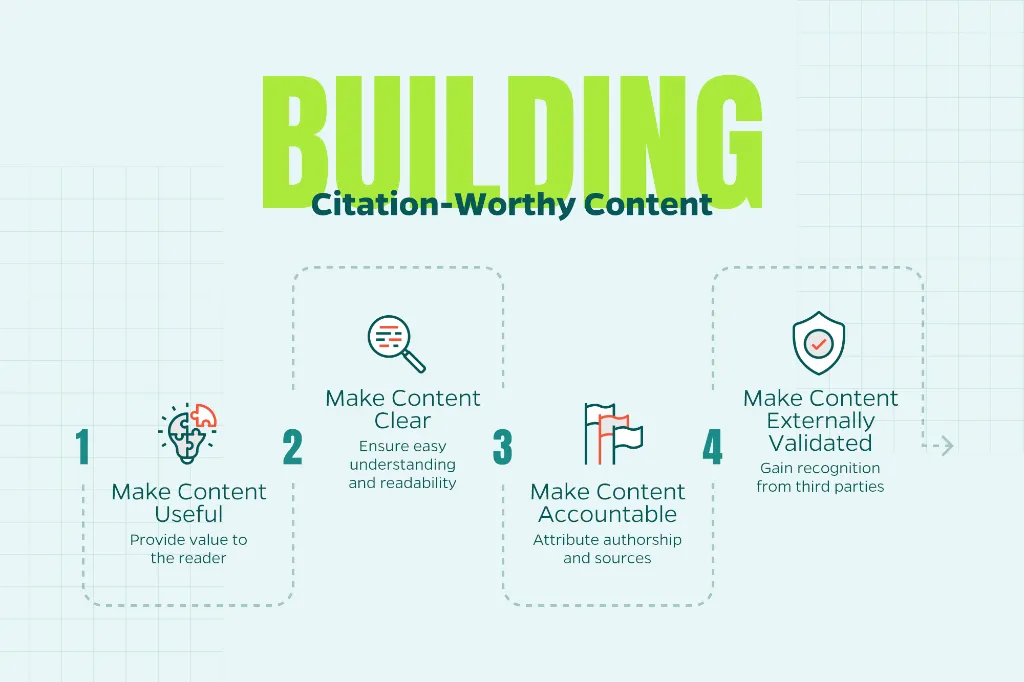
Trust matters just as much as clarity. AI is more likely to reference content backed by expert authorship, firsthand experience, credible evidence, and current information. Strong trust signals help establish your content as a reliable source.
Then give AI a reason to choose you. Original research, proprietary data, practical examples, and unique insights create value that generic summaries can’t replicate. When your content contributes something new instead of echoing what’s already available, it becomes much more citation-worthy.

They make the content harder to replace. If a page only repeats what every other site says, there’s no strong reason to cite it. Original data gives the answer something unique to use. Firsthand experience adds practical context that generic summaries can’t. Examples help users and systems understand how the information applies in the real world. That really connects directly to the experience part of E-E-A-T. In an AI-heavy search environment, original insight is one of the clearest ways to stand out from recycled content.
When Accuracy Matters, AI Raises the Bar
Not every query is treated equally. When a YMYL (Your Money or Your Life) topic involves health, finance, legal guidance, safety, compliance, or other real-world consequences, AI systems appear to place greater emphasis on trustworthy sources. Rather than relying on content that simply answers the question, they’re more likely to prioritize pages that demonstrate expertise, cite reliable evidence, reflect current information, and come from organizations with established authority. In these situations, credibility may influence whether a source is considered reliable enough to support the response.
“The goal is not just to have a strong page overall, but to make sure the page contains useful, extractable, and well-supported information.”
Senior SEO & GEO Strategist | SEO & GEO Authorship Expert
The Biggest Citation Gaps Brands Miss
When a lower-ranking competitor is cited and your page is not, start by looking at the specific answer AI used. Compare how competitor pages answer the question. Are their answers more specific, clearer, better supported, or easier to extract?
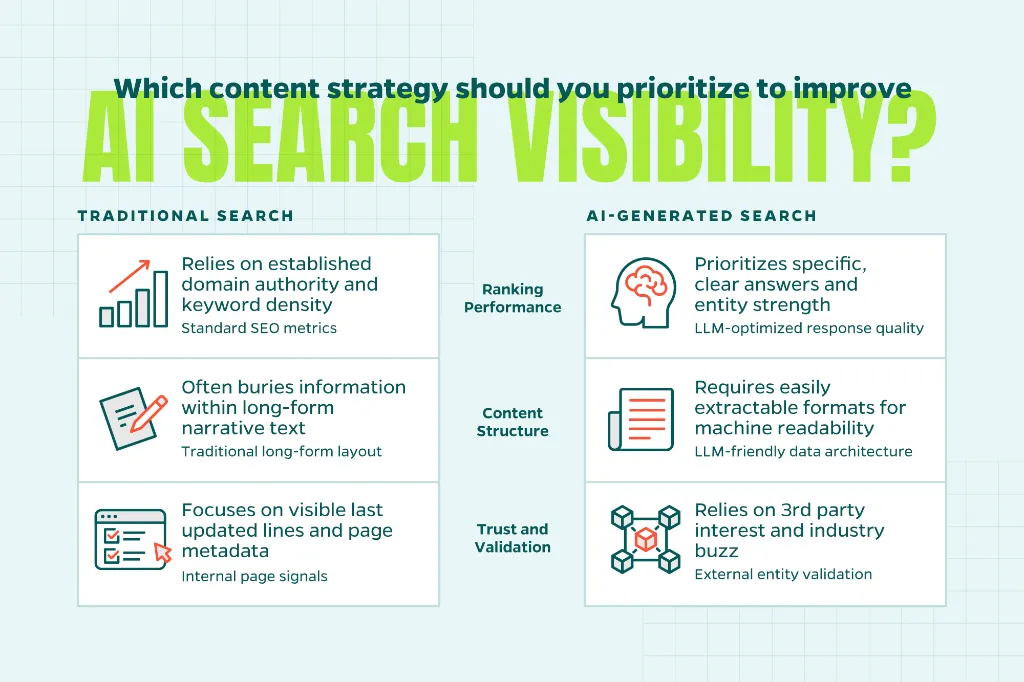
I would consider proof, structure, reputation, freshness, and entity strength. So, when I say that, I mean proof: Do they have better evidence, examples, data, or sourcing? In terms of structure, is their answer easier to extract for an LLM? As far as reputation, do 3rd party sources reinforce their authority? As far as freshness, is the content more current? I mean, you can either look at the visible last updated line on the page or look at the source code to see if that information is available. And then for entity strength is their brand more clearly associated with the topic as far as 3rd party validation buzz in the industry. Do people talk about their brand in relation to the topic at hand more frequently than yours?
It starts with a content audit that looks beyond traditional SEO metrics. First, ask whether the page answers the question users are asking and AI systems are trying to support. Next, evaluate the structure gap to determine whether that answer is easy to find or buried beneath unnecessary content. Then assess the trust gap by reviewing authorship, sourcing, expert input, update history, and credibility signals. Finally, examine the reputation gap by checking whether reviews, media mentions, third-party references, and industry sources connect your brand to the topic.
But even the strongest page isn’t evaluated in isolation. AI also considers the signals surrounding your brand across the web.
AI Doesn’t Just Evaluate Your Website
AI is looking for expertise, experience, authoritativeness, and trustworthiness (E-E-A-T). You need to demonstrate credibility beyond your website. Third-party recognition gives AI another reason to trust, and ultimately choose, your brand as a source.
Hand explained how brands can build that third-party recognition:
PR helps show that credibility exists beyond your own website. Anyone can claim expertise, but it’s more powerful when industry publications, partners, customers, podcasts, conferences, or third-party sources recognize that expertise. PR can strengthen brand topic associations. It can also help experts become more visible outside of your own website. For AI visibility purposes, this matters because the system may look across the broader web to understand whether a brand is even known, trusted, and relevant. The best PR for EEAT is not generic awareness. It’s coverage that reinforces what the brand is actually qualified to talk about.
Third-party validation is only one piece of building authority. The next step is making sure reviews, profiles, media mentions, expert visibility, and website content all reinforce the same area of expertise.
Build Authority Beyond Your Website
Creating great content is only part of the equation. AI search may also reflect signals that your expertise is recognized beyond your own website. The brands most likely to earn citations are often the ones contributing to the broader industry conversation, not just publishing content on their own domain.
That means building legitimate authority in places your audience already trusts. Publish original research that others want to reference. Contribute expert insights to respected industry publications. Speak on podcasts, webinars, and conference panels. Partner with reputable organizations, earn reviews on relevant platforms, and keep your business profiles accurate across the web. The goal isn’t simply to generate mentions. It’s to demonstrate that your expertise is acknowledged by others.
Over time, those efforts reinforce one another. As your expertise earns citations, links, media mentions, and industry recognition, your authority grows. That stronger credibility footprint can make your content a more plausible source in future AI-generated answers.
The strongest authority signals are earned, not manufactured. AI isn’t looking for the loudest brand. It’s looking for the one others already trust.
Stop Publishing More Content. Publish Better Content.
It’s tempting to look at competitors publishing hundreds of articles and assume you need to do the same. In reality, that’s one of the fastest ways to create shallow, repetitive content that offers little original value. A large content library is less valuable than a focused library of pages that answer real questions with depth, evidence, and expertise.
Rather than chasing every keyword, build comprehensive topic clusters around the subjects your business is genuinely qualified to own. Cover each topic from multiple angles with definitions, comparisons, use cases, costs, risks, decision guides, and expert commentary. Strengthen those resources with smart internal linking and regularly update them as new information becomes available.
“Give AI a reason to choose you — not just another page to crawl.”
Senior SEO & GEO Strategist | SEO & GEO Authorship Expert
Google has consistently emphasized helpful, original content over scaled content created mainly to perform in search. Instead of trying to publish more content, focus on creating content that’s worth citing. Volume alone does not make content more useful or more citation-worthy. Stronger citation candidates answer questions thoroughly, offer unique insights, and provide information users can’t easily find elsewhere. The goal isn’t to chase every keyword. It’s to become the most trusted resource on the topics that matter most to your audience.
Improving existing content, adding expert perspectives, incorporating original research, and keeping pages current often deliver more value than publishing another generic article. When your content consistently earns attention, references, and links, it creates a cycle where authority and visibility reinforce one another over time.
How to Measure Citation Visibility
AI search visibility is harder to measure because there is no single reliable dashboard for citations, mentions, and source inclusion across platforms. The technology is evolving, and so are the tools used to measure it. Citation visibility should be measured through several signals: citation frequency, brand mentions, competitor appearances, AI referral traffic, branded search growth, and share of voice.
Monitor the prompts that matter most to your business and track how often your brand appears compared to competitors. Pay attention to citation frequency, brand mentions, AI referral traffic, branded search growth, share of voice, and broader visibility trends over time. Each metric provides a different perspective, but together they reveal whether your content is becoming a more trusted source.
Before deciding what to measure, it’s important to understand what AI citations are responding to. As Hand explains, visibility isn’t driven by a single ranking factor. It reflects a combination of authority, trust, clarity, and external validation.
A lot of it is sentiment in PR. How well your brand is known, and why your brand is known, and what you’re known to be the expert of what? What is your lane? I think, assuming that adding facts or schema alone will solve the problem, because, again, it may be a matter of content depth, and it may be a matter of content structure. But as we discussed, there are other factors at play, external validation, authorship. I think it’s also important to not underestimate how much clarity and evidence matter. I think it’s also important not to ignore the role of third-party validation. I would also not assume that if you are not cited, the answer is simply publish more content. I would do that analysis of identifying where your gap truly is. You don’t want to balloon your page to the point that it becomes basically less useful for the user. There is a point of diminishing returns just in terms of publishing raw content. You can’t really do a single factor analysis with this. Being cited is about being trusted, useful, and easy to verify.
If citation visibility reflects trust, expertise, and usefulness, those are the signals your measurement strategy should capture over time — not just rankings or traffic.
Most importantly, don’t judge success by a single screenshot or one AI response. AI-generated answers change frequently as models evolve and new information becomes available. Instead, look for consistent patterns over weeks and months. Sustained growth in citations, mentions, and branded visibility is a much stronger indicator that your authority is increasing than any one-off appearance in an AI-generated answer.
Ranking Gets You Seen. Trust Gets You Cited.
The citation gap isn’t proof that SEO is becoming less important. It’s proof that search is changing.
Traditional SEO rewarded pages that ranked well. AI search rewards sources that help answer questions with clarity, evidence, and credibility. Rankings still matter. They remain an important signal, but they’re no longer the only measure of visibility. Today, the brands that earn citations are the ones that consistently demonstrate expertise, support their claims, and build trust both on and beyond their own websites.
That doesn’t mean chasing every new AI tactic or publishing more content than your competitors. It means creating resources that are genuinely useful, adding original insights that others can’t replicate, and building a reputation that extends beyond your own domain. When your content becomes the source others want to reference, citations, mentions, and authority begin to reinforce one another.
Authority should include whether the brand is cited, mentioned, trusted, and accurately represented. Backlinks still matter, but they’re not the whole picture. Reviews, media mentions, expert visibility, original research, citations, and brand consistency also matter. Authority is becoming more about the full credibility footprint around a brand. SEO team should ask, are we known for this topic? Does the broader web confirm that? They should also consider whether users and AI systems can clearly understand who created the content, why they’re qualified, and what evidence supports their claims. The future of authority is not just ranking power, it’s being recognized as a reliable source across search, AI answers, and the broader web.
Traditional SEO focused on earning rankings. AI Search focuses on earning trust. The brands best positioned for AI search will be the ones with clear answers, strong evidence, visible expertise, and credibility beyond their own websites.