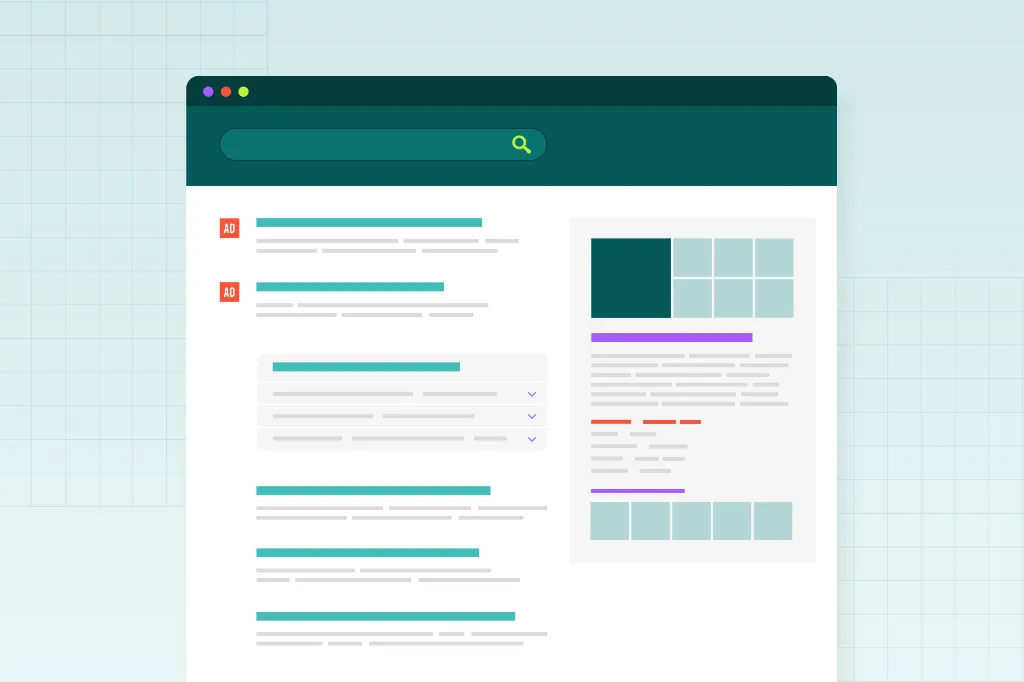



Imagine you’re researching financial topics online for a blog you’re writing, and you need to ensure that it’s all accurate. When you start searching for resources, the pages that are showing up have articles with random bylines: “by [Company Name]” “by editorial contributor” or “by financial expert.” Now you are uncertain of the credibility of these posts and are less likely to trust the sources. Who really wrote them? Where did the content originate?
Straight North Senior SEO Strategist Bob Hand explained how to conduct an effective audit for this type of content. An effective audit goes beyond a single blog post. Brands need to look at their overall credibility footprint by assessing content quality, author credentials, external reputation, and site-level signals.
E-E-A-T is important because it provides a source of truth in an environment where there’s a lack of authorship. If Google can attach your content to a specific voice with specific experiences, they’re going to see that as a stronger source of truth than the ocean of synthetic data that we have at our fingertips. It’s, you know, with that in mind, Google is going to realize that content with strong E-E-A-T signals is going to be a better user experience end product. They’re going to want to funnel users to that, to those pages, because they’re going to be more truthful based on those signals. In this environment, E-E-A-T functions as a filtering mechanism that helps search engines prioritize information created by knowledgeable, verifiable sources over content that simply repeats widely available information without meaningfully expanding on it.
As the web becomes saturated with AI-generated content, E-E-A-T audits are no longer a nice-to-have SEO exercise. These audits are essential for distinguishing real expertise from generic information and for building the trust and authority required to sustain search visibility.
Defining the Scope of an E-E-A-T Audit
An effective E-E-A-T audit goes beyond evaluating individual blog posts and instead examines the brand’s overall credibility footprint. This includes reviewing core landing pages, author entities, off-site reputation signals, and the site’s broader trust infrastructure.
“When doing an E-E-A-T audit, it’s important to look at content where there is likely to be increased scrutiny from Google.”
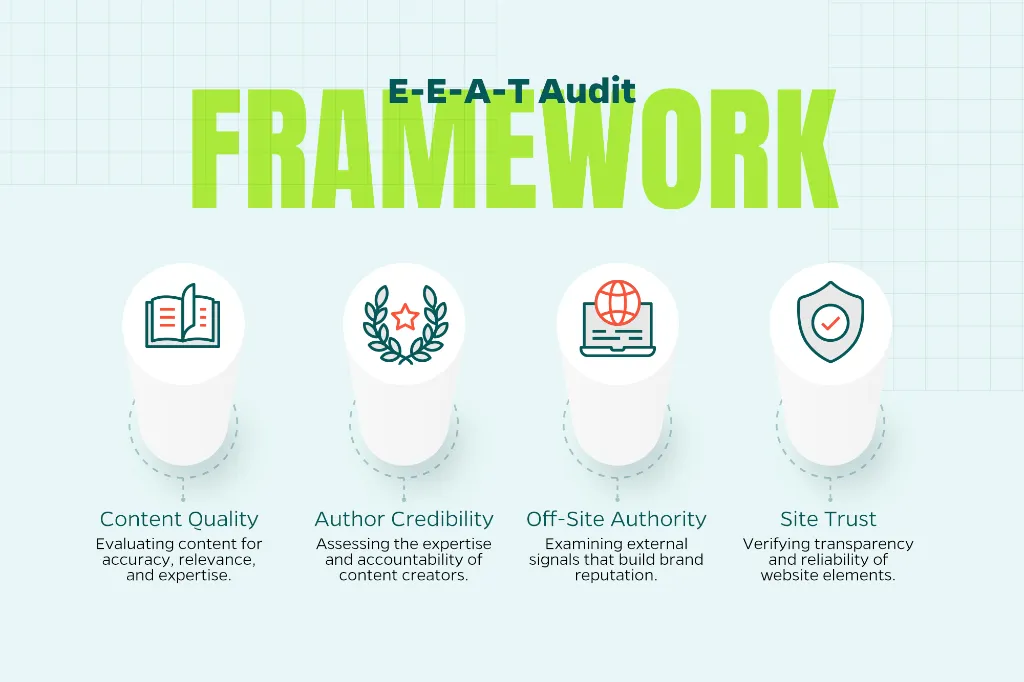
Most comprehensive audits focus on four key areas:
- Quality and accuracy of the content experience
- Accountability and credentials of authors
- External authority and reputation signals
- Foundational trust elements present across the site
Rather than attempting to assess every page at once, the scope should prioritize business-critical, high-traffic, and higher-risk pages, particularly in YMYL (Your Money or Your Life) industries where trust standards are significantly higher.
For smaller sites with a limited number of pages, review most of the content directly and focus on improving things like author credibility, topical depth, and reputation signals. For larger content libraries, sampling works better. Group pages into topic clusters and review representative pages.
Audit Content for Experience and Expertise Signals
To establish credibility, businesses need content created or reviewed by subject‑matter experts. What sets the content apart from generic AI overviews and summaries is first-hand knowledge of the subject that includes clear, detailed examples and properly attributed sources.
Google is reviewing content with factors like the following in mind:
- Is the content accurate?
- Is it up to date?
- Is it supported by credible resources?
Strong E-E-A-T requires unique perspective, real-world experience, and original framing. Regular updates help keep content accurate and maintain its long‑term value.
I think it’s important to treat evergreen content as maintained resources, rather than static pages. As a best practice, I would recommend establishing a scheduled review cycle, maybe once every half year, once every six months to once every year. Just update statistics, citations, examples. It’s not a great look if you have a, of 2025, when you’re in the year 2026, when you’re talking about trends from a year past.
As things change from year to year, particularly if you are in an industry like finance or legal, continue to check links to ensure that they are still active, too. Instead of rewriting successful pages, build updates on top of existing authority to maintain ranking and backlinks.
Evaluate Credible Authorship and Author Credibility
Strong authorship signals start with clear attribution. Key content, especially on expertise-driven or YMYL topics, should be tied to real, accountable authors with visible bylines and dedicated author pages. These bios should highlight relevant qualifications, industry experience, and topical focus rather than generic marketing language. Include details like credentials, years of experience, notable publications, and links to social profiles (such as LinkedIn). These signals give both users and search engines more context about the writer.
Most of this information doesn’t need to live on every page. Typically, the byline links to a dedicated author page that contains the full profile and supporting details. One common mistake brands make is using generic labels like “Admin,” “Staff,” or the company name as the author, which provides little meaningful information about who created the content. Even adding a clearly identified “reviewed by” expert can be more helpful than relying on vague or anonymous authorship.
Evaluating Off-Site Authority and Reputation Signals
Reputation matters. External citations and mentions can say a lot about your brand and your authority on a topic.
I think you can evaluate each signal using three criteria. That’s source credibility, that’s editorial context, and topical relevance. So when I say source credibility, I mean established media, industry organizations, academic sources. When I say editorial context, I mean mentions within meaningful content versus directories or low-quality placements. When something… when a link to another page thinks, like well, that was put in there for a reason that’s not necessarily for the user, that’s poor editorial context. And then for topical relevance, I would say links from sites within the same subject area. I mean, maybe for the same reason as the editorial context, just that it needs to make sense from a user experience perspective.
Users often form their first impression of a brand through its branded search results before they ever click on a website. Signals like news coverage, reviews and ratings, Wikipedia entries or knowledge panels, industry recognition, and third-party commentary all shape this perception. These elements influence pre-click trust, which can affect both user behavior and click-through rates. As part of an audit, it’s important to review branded search results to see what Google surfaces about the company’s reputation and credibility.
Verify Site-Level Trust and Transparency Signals
Users may question a site’s credibility if essential trust elements are missing, including:
- A clear description of what the company does
- Company ownership information (About Us page)
- Accessible contact information
- Transparent editorial policies
- Visible updates with timestamps
“Trust is reinforced when you can easily identify who created the content, when it was updated, how the information was sourced, and who’s responsible for the organization.”
Good design with clear page structure and readable layouts also helps reduce skepticism and reinforce the legitimacy of the page.
Prioritize E-E-A-T Fixes After Your Audit
Start by prioritizing E‑E‑A‑T improvements based on page impact, risk level, and implementation effort. Consider traffic potential, business value, YMYL risk, credibility gaps, and the technical effort required to implement improvements.
That’s the how to do it. Then you need to identify who is responsible for doing these things and how to distribute the work.
Effective implementation usually involves SEO teams, content teams, subject matter experts, and leadership or PR teams. For SEO teams, identify credibility gaps, prioritize actions. For content teams, that means to implement expertise signals and improve depth. For subject matter experts, that’s to validate the accuracy and insights of the content, to make sure that what’s actually being said is accurate, which is something that AI struggles with. We’re talking about hallucinations. And then for leadership, that means to strengthen off-site authority signals.
Re-Audit E-E-A-T Fixes and Maintain Over Time
Google processes enormous amounts of content to determine which sources demonstrate expertise and authority. Because of this, E‑E‑A‑T is not a one‑time project—it requires ongoing monitoring as industry standards and regulations evolve. Regular audits help ensure credibility signals stay strong and aligned with new expectations.
Here’s a sample schedule for how often you should be auditing your site:
Industry Type | Audit Frequency |
Highly regulated industries | Quarterly to semi-annually |
YMYL sectors | Every 6 months |
Stable informational sites | Annually |
After major algorithm updates | Additional review |
These efforts will pay off as you start to see E-E-A-T improvements working. Performance data will show improved rankings for competitive queries. You’ll also see ranking stability across core updates. Additionally, you’ll see growth in organic backlinks, stronger topical authority within clusters, and increased branded search demand. Likewise, your authority content should show higher engagement, including more clicks and lower bounce rates.
Bob explains this further.
That’s, improved rankings for competitive queries. Increased stability across core updates. Growth in high-quality backlinks and citations, those that you’re not even seeking through a structured link-building campaign, those that organically just show up because you’re providing quality content, especially. Stronger topical depth within clusters. More branded search demand, so you may see increase in branded traffic as well. And then finally, higher engagement on authority content. So you should see better bounce rates, you should see more clicks, more visibility, maybe even increased AI overview usage, which can take away from some of those clicks, but obviously, you’ll still see improved overall performance from those.
Why E-E-A-T Matters More in the Age of AI Search
As AI‑generated content floods the web, E‑E‑A‑T is becoming more important than ever. The internet is increasingly filled with synthetic content that often pulls from other synthetic sources, sometimes amplifying inaccuracies along the way.
By prioritizing traceable authorship, real‑world expertise, unique insights, and clear sourcing, search engines can better identify trustworthy information. Strong E‑E‑A‑T signals help credible brands rise above generic, mass‑produced content.
E-E-A-T Audit Checklist: Key Takeaways
As AI-generated content continues to scale across the web, credibility has become the true differentiator in search. Brands that stand out are the ones that clearly demonstrate expertise, transparency, and trust on their sites and across the broader web.
The strongest E-E-A-T strategies tend to focus on a few core principles:
- Show real expertise and experience in your content.
- Use transparent authorship with identifiable, credible contributors.
- Cite trustworthy sources and provide clear evidence behind claims.
- Build a strong off-site reputation through reviews, coverage, and recognition.
- Maintain and update content regularly as industries and information evolve.
When these signals work together, they help both users and search engines quickly recognize your brand as a reliable, authoritative source even in a web increasingly filled with automated content.