AI search optimization for local businesses means helping ChatGPT, Google AI Overviews, and AI Mode find accurate, consistent, and credible information about your company. Start with your Google Business Profile, matching business listings, authentic reviews that describe your work, and clear service pages. These basics give AI-powered search better information to work with.
Fix these first:
- Correct your name, address, phone number, hours, and services across listings.
- Complete and maintain your Google Business Profile.
- Ask customers for honest, specific reviews, and respond to feedback.
- Measure qualified calls, forms, and inquiries, not just AI mentions.
What AI Search Optimization Means for a Local Business
AI search optimization for local businesses is the process of making your company easier to identify and accurately recommend when people ask an AI assistant for nearby providers. Someone might search “best HVAC service near me,” ask for an industrial contractor with a particular certification, or wonder “how to get my business on ChatGPT.” The same information helps answer all three kinds of questions.
Local SEO for AI search is not a replacement for familiar local marketing. It extends the work of maintaining trustworthy business information so a search engine or assistant can summarize who you serve, where you work, and what makes you a suitable choice. For many local companies, correcting existing profiles and reputation signals deserves attention before producing another generic blog post.
How AI Search Finds and Recommends Local Businesses
AI search tools can draw on search results, websites, and outside sources, but their sourcing methods differ. Google says its AI search features follow established Search fundamentals. OpenAI says ChatGPT search can use third-party search providers and may share approximate location information for local results. Neither statement establishes a guaranteed path from one business listing to an AI recommendation.
Platform | Documented local-information path | What to check first |
Google AI Overviews / AI Mode | Google Search systems and existing SEO best practices | Profile accuracy, local search presence, and service pages |
ChatGPT | Search providers may be used; location may be shared for nearby results | Business facts across website and third-party listings |
Gemini | Specific local source pathway not established by the supplied research | Inspect answers and any cited sources |
Perplexity | Specific local source pathway not established by the supplied research | Inspect answers and any cited sources |
Because answers and cited sources vary, consistency across the web is more practical than optimizing for one assumed feed. Straight North’s guide to optimizing for AI search offers a broader framework.
Local SEO is Still the Foundation
AI search optimization is mostly an extension of local SEO. Google identifies relevance, distance, and prominence as the main factors in local results. Businesses cannot control a searcher’s location, but they can improve the accuracy of their service descriptions and strengthen their public reputation. Google also says AI search features do not require special AI-only files or markup.
What changes is the presentation. A conventional local result gives users a list to inspect; an AI answer may compress that information into a few recommendations and descriptions. If third-party listings describe your services inconsistently, the summary can be incomplete or misleading even when your website looks excellent.
For the underlying fundamentals, see Straight North’s local SEO guide.
Optimize Your Google Business Profile for AI Answers
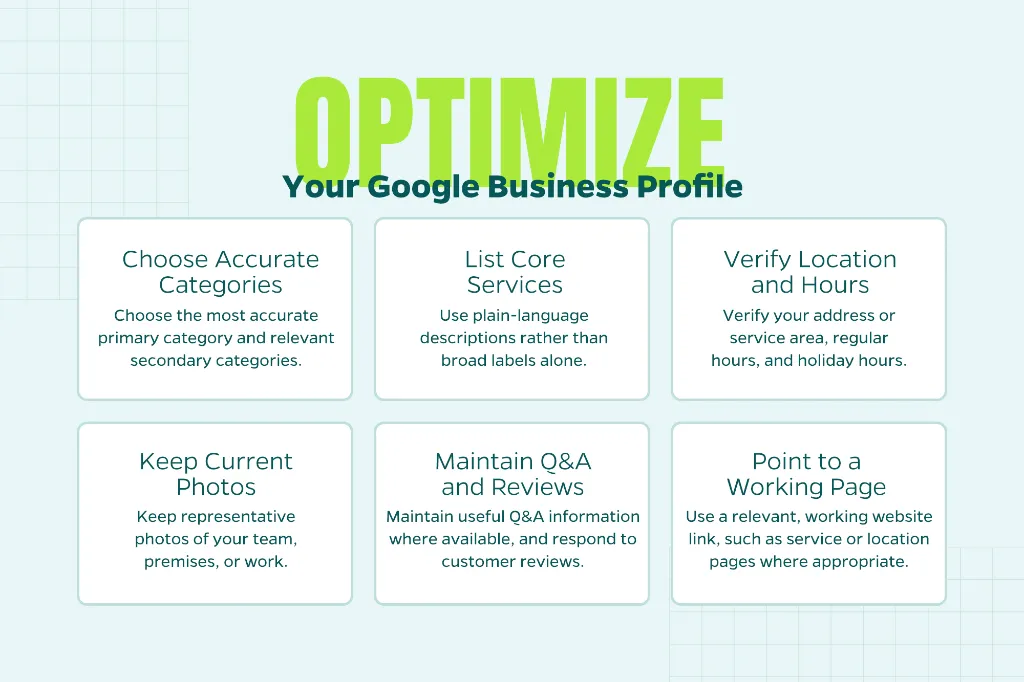
Your Google Business Profile should clearly answer what you do, where you do it, and when customers can reach you. Audit it for accuracy before adding more material:
- Choose the most accurate primary category and relevant secondary categories.
- List core services with plain-language descriptions rather than broad labels alone.
- Verify your address or service area, regular hours, and holiday hours.
- Keep current, representative photos of your team, premises, or work.
- Maintain useful Q&A information where available, and respond to customer reviews.
- Point the website link to a relevant, working page; use service or location pages where appropriate.
An accurate profile is more valuable than a long profile filled with outdated services. Review it whenever locations, hours, staffing, or offerings change.
Reviews: What Customers Write Matters More Than the Star Count
Reviews can influence local discovery in two distinct ways. Google says review count and score contribute to local prominence. Separately, detailed customer language can help readers and potentially AI systems understand the kinds of jobs a business handles. That second use should not be mistaken for a confirmed ranking factor across all AI platforms.
“A 5-star rating is useful, but detailed reviews are more persuasive because they explain why people trust the business,” says Bob Hand, Straight North’s Senior SEO & GEO Strategist. A rating conveys satisfaction; a review describing a same-day boiler repair, a successful permit application, or a complex installation explains the experience behind it.
“A 5-star rating is useful, but detailed reviews are more persuasive because they explain why people trust the business.”

Specificity makes a review more informative. A prospect comparing two contractors learns more from “the team replaced our commercial rooftop unit over the weekend” than from “great company.” Repeated, authentic references to specialties may reinforce what a business is known for, although an AI system may not use those reviews in every answer.
Build a steady, policy-compliant review process. Ask customers to describe their experience in their own words, without scripts, incentives, selective solicitation, or pressure for positive ratings. Respond professionally to criticism, explain remedies when appropriate, and never disclose private customer information. A dependable stream of real feedback is more useful than a short burst of suspiciously similar comments.
For more on this topic, see Straight North’s article on receiving Google reviews.
The Local Signals Most Marketers Skip
Local listings and reputation management receive less attention than content updates among surveyed marketers. In Straight North’s September 2026 GEO survey of 101 marketers, 49% reported updating existing content to improve AI visibility, compared with 18% improving directory or business profiles and 14% increasing review generation. These are reported activities, not evidence that any one tactic produces better results.
In the same survey, 42% of respondents said they were placing more emphasis on news or media websites because of AI search, compared with 33% for customer review platforms and 19% for business directories. The findings suggest an attention gap worth auditing, not a proven ranking advantage.
“A strong website can be weakened by poor reviews, inconsistent listings, or weak external validation, while a strong external presence can make the website more persuasive before the user even arrives,” says Bob Hand, Straight North’s Senior SEO & GEO Strategist. That is why a local trust audit should look beyond the website.
“A strong website can be weakened by poor reviews, inconsistent listings, or weak external validation, while a strong external presence can make the website more persuasive before the user even arrives.”
Local citations are references to your business information on directories and other sites. Prioritize accurate name, address, phone number, hours, and services on important general and industry-specific platforms. Claiming Bing Places and Apple Business Connect can also help maintain your public records, without assuming a particular AI engine uses either listing.
Signal | What goes wrong | Practical fix |
Outdated descriptions | Old positioning obscures current specialties | Rewrite profiles with current services |
Weak or stale reviews | Prospects see limited recent evidence | Request authentic feedback consistently |
Inconsistent locations or contact details | Customers encounter conflicting business identities | Standardize name, address, and phone details |
Old service information | Unavailable work appears to be offered | Update service menus across major listings |
Negative or irrelevant third-party pages | Unhelpful context can dominate research | Correct factual errors and strengthen credible sources |
Accuracy and relevance matter more than accumulating hundreds of low-value citations. See Straight North’s list of local directories to be listed on.
Local Pages and Schema That AI Can Quote
Your website should confirm and expand on what the public listings say. Build pages around real services and genuine locations, not dozens of near-duplicate city pages.
- Open each core service page with a clear description of the work, intended customer, and area served.
- Create location pages where there is a legitimate location or meaningful local service presence.
- Answer common questions in everyday language, including eligibility, process, timing, and published pricing ranges.
- Use appropriate LocalBusiness structured data to clarify business facts, while recognizing that Google does not require special schema for AI features.
See our article about schema markup implementation details for more information.
Service-Area and B2B Firms: Win the Shortlist Prompt
A company without a customer-facing storefront can still compete for detailed AI-assisted vendor research. In Straight North’s September 2026 survey of 101 marketers, 73% said at least one customer or prospect had told them they used ChatGPT or another AI platform to discover or research the company. This measures respondents’ reports of customer conversations, not verified platform usage.
For these firms, a valuable query often asks for a shortlist rather than a generic “near me” result. Consider:
- “Industrial electrical contractor near Joliet that does arc flash studies.”
- “Employment attorney in Charlotte for wage disputes.”
- “Engineering firm in Chicago for stormwater permits.”
Each query combines geography, a specialty, and a need. A generic “electrical services” page may not demonstrate arc flash expertise. A focused service page can describe the work, industries served, credentials, relevant project examples, and service territory. Where appropriate, named professionals and verifiable certifications add evidence that a buyer can check.
Small local firms can be credible alternatives to national brands when their information answers a narrow question more precisely. Set legitimate service areas in your profile, publish useful specialty pages, and make case studies or other proof easy to find. Do not create misleading addresses or claim geographic coverage you cannot serve.
Track AI Search Traffic to Leads, Not Just Mentions
A business should judge AI-search activity by meaningful inquiries and customers, not solely by whether its name appears in a test answer. In Straight North’s September 2026 survey of 101 marketers, 35% reported being able to connect brand mentions to AI-search efforts, while 24% reported being able to connect leads or conversions. Because respondents could select multiple answers, these figures are not mutually exclusive.
- Add UTM parameters to Google Business Profile website links so visits from the profile can be analyzed separately. Straight North uses source, medium, and city-specific campaign tags on its own profile links.
- Monitor identifiable AI referral sources in GA4, including chatgpt.com, perplexity.ai, gemini.google.com, and copilot.microsoft.com, while recognizing that some AI-influenced visits may appear under other channels.
- Connect visits to form submissions, qualified calls, appointments, and CRM outcomes. Add “ChatGPT/AI search” to the question asking new customers how they found you.
- Test a consistent sample of relevant prompts monthly. Record whether your business appears, whether cited facts are correct, and whether the answer accurately reflects your services and territory. Treat this as a spot-check, not a stable ranking.
A UTM-tagged profile visit is not proof of an AI referral, and an AI mention is not proof of a lead. Combining referral data, direct customer answers, and conversion records produces a more useful picture. Learn more about Straight North’s AI search services.
Where to Start This Month
Start with the records customers and search tools are most likely to encounter. A practical first-month sequence is:
- Audit and correct major directory listings and inconsistent business facts.
- Refresh every relevant Google Business Profile and matching website page.
- Launch a steady, compliant process for requesting detailed customer reviews.
- Set up referral, profile-link, call, and form tracking, then establish a monthly answer check.
Talk to Straight North about local SEO built for AI search.
FAQ
How do I get my business on ChatGPT?
There is no universal submission form that guarantees inclusion. Keep your public business information accurate, your website accessible, and your service descriptions and third-party references consistent.
How do I get my business recommended by ChatGPT?
No listing or review guarantees a recommendation. Strong service information, credible third-party evidence, and authentic recent reviews can make it easier for people and search tools to evaluate your business.
Does my Google Business Profile affect AI Overviews?
Google says its AI features build on established Search systems and best practices. A complete, accurate profile supports your broader local search presence, but Google has not established a guaranteed direct profile-to-answer feed.
How long does it take to show up in AI search?
There is no dependable timetable. Changes may take weeks or months to be discovered or reflected, and visibility varies by prompt, location, and platform.
Is SEO dead now that AI answers exist?
No. Accessible websites, relevant service information, and trusted local signals remain useful foundations for conventional and AI-assisted discovery.
Does a multi-location business need a separate strategy?
Use the same principles for each real location, with accurate location-specific profiles, pages, hours, services, and review management.
Need Help?
Want help navigating how AI search can help your local business? Contact Straight North for help with this process.