Parents now ask ChatGPT and Google’s AI Overviews questions they once saved for a school tour: Is this school safe? What does it cost? Where do graduates go? AI search for private schools makes clear, publicly available answers essential. When a school leaves those questions unanswered, AI tools may turn to reviews, directories, forums, or news instead.
A family’s first questions may sound like these:
- Which private elementary schools near me have strong arts programs and small classes?
- Is this school safe, and how does it handle bullying?
- What is the total tuition after fees, and where do graduates go?
How Parents Use ChatGPT and AI Search to Research Private Schools
Parents use AI search to build shortlists, compare schools, and investigate concerns in conversational language. Instead of entering “private schools near me,” they can describe a child’s personality, learning needs, commute, budget, and interests in one question. Follow-up questions help them narrow the options before contacting admissions.
These conversations happen in ChatGPT, Google AI Overviews and AI Mode, Gemini, and Perplexity. A parent might ask which school suits a shy seventh grader, whether a campus offers counseling, or how two schools differ on tuition and extracurriculars. AI responses can shape the list of schools a family considers, although answers may be incomplete or wrong and should be checked against original sources.
In EAB’s 2026 survey of 2,515 parents of high school students, 57% reported using AI tools to evaluate and compare colleges, and 34% said AI introduced schools they had not previously considered. This finding concerns college research, not K–12 private-school selection, but illustrates how families are using conversational tools for education decisions.
“As more families consider private-school options, schools are competing for attention earlier and across more channels than they may have in the past,” says Frank Fornaris, Straight North President. “Strong SEO and GEO help schools get found during the research process, while paid search and social can help them reach families sooner and communicate what makes the school meaningfully different.”
“As more families consider private-school options, schools are competing for attention earlier and across more channels than they may have in the past. Strong SEO and GEO help schools get found during the research process, while paid search and social can help them reach families sooner and communicate what makes the school meaningfully different.”

Why Your School Isn’t in AI Overviews or ChatGPT Answers
A school can rank well in traditional Google results and still be absent from an AI-generated answer. AI systems select information for particular questions, and prominent search placement does not guarantee that a school will be cited or recommended.
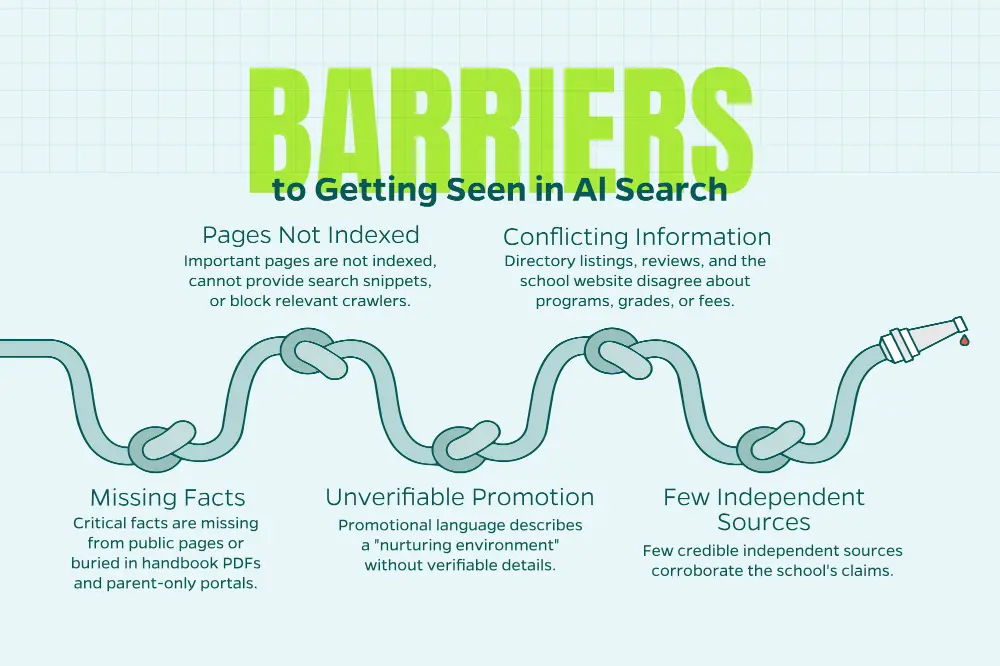
Common barriers include:
- Critical facts are missing from public pages or buried in handbook PDFs and parent-only portals.
- Important pages are not indexed, cannot provide search snippets, or block relevant crawlers.
- Promotional language describes a “nurturing environment” without verifiable details.
- Directory listings, reviews, and the school website disagree about programs, grades, or fees.
- Few credible independent sources corroborate the school’s claims.
In its 2026 study of 20 prominent U.S. private schools tested against 10 parent-style AI prompts, 5W reported that the six schools it rated strongest for AI instruction were not returned as primary answers, and most were not named. This agency study is a limited illustration, not proof of a universal ranking rule: excellence and visibility are different things.
The underlying issue is often a citation gap. A school may deliver a strong experience without publishing the specific evidence a system can use to answer a parent’s question.
What AI Says When a Parent Asks “Is This School Safe?”
When a parent asks whether a private school is safe, an AI answer may summarize whatever accessible information it finds. That could include the school’s policies, third-party reviews, local reporting, and community discussions. The answer is not an independent safety inspection, and it may overemphasize an old incident or an unrepresentative complaint.
Safety is too consequential to leave to vague assurances. Schools often place health guidance, discipline rules, and emergency procedures in lengthy handbooks or restricted portals. Those materials may be useful to enrolled families but inaccessible to prospective parents and search systems.
A public page headed “School Safety Policies” should clearly explain:
- Campus access: visitor check-in, supervision, and general security practices, without disclosing sensitive operational details.
- Screening: how staff and volunteer background checks are handled, consistent with applicable law.
- Bullying: prevention policies, confidential reporting channels, and response procedures.
- Emergencies: the types of plans maintained and how parents receive notifications.
- Student support: health services, counseling resources, and escalation contacts.
The goal is transparency, not a claim that no incident could ever happen. Explain what the school does, how concerns are reported, and when policies were last reviewed. Avoid publishing sensitive security specifics that could create risk.
If the school does not provide a clear answer, an AI system may rely more heavily on outside commentary. Publishing accurate, accessible information gives families a primary source to evaluate and gives search systems something checkable to reference. It does not guarantee a favorable AI answer.
What Your School Must Publish to Get Named
Private schools improve their chances of being understood in AI search by publishing direct answers to parents’ decision-making questions. The strongest content is specific, current, and easy to verify. “Small classes” is promotional; “average class size: 14 students during the 2025–26 school year,” if accurate, is useful evidence.
“Cost, format, duration, outcomes, accreditation, admissions requirements, and who the program is designed for should not require detective work,” says Nick Fatigato, Enterprise SEO & GEO Strategist at Straight North. Parents need practical information before they are willing to book a tour.
“Cost, format, duration, outcomes, accreditation, admissions requirements, and who the program is designed for should not require detective work.”

Parent Asks AI… | Publish This | Where It Lives |
Is it safe? | Public safety policies, reporting routes, and student-support resources | School Safety Policies page |
What does it cost? | Tuition by grade, mandatory fees, aid process, and what costs extra | Tuition and Financial Aid page |
Is it accredited? | Names of accrediting organizations and current accreditation status | About or Accreditation page |
Where do graduates go? | Defined, dated placement or graduation outcomes with methodology | Outcomes page |
How big are classes? | Average class size, student–teacher ratio, and grade-level context | Academics or grade pages |
How do admissions work? | Requirements, application steps, deadlines, and tour options | Admissions page |
What do parents say? | Links to independent review sources and clear feedback channels | Community or Reviews page |
Publish trade-offs as carefully as benefits. Explain whether a program has limited learning-support capacity, whether transportation is available, which activities carry extra fees, and which students the school serves best. Families comparing options need fit, not just a sales pitch.
“Different programs can attract students with completely different motivations, concerns, and competitive choices,” says David Duerr, Straight North CEO. “Marketing usually becomes more effective when the messaging, budget, and strategy reflect the individual program instead of asking broad institutional messaging to do all the work.” A kindergarten page and a college-preparatory high-school page should not rely on identical claims.
“Different programs can attract students with completely different motivations, concerns, and competitive choices. Marketing usually becomes more effective when the messaging, budget, and strategy reflect the individual program instead of asking broad institutional messaging to do all the work.”

Make Your Website Easy for AI to Read
A readable school website uses standard SEO foundations and clear page structure rather than a secret AI-specific technique. Google says there are no extra technical requirements for appearing in AI Overviews or AI Mode; pages must meet ordinary search eligibility requirements, including indexing and snippet eligibility.
- Put important answers in accessible HTML text, not only scanned PDFs, graphics, or logged-in portals.
- Use descriptive headings that mirror parent questions, and add concise FAQs where they help.
- Maintain crawlable internal links, accurate titles, canonical URLs, and appropriate structured data for the school’s identity and contact details.
- Review robots.txt and indexing rules. OpenAI identifies OAI-SearchBot as its ChatGPT search crawler; GPTBot, used for model training, is a separate control.
“The most practical step is to answer important student questions clearly, directly, and in a format AI systems can easily interpret,” says Nick Fatigato, Enterprise SEO & GEO Strategist at Straight North. Structured data helps describe content but does not promise inclusion in an AI response.
“The most practical step is to answer important student questions clearly, directly, and in a format AI systems can easily interpret.”
Reviews, Listings, and What Others Say About Your School
School reviews and third-party listings can influence the information AI tools encounter. Parents also consult directories, local reporting, and discussion forums to validate what a school says about itself. Schools should monitor these sources without treating every comment as authoritative.
“Think of your website as your résumé and third-party mentions as your references,” says Nick Fatigato, Enterprise SEO & GEO Strategist at Straight North. “You want both telling the same story.” Confirm that grades served, campus addresses, program offerings, tuition ranges, and admissions dates are consistent across reputable listings.
“Think of your website as your résumé and third-party mentions as your references. You want both telling the same story.”
Respond professionally to reviews when appropriate, but protect student and family privacy. A thoughtful response can clarify a policy or point readers to a public resource; it should not disclose personal information or attempt to erase legitimate criticism. Accuracy and consistency matter more than accumulating a large volume of reviews.
Run a Parent-Prompt Panel Every Month
The best way to learn what AI search says about your school is to test realistic parent questions on a repeatable schedule. A single ChatGPT answer is only a snapshot. Responses can change with model versions, search results, user context, and even repeated runs of the same question.
Start with 10–15 fixed prompts covering school-name questions, local shortlists, comparisons, safety, tuition, admissions, and outcomes. Run them monthly in ChatGPT, Gemini, Google AI Mode, and Perplexity, recording the date, wording, and result. Keep test conditions as consistent as practical, and repeat a few prompts to observe variation.
Parent Prompt | Engine | Named? | Facts: Right / Wrong | Sources Cited | Competitors |
Is [school] safe? | ChatGPT | Yes / No | Policy summary; errors | URLs or none | Names |
What does [school] cost? | Google AI Mode | Yes / No | Tuition and fees | URLs or none | Names |
Best private schools near [town] for arts? | Perplexity | Yes / No | Program details | URLs or none | Names |
Use the panel as a diagnostic tool. An incorrect tuition figure suggests updating a school page or directory; an omitted school may need stronger, more accessible evidence about a relevant program. Do not interpret a missing mention as proof of a technical penalty.
Straight North’s September 2026 cross-industry survey found that 68% of 100 responding marketers had identified prompts they wanted to appear for, but only 46% actively tracked those prompts. The survey was not specific to schools, yet it highlights the gap between setting visibility goals and measuring them.
Compare trends across months rather than celebrating one favorable answer. Track whether the school appears, whether its facts are correct, which sources are cited, and which alternatives parents are shown.
Count AI-Search Inquiries, Not Mentions
AI-search visibility matters when it contributes to admissions interest. A school appearing in an answer is useful only if the information helps qualified families move toward an inquiry, tour, application, or enrollment.
In Google Analytics 4, review referral sessions from recognizable AI domains such as chatgpt.com, gemini.google.com, and perplexity.ai. Group those sources into a reporting channel when possible, inspect the landing pages they send visitors to, and connect sessions with inquiry and tour conversion events. Some AI-influenced visits will not carry identifiable referral information.
An admissions measurement checklist should include:
- Track inquiry submissions, tour requests, application starts, and completed enrollments.
- Review assisted conversions and later direct visits where attribution tools permit.
- Add “AI assistant or AI search” to the “How did you hear about us?” question.
- Ask new families during their first admissions conversation how they discovered the school.
- Report monthly prompt-panel results beside AI referrals, inquiries, and tour bookings.
Straight North’s September 2026 cross-industry survey found that 64 of 99 marketers, approximately 65%, had connected leads or customers to ChatGPT or another AI platform. That result does not establish the share of private-school enrollments influenced by AI; schools must measure their own admissions funnel.
Look for patterns rather than perfect attribution. A parent may discover a school through an AI response, revisit through Google, and then call admissions directly. Combining analytics, self-reported discovery, and admissions records provides a more useful picture than mention counts alone.
Where to Start
Private schools can begin improving their AI-search presence without rebuilding the entire website:
- Run five parent prompts this week, including a safety question, and record the answers and cited sources.
- Publish or uncover clear public answers about safety, tuition, and outcomes; verify each fact with the responsible team.
- Establish a monthly prompt panel and connect AI referrals to inquiries and tour bookings.
FAQ
How do I know if a private school is good?
Check accreditation, transparent outcomes, class sizes, safety policies, and current parent feedback, then visit the campus and ask follow-up questions. Schools should make these facts publicly available and easy to verify.
How do I get my school to show up in Google’s AI search?
Make sure important pages are indexed and snippet-eligible, answer parent questions clearly, and maintain consistent information across trusted listings. No special AI markup guarantees an appearance.
Should private schools publish tuition online?
Yes. Publish at least a useful tuition range, required fees, and an explanation of financial aid. Families need enough information to decide whether to investigate further.
Do parents still use Google to research schools?
Yes. AI search adds another research path alongside traditional Google results, school websites, referrals, and campus visits. Clear factual pages help across these channels.
Need Help?
For help making your school easier to find in traditional and AI search, contact Straight North about school SEO and GEO.