
An AI visibility audit is a structured check of whether ChatGPT, Gemini, Claude, and Google AI Overviews mention your brand, cite your website, and describe you accurately for buyer questions. It compares those answers with competitors and examines the website access, content, and outside sources that may help explain the results.
In this guide, you will learn what to check, how to collect a repeatable baseline, and which findings deserve action first.
What is an AI Visibility Audit?
An AI visibility audit is a point-in-time diagnosis of how a company appears in AI-generated search answers. Unlike a quick search or a vendor-generated score, it uses a defined set of questions, a documented testing method, and evidence that someone else can review. It is often the starting point for generative engine optimization (GEO).
In Straight North’s September 2026 survey, 40 of 101 responding marketers said leadership had asked them to report current AI-search visibility. A defensible audit gives those teams more than an isolated screenshot.
Approach | Question answered | When used | Output |
AI visibility audit | Where do we appear, and why? | At baseline or reassessment | Evidence and prioritized findings |
Ongoing AI visibility tracking | Is presence changing? | Regularly after audit | Trends by prompt and engine |
AI brand monitoring | What is being said about us? | Continuously or periodically | Accuracy and reputation issues |
Technical SEO audit | Can search systems access and interpret the site? | During technical review | Site fixes |
For a deeper explanation of metrics, see Straight North’s guide to measuring AI visibility.
What Does an AI Visibility Audit Cover?
A complete AI search visibility audit examines both the answers buyers see and the conditions that might influence those answers.
On the answer side, check:
- Whether an AI-generated answer appears for the query at all.
- Whether the brand is mentioned, its website is cited, and its description is accurate.
- Which competitors appear, in what order, and which third-party websites receive citations.
On the site and authority side, check:
- Crawler access through robots.txt, content delivery networks, and firewalls.
- Structured data and pages that answer relevant buyer questions directly.
- Reviews, directories, publications, and other independent sources that AI systems reference.
Crawler rules differ by platform. OAI-SearchBot relates to ChatGPT search, while GPTBot is associated with training. Googlebot governs eligibility for Google Search features, including AI Overviews; Google-Extended is not a Google Search inclusion control. See Straight North’s crawlability guide for implementation detail.
How Do You Run an AI Visibility Audit?
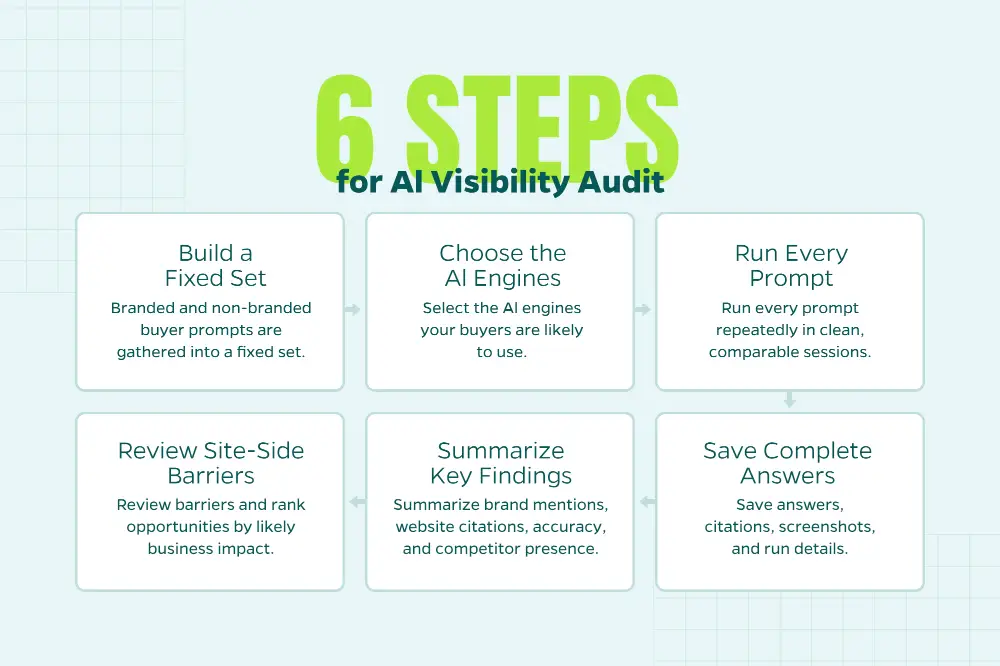
A practical AI visibility audit follows six steps, with the prompt set and testing rules established before collecting results.
- Build a fixed set of branded and non-branded buyer prompts.
- Choose the AI engines your buyers are likely to use.
- Run every prompt repeatedly in clean, comparable sessions.
- Save complete answers, citations, screenshots, and run details.
- Summarize brand mentions, website citations, accuracy, and competitor presence.
- Review site-side barriers and rank opportunities by likely business impact.
In Straight North’s September 2026 survey, 57 of 100 respondents prioritized ChatGPT, 42 prioritized Gemini, 34 prioritized Google AI Mode, and 33 prioritized Google AI Overviews. These are respondent priorities, not market-share figures. AI visibility tools can streamline capture and reporting, but the method still needs to be documented.
Which Prompts Should an AI Visibility Audit Test?
Choose prompts that represent real buyer questions, then separate them into branded and non-branded groups. Branded questions test what an AI system knows about the company; non-branded questions test whether it recommends the company when buyers have not named it.
“Include informational, comparison, commercial, and branded queries,” says Bob Hand, a Straight North Senior SEO & GEO Strategist. “Record whether an AI answer appears. Track which brands are mentioned and which sources are cited.” That mix keeps the audit from overrepresenting people who already know the brand.
“Include informational, comparison, commercial, and branded queries. Record whether an AI answer appears. Track which brands are mentioned and which sources are cited.”

A compact starter set could include:
- Branded: “[Brand]”; “What is [Brand]?”; “Is [Brand] a good [service category] provider?”; “[Brand] reviews.”
- Non-branded local: “Who offers [service] in [city]?”; “Best [service] companies near [city].”
- Non-branded niche: “Best [service] for [industry] companies.”
Adapt the examples to the actual products, industries, locations, and decisions in your sales process. Include questions from informational discovery through provider comparison, and avoid choosing only prompts where your company already appears.
Freeze each prompt’s wording before starting. If you revise a question, give the revised version a new identifier rather than combining its results with the original. Otherwise, apparent improvement may reflect a different question instead of a real change.
In Straight North’s September 2026 survey, 46 of 100 marketers said they actively tracked defined AI-search prompts, while 54 of 100 did not. A fixed prompt library is a useful first step even for a team that is not ready to purchase monitoring software.
How Many Times Should You Run Each Prompt?
One run per prompt is not enough because AI responses can change even when the question stays the same. An audit should measure how often a brand appears across repeated observations rather than treating one response as the final answer.
“I think it’s important to not overreact to one screenshot or a one-off answer,” says Bob Hand, a Straight North SEO & GEO Strategist. “AI results can vary by platform, timing, location, and even the phrasing of the question.” Repetition makes those variations visible instead of hiding them behind a single result.
“I think it’s important to not overreact to one screenshot or a one-off answer. AI results can vary by platform, timing, location, and even the phrasing of the question.”
Straight North’s documented internal tracking protocol provides a rigorous example:
Setting | Straight North protocol | Purpose |
Daily samples | Three per prompt, per engine | Measure variation |
Timing | Three spread-out times each day | Avoid a single time-of-day snapshot |
Sessions | Temporary or incognito; minimize personalization | Reduce history effects |
Location | Hold Google location settings consistent | Improve comparability |
Interface | Consumer-facing apps, not API substitutes | Test what buyers encounter |
Baseline | Daily for two weeks, then weekly | Establish baseline and track change |
The protocol covers ChatGPT, Gemini, Claude, and Google AI Overviews. Use the same supported settings throughout a study and record any interface changes. An API response may differ from the consumer experience, so do not quietly mix the two. Report appearance rates by prompt and engine, with sample counts alongside them.
This schedule is a methodology example, not a universal requirement. Smaller teams can start with fewer prompts or a shorter window, provided they disclose the limits and do not overstate precision.
What Evidence Should an AI Visibility Audit Keep?
An audit is useful only if someone can inspect its original observations. Save the raw evidence before scoring or summarizing it.
- Full answer text, preserving the order of named brands and recommendations.
- Every cited or linked URL, labeled as an inline citation, source-panel link, AI Overview reference card, or body link.
- A screenshot captured before opening citations or otherwise changing the page.
- A clear “no AI answer shown” entry when a Google query does not trigger an AI Overview.
- Prompt identifier and exact wording, engine, date, time, location, session mode, tester, and collection-method version.
A missing AI Overview is a valid observation, not a failed test. Similarly, a brand mention without a citation should not be recorded as a website citation. Those distinctions matter when you compare results six months later.
Keep a source map that identifies which outside sites AI answers repeatedly cite. If competitors receive citations where your company does not, review the specific sources before deciding what content or authority work is warranted.
AI Visibility Audit Checklist
Use this GEO checklist to confirm that the audit is repeatable, comparable, and actionable.
Area | Check | What pass looks like |
Prompts | Branded and non-branded groups defined | Buyer-relevant mix documented |
Prompts | Exact wording and IDs frozen | Revisions receive new IDs |
Engines | Relevant consumer surfaces selected | Platform list and rationale saved |
Sampling | Each prompt repeated per engine | Counts and appearance rates reported |
Sampling | Sessions and locations controlled | Settings documented |
Evidence | Full answers preserved | Original text retrievable |
Evidence | Citations and link positions saved | Links categorized by placement |
Evidence | Screenshots collected | Unmodified results captured |
Evidence | No-answer outcomes recorded | Missing AI answers counted |
Scoring | Mentions and citations separated | Clear denominators and definitions |
Competitors | Competing brands and sources logged | Comparable share-of-presence view |
Accuracy | Brand descriptions reviewed | Errors identified with examples |
Site | Crawler access and answer pages checked | Technical and content issues listed |
Reporting | Baseline and prioritized roadmap delivered | Owners and next steps identifiable |
What Should You Get Back From an AI Visibility Audit?
A useful audit should leave the marketing team with a decision-ready baseline, not just a single AI visibility score. Expect:
- Results by engine, prompt group, and individual prompt, with sampling counts.
- Competitor presence and a map of commonly cited websites.
- A documented list of crawler, content, accuracy, and third-party authority issues.
- An impact-ranked roadmap that distinguishes quick fixes from longer-term work.
- A reporting method that can be repeated with the same prompt set.
In Straight North’s September 2026 survey, 37 of 99 marketers said they regularly tracked defined GEO metrics and formally reported them, while 15 of 99 relied on occasional or manual checks. A repeatable audit gives both groups a clearer basis for reporting.
Free graders can be useful for initial exploration, but their scores depend on the vendor’s prompt selection, engines, and calculation method. An in-house team can perform a sound audit if it has time for repeated capture and technical review; a provider can help when the work spans multiple engines, complex sites, or detailed competitor research. Ask either team to explain its sampling method and deliverables.
How Do You Connect Audit Findings to Leads?
To assess business value, pair the AI visibility baseline with website analytics and lead tracking from the start. The audit can establish where your brand appears; analytics can show which identifiable AI referrals visit the site and become inquiries. Those are related measurements, not interchangeable ones.
“Today we would guess that a big chunk of the clicks, of the human traffic that we’re seeing through analytics, already a big chunk of that is AI platforms, and it’s just not separated out yet,” says Tom Lustina, Straight North’s Director of SEO & GEO. His observation highlights a measurement challenge, not a verified estimate of AI traffic. Separate known AI-referral sources where possible, while acknowledging that not every AI-influenced visit can be identified.
“Today we would guess that a big chunk of the clicks, of the human traffic that we’re seeing through analytics, already a big chunk of that is AI platforms, and it’s just not separated out yet.”

In Straight North’s September 2026 survey, 24 of 101 marketers reported being able to connect leads or conversions to AI-search visibility efforts, while 35 of 101 said leadership had asked them to connect AI-search work to leads, sales, or revenue. These self-reported responses do not establish causal attribution.
In GA4, group identifiable referrals from AI platforms, review their landing pages, and follow those sessions to meaningful conversions. Pair form submissions with call tracking and CRM lead quality when available. Keep campaign dates and site changes alongside the visibility baseline so you can assess what changed without claiming that an increase in citations caused every subsequent lead.
The goal is a measurable starting point and a prioritized plan. More mentions can be encouraging, but a credible business case also asks whether qualified traffic and inquiries improve over time.
AI Visibility Audit FAQs
Can ChatGPT do an SEO audit?
ChatGPT can help review pages and identify potential issues from material you provide. It cannot, by itself, establish what every buyer sees across repeated sessions and competing AI engines.
How can I check my AI visibility score?
A free grader can offer an initial snapshot. Ask which prompts, platforms, sample counts, and scoring rules produced its number.
What is the difference between SEO and GEO?
SEO focuses on discoverability in search results and the traffic those results produce. GEO focuses on visibility, mentions, and citations within AI-generated answers; both rely on accessible, useful content.
What is the best AI visibility audit tool?
The right tool depends on the engines, prompt volume, evidence capture, and reporting requirements. Compare options against your audit method rather than choosing by a single score.
How long does an AI visibility audit take?
It depends on prompts, engines, and sampling days. Straight North’s internal example uses a two-week daily baseline before shifting to weekly tracking.
Does ranking first on Google guarantee an AI mention?
No. Traditional rankings and AI citations can overlap, but a high organic position does not guarantee inclusion in an AI answer.
Is an AI visibility audit worth it?
It can be worthwhile when teams need a defensible view of competitor presence and an actionable baseline. Its value is stronger when follow-up reporting connects identifiable AI referrals with qualified leads.
Want Help?
Want to understand where your brand stands in AI search? Contact Straight North to discuss an AI visibility audit.