



Ask someone where they found an answer last week, and there’s a decent chance it wasn’t visiting links found on Google. Maybe they asked ChatGPT, checked Perplexity, or skimmed the AI Overview before scrolling any further. People are getting synthesized answers directly, built from a small set of sources an AI system decides are credible enough to cite. That’s a big change for brands. Visibility now depends not just on ranking, but on being trusted enough to show up in the answer.
That shift has created a new discipline: Generative Engine Optimization, or GEO. It’s the practice of shaping content so AI engines can find it, trust it, cite it, and recommend it in the answers they generate.
This article will take you through all the basics. We will outline what GEO is, how it differs from SEO and AEO, why it matters now, and which tactics give a brand a real shot at becoming a cited source.
What is GEO?
Generative Engine Optimization (GEO) is the practice of optimizing content so that generative AI engines retrieve it, cite it, and recommend it when answering user queries. It’s less about ranking and more about being chosen as a citation by ChatGPT, Perplexity, Google AI Overviews, Gemini, Claude, and similar tools.
It’s worth clearing up a common point of confusion: GEO is not about getting a brand’s website into an AI model’s training data. Training happens long before anyone asks a question, using data collected and processed in advance. GEO matters when someone asks a question and the AI engine looks for current, relevant material to build its answer. That is real-time retrieval, not training.
In other words, a brand doesn’t need to worry about whether ChatGPT “learned” from its website months or years ago. What matters is whether that content is structured, credible, and current enough to be pulled into an answer today. That distinction shapes everything else in this article.
GEO vs. SEO vs. AEO
SEO, AEO, and GEO sound like alphabet soup. Here’s how to distinguish these terms from each other.
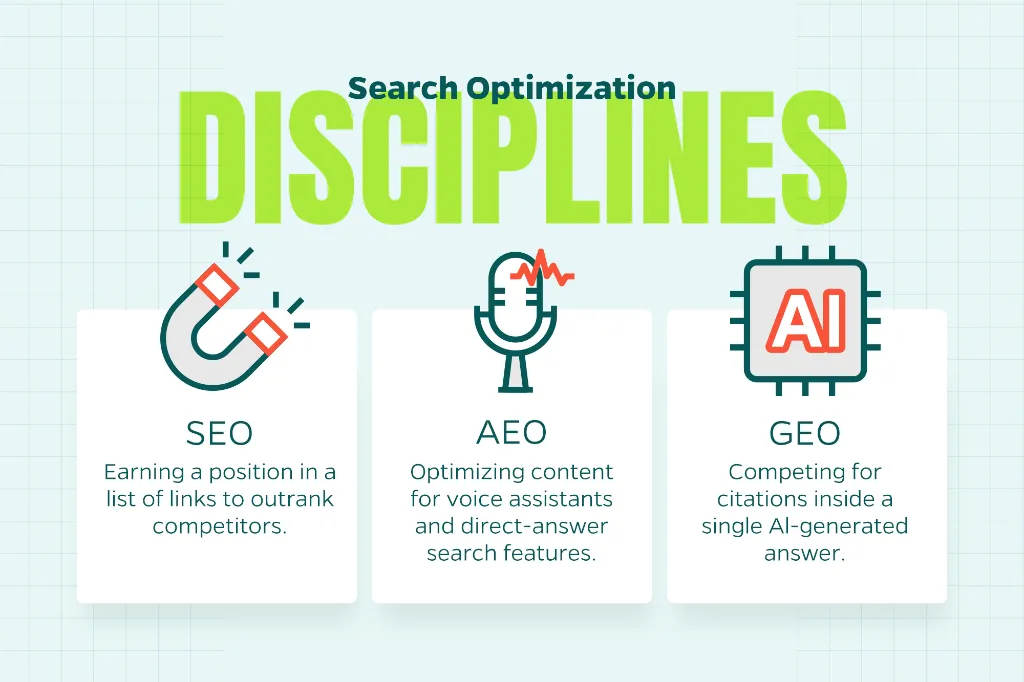
SEO (Search Engine Optimization) is about earning a position in a list of links. Rank on page one, ideally in the top few spots, and users click through to the site. The entire discipline is built around helping a page outrank competitors within that list format.
AEO (Answer Engine Optimization) emerged earlier to describe optimizing content for voice assistants and direct-answer search features. This could be showing up on featured snippets or a smart speaker reading back a single response. AEO was never a huge separate discipline, and at this point it’s largely been absorbed into GEO, since both are about winning a direct-answer format rather than a ranked list.
GEO (Generative Engine Optimization) is the newest and most demanding of the three. Instead of competing for one of ten spots on a results page, a brand is competing for one of a handful of citations inside a single AI-generated answer. The AI isn’t listing options. It’s synthesizing them into a paragraph, and only a few sources make the cut.
GEO doesn’t replace SEO. It builds directly on top of it. The two disciplines share the same foundation:
- Technical health (site speed, crawlability, mobile usability)
- Topical authority (depth of coverage on a subject)
- Relevance to the query being asked
What GEO adds is a layer of requirements on top of that foundation. This includes structure built for extraction, verifiable data, and consistency across the web that AI systems can cross-reference. A site with weak technical SEO and thin content won’t succeed at GEO either. Think of GEO as a more demanding tier built on the same base, not a separate building.
Why GEO Matters More Than Ever
The numbers behind this shift are hard to ignore. ChatGPT alone reportedly draws several hundred million weekly active users at this point. Meanwhile, Google’s AI Overviews now appear across a large share of search results, often sitting above the traditional listings where users used to click first. As AI-generated answers have become the default entry point for information, traditional click-through rates on organic listings have been trending downward. This pattern is often called the “zero-click” search problem.
A zero-click result doesn’t mean a wasted result. If an AI engine cites a brand by name inside its answer, that brand gets exposure, credibility, and top-of-mind awareness even without a click. It functions a lot like a strong mention in a trusted publication. The value shows up in trust and recall, not just in a session on the analytics dashboard.
There’s also a competitive dynamic worth flagging early. A traditional search results page can show ten or more organic listings, giving plenty of brands a shot at visibility. A generative AI answer typically draws from a much smaller pool of cited sources, often just a handful. Fewer available slots means more competition for each one. So, brands that build strong GEO practices now have a head start over the ones who wait until the space gets crowded. Being early to this shift is a meaningful advantage while the playing field is still forming.
How Generative Engines Choose Sources
To optimize for something, it helps to understand how it works. Most generative AI engines rely on a process called retrieval-augmented generation, or RAG. In plain terms: rather than answering purely from what the model learned during training, the system searches for current, relevant content in real time. It pulls the most useful passages, and then uses those passages to construct its answer. That’s why a brand’s live, current website content matters so much. It’s the raw material the AI reaches searches for during the query.
When engines decide which sources are worth pulling from and citing, a handful of signals tend to carry the most weight:
- Authority and credibility: Does the source have a track record of accurate, trustworthy information on this topic?
- Structural clarity: Is the content organized in a way that’s easy to extract, with clear headers, direct answers, and well-defined sections?
- Freshness: Is the information current, or does it look outdated?
- Direct answerability: Does the content answer the question being asked, without burying the point in unrelated material?
- Corroboration across sources: Does the same fact or claim appear consistently across multiple credible sources, or does it stand alone?
It’s also worth understanding that not all generative engines work the same way. Some, like Perplexity and Google AI Overviews, lean heavily on real-time retrieval. They’re actively searching the live web when a question is asked. Others draw more heavily on what the underlying model absorbed during training, supplementing that with retrieval rather than relying on it as the primary source. That distinction matters for strategy. Real-time retrieval engines reward fresh, well-structured, currently accessible content, while training-influenced responses depend more on the volume and consistency of a brand’s presence across the web over time.
Understanding this mechanism is the difference between guessing at GEO tactics and applying them with intent. Every strategy in the next section exists because it strengthens one or more of these signals.
Core GEO Strategies and Tactics
This is where GEO moves from theory to practice. The following tactics are the ones doing the heaviest lifting right now.
Lead with the answer. Generative engines tend to pull from the parts of a page that most directly answer the query. That’s often near the top. Front-load a clear, complete answer in the first 150 to 200 words of any piece before diving into supporting detail. Don’t make an AI engine (or a human reader, for that matter) hunt for the point.
Structure content for extraction. AI systems are essentially looking for clean, quotable chunks of information. Here are some formatting choices that help:
- Clear, descriptive headers that match how people phrase questions
- Bullet points and numbered lists for anything with multiple parts
- Defined terms, especially for industry-specific language
- FAQ sections that mirror common questions word-for-word
- Short “answer blocks” such as a tight paragraph that fully answers one specific question
Back claims with data. This is one of the most consistently supported tactics in the research. A 2023 Princeton study found that adding statistics and citing credible outside sources produced some of the largest gains in visibility across the methods tested, in some cases boosting citation rates by roughly a third or more. Vague claims (“many businesses struggle with X”) get skipped over in favor of specific, sourced ones (“a recent industry study found X”).
Add expert quotes and bylines. A named author with relevant credentials, or a quote from an internal expert, signals credibility in a way that anonymous content simply can’t. AI engines weigh trustworthiness heavily, and a byline is one of the clearest trust signals a page can carry.
Use structured data and schema markup. Schema helps machines, not just AI engines but search engines generally, understand what a page is about. That includes what entity it describes, what questions it answers, and what type of content it is. This doesn’t guarantee a citation, but it removes friction for the systems trying to parse the page correctly.
Build topical authority through depth, not density. Keyword stuffing was already a weak SEO tactic, and it performs even worse for GEO. What works instead is depth. Cover a topic thoroughly, link related pieces together into a coherent cluster, and demonstrate that a site is a real authority on the subject rather than a page that happens to mention it.
Keep brand facts consistent everywhere. Generative engines often cross-reference multiple sources to corroborate a claim before including it in an answer. That means a brand’s name, address, services, credentials, and other core facts need to match across its website, directory listings, review platforms, and any Wikipedia-style profiles. Inconsistency across the web undermines trust signals even when the primary website itself is accurate.
Keep content current. Freshness is a real ranking signal for retrieval-based engines. A page that hasn’t been touched in years, even if it was excellent when published, is less likely to get pulled into an answer than a comparable page that’s been recently reviewed and updated. Building a review cadence into content operations, not just publishing and forgetting, is now part of the job.
None of these tactics work particularly well in isolation. The research is clear that the strongest results come from combining several of them at once, rather than picking one and hoping it carries the whole strategy.
Measuring GEO Success
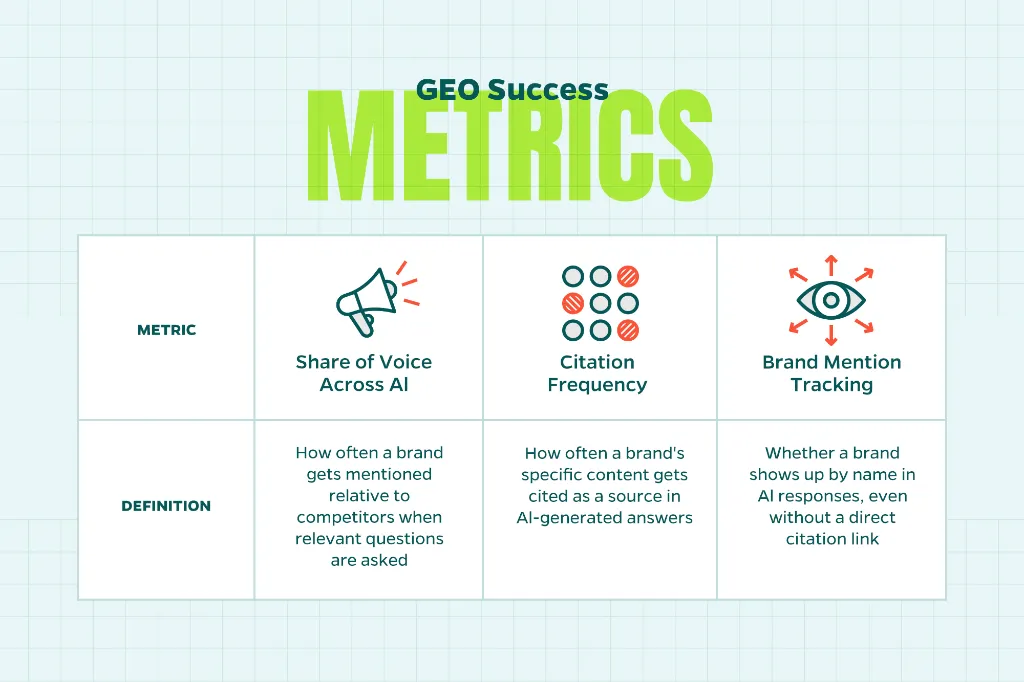
Traditional analytics were built for a world of clicks and rankings. GEO calls for a different scoreboard, because success can happen even when a user never visits the site. Here are some KPIs worth tracking:
- Share of voice across AI models — how often a brand gets mentioned relative to competitors when relevant questions are asked
- Citation frequency — how often a brand’s specific content gets cited as a source in AI-generated answers
- Brand mention tracking — whether a brand shows up by name in AI responses, even without a direct citation link
Measuring this well typically requires prompt testing. You should run a consistent set of representative questions through ChatGPT, Perplexity, Gemini, and other engines on a regular schedule, then log whether and how a brand appears. A growing set of citation-tracking platforms now automate much of this work, monitoring AI visibility the way rank-tracking tools once monitored search positions.
That said, traditional analytics platforms weren’t built to capture referral value from an AI-generated answer that never resulted in a click. They also weren’t built to show whether a brand got mentioned in a response the user read but didn’t act on. Relying on click data alone will understate, sometimes badly, how much value GEO efforts are producing. A complete measurement approach layers AI-specific tracking on top of traditional analytics rather than replacing one with the other.
Common Myths and Misconceptions
A few misunderstandings show up constantly in conversations about GEO, and they’re worth addressing directly.
“GEO replaces SEO.” Not even close. GEO depends on the same technical and authority foundation SEO has always required. Neglect one and the other suffers too.
“Keyword stuffing still works.” It hasn’t worked for SEO in many years, and it performs even worse for GEO. Generative engines are built to identify well-supported answers, not pages padded with repeated phrases.
“Results are instant.” Building the kind of authority, structure, and cross-web consistency that earns AI citations takes sustained effort, typically measured in months rather than days. There’s no shortcut that skips the groundwork.
Getting Started with GEO: A Practical Checklist
For a team ready to start applying GEO, here’s a scannable starting list:
- Audit key pages to confirm they answer their target question within the first 150–200 words
- Add clear headers, bullet points, and FAQ sections structured around real user questions
- Back major claims with specific data, statistics, or named sources
- Add author bylines and relevant credentials to key content
- Implement or update schema markup across priority pages
- Build topical depth through interlinked content clusters instead of isolated pages
- Audit brand information across directories, review sites, and profile pages for consistency
- Set a recurring schedule to review and refresh existing content
- Start running prompt tests across major AI engines to establish a baseline for current visibility
Tackling all of this at once isn’t realistic for most teams. Start with the pages most likely to answer high-value questions, and expand from there. This approach tends to produce the fastest visible traction.
Conclusion
GEO isn’t a replacement for SEO, and it isn’t a passing trend. It’s the next layer of a discipline that’s always been about earning trust and visibility wherever people go looking for answers. This increasingly means inside an AI-generated response instead of a list of links. The brands that treat GEO as additive, building on strong technical and content foundations rather than chasing shortcuts, are the ones positioned to be the source an AI cites.
Need Help?
If your team wants help building a content and technical strategy that positions your brand for AI-generated search, Straight North’s team is ready to talk. Reach out to start the conversation.