




Key Takeaways:
- Backlinks alone no longer define authority.
- External validation strengthens E-E-A-T.
- Expert visibility builds trust and credibility.
- Consistency across the web matters.
- Proof drives AI visibility and buyer trust.
Off-site SEO used to mean one thing: earning backlinks. Strong link profiles and third-party metrics were widely used to estimate a website’s authority and ability to rank. Those signals still matter, but they were always proxies for something much bigger: credibility.
AI-powered search rewards brands whose expertise is consistently reinforced by independent signals across the web. Reviews, experts, original research, and media coverage provide the proof AI uses to evaluate credibility.
Straight North Senior SEO & GEO Strategist Bob Hand explains this shift that has also transformed digital PR. Rather than focusing primarily on earning links, PR now helps build the external validation that reinforces Google’s E-E-A-T framework (Experience, Expertise, Authoritativeness, and Trustworthiness).
The question is no longer Who links to us? It’s What does the broader web independently confirm about us? A brand with a strong website but no external validation won’t be recognized as a credible authority. That recognition goes to brands whose expertise is consistently confirmed across trusted third-party sources, earning them visibility in both traditional and AI-powered search. This shift is often called GEO, or generative engine optimization — the practice of earning visibility inside AI-generated answers rather than just traditional search rankings.
Off-Site Authority Is No Longer Just About Backlinks
Backlinks remain an important ranking signal, but they were never meant to measure credibility on their own. Likewise, metrics like Domain Authority and Domain Rating provide useful estimates of a site’s link profile, but they can’t fully capture relevance, reputation, or trust.
Instead, strong content and genuine expertise often attract backlinks naturally. The opposite isn’t always true. A large volume of links doesn’t necessarily mean a brand is well known, respected, or trusted by the audiences that matter most. In many cases, a handful of relevant mentions from respected industry sources carries more weight than dozens of generic or low-context backlinks.
That’s one reason manipulative link-building tactics have lost much of their value. Blog networks and other schemes may create links, but they don’t create genuine credibility. AI search systems are increasingly able to distinguish between manufactured signals and independently earned credibility.
Reviews, customer sentiment, trade coverage, expert quotes, any third-party comparisons may influence how users and search systems interpret the brand. So, they really matter from a discoverability context now. AI search makes this more important because answers may be shaped by what is said across multiple sources, not just by links pointing to a page. If the inferred reputation of your brand is understood by someone using an AI tool, that may influence whether they even discover your brand. Or really choose to look deeper into it. Really, at the end of the day, SEO teams should ask whether external signals are relevant, credible, current, and aligned with the brand’s expertise. So, when I say external signals, what is the web saying about you? The better question isn’t: how many links do we have? It’s: do trusted sources validate that we belong in this conversation to begin with?
That’s because generative AI systems assess pages differently from the way traditional search engines do. They synthesize answers by checking whether multiple independent sources agree, which is why cross-source validation now carries more weight than link volume. The goal is to build enough independent evidence for people and AI systems to understand why your brand belongs in the conversation.
AI Looks for Evidence, Not Marketing Claims
For years, marketers focused on creating stronger websites. If the content was comprehensive, the technical SEO was sound, and enough quality websites linked back to it, the page stood a good chance of ranking well.
AI-powered search changes that equation.
Instead of evaluating a website in isolation, AI systems compare information across the broader web to determine whether a company’s claims are independently supported. They look for corroboration. If your website says you’re an industry leader, AI looks for evidence that other credible sources reach the same conclusion.
It really boils down to relevance. The most useful external validation comes from sources that are relevant to your brand’s industry or audience. Trade publications, reputable media coverage, expert interviews, professional associations, any industry awards. High-quality reviews, even. They can be especially useful because they reflect real user or customer experience. So, any evidence that you’re being engaged with and there are positive experiences is going to give better credence that you’re going to provide a worthwhile answer to the query. Third-party comparison pages or directories can also reinforce category relevance, especially if they’re reputable and current.
The question isn’t simply whether your website makes a compelling case. It’s whether the broader web tells the same story.
A brand with excellent on-site content but little outside validation may struggle to stand out because AI has fewer independent signals confirming its credibility. Meanwhile, when multiple trusted sources consistently describe a company in similar ways, AI can interpret that consistency as confidence.
The Evidence Layer
No single review, media mention, expert contribution, or industry profile establishes authority on its own. Together, these independent signals create a body of evidence that reinforces the expertise your website claims to have. As those signals become more consistent, they’re easier for both AI systems and potential customers to recognize and trust.
Your website communicates expertise. The rest of the web determines whether that expertise is independently recognized.
Reviews Build Trust Before the Click
Reviews have always influenced purchasing decisions, but in AI-powered search they also shape whether your brand appears trustworthy before someone ever visits your website.
Unlike marketing copy, reviews come from customers, making them one of the strongest forms of independent validation. AI systems evaluate star ratings, and they analyze review language, recurring themes, and customer experiences to build a more complete picture of your business.
“The most credible review profile usually has volume, recent reviews, detail, and just visible accountability.”
Senior SEO & GEO Strategist | SEO & GEO Authorship Expert
That means a strong review profile is about more than collecting five-star ratings. Specific, detailed reviews provide far more context than generic praise, while recent reviews demonstrate that positive experiences still reflect your business today.
Thoughtful responses matter, too. Professional replies — especially to negative feedback — show accountability and reinforce trust, even when every review isn’t perfect.
Finally, reviews need to appear where your audience expects to find them. Google Business Profile, industry-specific review sites, and trusted directories all influence how both buyers and AI systems perceive your brand. For many prospects, that first impression forms before the click, making a well-managed review profile an important trust signal long before they reach your website.
Media Coverage Creates Independent Proof
Not all media coverage carries the same weight. In an AI-driven search environment, what matters isn’t simply earning mentions. It’s also about earning recognition from credible sources that reinforce your expertise.

Most useful media coverage is relevant, credible, and connected to your actual expertise. Trade publications are often more valuable than generic, broad coverage, because they show recognition within the right industry. Media coverage is strongest when it creates a clear association between the brand and the topic it wants to own. For AI visibility, this matters because external sources help confirm that the brand is not just self-promoting, that it’s being recognized by others.
When reputable industry publications quote your experts, reference your research, or feature your insights, they provide independent validation that others recognize your expertise. Original research, expert commentary, customer success stories, interviews, webinars, podcasts, conference presentations, and legitimate industry awards all reinforce your authority because they demonstrate expertise through independent recognition rather than self-promotion.
Every mention should strengthen your association with the topics you want to own. Consistent recognition from trusted sources gives both buyers and AI systems greater confidence in your expertise.
High-Value PR vs. Generic Publicity
Distribution alone doesn’t create credibility.
Generic syndicated press releases and low-quality directories often repeat marketing messages without adding meaningful context or editorial validation. High-value PR is earned through reputable publications that connect your brand to genuine expertise through original research, expert commentary, data, or real-world outcomes.
The best PR continues creating value long after publication by supporting search visibility, buyer trust, and AI understanding.
A simple test can help evaluate any opportunity: Would this mention make a prospective customer or AI search system more confident in our expertise?
If the answer is yes, you’ve likely created meaningful external validation. If not, the mention may generate awareness, but it probably won’t strengthen your E-E-A-T.
Expert Visibility Makes Expertise Verifiable
Behind every credible brand are the people who make its expertise tangible.
A company can claim to have deep industry knowledge, but those claims become far more believable when they’re backed by recognizable subject matter experts. Authors with relevant experience, credentials, and a visible professional presence transform marketing claims into verifiable expertise.
When experts are consistently quoted in industry publications, speak at conferences, appear on podcasts and webinars, or publish insights beyond the company website, they strengthen their own credibility while reinforcing their organization’s authority. It’s especially valuable in technical, regulated, or high-consideration industries, where buyers want to know exactly who is behind the advice they’re reading.
Companies don’t demonstrate expertise. People do. Organizations build authority because people earn credibility.
Building an Expert Footprint
Expert visibility means showing up consistently in the right places.
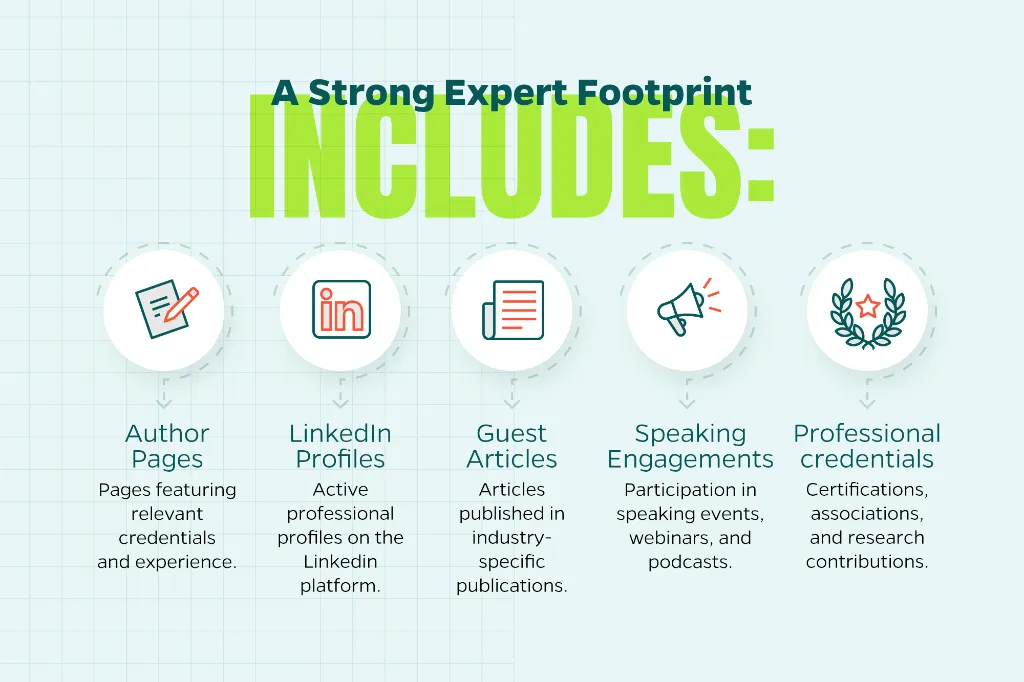
Consistency matters just as much as visibility. Each expert should own a defined area of expertise rather than commenting on every topic. Repeatedly contributing meaningful insights within the same subject builds recognition over time, while jumping between unrelated topics can dilute credibility.
Organizations can also maximize expert contributions by repurposing a single interview or presentation into blog articles, social posts, newsletters, media commentary, and other content. Connect every piece of content to someone with a visible, credible, and consistent professional footprint.
Consistency Across the Web Builds Entity Clarity
AI search doesn’t evaluate your website in isolation. It compares information across your About page, Google Business Profile, review sites, media coverage, author profiles, directories, and other third-party sources to understand who your company is and what it’s known for.
When those sources consistently reinforce the same expertise, services, and positioning, they create entity clarity, which gives search engines and buyers confidence in your brand. When they conflict, they create uncertainty.
Building a Consistent Brand Presence
Start by defining the topics, services, and expertise you want your brand to own. Then make sure every major touchpoint reinforces that positioning, including your website, Google Business Profile, LinkedIn profiles, author bios, directories, and media profiles.
Consistency doesn’t mean using identical wording. It means communicating the same expertise everywhere your brand appears.
As your business evolves, keep descriptions, service offerings, locations, and expert bios up to date. Focus on the platforms your audience actually uses, and ensure your SEO, PR, and content teams reinforce the same core themes.
The result is simple: every accurate, aligned mention strengthens your authority. Every contradiction weakens it.
Why SEO and PR Can No Longer Operate Separately
The traditional boundaries between SEO and public relations are disappearing.
Historically, SEO focused on improving search visibility, while PR focused on building awareness. AI search has changed that dynamic.
SEO teams can identify priority topics, search demand, competitor gaps, and questions buyers are asking the PR teams can then identify story angles, media opportunities, expert sources, and publication targets. When, in conjunction, they can build campaigns around topics that matter for both search visibility and brand credibility. SEO can help PR understand which topics support long-term authority, not just short-term coverage, while PR can help SEO earn external validation that owned content cannot create by itself. Original research is a strong collaboration point because it can support blog content, media pitches, backlinks, sales materials, and overall AI search visibility.
Neither discipline is enough on its own. Great content without external recognition lacks the evidence AI uses to validate expertise. Likewise, media coverage that isn’t tied to strategic topics may generate awareness, but it won’t contribute to long-term authority.
Original Research Connects Both Disciplines
Original research is one of the clearest examples of SEO and PR working together. A single research project can fuel authoritative content, earn media coverage, attract backlinks, support sales conversations, and generate the independent citations that strengthen AI visibility.
Together, SEO and PR create more than rankings or publicity. They build authority that’s supported by evidence across the web.
Measuring Whether Your Brand Is Actually Trusted
Building authority is only half the challenge. You also need to understand whether the broader web actually recognizes your expertise.
Don’t rely on AI answers alone. Instead, evaluate the signals buyers and AI systems encounter across your online presence.
Start by reviewing your branded search results. Do they accurately reflect your services, expertise, and positioning? Are your review profiles current? Do trusted third-party sources reinforce the same story your website tells?
Then look at AI search. Are you mentioned in AI-generated answers for important industry questions? Are your content, research, or third-party sources being cited? How is your brand being described?
It’s also worth reviewing comparison searches such as “best,” “top,” or “alternatives” to understand how your brand is positioned against competitors, and whether your subject matter experts are consistently recognized for the topics they own. Once you’ve identified where the gaps are, the fixes are the same levers covered earlier: strengthening reviews, expanding expert visibility, or pursuing media coverage in the areas where your credibility is thinnest.
Look for Patterns, Not Perfection
Don’t overreact to a single AI response. Large language models change constantly, and individual answers can vary.
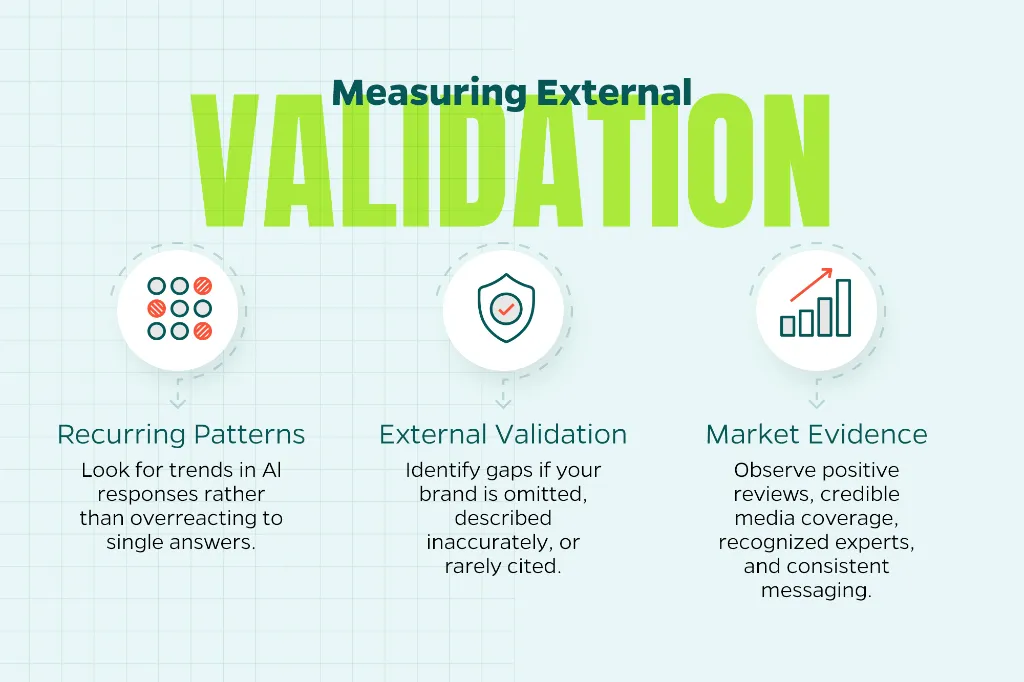
Ultimately, measuring trust isn’t about chasing perfect AI answers. It’s about identifying consistent evidence that the market and AI recognize your brand as credible.
Authority Is Built Through Proof
For years, SEO measured authority largely through pages and links. High-quality content and backlinks remain important, but they no longer tell the complete story.
Today, authority is built through evidence.
AI-powered search rewards brands whose expertise is consistently reinforced by independent sources across the web.
That shift is why PR has become an essential part of modern SEO. While SEO helps brands create authoritative content around the topics they want to own, PR generates the third-party validation that reinforces those claims.
- Reviews build trust.
- Experts establish credibility.
- Original research earns recognition and citations.
- Media coverage provides independent validation.
That doesn’t mean every off-site opportunity deserves equal attention. Instead, organizations should focus on the areas that matter most to their business goals. Start with the products, services, topics, and markets that drive growth, then identify where your external credibility is weakest. Those gaps often represent the greatest opportunities to strengthen your authority.
The brands that succeed in AI search will be those whose expertise is consistently reinforced wherever buyers and AI systems look for information.
Real authority is confirmed beyond the company’s own website. A brand that only appears authoritative on-site may have polished content, but little external proof. If you have real authority, and you have customers and publications, experts, partners, reviewers, and industry sources reinforcing your credibility, you’re going to look more trustworthy to AI search systems, and ultimately, at the end of the day, to buyers. The difference between a successful brand and an unsuccessful brand is proof.