



It’s Friday night and you’re craving barbecue. You open Google and type: “best BBQ restaurants near me.” Within seconds, you get a list of nearby spots, reviews, and directions.
For years, Google has had something incredibly valuable: direct access to real search behavior. Every query including “best BBQ near me,” “top ribs in Austin,” “BBQ restaurants open now,” fed into a dataset that revealed how people actually searched. That data became the backbone of keyword tools and SEO strategy.
AI prompt tracking tools don’t have that same visibility yet. These tools can’t see how users phrase prompts inside ChatGPT, Claude, Perplexity, or Google’s AI Mode. Instead, they rely on approximations using synthetic prompts generated by AI models, sampled datasets, and patterns derived from traditional search behavior.
I sat down with Straight North’s Chief Operating Officer Aaron Wittersheim, and Director of SEO Tom Lustina to discuss the wave of AI prompt tracking tools that increasingly claim they have visibility into prompts, citations, mentions, and competitive performance inside AI engines.
They break down what’s actually happening behind the scenes, what today’s tools can (and can’t) tell you, and how marketers should think about AI prompt tracking without falling for misleading metrics.
The Biggest Misconception in AI Prompt Tracking
Much of today’s AI prompt tracking is based on educated guesses. Tools infer likely prompts using AI-generated prompts, traditional search data, and other assumptions. As a result, companies are seeing what tools believe users might be asking rather than what they are definitively asking.
The best that they can do is say, hey, this is how your audience is searching within traditional search, and we think that’s how they are searching within, within ChatGPT, within AI mode, etc., all of those other places. The fact is, though, that those platforms aren’t releasing that, so it’s a total guess. It’s an educated guess, a really good guess, based on other information. But if there’s a promise that this is how your audience is searching, nobody knows that.
AI platforms closely guard prompt-level data because it reflects user behavior, product performance, and future advertising opportunities. Without direct data from AI platforms, prompt insights today remain speculative rather than definitive.
What’s Missing Today Is Real Volume Data
Google processes billions of searches every day, which gives marketers insight into how often specific queries occur. That volume data helps teams prioritize which topics deserve the most attention.
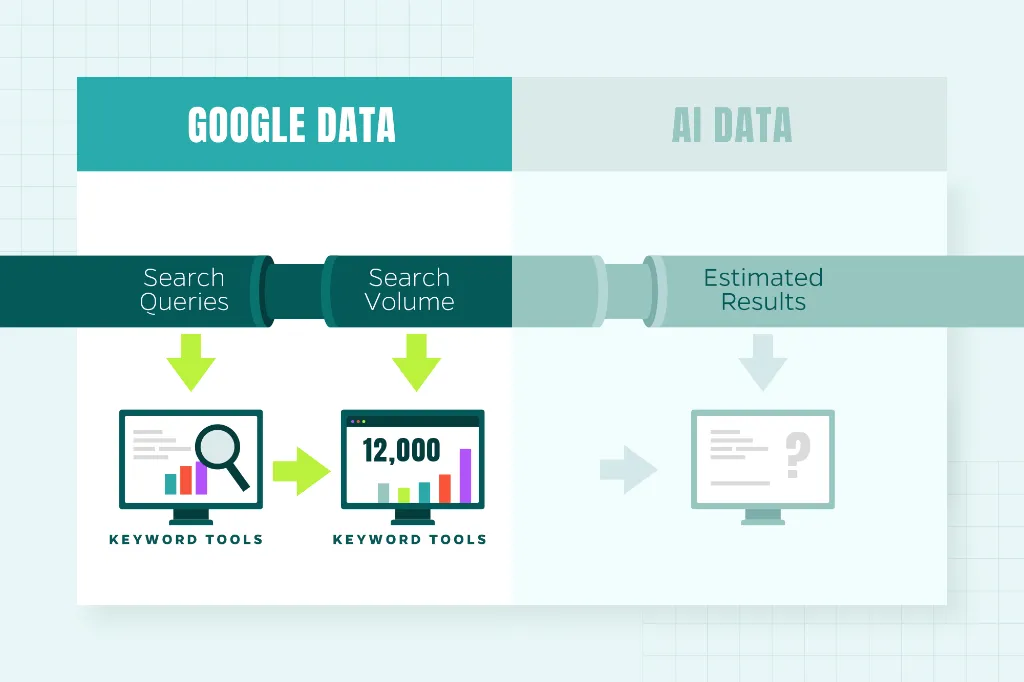
In traditional SEO, search volume is everything. It’s the data point that determines which keywords to pursue, which content to build, and where to invest. With AI prompt tracking, that number simply doesn’t exist. Without that data, marketers cannot confidently answer questions like:
- How many people are asking a prompt?
- Which topics matter most?
- Which prompts deserve the most investment?
Once AI platforms introduce advertising products, that will change.
AI Prompts Are Harder to Track Than Traditional Keywords
Go back to the original example of searching for BBQ near you. That’s how traditional search typically works. Although it has become much more conversational over time, it remains concise and keyword based.
In contrast, AI search is necessarily more conversational. Users add more context and may even explain their needs in paragraph-length prompts. They may also use voice inputs, refine their prompts several times to get to the best answer, and interact differently across platforms.
In AI platforms, it’s your best chance of getting the best answer is to give as much context as possible, and that’s why we see paragraphs there versus exact questions, and that’s why it’s really hard to duplicate, but it’s a matter of giving everything that you know, and then ChatGPT or others saying, okay, here’s the best response based on… based on the entire world.
Tom added that the personalization layer compounds the complexity. AI platforms have memory. They know what you’ve asked before. Two people typing the identical prompt into an AI engine can receive completely different answers, and neither answer is representative of what a third user would see.
“If five people asked ChatGPT the exact same question in the exact same manner, they’re likely to get different outputs. So how are you monitoring prompts when all the output is different?”
Why So Many Platforms Rushed This to Market
AI has quickly become the marketing world’s latest gold rush. Interest is surging from both global brands and smaller companies eager to understand how they appear in AI-driven search experiences. In the rush to meet that demand, many platforms are racing to launch AI tracking products and claim early market leadership. But in many cases, the sales narrative is more mature than the underlying data.
You’ve got those big brands that have large budgets, you’ve got smaller companies that have smaller budgets, but they all want this technology. They’re all overlooking the data that’s underlying the technology, and they’re just rushing into the market to basically land on, you know, to deliver on the huge promise that these platforms are making. It’s kind of a gold rush, you know? It’s the AI gold rush. These software companies stand to make a ton of money, and the ones that are first to market, and the ones that have the best technology and the functionality, they’re gonna make a lot of money. And so, you know, so that’s kind of… that’s the situation we’re currently dealing with AI prompt tracking. And again, this is the foundational structure. It’s going to come to life one day.
Some tools generate prompts using AI with no real audience data behind them, while others rely on tiny samples of third-party or anonymous data and then generalize broadly from it. The promise is huge, and with so much curiosity around AI visibility, companies are often willing to pay a premium for insights that are still evolving.
Volume Data Will Come — When Advertising Does
There is a clear path to when this data will be released: advertising platforms. Just as Google’s keyword volume data is fundamentally tied to its ad business, AI platforms will release query data only when advertisers are paying for it.
We will know volume when ChatGPT and Google AI Mode and all of the others release their advertising platform, because that understanding volume, understanding search behavior only comes after there is an advertising platform. Because people are paying for that information, so they get that information. Since advertising isn’t there yet, since they haven’t fully released that, they have no incentive to release that. So, we’re all waiting around for advertising to be released, so then they release that data. So, yes, it will be released at some point, it’s not until they perfect their advertising model and launch it.
Volume and behavior data from AI platforms will arrive alongside their advertising products. Until then, all prompt tracking is grounded in estimation. The best platforms are honest about this, and the best clients ask them to be.
When advertisers can target audiences and measure performance, platforms will have stronger incentives to release useful behavioral insights.
“As they start improving the advertising model, they have to turn some level of data over to advertisers to allow those advertisers to best target their ads to their audience for their products and services.”
Even then, the data will likely appear as grouped themes, aggregated patterns, and estimated volumes rather than exact prompt logs.
Setting Better Prompt Tracking Expectations
Prompt tracking tools are beginning to offer marketers a glimpse into how audiences might interact with AI search, but the data behind them is still largely inferential. However, because AI platforms like ChatGPT and others do not release prompt-level data, most tools rely on AI-generated prompts, traditional search queries, or other predictive modeling.
Credible vendors frame their data as informed estimates rather than definitive measurements. Companies should be cautious of vendors claiming to know exact prompt behavior, report precise search volumes, or map the entire AI search universe.
It’s good to get, you know, to start using this, to start seeing what technology is in the market, but you just gotta be very careful with what you’re putting into it, and the output that you’re getting, and then what actions you’re making based on that output. So, it’s more of a kind of a learning phase that we’re in, instead of a full action, you know, phase.
They have unlimited budgets to figure out AI prompt monitoring. The best partners will tell you, we don’t fully know this. We have educated guesses, and that can help us today, but this isn’t the full universe of knowledge that you think it is right now.
This reinforces an important reality: AI prompt data isn’t precise or complete. Because prompts and outputs vary widely, a more practical KPI may be visibility percentage rather than individual prompt rankings.
For example, instead of asking whether a brand ranks for one specific prompt, marketers can measure how often their brand appears across a representative prompt set and track whether that visibility improves over time.
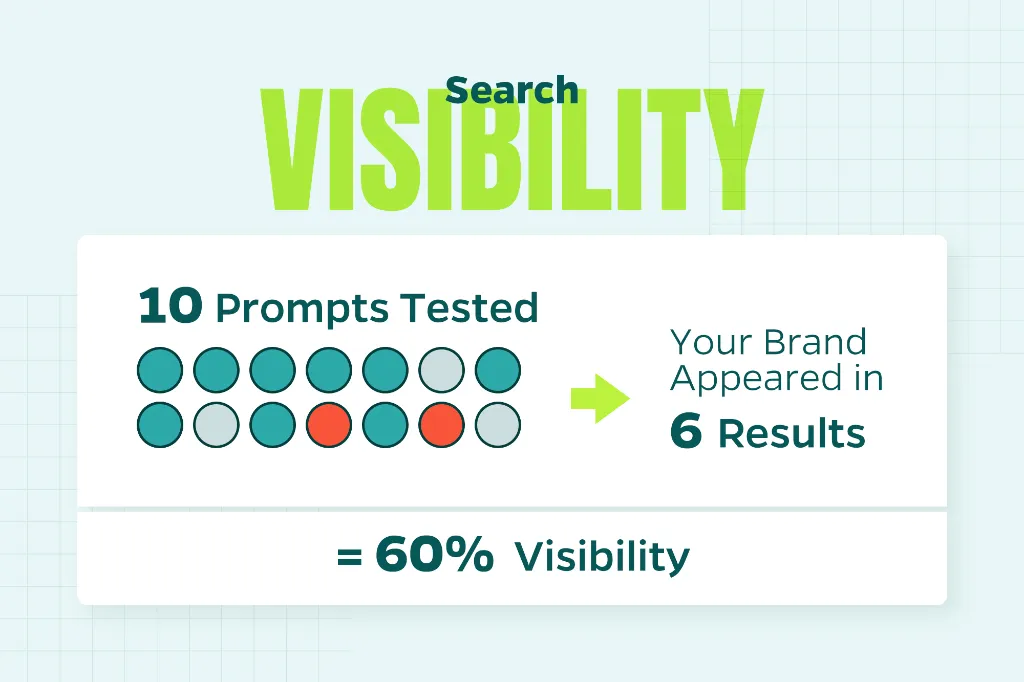
Supporting metrics from representative prompt sets may include:
- Citation frequency – how often a brand’s content is cited in AI responses
- Source diversity – whether AI platforms reference multiple pages or domains from the brand
- Brand sentiment – how the brand is described within responses
- Total referral traffic from AI platforms – visits arriving from tools like ChatGPT or Perplexity
What Companies Should Actually Pay For
Brands should not overly invest in current AI prompt tracking. A small, meaningful set of prompts can be as useful as a huge list. Plus, prompts are infinite in nature, so it can be wasteful to pay per prompt.
Instead, brands can follow a simpler approach:
- Select a representative set of prompts
- Focus on prompts tied to strategy, brand perception, or high-value topics
- Use findings to inform content and visibility improvements
“There’s no reason to pay for every single possible prompt that you think they might be using. Just think about what are the most meaningful for you to create a strategy around, and that’s what you should focus on.”
Why Good SEO Is Still the Foundation of Good GEO
Strong SEO remains one of the most reliable starting points for visibility in AI-generated answers. Despite the shift toward conversational interfaces, AI systems still rely heavily on the open web to discover and synthesize information. In most cases, the sources AI systems cite come directly from pages that already perform well in traditional search results.
Brands that consistently answer customer questions clearly, publish comprehensive content, and build strong authority signals are more likely to appear in the sources AI models reference. In practice, improving AI visibility often looks very similar to improving traditional search visibility: create helpful content, demonstrate expertise, and earn trust across the web.
“The key element that will always be there, and an important point for us to stress, is good SEO is good GEO, and SEO is the foundation.”
The Future of Prompt Data: Theme-Based Volume
AI responses are also far more personalized than traditional search results. The output a user receives can vary depending on:
- Platform used
- Prior conversation history
- Memory settings
- Stated preferences
- Phrasing
- Location or context
As a result, two users entering the same prompt may receive different answers. This variability is why future prompt data will likely be grouped into broader themes rather than tied to exact phrasing.
We do think that the initial output of these platforms, from an advertiser point of view, will be grouped, you know, will be theme-based words, you know, similar to what we’ve been seeing in the last, you know, recent months with Google Search Console. They’ve started to create groups of keywords, and that’s gonna be the best way for, you know, for these platforms to share that data, for the advertisers to consume it, and for also for us to monitor the prompts and, you know, what the visibility in there, the mentions, the brand sentiment. That’s how we’re kind of looking into the future, very theme-based.
The platforms will use AI to group all of this into themes and produce volume data based on that, which will be so much more meaningful to us than what we have now, because again, that volume data is totally just absent at this point. But, you know, Aaron makes a great point about that, where everything is just so unique. It’s personalized, personalized inputs, personalized outputs.
Best Practices for Today and Beyond
AI prompt tracking is promising but still immature. Today’s tools can guide strategy and highlight emerging opportunities, yet they cannot fully reveal how audiences interact with AI systems.
Brands that succeed will set realistic expectations, avoid hype, invest in strong SEO and GEO fundamentals, and use directional insights to guide learning.
Want to improve AI visibility without overreacting to flawed prompt data? Start with the fundamentals: better SEO, stronger source presence, and smarter measurement.
The whole point of tracking prompts, is to actually improve your visibility for those prompts, you know, for those responses. So once we have better data, all this, you know, the whole inner workings of, you know, what prompts are we gonna track, what’s the output of those prompts, how many people are searching for those prompts, what, you know, what sources are coming back from a web… you know, from our clients’ websites, and then from the rest of the internet and all those websites about our client. And then what are we going to do about it to improve those results? That’s the real end goal of this whole thing.
But where I think we’ll go, from, like, a metric standpoint and a strategy standpoint is prompt visibility… or, like, a visibility percentage. So, as Aaron said, every answer is going to be different, every question’s different, every answer is different, but if we agree on what the basic and most common prompts are. And you look at those responses every day over a month. Then the visibility percentage would be your brand is showing up for this query that we think is a very representative query. Your brand’s showing up 60% of the time, your brand’s showing up 70% of the time. Knowing that every single time, it’s different how often you’re showing up for a representative prompt is very telling information, and something that we could work with.
The Strategic Takeaway: Treat This as a Learning Phase
AI prompt tracking is advancing quickly, but the measurement ecosystem is still in its early stages.
Today’s tools can highlight patterns and surface potential opportunities, yet they cannot fully reveal how audiences interact with AI systems. For that reason, organizations should treat prompt tracking as an exploratory tool rather than a definitive decision engine.
The current phase of AI visibility is best approached as a learning period.
I mean, I think it’s exciting that there is technology out there, and everything’s getting better, and ChatGPT is, you know, on the verge of opening up additional access to their ad platform. I’m sure Perplexity and Claude and other AI platforms are going to be following. And so it’s an exciting time. It’s, it’s just still, very early in how this whole model’s gonna work.
For now, brands should stay engaged but cautious. That means focusing on practical experimentation and strong fundamentals while the underlying data infrastructure evolves.
Specifically, organizations should:
- Prioritize strong foundational SEO, which remains the backbone of AI visibility
- Monitor referral traffic from AI platforms
- Prepare to adapt quickly as platforms introduce better measurement and advertising data
In other words, the current moment is less about perfect measurement and more about building understanding and positioning for the future of AI search.