


If your business shows up in local search results with three different phone numbers and two different addresses, search engines notice. That kind of inconsistency is more common than most businesses realize, and it quietly undermines local SEO performance.
A NAP audit is the process of reviewing and correcting your business’s Name, Address, and Phone number across every online listing, directory, and platform where it appears. It’s not glamorous work, but it’s foundational. This article explains how to do it right.
Why NAP Consistency Matters for Local SEO
Google’s local ranking algorithm places significant weight on trust signals. When your business information matches across your website, Google Business Profile, Yelp, Bing, and dozens of other directories, it reinforces that your listing is legitimate and accurate. When that information conflicts — an old suite number here, a missing area code there — it introduces ambiguity that can suppress your rankings.
Beyond rankings, inconsistent NAP data creates a frustrating experience for real people. A customer who calls a disconnected number or drives to a location that moved six months ago isn’t coming back. Clean, consistent data protects both your SEO and your reputation.
Step 1: Establish Your Master NAP
Before you start fixing anything, decide on the exact version of your NAP that every listing will match. This is your master NAP, and it should reflect what’s on your website. That means what is specifically in your footer, contact page, and any embedded schema markup.
Here are a few decisions to make upfront:
- Business name: Will you include a legal suffix like LLC or Inc.? Will you use a DBA (“doing business as”)? Choose one format and use it everywhere.
- Address: Spell out “Street” or abbreviate it as “St.” — just pick one. The same applies to Suite vs. Ste., and any directional prefixes like North or N.
- Phone number: Standardize the format. Most businesses use (555) 555-5555, but whatever you choose, stick with it.
Having this reference document on hand before you start auditing will save a lot of time and second-guessing.
Step 2: Compile a List of Your Citations
A citation is any online mention of your business that includes NAP information. Some citations you created intentionally, such as your Google Business Profile, your Yelp page, and your industry directory listings. Others were created automatically by data aggregators that pull information from public sources and distribute it across the web.
To find them, start by searching Google for your business name along with your city, phone number, and address in separate queries. Tools like BrightLocal, Semrush’s Listing Management, or Moz Local can also crawl the web and return a more comprehensive list of where your business appears. Free manual searches will catch the major ones; paid tools are useful if you want full coverage quickly.
Pay particular attention to the major data aggregators — Data Axle, Neustar Localeze, and Foursquare — since these platforms feed hundreds of downstream directories. Fixing a mistake at the aggregator level often resolves multiple inconsistencies at once.
Step 3: Audit Each Listing Against Your Master NAP
With your citation list in hand, go through each one and compare it against your master NAP. Build a simple spreadsheet to track your findings. Useful columns include the platform name, the URL, what the listing currently says for name, address, and phone, and whether each field is correct, incorrect, or missing.
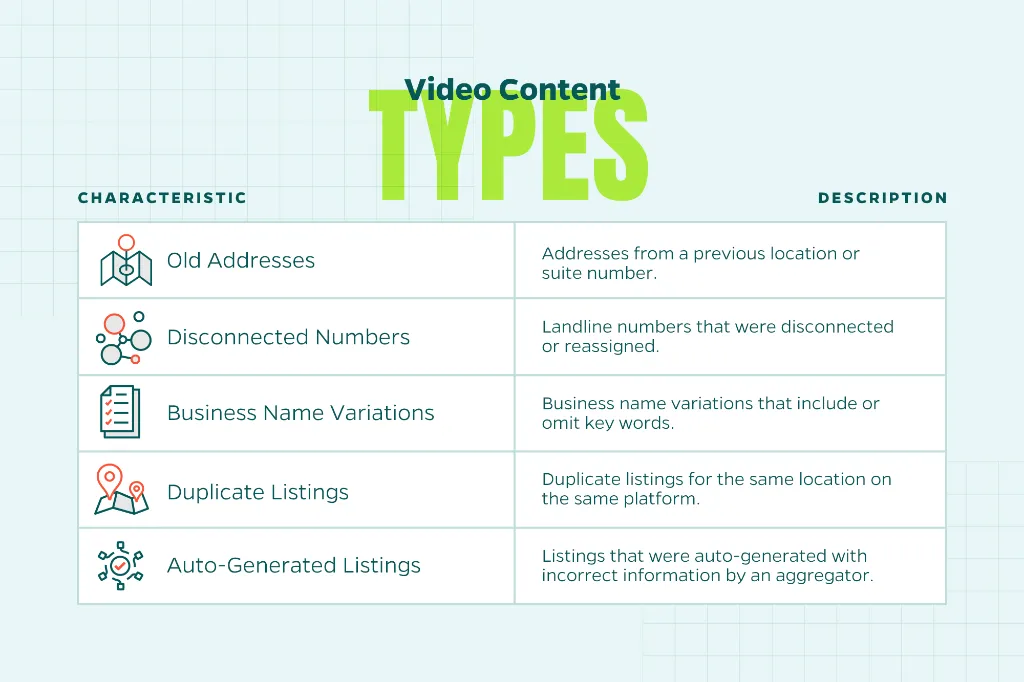
Common issues to watch for include:
- Old addresses from a previous location or suite number
- Landline numbers that were disconnected or reassigned
- Business name variations that include or omit key words
- Duplicate listings for the same location on the same platform
- Listings that were auto generated with incorrect information by an aggregator
Step 4: Fix the Inconsistencies
Prioritize high-authority platforms first. Your Google Business Profile, Apple Maps, Bing Places, Yelp, Facebook, and any industry-specific directories that rank well in your niche deserve attention before smaller, lower-traffic sites. Corrections on these platforms have the most immediate impact on both search visibility and customer experience.
For platforms where you have login access, log in and update the listing directly. For listings you didn’t create and can’t claim, look for a “Suggest an Edit” or “Claim This Listing” option. Some directories require email verification or a phone call to confirm ownership before allowing changes.
When you encounter duplicate listings on the same platform, request that the older or incorrect duplicate be merged or removed. Duplicates can split your review equity and confuse both users and algorithms, so they’re worth the extra effort to clean up.
If you’re working through a long list, set realistic daily goals. Trying to fix 50 listings in one sitting leads to errors. Steady, methodical progress is more effective.
Step 5: Monitor Your Listings Going Forward
A NAP audit isn’t a one-time task. Data aggregators periodically refresh their information, and sometimes that means a corrected listing reverts to old data. New directories crop up, and platforms may auto-generate listings for your business without notifying you.
Set a reminder to run a brief review every quarter. Spot-check your top ten or fifteen listings to make sure nothing has changed unexpectedly. If your business moves, rebrands, or changes its primary phone number, treat that as a trigger for a full audit immediately rather than waiting for the next scheduled review.
Listing management tools with automated monitoring can flag changes as they happen, which is worth considering if you’re managing multiple locations or don’t have bandwidth for frequent manual checks.
The Bigger Picture
A clean, consistent NAP across the web tells search engines that your business is credible and well-managed. It also removes unnecessary friction for potential customers who are trying to find you, call you, or show up at your door. In local SEO, the basics matter enormously. NAP consistency is one of the most fundamental elements.
Need Help?
Need help auditing your local listings or strengthening your local SEO foundation? Contact Straight North to learn how we can help.