

Key Takeaways:
- Build authority beyond backlinks through expertise, evidence, relationships, and third-party validation.
- Connect on-site and off-site content to strengthen visibility and trust.
- Repurpose strong research and expert insights into multiple authority assets.
- Measure success through qualified traffic, branded demand, engagement, and business impact.
- Create lasting competitive advantage by building authority that compounds over time.
Off-site SEO becomes more sustainable when each effort builds on the last, rather than treating every initiative as a standalone campaign. Straight North Off-Site SEO & GEO Expert Adam Rosenbaum explains why that continuity matters:
That continuity improves learning, and then the team sees which questions resonate, which sources send qualified visitors, and which assets attract citations. Long-term doesn’t mean constant publishing or rigid quotas, it means connecting work across different quarters, preserving the learning, and maintaining successful assets so that the external footprint becomes more coherent with every cycle.
That compounding effect is what separates campaigns that fade from ones that keep paying off: relationships teams can return to, assets that keep earning citations, and a growing sense of what actually resonates with the audience.
What Does a Sustainable Off-Site SEO Strategy Look Like?
A sustainable off-site SEO strategy starts with clear business priorities, then identifies the audiences, topics, and platforms most likely to support them. From there, teams can establish a manageable mix of expert contributions, original research, visual assets, PR, and profile management.
“A sustainable strategy has focus scope, a repeatable rhythm, and flexibility for real opportunities.”
SEO & GEO Manager | Offsite SEO & GEO Expert
The strategy also needs structure behind it. Planning for subject matter expert involvement, editorial reviews, publisher relationships, and future content updates keeps the program manageable and maintains quality. And instead of expecting every placement to drive conversions on its own, businesses can evaluate how these efforts work together to expand reach, establish credibility, and support broader goals over time.
Create an Authority Flywheel Between On-Site and Off-Site Content
On-site and off-site content are most effective when they reinforce each other. Your website should be the central source of expertise, evidence, case studies, service information, and other resources, while off-site content helps that information reach new audiences through articles, interviews, reviews, citations, search results, and AI-driven discovery.
That creates a continuous loop: people discover and validate your brand off-site, then arrive at your website with greater interest and intent. Strong on-site resources can then earn new citations, support future outreach, and create additional opportunities. External questions can also highlight gaps in your website content, while search and analytics data can show which resources are worth promoting more broadly.
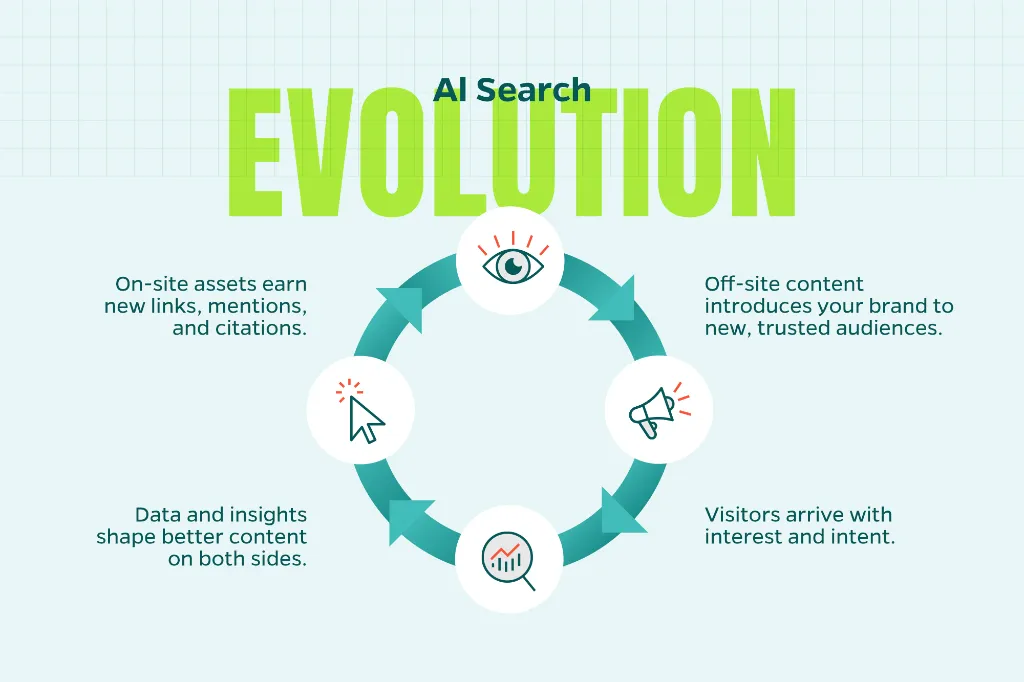
When both sides work together, they strengthen authority, attract better-qualified traffic, and create more opportunities for discovery and outreach. The key is continuity: each effort should make the next one more effective.
Turn One Strong Idea Into Multiple Authority Assets
Creating more authority-building content doesn’t have to mean starting from scratch. One strong source such as original research, proprietary data, or subject matter expert insight can become the foundation for several useful assets and extend the value of the work already invested.
Plan around a strong source idea, rather than in a single format. Start with a subject matter expert interview, then map the questions it can answer for different audiences. A survey can produce an on-site report, or an infographic, or even a guest article. An interview can become a video and a bank of quotes. Each derivative needs its own purpose and context.
The value comes from extending a strong idea without simply repeating it. Each new asset should adapt the original insight for a specific audience, channel, or purpose while staying connected to the source. That approach gets more from the expertise and research already invested while creating more ways for the idea to reach the right audiences.
From there, the question becomes which format will make that idea most useful.
Choose the Right Authority Investment for the Goal
Once you have a strong source idea, the next decision is how to package it. The right format depends on the story, the audience, and the objective rather than which tactic happens to be popular.
Guest Content
Guest content is a strong choice when your business has qualified experts with a valuable perspective to share. Contributing to publications your target audience already trusts can extend that expertise beyond your website while strengthening your brand’s association with relevant topics.
Surveys and Original Research
When useful data is missing from your industry, original research can give your brand an opportunity to fill the gap. Surveys are particularly valuable when you can reach a credible sample and turn the findings into insights that are useful to customers, publishers, and other industry sources.
Press Releases
Press releases are best reserved for timely, verifiable developments that an external audience would genuinely consider newsworthy. Pairing distribution with targeted outreach can help get the story in front of the publications and audiences most likely to care about it.
Infographics
When research, comparisons, or complex processes are easier to understand visually, an infographic can make the information more accessible and shareable. They can also complement other authority assets. For example, you can turn findings from original research into an easy-to-digest visual.
Ultimately, the format should serve the message. A guest article, survey, press release, or infographic only works when the underlying information is credible and useful, so choose the format that makes that information most effective for the intended audience.
Align Off-Site Authority With Business Goals
Authority-building should map to a specific business outcome. Before investing in off-site content, consider who you need to influence, where they look for information, and what you want them to do. The right approach will vary with the goal.
- Expand brand awareness: Reach new audiences through relevant publications, expert commentary, and content that establishes your brand’s voice within a specific topic or category.
- Improve lead quality: Focus on the publications, platforms, and questions that matter to decision-makers, with an emphasis on generating qualified referrals and supporting conversions.
- Strengthen your reputation: Build trust through reviews, accurate profiles, third-party mentions, and other external proof points that reinforce your credibility.
- Increase AI and search visibility: Develop useful, crawlable source content and strengthen the credible third-party references that help search engines and AI platforms understand and validate your expertise.
But aligning the overall strategy with business goals is only part of the equation. Each individual asset should have a clear reason for existing and a defined role within that strategy.
Every asset needs a… really a short strategy statement. Who it serves, what belief or action it should influence, and why the brand can credibly create it, and how success will be observed. This keeps the program from producing disconnected content. It gives leadership a clear explanation of how visibility and trust support the overall business plan.
This short strategy statement gives every asset a defined role. When the audience, purpose, reason for credibility, and measure of success are clear, teams can prioritize better opportunities and show how authority-building supports the larger business strategy.
Measure Authority Beyond Backlinks
Backlinks are one signal, not the full scorecard. A more complete view of performance should account for visibility, engagement, authority, and business impact.
Potential KPIs include:
- Relevant brand mentions
- AI citations across a controlled prompt set
- Research asset engagement
- Publisher relevance
- Repeat editorial invitations
- Qualified referral traffic
- Assisted conversions
- Branded demand
- Sales feedback
Keep in mind that attribution will never be perfect. Third-party authority scores are estimates, AI results can vary, and off-site exposure may influence a prospect well before they eventually reach your website or convert.
“A good report combines trends with real examples and asks whether the brand is easier to discover, more credible, and more likely to enter a buying conversation.”
SEO & GEO Manager | Offsite SEO & GEO Expert
Ultimately, the strongest measure of authority is not how many links you’ve accumulated, but whether your brand is becoming more visible, more trusted, and more influential with the audiences that matter to your business.
Evaluate and Maintain Brand Authority Over Time
Individual KPIs become more useful when they are viewed consistently over time. Establish a baseline, then compare the same signals to see where your brand appears, which topics it is associated with, and whether that presence is contributing to meaningful outcomes.
You want to evaluate growth against the baseline and define competitors using quantitative trends and qualitative evidence. Document where the brand appears, which topic it’s associated with, profile completeness and reviews, and then repeat the review with the same method. Connect those signals to qualified referrals, branded demand, assisted conversions, and even sales feedback. Examples matter because, 10 generic mentions may be less valuable than one detailed industry feature that creates a big opportunity. You want to separate outputs from outcomes. Publishing three articles is an output. Earning repeat editorial interest and qualified traffic is the outcome. Because authority has no universal score, the best evaluation is a weighted, goal-specific scorecard accompanied by examples and a narrative, explaining what change, likely contributors, and remaining uncertainty.
Once the review shows which signals and assets matter most, maintenance becomes the next priority. Information changes, content becomes outdated, and business priorities shift, so update frequency should reflect how quickly the underlying information can change.
Keep High-Value Authority Assets Current
- Critical profile information: Check at least quarterly and update immediately when important business information changes including name, address, and phone number (NAP).
- Evergreen guest content and infographics: Review annually to make sure information remains accurate and relevant.
- Fast-changing content: Review statistics, technology, regulatory guidance, and similar information every six months or quarterly when necessary.
- High-value resources: Prioritize assets that continue to generate traffic, citations, or value for sales teams.
- External relationships: Maintain an inventory of important off-site assets and publisher contacts so updates are easier to manage.
Don’t Overlook Your Brand Profiles
Brand profiles require regular attention, too. Business information can become outdated, customers may suggest edits, duplicate listings can appear, and reviews and questions continue to accumulate. Access should also be monitored as employees and agency relationships change. Tier profiles by importance and check mission-critical listings more frequently.
Ultimately, maintaining authority isn’t about constantly refreshing everything you’ve published. It’s about identifying the external assets and brand signals that continue to influence customers and keeping them accurate, credible, and aligned with the business.
The Future of Off-Site SEO: Become a Verifiable Source
Search is no longer the only place audiences encounter a brand. As discovery expands, the challenge is to establish signals that remain valuable across channels rather than chase each new one.
Organizations should focus on becoming verifiable sources rather than reverse engineering every new interface. Discovery’s going to fragment across classic results, AI answers, vertical platforms, communities, and publishers, but the durable inputs remain. The real expertise, the original evidence, the clear identity, the accessible content. Build systems to capture expert knowledge. Invest selectively in research and tools.
In practice, that foundation includes:
- Real expertise that demonstrates firsthand knowledge of the topics important to your business.
- Original evidence and research that gives others something credible to reference.
- A clear brand identity that consistently establishes who you are and what you know.
- Accessible, crawlable content with clear authorship, dates, and supporting information.
- Accurate brand profiles that reinforce consistent information across platforms.
- Trusted relationships with the publications and communities your customers already rely on.
AI can help businesses create and distribute content more efficiently, but speed shouldn’t come at the expense of accuracy, differentiation, or strategy. As discovery continues to evolve, the advantage won’t necessarily go to the brands that publish the most. It will go to those that consistently contribute something useful, demonstrate where their expertise comes from, and earn recognition around the topics that matter to their business.
How an Authority-First Strategy Creates a Competitive Advantage
Authority creates a different kind of competitive advantage because its value accumulates across assets, relationships, and recognition.
Authority first work accumulates assets and relationships that are difficult to copy quickly. Competitors can imitate a keyword target or use the same software, but cannot instantly reproduce years of expert insight, authentic reviews, accurate profile history, and useful third-party coverage. Each asset can lower the cost of the next opportunity. Research gives journalists a reason to call. A guest article establishes an expert. A referral creates a case, and recognition creates more branded demand.
That momentum improves the economics of future work. Established proof, relationships, and recognition can make outreach easier and future opportunities more productive.
A broader authority footprint also makes the business less dependent on any one source of visibility. If search rankings change, the brand can still benefit from publisher audiences, reviews, referrals, established relationships, and existing brand recognition.
That resilience is the payoff of treating authority as a compounding asset rather than a series of short-term wins.
Build Authority That Lasts
Sustainable off-site SEO isn’t about producing the most links, mentions, or content. It’s about accumulating expertise, evidence, relationships, visibility, and trust in a way that compounds.
When those signals reinforce one another, the payoff extends beyond any single ranking. The long-term goal is to become a brand that customers, publishers, search engines, AI platforms, and other trusted sources expect to be part of the conversation.