
Original research gives brands a stronger reason to appear in AI-generated answers: it supplies evidence that other websites cannot simply recreate. Surveys, benchmarks, and proprietary data can turn a company from another commentator into the primary source behind a useful statistic. That distinction can support AI visibility, media coverage, and conventional search performance, although publishing research never guarantees a citation.
Generative engine optimization (GEO) is the practice of making information easier for AI-powered search experiences to discover, understand, and reference. As search becomes less dependent on clicks, a research asset can create value even when people encounter its findings in an AI answer rather than visiting the original page. The objective is to publish something worth attributing, not simply to target another high-volume keyword.
What Counts as Original Research in Content Marketing?
Original research in content marketing is information a company collects or analyzes firsthand and publishes with enough context for readers to evaluate its findings. It differs from a roundup of industry statistics, which may be useful but does not create new evidence.
Original research can take several accessible forms:
- Customer surveys and audience polls that measure opinions, priorities, or behavior.
- Benchmark reports comparing performance across customers, projects, or time periods.
- Analyses of anonymized sales, product, website, or operational records.
- Interviews or structured observations that reveal recurring patterns.
A modest poll can qualify as original research if its methods and limitations are clear. A much larger dataset is not automatically more trustworthy. The question, sample, measurement process, and claims all matter. Companies should also secure appropriate permission, protect confidential information, and avoid treating a convenience sample as representative of an entire industry.
In Straight North’s September 2026 GEO survey, 65 of 100 respondents (65%) said their organizations had increased investment in original research, surveys, or proprietary data because of AI search. This describes reported investment among survey respondents, not evidence that the investment produced more citations.
Long-running programs, such as Orbit Media’s blogger survey and Content Marketing Institute’s B2B research, show how a recurring study can become a recognizable reference point. A company does not need their scale to begin; it needs a question its audience wants answered.
Why Original Research Can Earn Attention in AI Search
Original research offers three potential advantages for AI visibility: a traceable source, information that differs from existing pages, and repeated attribution when others discuss the findings. These are plausible pathways to citations, not publicly confirmed rules used uniformly by every AI system.
“In a world full of recycled opinions, original research gives a company something genuinely new to contribute,” says Frank Fornaris, President of Straight North. “It creates insights that customers, journalists, and AI platforms can cite, helping the company earn attention and authority instead of simply adding to the noise.” The practical difference is ownership: a brand publishing the underlying study can explain how its finding was produced, while a summary site can only repeat it.
“In a world full of recycled opinions, original research gives a company something genuinely new to contribute. It creates insights that customers, journalists, and AI platforms can cite, helping the company earn attention and authority instead of simply adding to the noise.”

New evidence also creates information gain. Ten articles repeating the same industry statistic add little to the available knowledge; a well-documented survey answering a previously unmeasured question adds something distinctive. If journalists and other publishers attribute that result to its creator, the brand may become more recognizable as the source across multiple sites.
Straight North’s September 2026 GEO survey found that 44 of 101 respondents (43.56%) selected original research or data among the content types their organizations were prioritizing to improve their chances of being referenced in AI-generated answers. This measures strategic priorities, not actual citation performance.
Research alone is insufficient. An AI system may overlook an inaccessible report, misunderstand a poorly labeled statistic, or select a different source. Strong evidence needs clear presentation, crawlable pages, and distribution.
What Does the Evidence Say About Research and AI Visibility?
Experimental GEO research provides a useful reason to include evidence in content. The Princeton-led paper “GEO: Generative Engine Optimization” evaluated content changes, including adding statistics, quotations, and citations, and reported visibility improvements in its experimental setup. Its results support testing evidence-rich writing, but they do not prove that any newly published survey will earn citations across ChatGPT, Perplexity, Gemini, and Google AI Overviews.
The distinction matters because platforms retrieve, rank, and present sources differently. Google AI Overviews operates within Google’s search experience; Perplexity often exposes source references prominently; and ChatGPT and Gemini vary by query, mode, and available retrieval. No single formatting technique guarantees selection across them.
Traditional Google rankings and AI citations also should not be treated as interchangeable. A source can be useful to an AI answer without ranking first for the exact wording of a user’s question. Conversely, a high-ranking page may add too little distinctive evidence to be cited. Businesses should test their own topic-level visibility rather than assume that a ranking change predicts an AI citation change.
Original Research Also Strengthens Traditional SEO
Research is a natural linkable asset because other authors may need to point readers to the underlying data. A benchmark with a clear methodology gives writers, analysts, and reporters something to verify and cite. Those earned links can support discovery and authority in traditional SEO, while attributed mentions may also help people encounter the brand in AI-assisted research.
A single study can therefore support two complementary goals: links and search traffic on one hand, and mentions or citations in AI answers on the other. Neither outcome is automatic. A useful report still needs relevant outreach, compelling findings, and a page that readers can access.
Research also helps sales and editorial teams. Instead of repeatedly borrowing competitors’ numbers, they can reference their own findings in service pages, presentations, proposals, and related blog articles. The resulting consistency makes the company’s point of view easier to recognize.
The Five-Step Citable Data Playbook
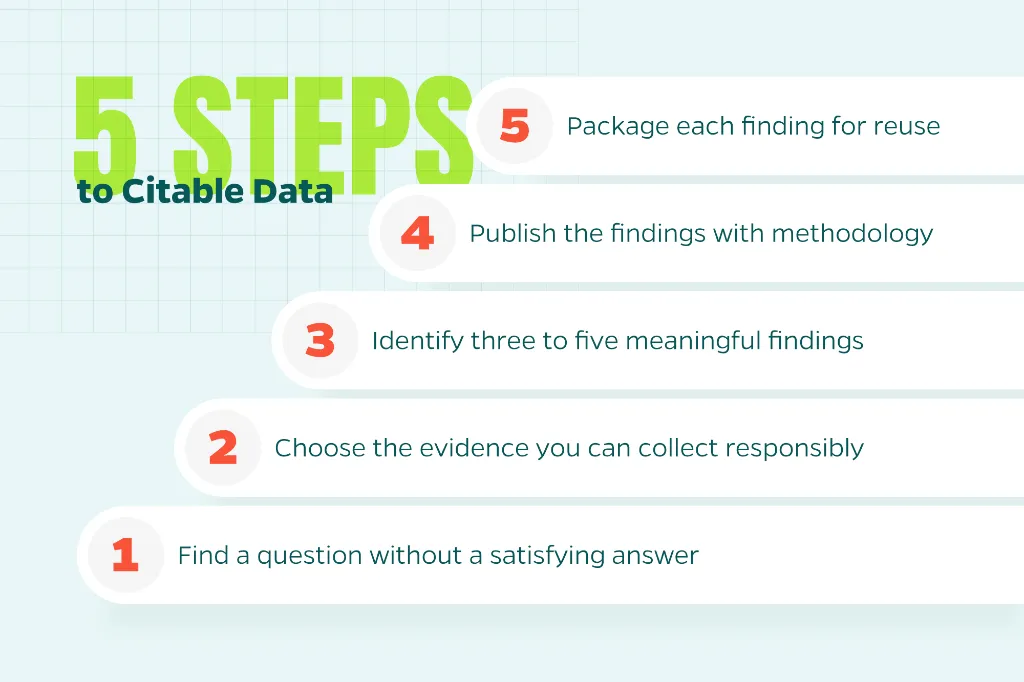
The most practical way to begin original research content marketing is to choose a narrow question, collect defensible evidence, and publish findings in reusable form. This five-step process keeps the study manageable without sacrificing credibility.
- Find a question without a satisfying answer
Look for recurring questions in sales conversations, support tickets, customer interviews, industry communities, and AI-assisted research. Prioritize a gap that matters to prospective buyers, not just a keyword with measurable search volume. A manufacturer, for example, might investigate how buyers compare suppliers before requesting a quote.
- Choose the evidence you can collect responsibly
Survey customers, poll a defined audience, analyze anonymized internal records, or commission a panel. Write neutral questions, define the population you are studying, and document exclusions. For internal datasets, verify that privacy, consent, and contractual obligations allow publication.
- Identify three to five meaningful findings
Look for useful differences, trends, or surprises rather than simply reporting every response. Keep denominators attached to percentages, separate correlation from causation, and avoid presenting a small subgroup as a broad market truth. A modest but well-explained finding is more valuable than an impressive-sounding number without context.
- Publish the findings with methodology
Create an accessible report or landing page containing a summary, key statistics, charts where useful, and the full method. State the sample size, collection dates, respondent source, question wording, and any weighting. Include a margin of error only when the sampling design supports one. An ungated findings page helps both people and automated systems access the evidence.
- Package each finding for reuse
Give each major statistic its own complete sentence and a link back to the study. Build a short media summary, supporting blog posts, social graphics, and sales materials. Keep the original wording and denominator consistent across formats so the evidence remains traceable.
“Writers, analysts, journalists, they need evidence, and a well-designed survey gives them a primary source rather than another opinion,” says Adam Rosenbaum, a Straight North SEO & GEO Manager. That is the standard to aim for: a source another writer can use without guessing how the number was produced.
“Writers, analysts, journalists, they need evidence, and a well-designed survey gives them a primary source rather than another opinion.”

Format Research So AI Systems Can Understand It
A citable finding should make sense outside the paragraph in which it appears. State who was surveyed, what was measured, when the research occurred, and the result in one sentence. For example: “In Straight North’s September 2026 GEO survey, 16 of 101 respondents (15.84%) reported publishing original research or proprietary data specifically to improve visibility in AI-generated search results.”
Put the most important findings near the top of the page and repeat them accurately in the relevant sections. Use descriptive headings, accessible HTML text, labeled tables, and clear source attribution. Structured data can describe appropriate content, but it does not force an AI engine to cite a page.
A dedicated methodology section is especially helpful. Readers should be able to distinguish a statistically sampled study from an opt-in poll and know whether percentages refer to all respondents or only those who answered a particular question. Transparency is a credibility signal, even when the limitations are substantial.
Promote, Refresh, and Reuse the Research
Distribution turns a finished study into a discoverable source. Pitch the most relevant findings to trade publications, share useful slices with professional communities, and give sales teams concise summaries that link back to the full report. Outreach works best when it explains why a specific audience would care about a result rather than merely announcing that a report exists.
“A strong piece of original research can deliver value far beyond a single report,” says Frank Fornaris, President of Straight North. “It can fuel months of content, earn media coverage, open sales conversations, and give the business a point of view competitors cannot easily copy.” A well-run program treats the report as the beginning of an editorial cycle, not the end.
“A strong piece of original research can deliver value far beyond a single report. It can fuel months of content, earn media coverage, open sales conversations, and give the business a point of view competitors cannot easily copy.”
Repeat studies annually when the subject changes enough to justify fresh data. Preserve older editions with dates so readers can compare trends without confusing historical results with current ones. Measure referring domains, qualified traffic, brand mentions, and observed AI citations for a consistent set of relevant prompts. Search Console impressions can add context, but they do not directly identify every appearance in an AI answer.
How Straight North Uses Research in Practice
Straight North’s own research program illustrates how a mid-sized agency can turn targeted questions into multiple content assets. Its zero-click marketing survey of 100 marketers supplies evidence for articles about changing search behavior, while its manufacturer marketing research addresses questions from a specific industry audience. The studies create reusable material beyond their initial publication dates.
Straight North’s research brief also reports that its Citation Gap article appeared around average position 2.6 for an AI-assistant-style Google query about citation gaps. That is an internal search-performance observation, not proof of an AI-platform citation or a causal result of original research. The more useful lesson is that narrowly focused evidence can support content addressing new types of search questions.
The September 2026 GEO survey found that 16 of 101 respondents (15.84%) said their organizations had published original research or proprietary data specifically to improve visibility in AI-generated search results. This is a separate measure from the survey’s investment and prioritization questions, and the three figures should not be combined into a conversion funnel.
Original Research and AI Visibility: FAQs
How much does original research cost?
A small customer poll may require mostly staff time, while professional sampling, incentives, analysis, and design can make a larger study substantially more expensive. Start by budgeting for sound question design and transparent reporting before investing in a polished campaign.
Can a small B2B company publish useful research?
Yes. A small B2B company can analyze anonymized project trends, survey customers about a specific decision, or compare operational benchmarks. Narrow, relevant evidence can be more useful than an ambitious report with weak data.
What survey sample size is credible?
There is no universal minimum. Credibility depends on the question, recruitment method, population, subgroup sizes, and claims being made. A transparent sample of 100 can describe those respondents, but it cannot automatically support population-wide conclusions or a conventional margin of error.
Is research worth publishing if the topic has little search volume?
Potentially. A useful statistic can be discovered through related searches, cited by industry writers, reused in sales conversations, and referenced in AI-generated answers. Evaluate the audience need and likely reuse, not keyword volume alone.
Need Help?
Original research gives your brand evidence worth sharing and a stronger foundation for both SEO and GEO. To explore a research-led visibility strategy, contact Straight North.