

No, ChatGPT cannot do SEO on its own. It can make many SEO tasks faster. But a person still needs to supply reliable inputs, verify the output, make strategic decisions and take responsibility for the result.
“Using ChatGPT for SEO work” is not the same thing as optimizing a brand so ChatGPT or another AI engine cites it. This article is about the first problem: how marketing managers, business owners and SEO teams can use AI assistants as working tools. If your goal is visibility inside AI-generated answers, Straight North’s guide to generative engine optimization covers that topic thoroughly.
The practical risk is not that AI tools are useless. It is that they can sound certain when they are wrong, outdated, or missing business context. Used inside a disciplined workflow, ChatGPT, Claude, and related tools can be force multipliers. Used as autopilot, they can scale weak assumptions just as quickly as good work.
What SEO Tasks Can AI Tools Do Well?
AI performs best at SEO tasks that transform information you already have. If you provide source material, constraints and examples, an LLM can reorganize, summarize, expand or critique that material quickly. Its reliability drops when the task requires live market data, site crawling or a judgment call tied to business outcomes.
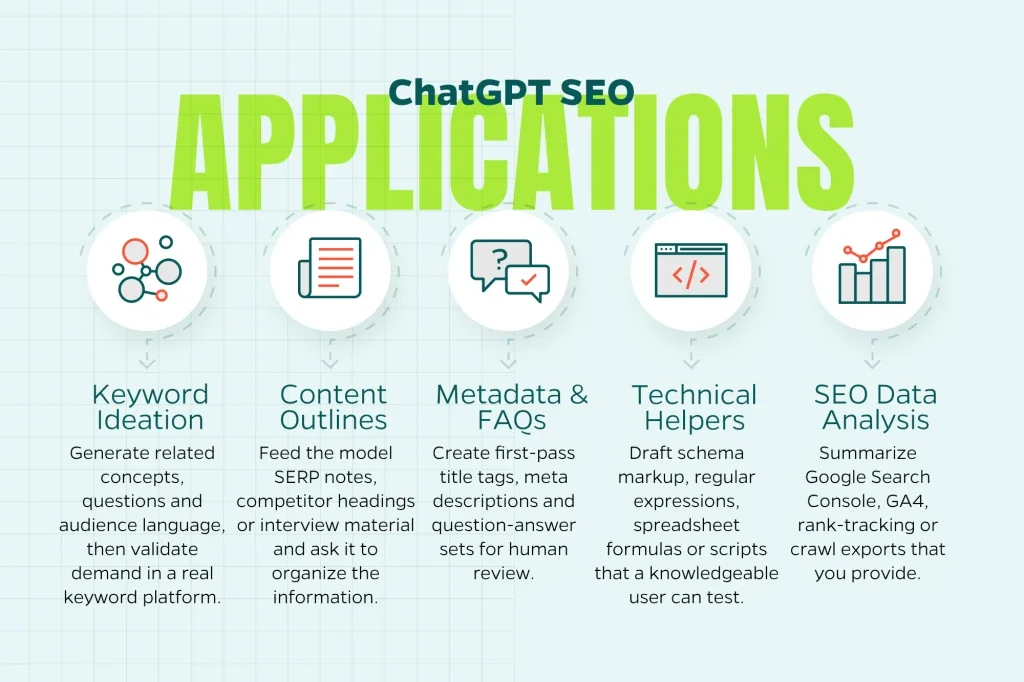
ChatGPT can support SEO in several practical ways, including:
- Keyword and topic ideation: generate related concepts, questions and audience language, then validate demand in a real keyword platform.
- Outlines from research you have already done: feed the model SERP notes, competitor headings or interview material and ask it to organize the information.
- Metadata and FAQ drafts: create first-pass title tags, meta descriptions and question-answer sets for human review.
- Technical helpers: draft schema markup, regular expressions, spreadsheet formulas or scripts that a knowledgeable user can test.
- SEO data analysis: summarize Google Search Console, GA4, rank-tracking or crawl exports that you provide.
This is a shorter list than many “14 ways to use ChatGPT for SEO” articles, and that is intentional. A sitemap, a sitewide technical audit or a finished article may involve language, but they also involve measurement, context, and accountability. Those jobs should not be delegated to a chat box just because the tool can produce something that looks plausible.
In Straight North’s September 2026 GEO survey, 66 of 100 respondents, or 66%, said their organization had increased informational or blog content because of AI-generated answers; the finding reflects increased publishing activity, not proof that the added content was itself AI-generated or more effective.
How to Use ChatGPT for SEO: A Working Workflow
The safest and most productive rule is “context in, transformation out.” Give the model your real inputs and explicit constraints, ask it to perform a defined transformation or critique, then verify every factual claim or metric against the source that owns the data.
“So, list data just repeats numbers you already know,” says Marc Holt, Enterprise SEO & GEO Strategist at Straight North. “Analyze and Recommend turns those numbers into insights and next steps. Asking for analysis gives you actions, like improving pages, adding topics, or refining CTAs instead of raw stats. That’s where the real value comes from.”
“So, list data just repeats numbers you already know. Analyze and Recommend turns those numbers into insights and next steps. Asking for analysis gives you actions, like improving pages, adding topics, or refining CTAs instead of raw stats. That’s where the real value comes from.”

This is the difference between using AI as a calculator and using it as an analyst. A useful prompt does not ask the model to invent what happened. It supplies the evidence, identifies the goal and asks for patterns, priorities or recommendations that a human can evaluate.
Four prompt patterns worth reusing
- Metadata: “Using the page copy below, draft five title tags under 60 characters and five meta descriptions under 155 characters. Preserve the page’s actual offer and do not introduce claims that are not in the copy.”
- Outline from research: “Using only these SERP notes and SME interview excerpts, build an outline that answers the searcher’s main questions. Put the clearest answer first in each section and flag any question the sources do not answer.”
- FAQ extraction: “From this article draft, identify five questions a reader could reasonably ask. Answer each in two to four sentences using only information already supported in the draft.”
- Data summary: “Analyze this GSC export by page and query. Identify meaningful gains, losses and opportunities, explain the evidence for each, and separate observations from recommendations.”
Keyword research follows the same pattern. ChatGPT is useful for expanding seed terms, identifying topic relationships and clustering a list you already have. It is not a dependable source of search volume. In a Slicedbread test, ChatGPT estimated 40,000 monthly searches for a term that Semrush measured at 60,500, a useful reminder that generated numbers still need a measurement source.
Content writing also needs a gate. AI can draft or reorganize copy, but people should add firsthand experience, original examples, expert opinion and verification before publication. A custom GPT or reusable research workflow can make that process more consistent, but the setup does not replace the strategy.
ChatGPT vs. Claude for SEO Work
ChatGPT and Claude can both support SEO work, and the better choice depends more on the task and connected data than on the logo. Search interest in “Claude SEO” rose sharply in 2026, reflecting growing attention to Claude-based workflows rather than a universal migration from one assistant to another.
ChatGPT’s practical advantage is familiarity and a broad ecosystem of integrations. Claude is often useful for long-document review and tasks where sustained adherence to editorial instructions matters. For either model, the same rule applies: the tooling layer and the data you connect to it matter more than the model name.
That is why the most useful question is not “Which model wins?” It is “Which assistant can work with the right source material, within the right guardrails, for this specific task?”
Beyond the Chat Box: Agentic AI for SEO Automation
Agentic tools such as Claude Code and Codex move beyond the paste-and-response workflow. Instead of only transforming text you provide, they can work across files, execute multi-step processes and help automate repetitive data tasks when they have the right permissions and instructions.
Straight North has published a practical example using Codex and Claude Code to automate SEO data tasks. The lesson is not that strategy should be automated. It is that a well-understood process can often be automated after a human defines the steps, tests the output and installs quality checks.
Start with retrieval, cleanup, and formatting. Be much more cautious about automating prioritization, recommendations, or publishing decisions because automation compounds mistakes as efficiently as it compounds output.
Where AI Fails at SEO
AI fails most often when SEO work requires live measurement, business context or accountable judgment. Common failure modes include fabricated statistics or citations, invented search volumes, outdated recommendations, generic writing and confident answers that ignore what is happening on the site today.
“But at the end of the day, when it comes to analyzation, I think that your critical thinking skills and your familiarity with a website or a client are just always going to be better than what a, you know, software or AI tool can understand,” says Nick Fatigato, Enterprise SEO & GEO Strategist at Straight North
“But at the end of the day, when it comes to analyzation, I think that your critical thinking skills and your familiarity with a website or a client are just always going to be better than what a, you know, software or AI tool can understand.”

That client knowledge is hard to prompt into existence. A model can help analyze a crawl export, but it cannot infer every commercial priority behind the site. It does not know which product line has the best margin, which service area the sales team wants to grow, which leads are poor quality or which ranking matters because it consistently produces revenue.
“A model can organize ideas, but it doesn’t possess the client’s lived experience unless that experience is supplied,” says Adam Rosenbaum, SEO & GEO Manager at Straight North
“A model can organize ideas, but it doesn’t possess the client’s lived experience unless that experience is supplied.”

This is also why ChatGPT does not replace Semrush, Ahrefs, Google Search Console, GA4 or a crawler. An LLM primarily transforms language and supplied data; SEO platforms measure search demand, rankings, links, traffic and site conditions. You still need the measurement layer.
In Straight North’s September 2026 GEO survey, 71 of 98 respondents, or 72.45%, said their organization had increased the use of internal subject matter experts because of AI search, which provides context for why human expertise is becoming more visible in content workflows.
Will Google Penalize AI-Generated Content?
Google does not treat “AI-generated” as its own penalty category. Google Search Central says generative AI can be useful for research and structure, while using automation to generate many low-value pages for the purpose of manipulating rankings can violate its scaled content abuse policy.
The practical standard is quality, originality and usefulness. Google’s current guidance emphasizes accurate, high-quality, relevant content and specifically encourages unique, non-commodity material grounded in experience rather than summaries that merely recycle what is already available online. Google’s guidance on generative AI content and its guidance for generative AI features in Search both reinforce that direction.
So the risk with unedited ChatGPT copy is usually not a secret “AI detector.” The bigger problem is that generic text often contributes little original evidence, experience or point of view. Human review should be the publishing gate because the page still has to deserve attention.
Can ChatGPT Replace an SEO Agency or SEO Hire?
For a small website with simple needs, AI assistance can cover more ground than it could a few years ago. A business owner can draft metadata, brainstorm topics, summarize analytics exports and build basic checklists without paying someone to type every first draft.
The boundary appears when the work requires accountability. What an experienced SEO provides is not merely production. It is access to real data, pattern recognition across sites, prioritization, communication with other teams and responsibility for deciding which recommendation is worth acting on.
A practical resourcing model looks like this:
- No SEO budget: use AI for low-risk drafting and analysis tasks, but accept that you own the verification burden.
- Some budget: let AI handle first drafts and repetitive work, while an experienced SEO sets strategy and reviews important changes.
- Growth-stage program: use AI to accelerate a senior team rather than trying to replace the team with AI.
In the same September 2026 survey, 10 of 100 respondents, or 10%, selected lack of internal expertise as their biggest GEO challenge; that result identifies an expertise gap for some respondents but does not show that an AI assistant can fill it by itself.
FAQ: Using AI Tools for SEO Work
Can ChatGPT do SEO?
ChatGPT can help with many SEO tasks, including ideation, outlining, metadata, data summarization and technical drafting, but it cannot responsibly own SEO from end to end. Live data, verification, strategy and accountability still require people and dedicated tools.
What are the biggest AI SEO trends in 2026?
SEO use is moving from simple brainstorming toward data-connected and agentic workflows that can retrieve, clean and organize information across tools. At the same time, AI-generated search experiences are creating a separate optimization discipline around visibility and citations in AI answers.
Is it safe to publish content written by ChatGPT?
It can be safe to publish AI-assisted content when the final page is accurate, original, useful and reviewed by a person. Publishing unedited output at scale is risky because it can introduce factual errors, generic copy and low-value pages that conflict with Google’s quality and spam guidance.
Should I use ChatGPT or Claude for SEO work?
Use the model that best fits the task, your data access and your workflow. Both can be productive assistants, and both need the same verification layer before their output becomes an SEO decision or published page.
The Bottom Line: Use the Tools, Keep the Judgment
AI should change how SEO work gets done, but it should not erase the line between assistance and ownership. A useful rule is simple: if a task transforms your inputs, hand it to AI and review the result; if it requires live data or accountability for an outcome, a human owns it and AI assists.
Here are some key takeaways:
- ChatGPT cannot do SEO by itself, but it can accelerate specific parts of the workflow.
- AI is strongest when you provide the source material and ask it to transform, organize or analyze it.
- Use dedicated SEO tools for measurements such as volume, rankings, backlinks, crawl data and performance.
- Keep human review around strategy, publishing, client context and any claim that could affect a business decision.
- Agentic automation will expand what can be delegated, so revisit the division of labor as the tools mature.
“The way people find information and make decisions is changing quickly, but that doesn’t mean businesses should chase every new development,” says David Duerr, Chairman and Chief Executive Officer of Straight North. “Stay focused on your customers and your brand: clearly communicate the problems you solve, why you’re different, and build credibility.”
“The way people find information and make decisions is changing quickly, but that doesn’t mean businesses should chase every new development. Stay focused on your customers and your brand: clearly communicate the problems you solve, why you’re different, and build credibility.”

The tools will keep changing. The durable advantage is knowing where they help, where they fail and what your customers need from you.
Need Help?
For help building an SEO program that uses AI without giving up the judgment behind it, contact Straight North.