
Google AI Mode is a conversational Google Search experience powered by Gemini that explores related searches, synthesizes findings, and provides supporting links. To improve your chances of appearing, start with the same fundamentals that make a page useful in Google Search: indexability, strong topic coverage, original expertise, and clear answers. There is no separate shortcut that guarantees an AI Mode citation.
Three things to know:
- AI Mode can investigate multiple aspects of a buyer’s question and accept follow-up questions.
- Google says supporting pages must be indexed and eligible for a Search snippet.
- Measurement is improving, but marketers still cannot see a complete inventory of the prompts people enter.
What is Google AI Mode?
Google AI Mode is a dedicated, conversational option within Google Search that produces a synthesized response with links to sources and lets users continue asking questions. Instead of reviewing a list of pages one by one, a person can ask Google to compare alternatives, explain tradeoffs, and refine the recommendation in a continuing exchange.
For example, a procurement director might ask which industrial labeling systems suit a refrigerated food facility, then ask about maintenance costs, integration requirements, and vendor support. AI Mode can address the evolving research process without requiring the user to restart every search.
AI Mode is accessible through Google Search, including its AI Mode tab, without requiring a separate paid search subscription. Work intended to improve visibility in these generated answers is often called generative engine optimization (GEO), AI search optimization, or AI SEO.
In Straight North’s September 2026 GEO survey, 34 of 100 respondents (34%) selected Google AI Mode as an AI-search platform their organization was prioritizing. This measures priorities among survey respondents, not AI Mode adoption or market share.
For a broader explanation of AI search optimization, see Straight North’s GEO guide.
How Google AI Mode Works
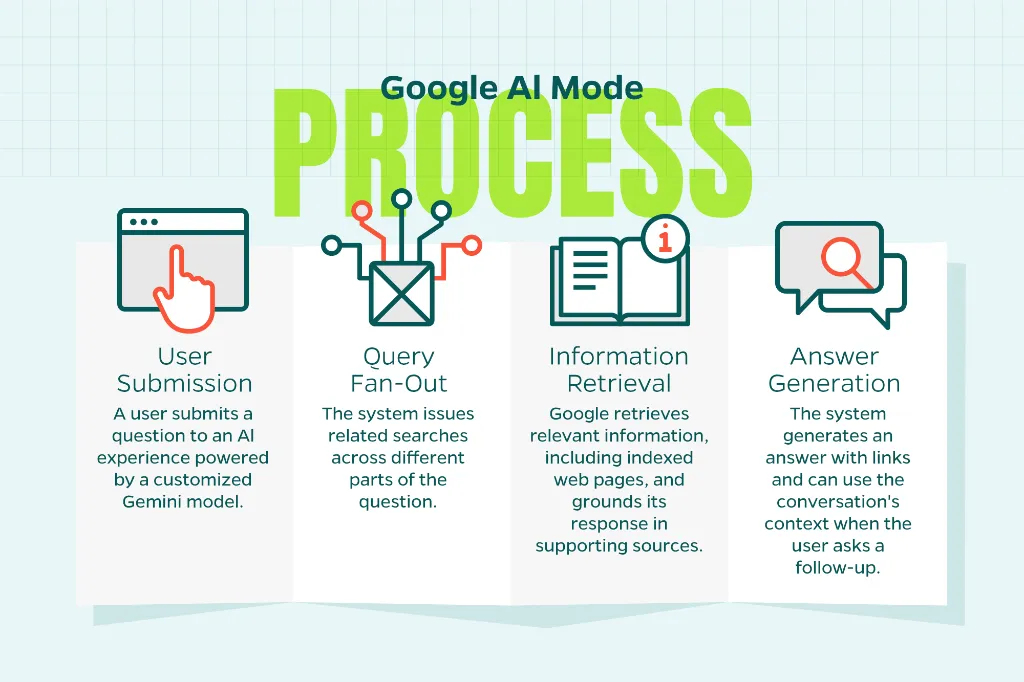
AI Mode uses Google’s Search infrastructure to gather relevant information, then presents a synthesized answer rather than only a ranked list of links. A simplified four-step explanation is:
- A user submits a question to an AI experience powered by a customized Gemini model.
- The system can use “query fan-out,” issuing related searches across different parts of the question.
- Google retrieves relevant information, including indexed web pages, and grounds its response in supporting sources.
- The system generates an answer with links and can use the conversation’s context when the user asks a follow-up.
As an illustration, “What is the best industrial label printer for a food plant?” could branch into searches about washdown durability, food-label requirements, operating cost, and competing vendors. These are illustrative sub-questions, not a disclosure of Google’s exact internal searches.
Yes, AI Mode uses Google’s Search index and ranking and quality systems. That makes established SEO practices relevant to whether a source can be found and considered. Google’s more intensive Deep Search capability can investigate a question through a larger set of searches and produce a longer, sourced report.
AI Mode vs. AI Overviews: What’s Different for Your Content
AI Mode vs. AI Overviews is a distinction in search experience, not a reason to build two disconnected SEO strategies. AI Overviews appear on ordinary search results when Google determines a summary would help; AI Mode is a conversational destination users choose to explore a question more deeply.
Dimension | AI Overviews | AI Mode |
Where it appears | Within standard search results | Dedicated conversational Search mode |
How it starts | Google decides when to show it | User opens AI Mode |
Typical question | A query that benefits from a quick synthesis | Complex research, comparisons, and multi-part questions |
Follow-ups | May offer paths to explore further | Designed for continuing follow-up questions |
Supporting links | Links selected for that generated overview | Links selected for the generated conversation |
Content priority | Answer a specific question clearly | Cover the connected questions across a buyer journey |
Google says AI Mode and AI Overviews can use different models and techniques, so they may show different supporting links even for related searches. A page cited in one is not guaranteed to appear in the other.
The content implication is important. A focused page that answers a single question may work well as an AI Overview source. A business trying to participate in AI Mode conversations also needs connected coverage of comparisons, constraints, implementation, pricing, and next-step questions. Build useful pages for those topics and connect them with clear internal links.
“So it’s a little bit less about winning a click and a little bit more about earning that place in the AI’s recommendation set,” says David Ohm, Straight North’s Paid Advertising Director. His point is that a brand can influence a buyer’s shortlist within a synthesized response, even when the buyer does not immediately visit its website.
“So it’s a little bit less about winning a click and a little bit more about earning that place in the AI’s recommendation set.”

That does not make visits or leads irrelevant. It means marketers should evaluate both on-site outcomes and the visibility of their brand in the research process.
Traditional SEO Is Still the Way Into AI Mode
Traditional SEO remains the foundation for AI Mode visibility because Google’s AI features draw on its established Search systems. Google says a page must be indexed and eligible to appear with a snippet to qualify as a supporting link. Meeting those requirements does not guarantee selection, but failing them can prevent inclusion.
“So, if you want to be in the game with an AI model, you still have to focus on having the best singular, unique answers within traditional search,” says Tom Lustina, a Straight North SEO & GEO Director. That approach favors pages with meaningful answers over superficial AI-specific formatting tricks.
“So, if you want to be in the game with an AI model, you still have to focus on having the best singular, unique answers within traditional search.”

The practical shift is from chasing only a broad head term to serving a collection of related searches. If AI Mode fans a purchasing question into subtopics, a company with credible pages addressing several of those subtopics has more opportunities to be discovered. Rankings for conventional search terms remain useful signals, but they are not a direct prediction of which links an AI response will cite.
In Straight North’s September 2026 GEO survey, 69 of 101 respondents (68.32%) reported increasing their investment in traditional SEO compared with one year earlier. The finding describes the surveyed organizations’ investment decisions; it does not establish that higher spending caused better AI visibility.
Google’s guidance also undercuts several popular shortcuts. Sites do not need a special AI Mode schema, an llms.txt file, or AI-only rewrites to become eligible. Better investments usually include crawlability, useful internal links, reliable content, relevant evidence, and an accessible page experience.
Read more about the connection between traditional SEO and AI citations.
How to Show Up in Google AI Mode
A sensible Google AI Mode optimization plan makes content easy for Google to access and gives the system substantive reasons to cite it. These six steps improve readiness, not guaranteed placement:
- Check technical eligibility. Confirm priority pages are crawlable, indexed, and snippet-eligible. Review robots.txt, CDN and bot protections, and unintended noindex or nosnippet directives.
- Map the full buyer conversation. Group questions by need, comparison, objection, purchase criterion, and follow-up rather than targeting one imagined prompt.
- Put the answer first. State the conclusion clearly, provide evidence, and then explain qualifications or exceptions. Make each paragraph useful on its own.
- Publish information competitors cannot easily duplicate. Include interviews with specialists, original research, firsthand examples, methodology, and specific product or service knowledge.
- Make supporting assets usable. Add helpful images and video where they clarify the subject, keep essential information in text, and ensure structured data matches visible content. Special AI Mode markup is not required.
- Build legitimate authority. Seek relevant editorial references, industry coverage, and authentic mentions; avoid manufactured endorsements or link schemes.
“A good model is answer first, prove it second, explain the nuance third,” says Bob Hand, a Straight North Senior SEO & GEO Strategist. “The content should be easy to summarize, but not easy to replace.” That is a useful editorial test: the first sentence should be understandable by itself, while the rest of the page adds evidence a generic summary cannot supply.
“A good model is answer first, prove it second, explain the nuance third. The content should be easy to summarize, but not easy to replace.”

For anyone asking how to rank in Google AI Mode, the answer is to strengthen eligibility and usefulness across a topic. There is no publicly documented fixed “AI Mode rank” that an optimization checklist can promise.
How to Measure AI Mode (and What You Can’t See Yet)
You can measure some AI Mode visibility through Google Search Console, but you cannot yet reconstruct every conversation or calculate exact demand for every prompt. AI Mode traffic contributes to Search Console’s standard Web performance totals, while Google’s dedicated Search Generative AI performance reports provide a separate view of AI-feature impressions.
Google announced those dedicated reports in June 2026 and stated that the rollout reached websites worldwide by August 31, 2026. The reports show impressions and associated pages, countries, devices, and dates; they do not provide a complete prompt-level view or separate click metrics for those AI-feature impressions.
“That is all in a black box today,” says Aaron Wittersheim, Straight North COO. “There’s no keyword data, theme data, there’s no volume data, none of it.” Wittersheim’s assessment captures the gap between sampling a set of prompts and knowing how frequently users ask those exact questions.
“That is all in a black box today. There’s no keyword data, theme data, there’s no volume data, none of it.”

In Straight North’s September 2026 GEO survey, 46 of 100 respondents (46%) said their organizations had identified target AI-answer prompts and were actively tracking them. Such tracking can reveal directional changes, but a selected prompt set is not a representative census of all user conversations.
Straight North’s Search Console export for July 20 through October 18, 2026, offers a useful example. The query “ai mode seo” generated 143 impressions with an average position of 6.1, while “ai mode seo software” generated 85 impressions with an average position of 14.6, both leading to a general AI-SEO article. Longer, prompt-like queries also reached an AI-tools article. These are observed Search Console queries, not proof that any particular impression originated inside AI Mode.
Here is a practical measurement checklist:
- Filter standard Search Console queries for “ai mode” and longer question-style searches.
- Identify which pages receive those impressions and whether a more relevant page should answer the topic.
- Review generative AI impressions by landing page, country, device, and date.
- Test a modest, repeatable set of representative buyer prompts by theme, recording cited sources and changes over time.
- Connect search visits and assisted journeys to qualified leads and pipeline where your analytics allow it.
Treat changes in sampled citations as directional evidence. Query wording, location, timing, personalization, and evolving models can change the response. Combine these observations with page-level Search Console evidence instead of presenting a proprietary visibility score as a precise measure of demand.
What’s Next for AI Mode: Ads and One Search Interface
AI Mode is becoming both an organic discovery surface and an advertising environment. Google says eligible Search, Shopping, and Performance Max campaigns can serve sponsored placements in AI Mode where supported; advertisers do not need a separate AI Mode campaign or budget. Paid placements are labeled and do not determine which sources appear in organic AI answers.
“Gemini powers AI mode, and we’re starting to see ads show up in AI mode,” says David Ohm, Straight North Paid Advertising Director. For paid teams, this means reviewing conversion data, campaign eligibility, and landing-page relevance alongside organic visibility.
“Gemini powers AI mode, and we’re starting to see ads show up in AI mode.”
Straight North practitioners expect conversational AI answers, AI Overviews, and familiar search results to become more closely integrated over time. That is an industry outlook, not a confirmed Google product roadmap. The durable response is to keep improving technical SEO, expert content, and measurement rather than betting on one interface.
Need Help?
Want a practical plan for AI search? Contact Straight North to discuss a GEO program.