


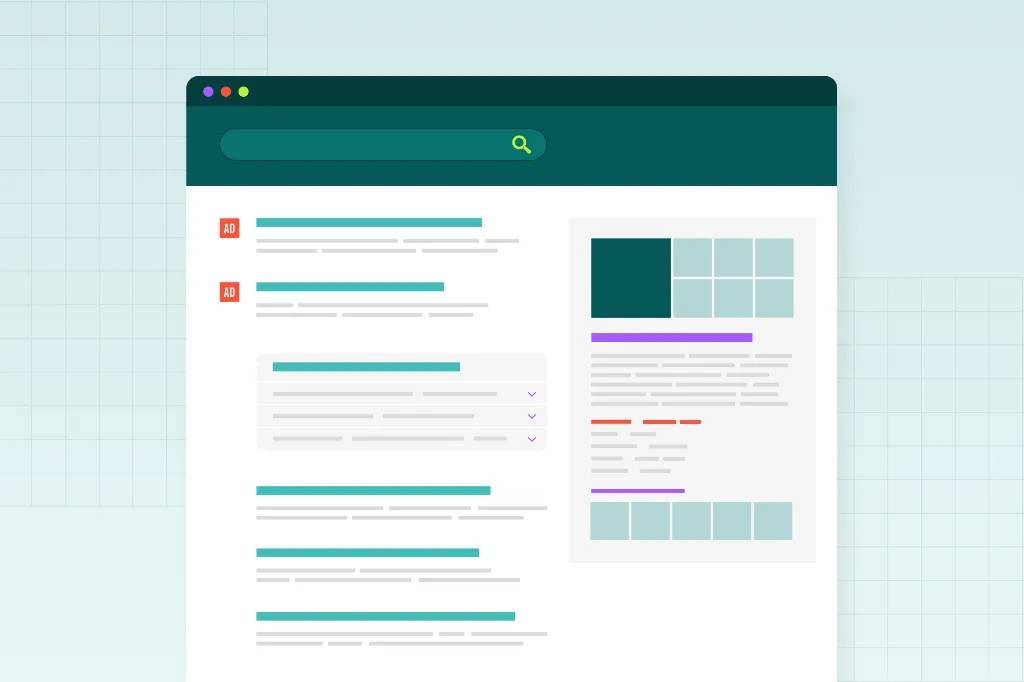
Ranking in Google AI Overviews means earning a citation in Google’s AI-generated search answer. The most reliable starting point is strong SEO. You should publish useful, specific answers, make them accessible to Google, and demonstrate why your business is credible. Then measure citations alongside organic performance. There is no guaranteed placement or separate shortcut for AI Overviews.
This guide provides a practical eight-step approach for businesses, including specialized B2B companies competing for narrow, high-value searches. The goal is not simply to appear in another search feature. It is to become a source buyers encounter while forming their shortlist.
What are Google AI Overviews and How Do They Work?
Google AI Overviews are AI-generated summaries that appear within some Google Search results and link to supporting websites. They are different from AI Mode, Google’s more conversational search experience. AI Overviews grew out of the earlier Search Generative Experience (SGE).
For complex questions, Google may use a process called query fan-out, exploring related searches to assemble a response. That creates an opportunity: a page answering a specific sub-question may be cited even when it is not the strongest page for the broadest keyword. Informational, multi-part questions are sensible starting targets, but Google determines when an Overview appears and can change the sources shown.
Why AI Overview Placement Matters When Clicks Decline
AI Overviews can answer a question without requiring a website visit. That may reduce clicks for some searches, so citation visibility should not be presented as a guaranteed traffic strategy. For B2B marketers, however, a relevant mention can introduce a company to a buyer before a form submission or sales call.
“In B2B, the shortlist often begins forming before anyone visits a website,” says Frank Fornaris, President of Straight North. “When Google includes your company in an AI-generated answer, it builds familiarity and credibility at a critical point in the buying process, even if the click comes later.” The practical value is especially clear for specialized manufacturers and service firms, where a small number of qualified opportunities can matter more than large volumes of casual traffic.
“In B2B, the shortlist often begins forming before anyone visits a website. When Google includes your company in an AI-generated answer, it builds familiarity and credibility at a critical point in the buying process, even if the click comes later.”

In Straight North’s September 2026 GEO survey, 33 of 100 respondents (33%) said their organizations were prioritizing Google AI Overviews among AI-search platforms. This describes the surveyed marketers’ priorities, not the effectiveness of any particular optimization tactic.
How Does Google Choose Which Pages to Cite?
Google does not publish a fixed formula for AI Overview citations. Conventional search visibility matters because Google must discover and understand candidate pages, but a first-page organic ranking does not guarantee a citation. Conversely, an answer to a narrow sub-question can sometimes be useful even when the page is not a leading result for the main query.
The brief cites research from Semrush and SE Ranking connecting AI Overview citations with strong organic rankings, as well as studies associating citations with content depth and freshness. These are observational relationships, not proof that a particular ranking position, article length, or publication date causes inclusion. Google’s own guidance emphasizes ordinary SEO fundamentals and helpful, people-first content rather than special AI Overview tricks.
The strongest editorial test is straightforward: does this page offer a reliable answer, in a form Google can access, that adds something useful beyond what competing pages say?
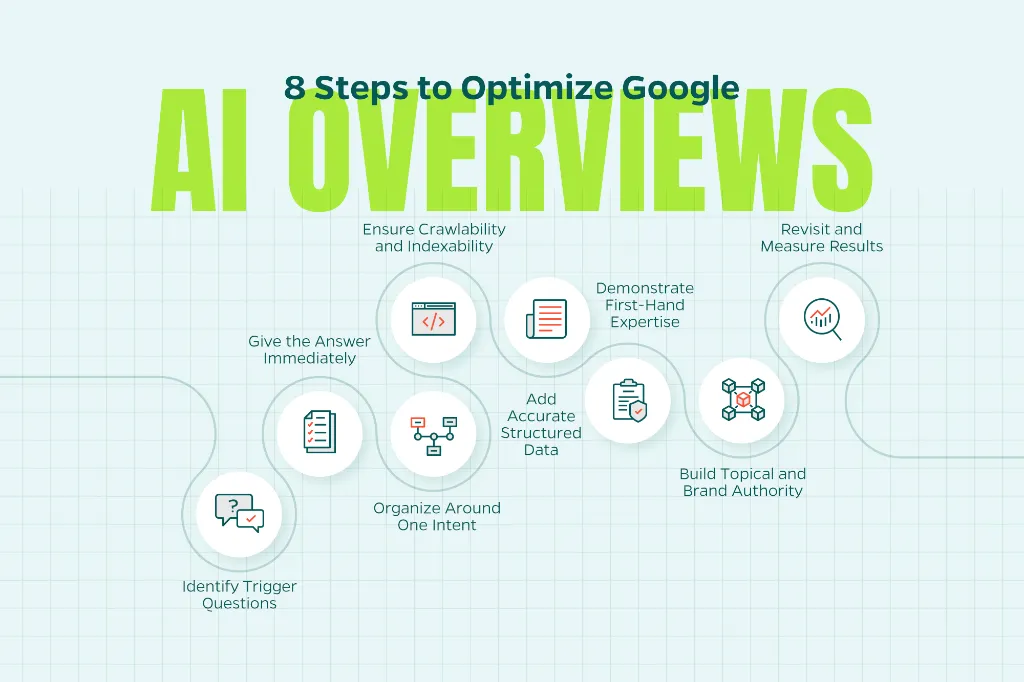
Eight Steps to Optimize for Google AI Overviews
The following checklist combines traditional SEO with changes that make individual answers easier to find, understand, and evaluate.
- Identify questions that could trigger an AI Overview. Start with long-tail, informational searches your customers ask during research. Examine actual search results, People Also Ask questions, sales conversations, and support tickets. Prioritize queries where your expertise is unusually specific, such as a technical product comparison or an implementation constraint.
- Give the answer immediately. Open each question-focused section with one or two sentences that answer the heading directly. Follow with conditions, examples, limitations, or evidence. A reader should understand the main point without having to read the entire article.
- Organize around one clear intent. Use descriptive headings that match the questions addressed beneath them. Lists work well for steps; tables help with comparisons; short paragraphs help explain decisions. Avoid burying the answer under an extended introduction or building one sprawling page that attempts to address unrelated intents.
- Make the page crawlable and indexable. Check robots directives, canonical tags, indexing status, and whether essential copy appears in rendered HTML. Fix broken navigation and JavaScript rendering issues. Connect related pages with useful internal links, and maintain a fast, accessible experience. An excellent answer is of limited value if Google cannot retrieve it.
- Add accurate structured data where appropriate. Article, Organization, Product, and other supported schema types can clarify page information. Markup must match visible content and follow Google’s eligibility rules. There is no special “AI Overview schema,” and adding FAQPage or HowTo markup does not secure an AI citation or necessarily produce a rich result. Validate eligible markup with Google’s Rich Results Test.
- Demonstrate first-hand expertise. Identify authors and reviewers, show relevant credentials, cite dependable sources, and explain how claims were established. For technical B2B subjects, original measurements, product specifications, implementation examples, and informed limitations are often more valuable than generic advice.
- Build topical and brand authority. Publish a connected set of focused resources instead of relying on one oversized guide. Earn legitimate coverage and references from trade publications, partners, professional associations, and relevant communities. Consistent company information and genuine industry participation make expertise easier for people and search systems to assess.
- Revisit and measure the results. Refresh outdated details, check target queries regularly, and record whether an Overview appears and which pages it cites. Compare the findings with organic search trends and business outcomes. Treat the process as continuous improvement rather than a one-time submission.
How Should You Structure Content So AI Can Cite It?
Answer-first writing gives each section a self-contained claim before supplying detail. For example, a section titled “Does stainless steel resist corrosion?” should begin with a qualified answer identifying the relevant grades and environments, rather than several sentences about the history of steel. A useful answer is both concise and precise.
“So, it’s important to sort of front-load the content, you know, state your point right off the bat,” says Bryan Paravola, Senior SEO & GEO Strategist at Straight North. That approach also benefits human readers scanning for an immediate decision.
“So, it’s important to sort of front-load the content, you know, state your point right off the bat.”

“Formatting makes strong content more usable, but it doesn’t turn generic content into authoritative content,” says Bob Hand, Senior SEO & GEO Strategist at Straight North. A neat list cannot replace original analysis, defensible facts, or expertise. Likewise, winning a featured snippet may indicate that Google can extract your answer, but featured snippets and AI Overviews are different features with different selection behavior.
“Formatting makes strong content more usable, but it doesn’t turn generic content into authoritative content.”

In Straight North’s September 2026 GEO survey, 58 of 98 respondents (59.18%) reported changing or creating website content to increase visibility in AI-generated results, including ChatGPT and Google AI Overviews. That result measures reported behavior across AI platforms, not a proven increase in Google AI Overview citations.
How Technical SEO Helps with AI Overview Visibility
Technical SEO helps Google discover and interpret content, but it does not provide an independent route into AI Overviews. Verify that important pages are indexable, linked from the site, and readable without requiring user interaction. Audit duplicate URLs, misleading canonicals, blocked assets, and rendering problems that conceal essential text.
Structured data can describe entities and page attributes, but it must be valid and truthful. Core Web Vitals and clear site architecture support usability and established search fundamentals. An llms.txt file is not a documented Google AI Overview ranking requirement; do not treat it as a substitute for crawlability, indexable content, or useful internal linking.
How Do Expertise, Original Research, and Brand Mentions Help Get You Cited in AI Overviews?
Google’s E-E-A-T framework stands for experience, expertise, authoritativeness, and trustworthiness. It is a quality-assessment concept, not a single numerical ranking factor. A trustworthy page makes authorship, sourcing, update history, and organizational accountability visible, particularly when the subject requires specialized judgment.
“Trust is reinforced when you can easily identify who created the content, when it was updated, how the information was sourced, and who’s responsible for the organization,” says Bob Hand in a Straight North subject-matter interview. Give readers the information they need to evaluate a claim rather than asking them to trust a polished presentation.
“Trust is reinforced when you can easily identify who created the content, when it was updated, how the information was sourced, and who’s responsible for the organization.”
In Straight North’s September 2026 GEO survey, 71 of 98 respondents (72.45%) said their organizations had increased subject-matter expert participation in content because of AI search. This indicates an editorial shift among respondents, not evidence that expert involvement alone causes citations.
Original surveys, benchmarks, case studies, and documented field experience can distinguish a company from pages repeating familiar advice. Relevant mentions on respected industry sites can also help people discover and evaluate a brand. Neither original data nor off-site coverage guarantees selection in an AI Overview.
How to Track AI Overview Visibility
Track AI Overview visibility with a repeatable query-level log, not just an organic rankings report. For each priority search, record the date, location or device context, whether an Overview appeared, whether your domain was cited, and which URL received the citation. Results can vary by query and context, so repeated observations are more useful than one screenshot.
Google Search Console includes AI Overview activity within standard Search performance reporting rather than providing a dedicated, comprehensive citation report. Watch impressions, clicks, click-through rate, and changes in branded searches, but do not assume a CTR decline was caused by an Overview. Third-party platforms such as Semrush, Ahrefs, and SE Ranking offer AI Overview monitoring features; their coverage and methodologies vary. Here are a few areas to track:
- Monitor the percentage of tracked queries displaying an AI Overview.
- Measure how often your site is cited and which specific pages earn citations.
- Compare visibility changes with qualified inquiries, assisted conversions, and branded demand.
These indicators offer directional evidence, not a complete measure of exposure or revenue attributable to AI-generated answers.
Google AI Overviews FAQ
How long does it take to appear in AI Overviews? There is no published timetable. Established, indexed pages may be considered as Google reevaluates search results, while new pages need time to be discovered and earn visibility. Even well-optimized pages may never be cited.
Is ranking in AI Overviews different from being cited by ChatGPT? Yes. Google AI Overviews are part of Google Search; ChatGPT uses different systems and retrieval behavior. Clear writing, credible sourcing, and technical accessibility can help across platforms, but citation results should be tracked separately.
Is SGE the same as AI Overviews? SGE was the experimental Search Generative Experience that preceded the public AI Overviews launch in 2024. Older SGE research may provide historical context, but Google’s implementation has continued evolving.
Is AI Overview optimization the same as GEO or AEO? AI Overview optimization is a Google-specific application of generative engine optimization (GEO). Answer engine optimization (AEO) is a related term focused on making information usable in direct answers. Their tactics overlap, but the platforms and measurements are not interchangeable.
Need Help with AI Overviews?
Winning citations starts with useful answers, sound SEO, and evidence readers can trust. Contact Straight North to discuss how to strengthen your visibility in Google AI Overviews.