




A good GEO strategy is a managed program built around a baseline audit, business-tied goals, prioritized workstreams, clear ownership and budget, and a quarterly review cadence. It is not a disconnected list of AI-search tactics.
GEO means Generative Engine Optimization. It is the work of improving a brand’s visibility and citations in systems such as ChatGPT, Google AI Overviews and AI Mode, and Perplexity. If you want a broader introduction to this topic, see Straight North’s complete guide to generative engine optimization.
The most useful way to plan GEO is to treat it like any other durable marketing program. Establish where you are, decide what success means, focus resources where they can matter most, assign responsibility, fund the work, and revisit the plan as the market changes. That strategy layer is what keeps promising tactics from turning into random acts of optimization
Why Your Company Needs a GEO Strategy Now
AI-generated answers are changing where research happens and how often a search produces a website visit. Pew Research Center found that Google users clicked a traditional result on 8% of visits when an AI summary appeared, compared with 15% of visits when no AI summary appeared.
Straight North’s September 2026 GEO survey found that 44.55% of 101 respondents said GEO was already a formal marketing strategy with documented goals, showing that structured AI-search planning is no longer limited to a small group of experimenters.
“Not being able to perfectly measure GEO doesn’t mean the value isn’t there,” says Frank Fornaris, President of Straight North. “If customers are changing how they find and evaluate companies, waiting until every lead can be neatly attributed to GEO may mean waiting until your competitors already have the advantage.” The point is not to ignore attribution; it is to avoid making perfect attribution a prerequisite for beginning work in a channel that already influences discovery and evaluation.
“Not being able to perfectly measure GEO doesn’t mean the value isn’t there. If customers are changing how they find and evaluate companies, waiting until every lead can be neatly attributed to GEO may mean waiting until your competitors already have the advantage.”

Strong Google rankings help, but they do not automatically guarantee visibility in AI answers. GEO therefore manages a related but different outcome: whether AI systems retrieve, cite and recommend your brand when buyers ask questions, compare options or build shortlists.
A Strong GEO Strategy Builds on SEO
GEO should usually sit on top of an existing SEO foundation. Crawlability, technical health, topical authority, credible authorship and strong content remain essential because an AI system cannot reliably cite a page it cannot find, parse or trust.
SEO and GEO are separated by success metrics. Traditional SEO often emphasizes rankings, impressions and clicks. A GEO strategy adds citations, mentions, share of voice in AI answers and AI-influenced leads to the measurement mix. For most companies, that means expanding the search program rather than creating a rival program with a completely separate team and budget.
The GEO Program Blueprint: Six Components of Every Good Strategy
A complete GEO strategy should answer six management questions in order: Where are we now? What business result are we pursuing? What work matters most? Who owns it? What will we spend? How will we sequence and review the program?
- Baseline audit of AI visibility.
- Goals and KPIs tied to business outcomes.
- Prioritized workstreams based on impact and effort.
- Clear ownership and team responsibilities.
- A realistic budget and resource plan.
- Quarterly sequencing and a review cadence.
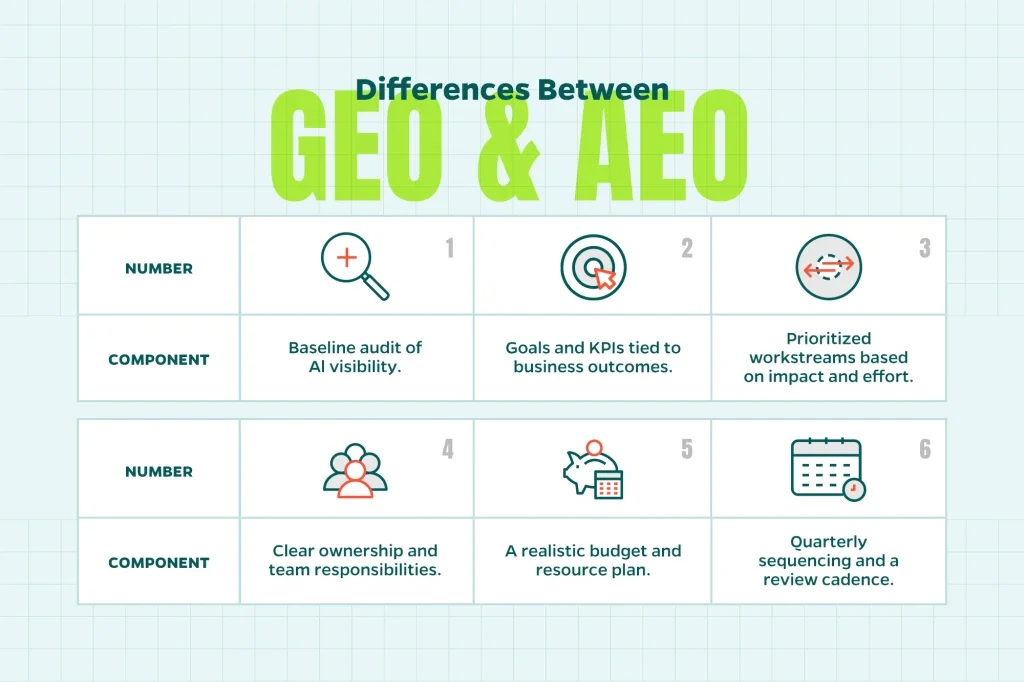
You have a tactics list rather than a strategy if there is no baseline, no priority order, no named owner, no budget decision and no scheduled review. A strategy tells the organization what to do, in what order, with whose time and money, and how it will decide what to change next.
Component 1: Baseline Your AI Visibility With a GEO Audit
A GEO audit should show how visible your brand is across a representative set of buyer prompts, which competitors are cited instead, and how AI systems describe your company. The goal is a practical baseline, not a perfect score.
A useful starting audit can be done before buying specialized software. Create a panel of buyer questions, test them across major AI surfaces, record whether your brand appears, note the cited sources, and compare the results with your traditional search positions. The most actionable output is often a citation gap: prompts where your site ranks well but AI answers still favor competitors.
“So, we have referral data, we have those really long prompts within traditional search, and we have the sources that are important to ChatGPT and others,” says Tom Lustina, Director of SEO & GEO at Straight North. “So, those are the key elements that should feed a GEO or an AI optimization strategy.” In practice, the audit should combine prompt observations, referral signals, search-query evidence and source patterns rather than rely on a single visibility score.
“So, we have referral data, we have those really long prompts within traditional search, and we have the sources that are important to ChatGPT and others. So, those are the key elements that should feed a GEO or an AI optimization strategy.”

Component 2: Set GEO Goals and KPIs Leadership Will Fund
Good GEO measurement uses a ladder from visibility to business impact. Leading indicators show whether AI systems are surfacing the brand; traffic indicators show whether that visibility creates visits; business indicators show whether those visits contribute to qualified opportunities and revenue.
- Visibility: citations, mentions and share of voice across the prompt panel.
- Traffic: AI-referral sessions and search visibility tied to AI features.
- Business outcomes: qualified leads, pipeline and revenue influenced by AI-assisted discovery.
Straight North’s September 2026 GEO survey found that 60.61% of 99 respondents described themselves as extremely or very confident in assessing meaningful GEO business results, a self-reported confidence measure rather than proof that attribution is already solved.
The strongest goal is specific enough to manage. “Be cited on 15 of the 25 prompts our buyers repeatedly ask” is more useful than “increase AI mentions” because it has a defined denominator, a relevant audience and a baseline that can be revisited.
Component 3: Prioritize Quick Wins Without Neglecting Compounding Authority
GEO priorities should move from gating problems to citable content to authority building, while measurement runs alongside the work from day one. Fix technical blockers first, improve the highest-value answer pages next, then invest in the slower off-site and authority signals that can compound over time.
“I think a practical prioritization framework combines impact, risk, and effort,” says Bob Hand, Senior SEO & GEO Strategist at Straight North. That framework keeps a team from chasing every new AI-search idea: high-impact, low-effort fixes can move first, while high-risk or expensive work needs stronger evidence.
“I think a practical prioritization framework combines impact, risk, and effort.”

The original GEO research also supports prioritizing evidence-rich content over gimmicks. In the GEO-bench results from Aggarwal and colleagues, quotation addition scored 27.8, statistics addition 25.9 and source citation 24.9 on the paper’s position-adjusted word-count measure, compared with a 19.3 baseline; the authors summarize the best-case improvement as up to 40%. The paper is useful evidence for direction, but its test environment should not be treated as a guarantee of the same lift on every current AI platform.
A practical priority stack is simple: remove crawl or rendering obstacles; rewrite a small set of high-intent pages so they answer questions clearly and support claims with evidence; then strengthen topic coverage, expert signals, mentions and digital PR. This keeps the program moving while longer-term authority develops.
Components 4 and 5: Decide Who Owns GEO and What It Costs
GEO should have one accountable owner, usually within the team responsible for organic search, with content, development and PR assigned as contributors. A small company does not need a new GEO department; one senior owner with access to the right specialists can be enough.
Straight North’s September 2026 GEO survey found that 9% of 100 respondents said GEO responsibility was shared across multiple teams, a description of current practice rather than evidence that shared ownership is the best model.
A realistic GEO budget depends on the starting SEO foundation, content volume, technical needs, competitive pressure, off-site authority work and measurement tools. For many organizations, the first GEO budget is mostly a reallocation of existing SEO and content resources plus incremental measurement or digital PR costs. In-house teams work well when they already have senior search expertise and enough publishing capacity; agencies can add speed, cross-client pattern recognition and reporting infrastructure when those capabilities are missing.
Component 6: Sequence the Strategy Across Four Quarters
A GEO roadmap should be specific enough to create momentum but flexible enough to change when the evidence changes. A sensible first-year sequence is crawl, walk, run: establish the baseline, improve priority content, build authority, then scale what worked.
- Q1: Build the prompt panel, complete the audit, fix technical blockers and establish the reporting baseline.
- Q2: Transform the highest-priority topic clusters and buyer-intent pages into clear, evidence-rich, citable resources.
- Q3: Expand authority through expert content, mentions and digital PR, then complete the first major share-of-voice review.
- Q4: Scale the workstreams that moved citations or business outcomes, stop the ones that did not, and re-baseline for the next year.
“Long-term doesn’t mean constant publishing or rigid quotas, it means connecting work across different quarters, preserving the learning, and maintaining successful assets so that the external footprint becomes more coherent with every cycle,” says Adam Rosenbaum, SEO & GEO Manager at Straight North. The quarterly review matters because a GEO strategy should learn. It should keep what improves visibility, revise what stalls, and narrow or stop work that does not justify its cost.
“Long-term doesn’t mean constant publishing or rigid quotas, it means connecting work across different quarters, preserving the learning, and maintaining successful assets so that the external footprint becomes more coherent with every cycle.”

Timelines should be treated as ranges rather than promises. Technical corrections can show effects in weeks, content-level citation gains may take one or two quarters, and authority-driven improvements can require longer. A mature program is not one that has “finished GEO.” A mature GEO program is one that can connect a stable audit panel, consistent execution and business reporting to better decisions every quarter.
What a Good GEO Strategy Looks Like in Practice
Consider a B2B manufacturer that begins the year cited on only two of 25 prompts engineers and procurement teams use to compare suppliers. In Q1, the company discovers technical access issues and several citation gaps. In Q2, it improves the product, specification and comparison content tied to those prompts. In Q3, it adds named engineering expertise and earns relevant trade mentions. In Q4, it expands the formats and topics that increased citations and stops spending time on pages that did not move.
The point of the example is not the exact citation count. It is the operating rhythm: a fixed buyer-oriented baseline, explicit priorities, accountable owners and quarterly decisions. That is what turns GEO from a collection of experiments into a strategy.
GEO Strategy FAQs
What is a good AEO strategy?
A good AEO strategy uses the same program structure. Audit current answer visibility, set measurable goals, prioritize answer-first content, assign ownership and budget, and review progress on a fixed cadence. AEO places more emphasis on becoming the extracted answer, while GEO more often describes visibility within generative responses, but the disciplines overlap heavily in practice.
Do small businesses need a GEO strategy?
Yes, but the program can be smaller. A small business can start with one accountable owner, one commercially important topic cluster, a 10-prompt panel, a few technical fixes and a short list of pages to improve. Narrow focus is usually better than trying to optimize the entire site at once.
What are the signs a GEO strategy is failing?
Warning signs include no citation movement on prioritized prompts after multiple review cycles, competitors being repeatedly recommended where your brand should be relevant, measurement based on isolated screenshots instead of a consistent prompt panel, and tactics running without a clear owner or business goal. Each problem points back to a missing piece of the program blueprint.
Is an AEO strategy different from a GEO strategy?
AEO and GEO are best treated as closely related labels with different emphasis rather than separate marketing programs. Both depend on strong SEO foundations, clear answers, credible evidence, authority and measurement; the difference is mainly whether the discussion centers on answer extraction or broader generative-engine visibility.
Build the Program Before Chasing the Tactics
A good GEO strategy gives a company a repeatable way to decide what deserves attention as AI search evolves. Start with a baseline, tie goals to buyer and business outcomes, prioritize work by evidence and value, assign responsibility, fund the plan realistically, and use quarterly reviews to keep learning.
Need Help?
If you want help building or improving a GEO strategy, contact Straight North to talk with our team.