




SEO helps a business earn visibility and clicks in traditional search results. GEO helps a brand and its content become sources, citations and mentions in AI-generated answers. Businesses whose customers research online generally need both because buyers now discover information through search listings and AI responses.
The choice is not SEO versus GEO. It is how to build one search program that performs across both experiences without duplicating every task. Here is what differs, what overlaps and where to invest first.
What is SEO, and What is GEO?
What is SEO?
Search Engine Optimization (SEO) improves a website’s ability to appear in unpaid search results on platforms such as Google and Bing. It combines technical accessibility, useful content, keyword and intent research, and signals of credibility to attract relevant organic visits and turn those visits into business opportunities.
What is GEO?
Generative Engine Optimization (GEO) improves the likelihood that AI-powered experiences, including ChatGPT, Google AI Overviews, Gemini, Perplexity and Copilot, can find, understand and reference a business’s information when forming answers. Its emphasis is not merely appearing on a results page, but being represented accurately within a synthesized response. For a broader explanation, see Straight North’s guide to GEO.
Here, GEO means generative engine optimization, not geographic SEO or geo-targeting. Geographic optimization helps businesses appear for searches tied to a place, such as “accountants near Chicago.” Answer engine optimization (AEO) is another related term, often emphasizing concise answers to direct questions. The terminology overlaps, but GEO particularly emphasizes visibility in generative responses.
GEO vs. SEO: Six Differences That Matter
Dimension | SEO | GEO |
Primary goal | Organic rankings, qualified clicks | AI citations, brand mentions, accurate inclusion |
Where visibility happens | Search engine results pages | AI-generated answers and source links |
Typical query | Keyword or search phrase | Conversational, multi-part prompt |
Content priority | Findable, useful pages matching intent | Clear, attributable, extractable answers |
Discovery process | Crawling and indexing for search | Model knowledge and selective retrieval, depending on platform |
Core metrics | Rankings, impressions, clicks, conversions | Prompt visibility, citations, mentions, AI referrals, conversions |
Goals: SEO competes for prominent placement in search results, while GEO competes to become useful evidence inside an answer. Bob Hand, a Straight North subject-matter expert, explains: “Ranking means Google thinks your page deserves visibility. Citation means the system thinks your page is useful evidence for a specific answer.” A highly ranked page is not guaranteed to be cited, and a cited source need not occupy the top organic position.
“Ranking means Google thinks your page deserves visibility. Citation means the system thinks your page is useful evidence for a specific answer.”

Placement: An SEO result typically gives the searcher a link to evaluate and click. An AI response may summarize several sources before a user visits any website. Brand familiarity and correct attribution can therefore matter even when a visit never happens.
Queries: Traditional keyword research often starts with short phrases such as “industrial HVAC maintenance.” An AI user might ask, “What should a facilities manager compare when choosing an industrial HVAC maintenance provider for five locations?” That longer question combines criteria, buyer role and operational context. Some AI systems use query fan-out, breaking a complex prompt into several related searches, so a page that addresses adjacent questions coherently can be more useful than one optimized for a single phrase.
Content: SEO requires pages that search engines can discover and that readers find helpful. GEO adds emphasis on answer-first sentences, explicit entity names, supported claims and sections that make sense when retrieved individually. Neither approach rewards empty repetition of keywords.
Discovery: Traditional search engines crawl and index pages, while AI products vary in whether they draw on pretraining, live web search, their own retrieval systems or search partners. Not every AI answer searches the web, and allowing a crawler does not guarantee inclusion in an answer.
Measurement: Organic positions and click-through rates tell part of the SEO story; citation frequency, brand mentions and share of voice across representative prompts tell part of the GEO story. Both sets of metrics should ultimately be tied to qualified leads and revenue, not treated as wins in isolation.
What SEO and GEO Have in Common
Strong SEO is a practical foundation for GEO because both depend on accessible, trustworthy and well-organized information. AI products may retrieve pages through search infrastructure, but they do not all use Google rankings as a direct citation rule. Strong rankings can improve discoverability without guaranteeing that an AI system will quote a particular page.
“SEO still matters because AI search relies on credible, well-structured online content to decide which businesses and sources to reference,” says Frank Fornaris, President of Straight North. “A strong SEO strategy builds digital authority and helps customers find and trust your business across both traditional and AI-powered search platforms.” The shared priority is information that people and automated systems can understand and verify.
“SEO still matters because AI search relies on credible, well-structured online content to decide which businesses and sources to reference. A strong SEO strategy builds digital authority and helps customers find and trust your business across both traditional and AI-powered search platforms.”

Tom Lustina, a Straight North subject-matter expert, puts it this way: “And the key element that will always be there, and an important point for us to stress, is good SEO is good GEO, and SEO is the foundation.” That principle translates into practical work that serves both channels:
“And the key element that will always be there, and an important point for us to stress, is good SEO is good GEO, and SEO is the foundation.”

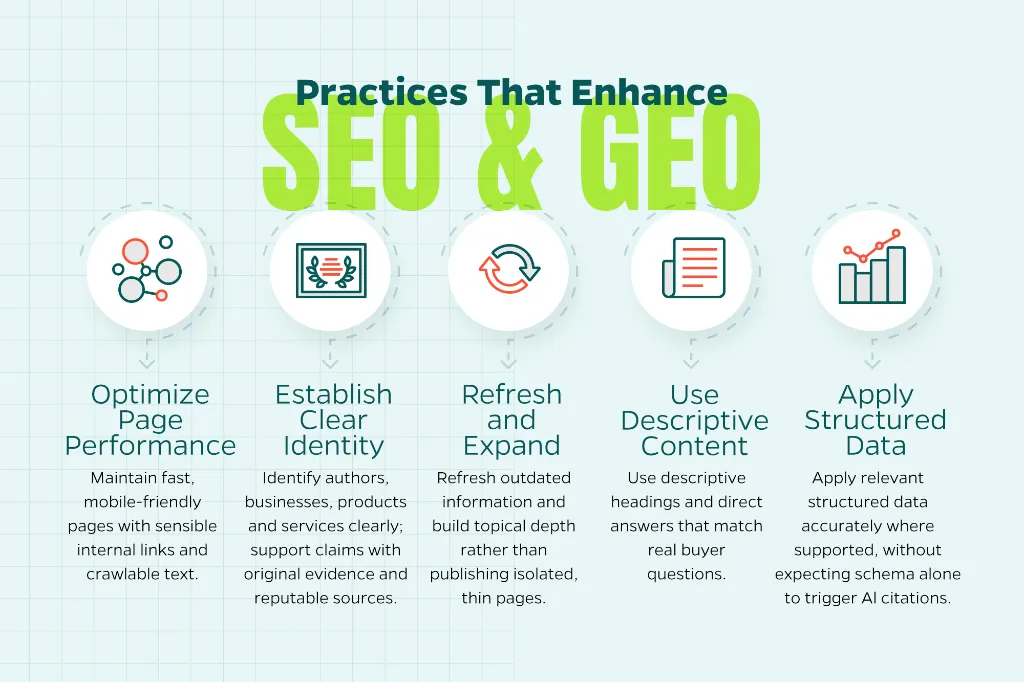
- Maintain fast, mobile-friendly pages with sensible internal links and crawlable text.
- Use descriptive headings and direct answers that match real buyer questions.
- Identify authors, businesses, products and services clearly; support claims with original evidence and reputable sources.
- Apply relevant structured data accurately where supported, without expecting schema alone to trigger AI citations.
- Refresh outdated information and build topical depth rather than publishing isolated, thin pages.
GEO tactics such as concise summaries and clear sourcing do not inherently damage SEO. They often improve usefulness for human readers as well. The risk comes from replacing substantive content with shallow answer snippets or implementing markup that does not reflect the page.
Is GEO Replacing SEO?
No. GEO is expanding the surfaces where search visibility matters, not making conventional search disappear. AI summaries can reduce clicks for some informational queries, however, so businesses should prepare for more research to happen before a prospect reaches their website.
In Straight North’s September 2026 GEO survey, 68.32% of respondents (69 of 101) said their organizations had increased investment in traditional SEO compared with one year earlier. This describes the surveyed organizations, not all marketers, but it illustrates that investment in conventional search continues alongside AI experimentation.
“So, it’s still that same path, it’s just way less dependent on the traffic,” says Tom Lustina, a Straight North subject-matter expert. His observation points to a changing buyer journey: an AI mention can shape consideration without producing an immediately attributable website session. That does not mean traffic is irrelevant; it means visits alone no longer capture every meaningful exposure.
“So, it’s still that same path, it’s just way less dependent on the traffic.”
Search has absorbed changes before, including mobile use, voice queries and featured snippets. AI-generated answers are a substantial new shift, but the sensible response is to adjust measurement and content delivery rather than abandon proven SEO work.
How to Run SEO and GEO Together Without Doubling the Work
A dual optimization strategy starts with one useful page and makes it effective for both search listings and AI retrieval. It is usually more efficient to strengthen existing high-value pages than to build a separate library labeled “AI content.”
“Companies should focus on creating credible, useful content that serves both traditional search engines and AI platforms,” says Frank Fornaris, President of Straight North. “The goal is to build a strong digital presence that makes the company easy to find, understand, and trust wherever customers are searching.” In practice, this means coordinating content, technical SEO and visibility measurement rather than assigning GEO to a disconnected team.
“Companies should focus on creating credible, useful content that serves both traditional search engines and AI platforms. The goal is to build a strong digital presence that makes the company easy to find, understand, and trust wherever customers are searching.”
- Start with buyer intent: map priority keywords and the questions buyers ask before contacting a provider.
- Build or improve the core page: resolve crawl barriers, explain the service and establish credible expertise.
- Add answer-ready sections: state the answer first, then give context, examples, limitations and supporting data.
- Clarify entities and evidence: consistently name the business and services; attribute statistics and expert commentary.
- Support discovery: use relevant internal links, appropriate schema and accessible page formats. FAQ markup can describe FAQs, but rich-result eligibility is restricted and markup does not ensure AI inclusion.
- Test and refine: review real prompts, check whether AI responses mention or cite the brand, and compare those findings with leads.
Some teams also evaluate an llms.txt file as an optional way to describe site content to AI tools. It is not an established requirement for GEO, and there is no reliable basis to promise improved citations from adding one.
Consider a commercial roofing company with a page about roof replacement planning. SEO can help that page appear for “commercial roof replacement cost.” The same page can answer a prompt such as “What affects replacement costs for a 100,000-square-foot warehouse roof, and what questions should I ask contractors?” by explaining materials, disruption, warranties and estimating variables in self-contained sections. This is an illustrative strategy, not a claim that any particular brand has achieved both outcomes.
In Straight North’s September 2026 GEO survey, 64.36% of respondents (65 of 101) said their organizations had increased combined investment in SEO and AI-search visibility compared with one year earlier. That finding reflects respondents’ reported spending direction, not evidence that a particular budget split produces better returns.
Where Should You Invest First, and How Do You Measure Results?
The right starting point depends on the health of your existing search program. A business with weak indexing, thin service pages or limited organic reach should fix SEO fundamentals first. A business with strong search visibility but few AI mentions should test GEO improvements on pages tied to valuable buyer questions. A new site should design for both from the beginning, while prioritizing technical accessibility and useful content.
SEO measurement should track search impressions, ranking trends, organic clicks, conversions and lead quality. Google Search Console is useful for search performance, although AI-related appearances are not always separately identifiable in its standard reporting. GEO measurement should use a repeatable set of prompts, record mentions and linked citations, evaluate answer accuracy, and examine AI referral sessions when referrer information is available. Bing Webmaster Tools also offers AI-related visibility reporting, subject to the features available in the account.
In Straight North’s September 2026 GEO survey, 9.09% of respondents (9 of 99) reported identifying leads or customers influenced by ChatGPT or another generative AI platform even when AI was not the direct referral source. This underscores why last-click analytics alone may miss part of AI’s role in discovery, although the survey does not establish how much revenue AI caused.
Expect SEO improvements to compound over months, while AI citations may change more quickly from prompt to prompt and platform to platform. Neither channel has a universal timetable. The most useful common scorecard connects search exposure to qualified inquiries, validated leads and eventual revenue; Straight North’s lead validation and GoNorth! reporting are designed around that business outcome.
GEO vs. SEO: Frequently Asked Questions
What is the difference between GEO, SEO and AEO?
SEO improves visibility in conventional search results; GEO improves visibility and attribution in generative AI answers. AEO, or Answer Engine Optimization, focuses on making information suitable for direct answers and overlaps with both. The terms describe related goals rather than three completely separate content programs.
Does GEO mean geographic SEO?
Not in this comparison. GEO stands for Generative Engine Optimization. Geographic SEO, including local SEO and geo-targeting, focuses on searches associated with particular locations.
Is GEO just SEO with a new name?
No. GEO shares SEO’s technical and content foundations but adds distinct visibility goals, including being cited or accurately mentioned in AI-generated responses. Rankings and AI citations do not always move together.
Can you do GEO without SEO?
You can improve how an AI platform understands your brand without a mature SEO program, but ignoring crawlability, useful content and credibility limits your opportunities. Most businesses should establish those fundamentals before investing heavily in specialized GEO tactics.
Do you need an agency for GEO?
Not necessarily. An experienced SEO team can learn prompt testing, citation analysis and answer-focused editing. Outside support may be valuable when technical fixes, content production and measurement exceed internal capacity or when lead attribution needs closer coordination.
Need Help?
Want a search strategy that works across traditional results and AI answers? Contact Straight North to discuss SEO and GEO.