




Key Takeaways
- There is no magic word count for SEO or GEO.
- Search intent should determine how much content a topic needs.
- Content depth matters more than length alone.
- Clear structure helps people and AI find important information.
- Use word count as a guide, not a ranking goal.
“How long should this page be to rank?” It’s one of the first questions marketers ask when planning content, and it’s one of the hardest to answer with a straight number.
The answer is that there’s no universal word count that guarantees rankings. Search engines don’t score pages by length. They evaluate relevance, helpfulness, and expertise, as well as whether a page satisfies what the searcher is looking for. A tightly written 400-word page can outrank a bloated 2,000-word one if it does a better job answering the question.
Straight North’s On-Site SEO & GEO Strategist Bryan Paravola explains that it doesn’t make word count meaningless. A simple definition might need a paragraph, while a detailed comparison of enterprise software platforms may need far more to demonstrate expertise and cover the topic completely.
Generative engine optimization (GEO) doesn’t change this dynamic. Content needs enough depth to be useful while making its most important information clear and accessible to both people and AI systems.
So, the better question isn’t “How many words do I need?” It’s “How much depth does this topic deserve?” The answer helps explain why word count still has a place in content strategy, even if it isn’t a ranking factor.
Why Word Count Isn’t a Direct SEO Ranking Factor
The idea of an ideal word count has stuck around in part because length and search performance can appear connected. Comprehensive pages often perform well, making it tempting to attribute that success to the number of words on the page. But length alone isn’t what makes the content valuable.
Chasing a predetermined number can have the opposite effect. Padding an article to reach a specific number of words can introduce repetition, bury useful information, and consume resources without making the content any more helpful.
Instead of eliminating word count from the equation, the key is to change how you use it.
We shouldn’t completely abandon our old ways of thinking about things, but we should be aware that, you know, it’s a useful tool still. But we should always be focused on quality first and creating helpful content for humans first. Word count is a functional constraint that has practical implications, but it shouldn’t be the end goal.
Word count can help determine the scope and resources a topic deserves, but it shouldn’t dictate what goes on the page. Quality comes first, with length following naturally from what it takes to satisfy the user’s intent.
That distinction also explains why longer content frequently performs well: not because it’s longer, but because some topics require greater depth to cover effectively.
Why Longer Content Can Still Perform Better
The advantage isn’t the length itself. It’s what that additional space allows you to do.
Comprehensive content can explain complex ideas, answer related questions, and approach a topic from multiple angles. It also creates opportunities to incorporate examples, original insights, data, and other evidence that demonstrate real expertise. Together, those elements can strengthen topical depth and give search engines a clearer picture of what your brand knows about a subject.
But there’s an important distinction: more words don’t create authority. Having more valuable things to say can.
Word count can matter indirectly because establishing authority on a topic requires enough substance to cover it comprehensively. Content needs room for useful insights, examples, and supporting information that demonstrate real knowledge of the subject. But simply adding more words isn’t enough. The content must be unique and valuable, with each addition contributing something meaningful rather than increasing length for its own sake.
One way to think about it is the old practice of writers being paid by the word. Longer stories weren’t necessarily better because they contained more words. The additional length mattered when it developed the characters, advanced the story, or added something meaningful.

I used to always think that less is always more, that we want to say as much as we can in as few words as possible, and I’ve sort of inverted my thinking on that over the years. You know, that sometimes more is more, and sometimes setting a goal for yourself can help you push yourself to get to, new ideas, new ways of thinking about things, you know, new ways of approaching a topic. So, we just want to be careful about remembering what the goal is. You know, the goal isn’t necessarily to hit a certain mark, but to create more helpful content that is actually going to be beneficial.
The same principle applies to search content. Adding another 500 words only helps when those words deepen the reader’s understanding. If they introduce new evidence, answer another relevant question or offer a useful perspective, more can be more. If they simply repeat what’s already been said, they’re just making the page longer.
Content Length vs. Content Depth: What’s the Difference?
The distinction is straightforward:
Content length is simply how many words are on the page.
Content depth is how completely and meaningfully those words address the subject.
Depth can come from original insights, examples, data, research, first-hand experience, supporting evidence, and expert perspectives. It can also mean answering related questions or approaching a topic from different angles when those additions help readers better understand the subject.
“We want to make sure that the content is saying something important, so it’s actually answering relevant questions.”
Senior SEO & GEO Strategist | Onsite SEO & GEO Expert
That means a 3,000-word article that circles around the same ideas may offer less depth than a focused 1,500-word article supported by original evidence, examples and expertise.
Approaching the same question from different angles can still add depth when it helps the content be found or understood in different contexts.
Instead of asking whether a page is long enough, ask what each additional section contributes. If it introduces new information, strengthens an answer or gives readers a useful perspective they didn’t have before, it adds depth. If it simply restates what the page has already established, it adds length.
Let Search Intent Determine the Right Content Length
If depth matters more than an arbitrary number, how do you determine how much content a page actually needs? Start with search intent.
Different searches demand different levels of detail. Someone asking a straightforward question may want an answer in a few sentences, while someone researching a complex subject may expect an in-depth guide supported by examples and evidence. Users comparing options may need multiple perspectives to make a decision, while someone with transactional intent may want less explanation and a clearer path to a product or service.
While it’s difficult to predict exactly how algorithms behave, it’s important to understand intent before determining content length:

I think the key is that search intent is going to vary a lot from different topics, so the way they need to look at signals is going to depend a lot on the search intent itself. A more transactional intent, you know, some people are just looking to get to a product or a service. Certain informational, types of searches. People might be looking to either just get a quick yes or no answer, they might be looking to do more in-depth research. So I think the first way to try to sort of think about that is to think about, the intent itself and what people are actually looking for.
Before deciding how long a page should be, consider the intent behind its primary keywords and themes. What brought the searcher there, and what would fully answer the question?
The goal is intent satisfaction, not hitting a number. Once you understand what the searcher needs, the appropriate content length becomes much easier to determine.
How GEO Changes the Way We Think About Content Length
AI-powered search adds another layer to the conversation about content length. Generative engines need to identify, interpret, and extract useful information from a page, making information density and clear structure increasingly important. The goal isn’t necessarily to write less. It’s to make the value within the content easier to find.
That starts with putting important information where readers and AI systems can find it quickly. Long introductions that take several paragraphs to reach the point can bury the answer. Instead, front-load the essential information, provide concise answers beneath relevant headings and then use the rest of the section to add context, evidence, and detail.
Bryan compares this approach to the structure of a traditional newspaper article:
I think the reason why long-winded introductions are problematic is simply because people don’t like them. It makes it harder to get the answer that you’re looking for, and the risk is the same with, you know, AI algorithms that are… if you sort of hide the key focus way down at the bottom of the article, they might not even get to it. So, it’s important to sort of front-load the content, you know, state your point right off the bat. Sometimes you want to think of it more like, you know, a traditional newspaper article or something where, you know, the highlights should be first, you know, you want to have the answer first, and then you kind of expand on that as the article goes down.
In other words: give the answer first, then expand on it.
A brief summary at the top of a page can put that principle into practice. Explicitly stating the main points upfront provides a more direct explanation of what the content is saying and may leave less room for AI systems to misinterpret those points.
The same principle applies throughout the page. Clear headings, concise answers, scannable formatting, and supporting details help organize longer content so its most valuable information doesn’t get lost.
GEO doesn’t necessarily mean writing shorter content. It means making comprehensive content more information-dense, structured, and accessible.
Make Comprehensive Content Easy for Humans and AI to Navigate
Comprehensive content can provide the depth a topic deserves, but long content shouldn’t feel long. Readers should be able to quickly understand what a page covers, move to the information they need and find answers without digging through dense blocks of text.
The same structure that makes content easier for people to navigate can also make important information easier for AI systems to identify and interpret. Approach that structure from a human-first perspective rather than trying to predict exactly what an algorithm wants.
For longer content, consider using:
- Key takeaways or summaries near the beginning to establish the main points upfront.
- Descriptive H2s and H3s that clearly communicate what each section covers.
- Tables of contents for extensive guides so readers can jump directly to relevant information.
- Shorter paragraphs that prevent complex information from becoming a wall of text.
- Bulleted lists when information can be communicated more clearly at a glance.
- Clear sections that separate distinct questions, ideas or topics.
- Section summaries that reinforce important information within particularly detailed content.
- Scannable formatting that makes key information easier to locate.
Content becomes easier to navigate when these elements guide readers and AI systems to the important details.
For especially long pieces, summaries and key takeaways can clarify the main points upfront and give AI systems a clearer representation of the content. It leaves less room for AI-generated summaries to misinterpret the original message.
The takeaway is simple: depth doesn’t have to come at the expense of usability. The more comprehensive the content becomes, the more important its structure becomes.
What to Do When a Long Blog Post Starts Losing Rankings
When a once-successful article starts losing organic traffic or rankings, resist the instinct to simply add another 500 words. More content won’t necessarily address the reason performance has declined.
Instead, reassess the page by asking:
- Has search intent or the preferred content format changed? What searchers need today may be different from when the page was created.
- Are important answers missing or difficult to find? Look for gaps and opportunities to make existing information clearer.
- Is anything outdated or repetitive? Refresh old research and examples while removing content that no longer adds value.
- Could the page be easier to navigate? Break up dense sections and make important information easier to locate.
Optimization should focus less on adding or cutting words and more on what would make the content better.
“Are there any answers that are missing? Are there any answers that we could maybe make clearer or easier to find within the text?”
Senior SEO & GEO Strategist | Onsite SEO & GEO Expert
Credibility matters, too. Current research, external citations, case studies, testimonials and expert perspectives can strengthen the evidence behind the content, while clear author bylines and bios help establish who created it and why they’re qualified to speak on the subject.
This is where content depth intersects with E-E-A-T and source credibility. Instead of asking “What else can we add?”, ask “What would make this page more useful, complete and credible?” The answer may be adding something new, but it could just as easily mean updating, clarifying, restructuring or cutting what no longer earns its place.
Use Engagement Signals to Evaluate Whether Content Serves Its Purpose
Engagement metrics can provide useful context, but they shouldn’t be treated as definitive judgments about whether a page is too long or too short.
Metrics such as scroll depth and exits are better viewed as clues about how people interact with the page. Their meaning depends on the search intent behind the visit.
Bryan explains:
Certain topics lend themselves to, you know, a quick search, they just want a yes or no answer. Certain things, you know, they want to do a little more in-depth research, and they might naturally, you know, go from your website to looking at other outside third-party reviews and forums and things like that. Sometimes they just want to quickly get to a product or service, and they want to, you know, make a conversion right there. So, it really depends on the topic, but depending on what the topic is, you know, those signals can just give you clues as to how people are interacting with your content and, whether or not it’s serving its purpose or not.
A short visit, for example, isn’t automatically a bad sign. Someone may spend 30 seconds on a page because they found the exact answer they needed and moved on. Another visitor may spend 10 minutes with an in-depth guide because the topic requires more research.
In AI-powered search, users may not visit the page at all. AI Overviews and LLMs can surface information directly in generated answers, making traditional website engagement metrics even less representative of a piece of content’s value. Content can strengthen visibility and brand authority when it informs an AI-generated response or earns a citation, even if it doesn’t produce a click.
However, not every zero-click appearance delivers the same value. If a topic can be fully addressed with a quick AI-generated answer and offers little opportunity for deeper engagement, it may be less valuable to target than one that can introduce users to your expertise, services or point of view.
That context makes it difficult to evaluate content through any single engagement metric. Look at user behavior alongside the purpose of the page, the intent it was designed to satisfy and the visibility it earns across both traditional and AI-powered search.
The better question isn’t:
“Are people reading every word?”
It’s:
“Is this content helping people accomplish what they came to do, or helping them discover and trust the brand behind the answer?”
A Content Checklist: Is Every Word Earning Its Place?
There may not be an ideal word count to aim for, but there are clear ways to evaluate whether a page has enough depth. Before publishing new content or updating an existing page, review it from the perspective of intent, usefulness, credibility, and usability.
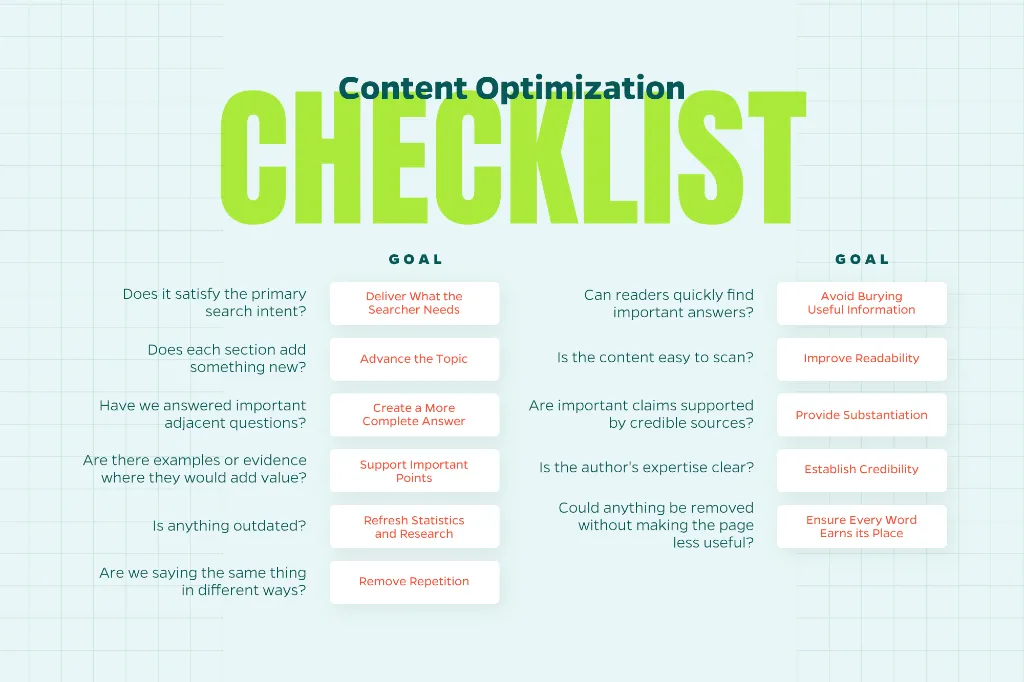
The goal isn’t to make every page shorter. It’s to make every word earn its place. Some topics will naturally require thousands of words to cover well, while others can satisfy the same standards in a fraction of that space.
Use the checklist to decide what earns a place on the page, not to chase a predetermined length.
Stop Writing to a Word Count. Start Writing to the Topic.
Word count still has a place in an SEO and GEO content strategy. It can help scope a project, allocate resources and estimate the level of effort a topic deserves. What it can’t do is tell you whether the finished content is actually good.
Treat word count as a functional guide rather than an absolute goal. What ultimately matters is whether those words deliver relevance, depth, credibility, structure and intent satisfaction.
Whether a page ends up at 500 words or 5,000, the right length is the one that fully answers the query without sacrificing clarity or the user experience.
Write enough to satisfy the intent, cover the topic completely, and show why your perspective is worth trusting. Make every section useful. Once the content delivers the answer your audience needs, it’s ready to publish. Later it can evolve as the topic does.