


AI search engines choose citations by finding material relevant to a question, evaluating which passages can support an answer, and linking to a limited set of sources in the response. The process depends on the platform and query; there is no publicly disclosed universal formula for becoming a cited source. For marketers, the distinction matters. A page can rank well in search without being the clearest evidence for an AI-generated answer.
For our purposes, “AI search” means consumer-facing experiences such as ChatGPT search, Perplexity, Google AI Overviews, Google AI Mode and Gemini when they use web information. It does not mean AI-powered search tools built into an individual company’s website. A linked reference in an AI answer is an AI citation, sometimes called an LLM citation.
AI Search vs. Traditional Search: What Changed?
Traditional search typically crawls and indexes pages, then ranks links for users to investigate. AI search can build on that same discovery infrastructure but adds a step: it assembles an answer from selected information and may cite supporting sources. The competition is therefore not just for a high-ranking page, but for a useful passage within that page.
“The biggest shift is that customers are moving from searching to asking,” says Frank Fornaris, President of Straight North. “Instead of sorting through pages of links, they expect AI to do the homework, narrow the options, and tell them which companies are worth considering.” For a B2B buyer comparing suppliers, that shift can place an AI-generated shortlist earlier in the research process.
“The biggest shift is that customers are moving from searching to asking. Instead of sorting through pages of links, they expect AI to do the homework, narrow the options, and tell them which companies are worth considering.”

In Straight North’s September 2026 GEO survey, 73.27% of respondents (74 of 101) said a customer or prospect had told their organization at least once in the previous 12 months that they used ChatGPT or another AI platform to discover or research the company. This finding describes respondents’ experiences, not the prevalence of AI research among all buyers.
Zero-click behavior adds urgency. Pew Research Center reported that users clicked a traditional search result in 8% of Google visits with an AI summary, compared with 15% of visits without one. Being mentioned inside an answer may therefore matter even when the user does not visit the cited website.
The AI Citation Pipeline: From Question to Source
A useful way to understand AI citations is as a five-stage process. These stages describe a common retrieval-grounded architecture, not a verified internal blueprint shared by every commercial platform.
1. Interpret the question
The system identifies what the user wants to know, including constraints such as location, industry, price, or recency. It may also recognize named companies and concepts through entity information and search indexes. “Best industrial pump supplier” requires different evidence than “How does a centrifugal pump work?”
2. Expand the search through query fan-out
Query fan-out means turning one question into several related searches. A request for a manufacturing vendor might prompt searches for product specifications, certifications, customer reviews, and regional availability. Each search creates another opportunity for a relevant source to be discovered.
“So, in addition to all of that, the biggest change with contextual understanding is embracing query fan out,” says Tom Lustina, Director of SEO & GEO at Straight North. The practical consequence is that a site should answer the specific follow-up questions buyers ask, not merely repeat a broad target keyword.
3. Retrieve candidate sources
Many AI answer systems use retrieval-augmented generation (RAG), which supplies outside documents or search results to a language model when it prepares an answer. Retrieval can use conventional keyword matching, semantic matching based on meaning, or a combination. Vector embeddings are one technique for comparing a query with conceptually related content even when the words differ.
4. Extract and evaluate passages
Retrieved pages can be divided into smaller sections, often called chunks or passages. A system can compare these sections against the question and consider whether they contain a direct, coherent and credible answer. Clear headings, focused paragraphs, and identifiable facts make the relevant evidence easier to locate. Retrieval alone does not guarantee a citation.
5. Synthesize an answer and attach citations
The model combines selected evidence into a response and, where supported, provides links to sources. Citations are intended to ground claims in retrievable material, but they do not prove that every sentence was independently verified. Different runs can surface different links because search results, query expansion, and answer composition can vary.
Step Zero: Can AI Search Retrieve Your Content?
A page cannot reliably compete for a web-grounded citation if the search system cannot discover or access its useful content. Conventional SEO foundations still matter. That includes indexable URLs, descriptive HTML, working internal links, sensible canonical signals, and readable page text.
Crawler controls require precision. OpenAI distinguishes OAI-SearchBot, which is associated with ChatGPT search discovery, from GPTBot, which is associated with model training. Googlebot supports Google Search crawling, while Google-Extended is a separate control relevant to certain AI uses; it is not simply an AI Overview indexing switch. Perplexity also documents its own crawler. Review robots.txt and server or CDN restrictions against each platform’s published guidance rather than assuming one bot rule governs all AI citations.
Important information rendered only through client-side JavaScript may be harder for some crawlers to process. Put core answers in accessible HTML where possible. Check Google Search Console and Bing Webmaster Tools for indexing issues, because traditional search discovery can influence what AI systems can retrieve. An llms.txt file is an emerging convention, not a proven substitute for crawlability or a guaranteed citation signal.
What Makes a Source Citation-Worthy?
Three practical qualities help explain why some sources are easier to cite than others: extractability, credibility, and freshness. These are useful editorial categories, not confirmed weighting factors in any one engine’s algorithm.
Extractability: Make the answer easy to identify
An extractable page gives the answer near the relevant heading, defines technical terms, and keeps each paragraph focused on one idea. Lists can clarify steps or comparisons; tables can organize specifications. Appropriate structured data can help search systems understand page information. But adding schema markup does not guarantee that an AI system will cite the page.
“AI systems need passages they can retrieve and sources they can cite, not just a homepage claiming expertise,” says Adam Rosenbaum, a practitioner interviewed in Straight North’s brand-authority research. A detailed page explaining testing procedures or product tolerances offers more useful evidence than a general claim that a company is an industry leader.
“AI systems need passages they can retrieve and sources they can cite, not just a homepage claiming expertise.”

Credibility: Support claims with evidence
Credible sources identify who produced the information, explain how conclusions were reached and make important claims verifiable. Firsthand expertise, named authors, transparent methods, reputable references, and recognition from independent sources can all strengthen the reader’s confidence. Google’s experience, expertise, authoritativeness, and trustworthiness (E-E-A-T) framework is helpful for evaluating content quality, but it is not a disclosed numerical AI citation score.
“A company becomes a credible source by consistently publishing accurate, useful information that reflects real expertise and answers customers’ questions,” says Frank Fornaris, President of Straight North. “A strong reputation, reliable website, and recognition from other trusted sources also signal authority to AI platforms.” The point is to substantiate expertise, not merely label a page “expert-written.”
“A company becomes a credible source by consistently publishing accurate, useful information that reflects real expertise and answers customers’ questions. A strong reputation, reliable website, and recognition from other trusted sources also signal authority to AI platforms.”
In Straight North’s September 2026 GEO survey, 43.56% of respondents (44 of 101) selected original research or data as content their organizations prioritize to improve their chances of appearing in AI-generated answers. That describes a marketing priority, not proof that publishing research causes citations.
Original surveys, benchmarks, documented case studies, and detailed technical explanations can give an answer something specific to cite. Third-party coverage and digital PR can reinforce a brand’s identity beyond its own website. For more detail, see Straight North’s article on how AI systems evaluate authorship and trust signals.
Freshness: Match the information to the question
Freshness matters most when the answer could change: pricing, product availability, regulations, software features, or current events. A current, dated source may be more appropriate than an older page with obsolete details. An evergreen explanation, however, does not become inaccurate simply because it was published years ago. Update information when it changes, and distinguish substantive revisions from cosmetic date changes.
Why Google Rankings Do Not Equal AI Citations
Organic ranking and AI citation selection answer related but different questions. A search ranking indicates that a page is considered relevant to a search result; a citation indicates that a source was selected as support for a particular generated answer. A high-ranking page can be too broad for the requested fact, while a lower-ranking specialist page can contain the precise evidence needed.
“Ranking means Google thinks your page deserves visibility,” says Bob Hand, a GEO expert at Straight North. “Citation means the system thinks your page is useful evidence for a specific answer.” The distinction helps explain why a business may see competitors cited even when its own pages rank higher for familiar keywords.
“Ranking means Google thinks your page deserves visibility. Citation means the system thinks your page is useful evidence for a specific answer.”

Strong technical SEO improves the chance of discovery, but focused evidence improves the usefulness of a retrieved passage. Neither alone ensures inclusion.
How ChatGPT, Perplexity and Google Choose Sources
Each AI search product has different retrieval tools, indexes, interface choices, and citation practices. Their exact source-selection weights are not public, and behaviors can change over time.
ChatGPT search
ChatGPT can search the web for timely information and present links to supporting sources. It may use search providers and other retrieval methods; marketers should not assume every answer comes from Bing or that every cited URL must rank in Bing’s top results. An answer based only on a model’s learned knowledge is different from a search-grounded answer with linked references.
Perplexity
Perplexity is designed around searching for information and presenting source-linked answers. It can retrieve current pages and draw from multiple source formats. Its visible citations help readers inspect evidence, but a linked page should still be checked to confirm that it supports the claim attributed to it.
Google AI Overviews and AI Mode
Google AI Overviews and AI Mode draw on Google Search systems to provide synthesized answers with supporting links. Google describes query fan-out as part of AI Mode’s approach to exploring related topics. Strong indexing and helpful, accessible content remain relevant, but appearing in the top organic results is not a promise of an AI citation.
No platform should be assumed to cite Wikipedia, Reddit, YouTube, or any other domain in every topic. Source patterns differ by question, geography, and product experience. Build content that stands up across platforms before chasing a perceived preference for one website.
What These Mechanics Mean for Your Marketing
Businesses should approach AI citation visibility as an extension of sound search and content practices, with a few additional checks focused on whether information can be reused as evidence.
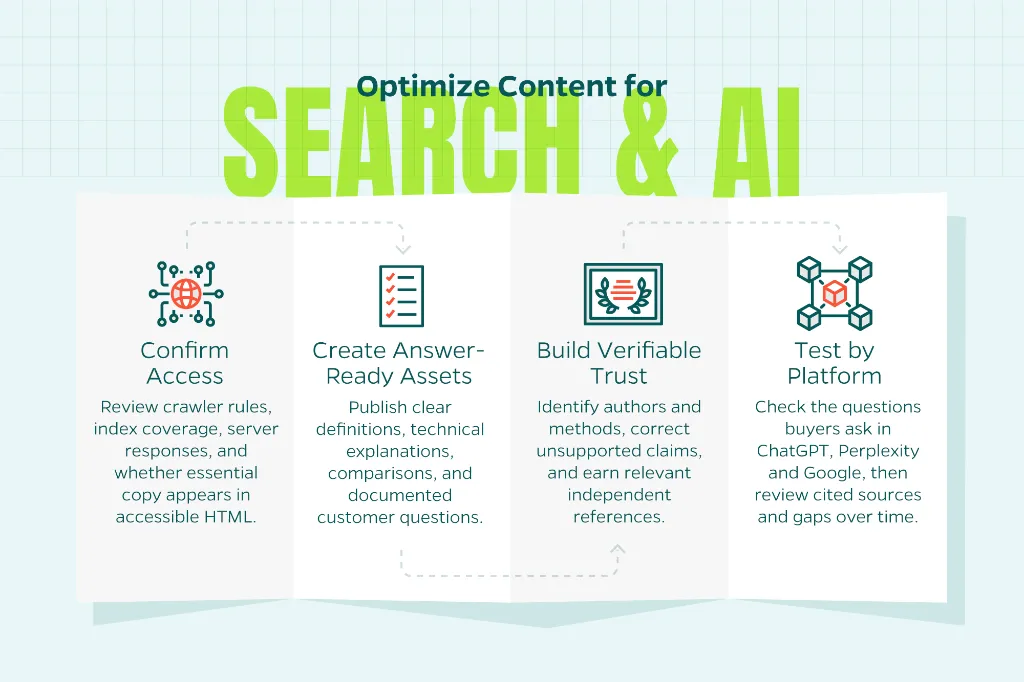
- Confirm access: review crawler rules, index coverage, server responses, and whether essential copy appears in accessible HTML.
- Create answer-ready assets: publish clear definitions, technical explanations, original findings, comparisons, and documented customer questions.
- Build verifiable trust: identify authors and methods, correct unsupported claims, and earn relevant independent references.
- Test by platform: check the questions buyers ask in ChatGPT, Perplexity and Google, then review cited sources and gaps over time.
In Straight North’s September 2026 GEO survey, 46% of respondents (46 of 100) said their organizations had identified specific prompts where they wanted to appear and were actively tracking them. Prompt tracking can reveal patterns, but individual responses fluctuate; evaluate repeated observations alongside qualified traffic, inquiries and validated leads rather than treating citation counts as revenue.
For manufacturers and B2B service providers, the opportunity is to become a dependable reference during vendor research. Generative engine optimization (GEO) organizes that work across technical access, content quality, and brand credibility.
FAQ: How AI Search Engines Cite Sources
Does ChatGPT cite sources?
Yes. When ChatGPT uses web search, it can include links to sources that support its answer. Not every ChatGPT response involves web retrieval, and responses based on learned knowledge may have no citations.
Can AI search engines cite incorrect or fabricated sources?
Yes. AI systems can misattribute claims, cite a page that does not support the answer, or generate an incorrect reference. Readers should open important citations and verify the original evidence, especially for consequential decisions.
What sources do AI search engines use most?
AI search systems may use indexed webpages, news articles, official documentation, research, forums and multimedia sources, depending on the platform and question. There is no single source type that dominates every query.
Is a citation valuable if the user does not click?
It can be. A citation or brand mention can introduce a company during research and influence a later visit or inquiry. That value is difficult to attribute from a single answer, so measure downstream business outcomes alongside visibility.
Need Help?
Want to make your expertise easier for AI search engines to find and cite? Contact Straight North to discuss your GEO strategy.