
Most B2B buyers do not act the first time they see your brand. LinkedIn retargeting helps you stay in front of the people who already showed interest, then follow up with a message that matches what they looked at or did. Instead of starting from scratch, you are picking up a conversation that is already underway.
LinkedIn’s retargeting tools have matured well beyond simple website visitor lists. Today, marketers can build audiences from video views, lead form interactions, event registrations, and even engagement with company pages. Understanding how to put these options to work can help steadily fill your pipeline with qualified leads.
Why LinkedIn Retargeting Deserves a Place in Your Strategy
B2B buying decisions rarely happen in a single sitting. A director of operations researching new software might visit a vendor’s site three or four times, read a case study, then step away to consult colleagues before ever filling out a form. Standard prospecting ads treat every impression as a first meeting. Retargeting treats it as a continuation of a conversation that already started.
Because LinkedIn ties its ad targeting to professional data rather than browsing behavior alone, retargeted ads can reach the right person with even greater precision. That accuracy is part of why LinkedIn tends to carry a higher cost per click than other platforms. Yet, for campaigns aimed at a narrow, high-value buyer, the tradeoff often pays for itself.
Building Retargeting Audiences That Convert
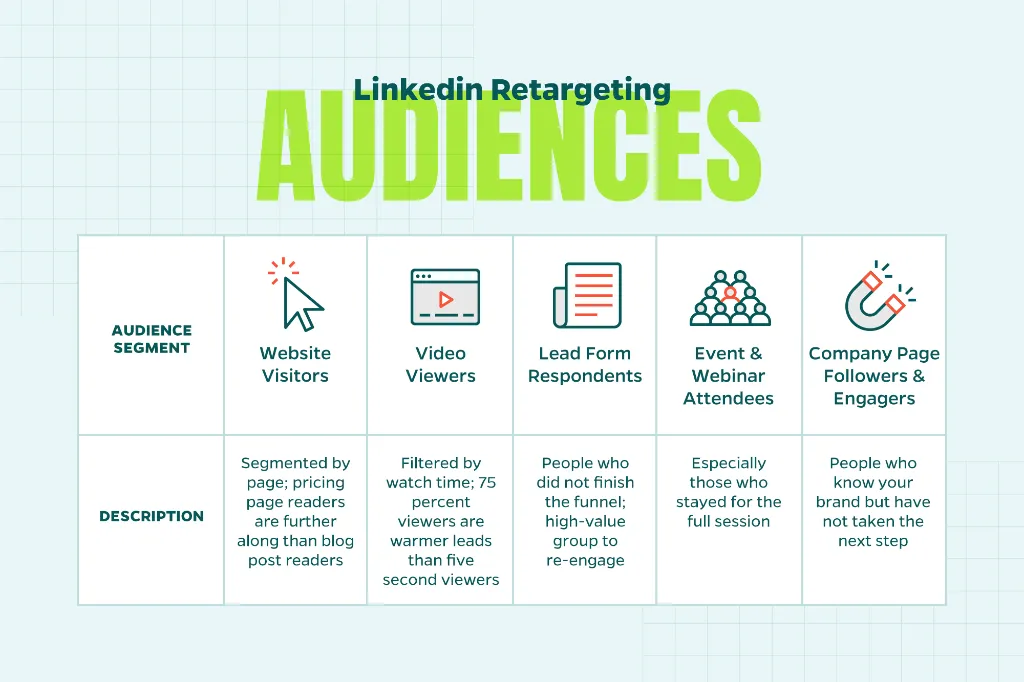
The strength of any retargeting campaign starts with how the audience is built. Too many campaigns lump every past visitor into a single bucket, which wastes the platform’s true advantage: the ability to speak to people based on both who they are and how they’ve already engaged. LinkedIn offers several sources worth combining rather than treating as separate campaigns. Here are a few:
- Website visitors, segmented by page. Someone who read your pricing page is further along than someone who skimmed a blog post, so they deserve a different message.
- Video viewers, filtered by watch time. A person who watched 75 percent of a product demo is a warmer lead than one who watched five seconds and scrolled past.
- Lead form respondents who didn’t finish the funnel. These are people who raised a hand but stalled, often the highest-value group to re-engage.
- Event and webinar attendees, especially those who stayed for the full session.
- Company page followers and engagers, who already know your brand but haven’t taken the next step.
Layering these sources lets you build a sequence rather than a single ad. A prospect might first see a retargeting ad built around the blog post they read, then later see a case study tied to their industry, and finally a direct offer once they’ve shown enough engagement to suggest they’re close to a decision.
Matching Ad Content to Where the Prospect Left Off
One of the most common retargeting mistakes is running the same generic ad to every segment. A visitor who read a detailed guide on your site already has more context than someone who bounced off the homepage in ten seconds, and the ad they see should reflect that. Speaking to their specific point of interest tends to earn far better engagement.
For visitors who spent time on a service or product page, a testimonial or short case study often works well. For those who engaged with a webinar or downloaded a resource, a direct offer to talk with your team can move things forward, since they’ve already demonstrated intent. And for cold traffic that only glanced at your site once, a softer follow-up keeps the relationship warm.
Setting Frequency and Timing So Ads Don’t Backfire
Retargeting works because it keeps a brand visible during a long consideration window. But there’s a point where visibility turns into annoyance. Showing the same ad to the same person a dozen times in a week rarely speeds up a decision. It simply wears out the message and can leave a poor impression of the brand.
Here are a few practices to help keep frequency in check:
- Cap impressions per user per week. Rotate creative every few weeks so the same visual doesn’t grow stale.
- Set a window that matches your sales cycle. A 30-day retargeting window makes sense for a fast-moving product but may cut off prospects too early for a longer enterprise sale.
- Exclude converted leads promptly, so customers and closed deals stop seeing acquisition ads meant for prospects.
Getting this right takes some testing, since the ideal frequency varies by industry and audience size. Smaller, niche audiences tend to fatigue faster than broad ones, so tighter frequency caps usually make sense when the target list is short.
Measuring What Retargeting is Doing
Retargeting campaigns can seem underwhelming if you judge them only by last-click conversions. Their main role is often to move prospects closer to a decision, not close the deal on the spot. Tracking assisted conversions and comparing retargeted audiences with cold audiences gives you a clearer view of performance. If retargeted leads move through the pipeline faster or close at a higher rate, the campaign is working.
It’s best to review audience overlap periodically as well. When segments overlap, the same person may see competing ads at the same time, which can weaken the message and muddy the reporting.
LinkedIn’s dashboard shows how the campaign performed inside the platform, but your CRM tells you what happened next. If a retargeted contact later books a demo or requests a proposal, that activity should be tied back to the campaign that kept your brand in front of them. That is why attribution matters. It helps you see when retargeting is quietly moving prospects toward the next step, even if it does not get credit for the final click.
Conclusion
LinkedIn retargeting rewards marketers who treat it as an ongoing conversation rather than a single ad set left running in the background. Segmenting audiences by behavior, matching creative to intent, managing frequency thoughtfully, and measuring beyond last-click attribution all contribute to campaigns that turn quiet website visits into a pipeline. The prospects who almost converted the first time are often the ones most ready to convert the second.
Need Help?
Want help building a LinkedIn retargeting strategy that fits your sales cycle? Contact Straight North to talk with our digital marketing team.