

LinkedIn outreach has earned a bad reputation, and marketers did it to themselves. That’s a shame, because LinkedIn is still one of the best channels for building real B2B relationships. Unlike a cold email list, LinkedIn hands you context: a prospect’s role, their industry, what they’ve posted or commented on recently. Sending a copy-paste pitch anyway signals you never looked at their profile at all, which is exactly what gets you ignored or blocked.
The framework below is built around using that context instead of ignoring it. Outreach that starts relationships rather than burning through a prospect list.
Why Most LinkedIn Outreach Falls Flat
Before fixing the problem, it helps to name it. Spammy outreach usually shares a few traits:
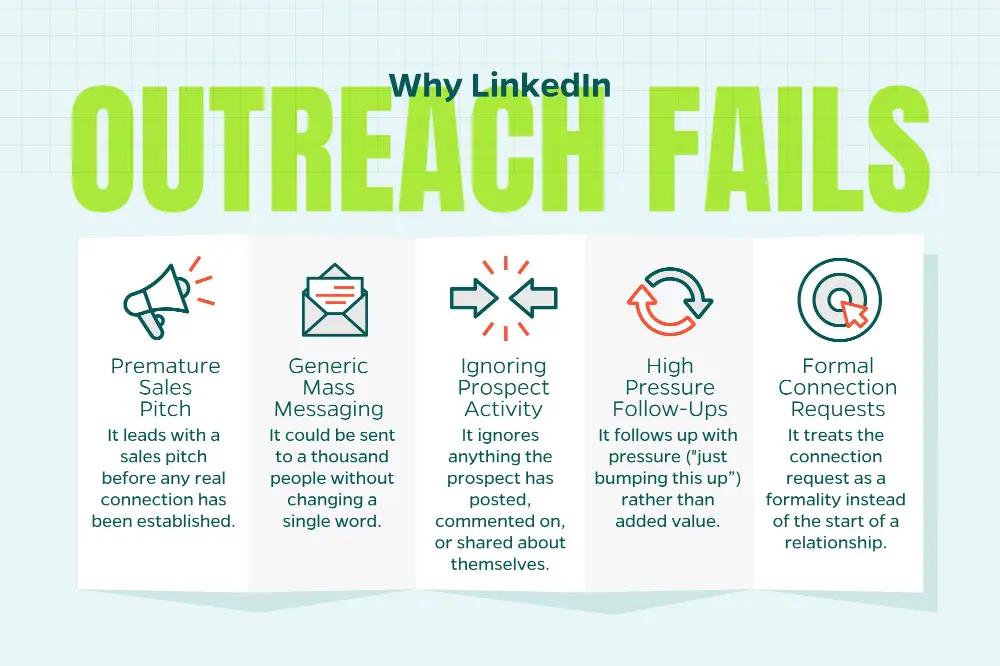
- It leads with a sales pitch before any real connection has been established.
- It could be sent to a thousand people without changing a single word.
- It ignores anything the prospect has posted, commented on, or shared about themselves.
- It follows up with pressure (“just bumping this up”) rather than added value.
- It treats the connection request as a formality instead of the start of a relationship.
None of this makes the person reaching out a bad marketer. It’s simply what happens when outreach gets treated as a numbers game rather than a conversation. The fix isn’t to message fewer people — it’s to message with more care.
Start With a Real Reason to Connect
Every connection request is an opportunity to set the tone for everything that follows. A blank request, or one with a boilerplate note, tells the recipient they’re one of hundreds. A short, specific note does the opposite.
The best connection notes reference something concrete: a shared industry event, a mutual connection, a piece of content the prospect published, or a specific challenge their company appears to be navigating. This doesn’t require a long message. One or two honest sentences that show you did more than glance at a job title is usually enough.
Build the Relationship Before the Pitch
This is the step spammy outreach skips entirely, and it’s the one that makes the biggest difference. Once someone accepts a connection request, resist the urge to immediately introduce a product or service. Instead, spend a message or two learning what matters to them.
Here are a few ways to do this without feeling forced:
- Comment thoughtfully on a recent post before messaging at all.
- Ask a genuine question about a challenge common to their role or industry.
- Share a resource that’s useful regardless of whether they ever become a client.
- Reference something specific from their profile or recent activity, rather than a generic compliment.
Think of this stage as earning attention rather than demanding it. Prospects can tell the difference between someone trying to understand their situation and someone working through a script, and that difference shapes whether the next message even gets opened.
Personalize Without Overdoing It
Personalization has become a buzzword, which has led some marketers to overcorrect into something that reads more like surveillance than sincerity (“I saw you liked a post about hiking three weeks ago!”). The goal isn’t to prove you’ve studied someone’s every move. It’s to show the message was written for them specifically, not lifted from a template with a name swapped in.
Here is a useful test. If the message could be sent to five different people in five different industries without any edits, it needs more personalization. If it references something only that person’s role, company, or recent activity would make relevant, it’s on the right track.
Lead With Value, Not a Pitch
Once a relationship exists, the pitch becomes far less awkward, but it still shouldn’t be the entire message. The strongest outreach offers something useful regardless of whether the prospect ever buys anything: an industry insight, a relevant case study, a tool, or an honest observation about a challenge their business might be facing.
This approach does two things at once. It positions the sender as a resource rather than a salesperson, and it gives the prospect a reason to respond even if they aren’t ready to buy. Neither outcome happens when the first real message is a demo request.
Respect “No” and Silence
Not every prospect will respond, and that’s fine. A non-spammy outreach strategy treats silence as information rather than an obstacle to push through. One or two thoughtful follow-ups, spaced out and each adding something new, is reasonable. Repeated “checking in” messages with nothing new to offer are not.
The same goes for an explicit “no.” Respecting it, rather than continuing to message through other channels, protects the relationship for the future. People change roles, companies grow, and needs shift. A prospect who wasn’t ready this year may remember — and reach back out to — the marketer who respected their answer the first time.
Track What’s Working
Spammy outreach optimizes for volume. This includes messages sent, connection requests fired off, and follow-ups scheduled. A better strategy optimizes for quality of engagement instead. Response rates, the depth of conversations that follow, and how many relationships eventually turn into real business discussions all tell a more useful story than raw activity counts.
Reviewing these signals regularly also makes it easier to catch when outreach has quietly drifted back toward the templated, high-volume approach that gets ignored in the first place.
Conclusion
A non-spammy LinkedIn outreach strategy isn’t slower or less effective than a high-volume approach. It just measures success differently. It trades a flood of ignored messages for a smaller number of conversations that go somewhere. For marketers willing to trade quick pitches for real context, LinkedIn remains one of the most effective places to build the kind of relationships that turn into business.
Need Help?
Straight North helps B2B marketers build LinkedIn strategies that connect with the right people the right way. Contact us to learn how we can help refine your approach.