
Your LinkedIn headline shows up next to your name in every comment you leave, every post you publish, and every connection request you send. For B2B marketers, that small line of text often forms a prospect’s first impression of your company.
Yet plenty of B2B profiles and company pages still default to a job title and nothing else. “Marketing Director at XYZ Corp” tells a reader what you do, but it does nothing to tell them why they should care. A strong headline works harder. It signals who you help, what problem you solve, and why someone should keep reading.
Here’s how to write LinkedIn headlines that pull your target audience in rather than letting them scroll past.
Why Your LinkedIn Headline Matters
LinkedIn headlines appear in search results, comment threads, connection requests, and the small preview that shows up when someone hovers over your name. That visibility is important to marketing your company on LinkedIn. A vague or purely descriptive headline is a missed opportunity to plant a specific idea in a prospect’s mind before any real conversation has started.
Think of the headline as a one-line pitch. It should answer a simple question for the reader: “What’s in this for me?” When a headline does that well, it earns a profile visit. When it doesn’t, it blends into the feed.
Know Who You’re Writing For
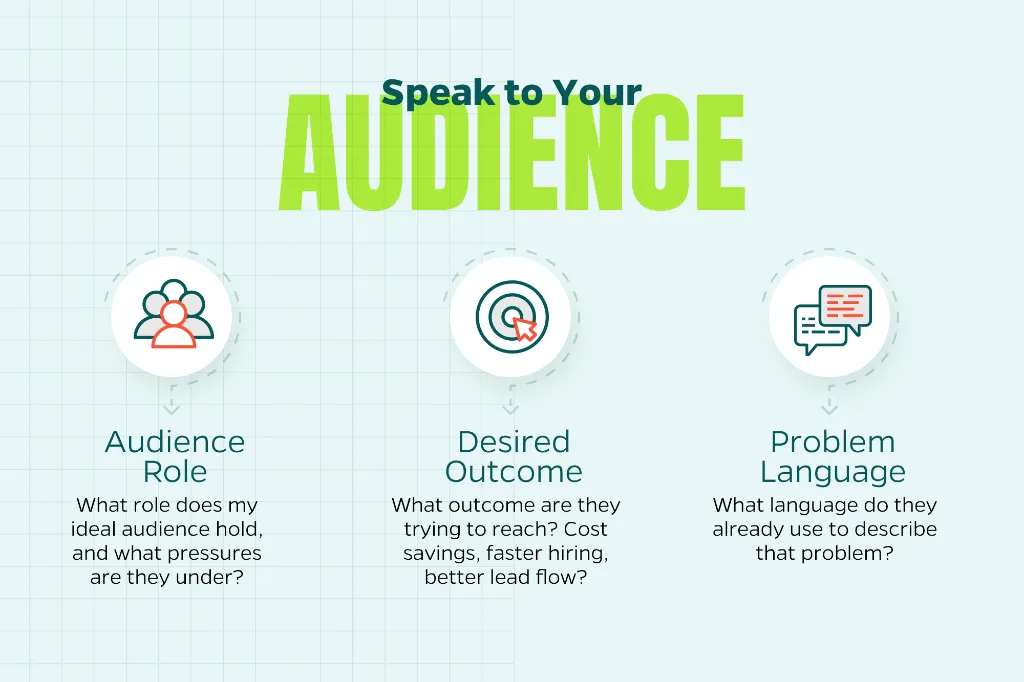
Get specific about the audience. A headline aimed at procurement managers at manufacturing firms should read differently than one aimed at HR leaders at software companies. Ask:
- What role does my ideal audience hold, and what pressures are they under?
- What outcome are they trying to reach — cost savings, faster hiring, better lead flow?
- What language do they already use to describe that problem?
Lead With Value, Not Just a Title
Job titles tell readers where you sit in an org chart. They rarely tell readers what you can do for them. Compare these two headlines:
- “Sales Manager at Apex Industrial Supply”
- “Helping mid-size manufacturers cut procurement costs by 15% or more”
The second version gives a prospect a reason to click. It names a specific audience (mid-size manufacturers), a specific benefit (cost reduction), and even a rough number to back it up. That combination is far more persuasive than a title alone, and it works whether the headline belongs to an individual salesperson or a company page.
Use Keywords Your Audience Searches
LinkedIn’s search function relies heavily on headline text, so the words you choose affect whether your profile surfaces at all. If a buyer searches “supply chain consultant” or “B2B lead generation agency,” and those terms appear nowhere in your headline, you’re harder to find.
Here is a quick way to identify the right terms: look at job postings, industry forums, and competitor profiles in your space. Notice the phrases that show up repeatedly. Those are strong candidates for your own headline, provided they still sound natural rather than stuffed in for search purposes alone.
Clear is Better Than Clever
It’s tempting to write something punchy or a little abstract to stand out. In B2B contexts, clarity almost always wins over cleverness. A headline like “Turning Ideas Into Impact” sounds nice, but it tells a reader nothing about who you serve or what you do. Compare that to “Helping SaaS companies shorten their sales cycle through targeted content.” That is less flashy, but far more useful.
Read your headline as if you were a stranger scrolling LinkedIn with no context about your company. Does it explain, in plain terms, who benefits from what you offer? If not, it needs another pass.
Structure That Works for B2B Headlines
There’s no single formula that fits every industry, but a few structures consistently perform well for B2B audiences:
- Audience + Outcome: “Helping [audience] achieve [specific result]”
- Role + Specialty: “[Job title] specializing in [niche or industry]”
- Problem + Solution: “Solving [common pain point] for [industry or audience]”
Whichever structure you choose, keep the headline under roughly 220 characters so it doesn’t get cut off in previews. Lead with the most important information first, since mobile views often truncate the end of longer headlines.
Refresh It as Your Business Evolves
As your company shifts focus, launches new services, or targets a different buyer, the headline should shift too. Revisiting it every few months — or any time your positioning changes — keeps it aligned with the audience you’re currently trying to reach, rather than the one you served a year ago.
Need Help?
If you’d like help refining your LinkedIn presence or building a broader B2B marketing strategy, contact Straight North to see how our team can support your goals.