

This article is part of CFO Turned CMO, a series on what I’ve learned from leading both finance and marketing. It explores how my finance background has shaped the way I approach marketing, and how that perspective can help business leaders make better decisions about growth.
One of the first things finance wants to know about marketing is simple: What are we getting for the money?
That is a fair question. Marketing spend can get expensive quickly, and in a growing business, every dollar has a job. Cash matters. Margins matter. Payback matters. If we are going to invest more into marketing, finance should be asking how we know it is working.
The hard part is that marketing does not always give clean answers.
I used to think better attribution would solve most of those arguments. If we could track the lead source more accurately, tag every campaign correctly, and connect the dots from first click to closed revenue, the decision would be obvious. Scale what works. Cut what doesn’t.
That sounds good in theory. But most buying decisions are messier than that.
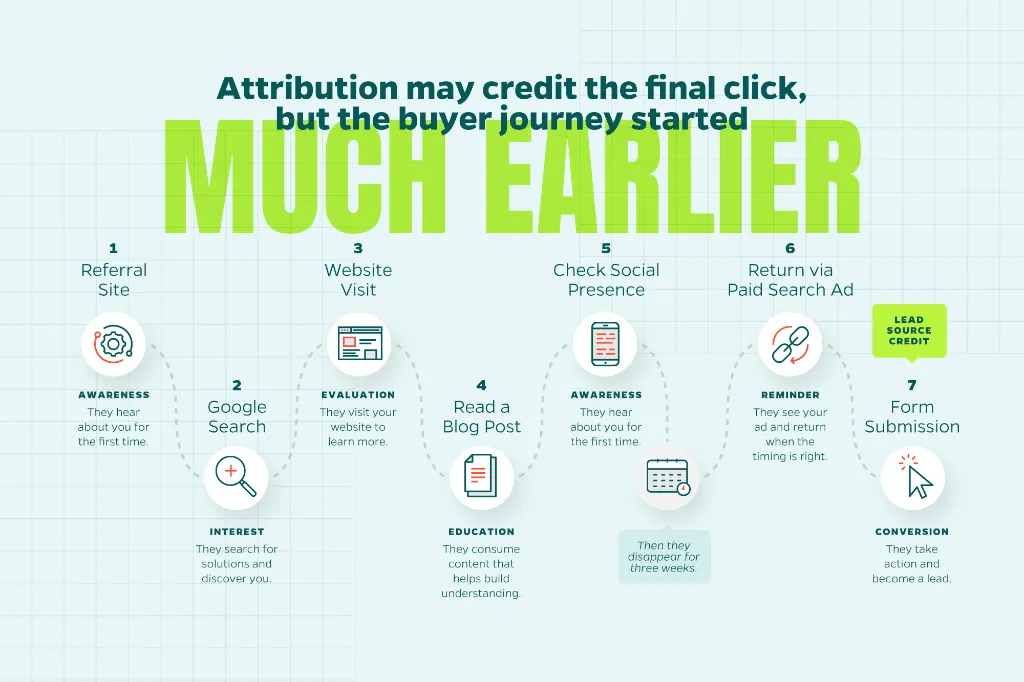
A prospect might first hear about you from a referral site. Then they Google you. Then they visit your website. Then they read a blog post. Then they check your social presence to see if you look credible. Then they disappear for three weeks. Later, they come back through a paid search ad and fill out a form.
So which channel gets credit?
The honest answer is: we may never know perfectly.
Attribution is still useful. It can show direct response, obvious sources, conversion paths, and trends. But it rarely tells the entire story. It struggles to capture trust, timing, credibility, and all the small moments that make a buyer comfortable enough to take the next step.
That is why the answer is better decision-making, not perfect attribution.
Before we spend, scale, or cut, we need to agree on what matters most, what we can measure directly, what we treat as directional, and how long we give an initiative to show progress.
For our business, the true north metric is qualified leads. Closed deals ultimately matter most, but qualified leads give us a larger sample size earlier in the process. That helps us evaluate overall marketing performance faster and reduces some of the volatility that comes from judging everything only by closed revenue.
That does not mean qualified leads are the right metric for every business. The point is that leadership needs a clear primary metric that fits the business model, sales cycle, and goals. Without that, marketing conversations become too subjective.
Channels Support Each Other
One of the easiest mistakes is evaluating every marketing channel like it should win by itself.
Some channels have a clearer path to conversion. Paid search can be one of them. A buyer has intent, searches for a solution, clicks, and submits a form. That path is easier to see.
Other channels play a different role.
Some create discovery. Some build credibility. Some help buyers compare options. Some keep you top of mind. Some reduce perceived risk. Some help convert demand another channel created. That is why I think about marketing less as a group of isolated channels and more as a buying environment.
A customer rarely comes from one place. They move through a series of moments. If we only look at the final click, we can overvalue the last step and undervalue the steps that helped the buyer get there.
This is especially true for channels that support trust.
We invest a lot in onsite content: traditional blogs, SME interview articles, and research articles. That content generates visibility and traction, but it is rarely attributed as the source of a lead. If we judged that investment only by directly attributed leads, we probably would have stopped long ago. But that would have been the wrong decision.
At the same time, we run retargeting campaigns across Google’s ad network, including Performance Max, as well as Meta and LinkedIn. Leads are often attributed to those campaigns, but retargeting did not create the original demand. It brought people back after earlier interactions had already created awareness, trust, or interest.
That is why attribution can be misleading. The report may give credit to the campaign closest to conversion, while missing the content, organic search, referral traffic, brand exposure, or prior research that influenced the buyer earlier.
We have also seen branded search volume increase over time. And our sales team has heard prospects mention the quality of our content during the sales process. In some cases, that content helped answer questions before or during the sales conversation. That is the point.
The content may not “get credit” in the attribution report, but it is still supporting the marketing system. Retargeting may get the lead source credit, but it is often standing on trust and awareness that were built somewhere else.
What We Measure Directly
Some things can be measured fairly directly, and we should pay attention to them.
Qualified leads. Cost per qualified lead. Website conversion rate. Landing page performance. Lead-to-opportunity rate. Close rate by source, when the source data is reliable. Revenue from clearly sourced opportunities. Sales feedback on lead quality.
These metrics keep the conversation grounded.
If qualified leads are increasing, cost is within an acceptable range, and sales feedback is strong, that tells us something important. If qualified leads are flat, quality is weak, or cost per qualified lead is drifting too high, that tells us something too.
The key is to use direct measurement where the data is reasonably clean without pretending it captures everything.
Good measurement should make decisions clearer. It should not give us false confidence.
What We Treat as Directional
Other signals are harder to tie directly to revenue, but still useful.
Branded search increasing. Direct traffic improving. Organic rankings moving in the right direction. More prospects mentioning content during sales calls. Better website engagement. Higher conversion rates after messaging or website changes. Sales saying buyers seem more educated before the first conversation.
These signals do not prove ROI by themselves. But they help us understand whether the market is responding, whether trust is building, and whether the overall marketing foundation is getting stronger.
This matters most for investments that improve multiple channels at once.
A better website may never show up as a lead source. But if it improves conversion across paid, organic, referral, and direct traffic, it can be one of the highest-leverage investments we make.
Clearer messaging may not create a lead by itself. But it can make every campaign, landing page, email, and sales conversation perform better.
The easiest thing to measure is not always the most important thing to improve.
This is where finance and marketing need a shared language. Finance needs accountability. Marketing needs room to build trust and long-term demand. Leadership has to decide how much uncertainty the business can tolerate based on goals, cash position, margins, and time horizon.
Match the Timeline to the Investment
Different marketing investments need different evaluation windows.
Paid media can usually show signals faster. If we are spending on clicks today, we should start seeing activity relatively quickly. We may need time to refine targeting, creative, landing pages, and follow-up, but early feedback should come sooner.
SEO and content take longer. You may invest for months before the payoff becomes obvious. But if those investments work, they can create a longer tail.
Website and brand investments are different again. A stronger website may not create new traffic on its own, but it can improve the performance of every channel that sends buyers there.
The principle is simple: judge the investment on the timeline it actually needs.
A short-term campaign should show short-term signals. A long-term investment should have checkpoints along the way, but it should not be expected to behave like paid search in the first month.
This is where many businesses make decisions too quickly. They fund something with a long-term payoff, then get uncomfortable when the return is not immediate. Or they keep funding something short-term because activity looks good, even though the economics are not improving.
Both mistakes come from unclear expectations.
Decide When to Stop, Continue, or Scale
The most useful part of measurement is deciding what action the data should trigger.
Before launching or scaling an initiative, I want to know what would cause us to stop, continue, or scale.
We may stop if the primary metric is not improving after the agreed window, lead quality is consistently poor, cost is outside the acceptable range, or the channel only works at a volume too small to matter.
We may continue if the primary metric has not fully moved yet, but the supporting indicators are improving, and the timeline has not played out.
We may scale if lead volume is increasing, cost is acceptable, quality is strong, and the economics make sense.
This is where marketing needs to understand the business model: average deal size, gross margin, retention, payback period, cash position, and growth goals.
Those numbers shape the marketing decision.
Better Rules Beat Perfect Attribution
Perfect attribution would be nice. Yet, in most real businesses, that is unrealistic to achieve.
So, we need a practical way to make decisions with imperfect information.
For us, that starts with qualified leads as the true north metric. For another business, it may be something else. The important part is choosing a primary measure, separating direct measurement from directional signals, defining the role of each channel, matching the timeline to the investment, and deciding in advance what will cause us to stop, continue, or scale.
That approach reduces emotional decision-making.
Finance gets accountability. Marketing gets room to build trust and long-term demand. Leadership gets a more consistent way to decide where to invest.
The best marketing decisions are rarely made with perfect data.
They are made by teams that are honest about what they know, honest about what they cannot know, and disciplined enough to keep making decisions anyway.