



Key Takeaways:
- Experience shows what happens in practice; expertise is the knowledge and skill needed to interpret it and make sound recommendations.
- Match each contributor’s qualifications to the page’s claims.
- Credential recommendations and clearly attribute firsthand observations.
- Turn internal knowledge into original content competitors cannot replicate.
- Relevant authority builds trust across search engines, AI platforms, and readers.
Two people could write a page about replacing a commercial roof: a structural engineer who understands building codes and load requirements, or a roofing contractor who has completed 200 replacements and knows what can go wrong once the old roof comes off. Both are qualified in different ways. The right choice depends on what the page needs to say.
That distinction often gets lost when companies apply the same E-E-A-T checklist to every page: add a byline, include a bio, and bring in a credentialed reviewer for anything sensitive. As a result, some pages receive credentials they do not need, while others lack the qualifications their claims require.
Google’s Quality Rater Guidelines treat experience and expertise as distinct but sometimes overlapping components of E-E-A-T. Experience refers to the firsthand or life experience a creator has with a topic, while expertise refers to the knowledge or skill needed for that topic. Even on high-stakes topics, firsthand experience may be appropriate when the content is safe, trustworthy, and consistent with established expert consensus.
This distinction is especially important for businesses whose most knowledgeable employees are experienced practitioners rather than licensed professionals. In my conversation with Straight North Senior SEO & GEO Strategist Bob Hand, we explored how to match each page with the right contributors, when professional review is necessary, and how to turn internal knowledge into original content that earns trust and strengthens search visibility.
The guiding principle is simple: credential the recommendations, clearly attribute the observations, and make sure every authority signal supports the claims on the page.
Experience and Expertise Are Two Different Kinds of Authority
A well-researched page can explain a topic clearly, but research alone cannot supply the details that come from doing the work. Experience shows what happens in practice; expertise provides the qualifications and judgment to interpret standards and recommend what someone should do.
A writer can research, organize, and explain a subject, but pages built around real-world outcomes need input from someone who has lived or performed the work. Without that firsthand perspective, even accurate content can feel theoretical and interchangeable with competing pages.
“When content is not anchored in real-world experience, it can perform less well.”
Senior SEO & GEO Strategist | SEO & GEO Authorship Expert
The page’s claims should ultimately determine who writes, contributes to, or reviews it.
Why E-E-A-T Advice Often Overemphasizes Credentials
Much of today’s E-E-A-T advice grew out of the original E-A-T framework, before Google added the second “E” for experience in 2022. That history helps explain why companies still default to credentialed contributors whose qualifications are easy to document and defend to leadership, attorneys, and regulators.
A polished byline, bio, or reviewer also provides a simple way to satisfy a checklist. But while a company can quickly hire someone with the right credential, it cannot manufacture 20 years of experience using its equipment in its market.
Relying on an impressive but irrelevant title can mislead readers while leaving the company’s most valuable practical knowledge off the page. Authority comes from relevance, not the number or prestige of the credentials attached to the content.
Use Experience to Describe and Expertise to Prescribe
Google’s guidance recognizes that firsthand experience can be valuable even on some high-stakes topics, but it does not mean every contributor is qualified to provide every type of information or advice. Firsthand experience may be enough when content is trustworthy and consistent with established expert consensus. The line generally falls between describing and prescribing.
Experience can support content about what happened, what a practitioner observed, what a project cost, or how specific conditions affected the outcome. A high level of expertise may be required when YMYL content provides information or advice, particularly when it interprets laws or professional standards or provides consequential health, safety, financial, or compliance guidance.
The distinction becomes more complicated when field experience appears to conflict with an established standard. As Bob explains, observing how a standard performs under specific conditions is not the same as challenging the standard itself:
For example, in our region, on this soil, in this work field, we see X consistently. That’s an observation. Observations are what experience is for. That’s describing the circumstances as you experience them. That the first one isn’t a blog post. A general reader can’t evaluate it. You’re asking them to take your word over the field’s word. So if it’s about observation based on your experience, it’s fine. If you’re being prescriptive in telling you what… in telling readers what guidelines they should follow based on your anecdotal experience, you’re probably hedging into dangerous territory. I think it’s important to write with conditions attached how many jobs have you done, under what conditions, over what period. If you have a finding that cuts against consensus, you need more specifics to justify why that may be. I think it’s important to never run it as advice, especially if it’s a health or safety topic. Just say what you saw, point the reader to the standard recommendation. If the disagreement is real and it matters, that’s a case for formal review or an outside expert, before you publish it, not a post that quietly breaks with the field.
When an observation differs from expert consensus, provide enough context for readers to understand it. Explain where it occurred, how many projects or cases were involved, the conditions present and the period observed. This positions the finding as firsthand evidence rather than universal advice.
Practitioners should never use anecdotal experience to tell readers to disregard an established standard, especially on YMYL content. If the disagreement involves health, safety or another consequential issue, bring in an outside expert or commission a formal review before publishing.
The planning question is not, “Do we have someone credentialed to discuss this topic?” It is, “What does this page need to say, and who is qualified to say it?” Credential the recommendations and clearly attribute the observations.
Which Pages Benefit Most From Firsthand Experience?
Before assigning a practitioner to a page, ask one question: Could this content be written entirely by researching other websites?
If the answer is yes, practitioner input may not add much value. If the page depends on insights that only come from doing the work, firsthand experience is essential.
Use this checklist to identify experience-led content:
☐ Helps readers troubleshoot or diagnose a problem
☐ Discusses real costs, timelines, and the factors that affect them
☐ Compares equipment or products beyond published specifications
☐ Identifies early warning signs or common failures
☐ Explains what the company no longer recommends and why
☐ Addresses local or industry-specific conditions
☐ Sets realistic maintenance or long-term performance expectations
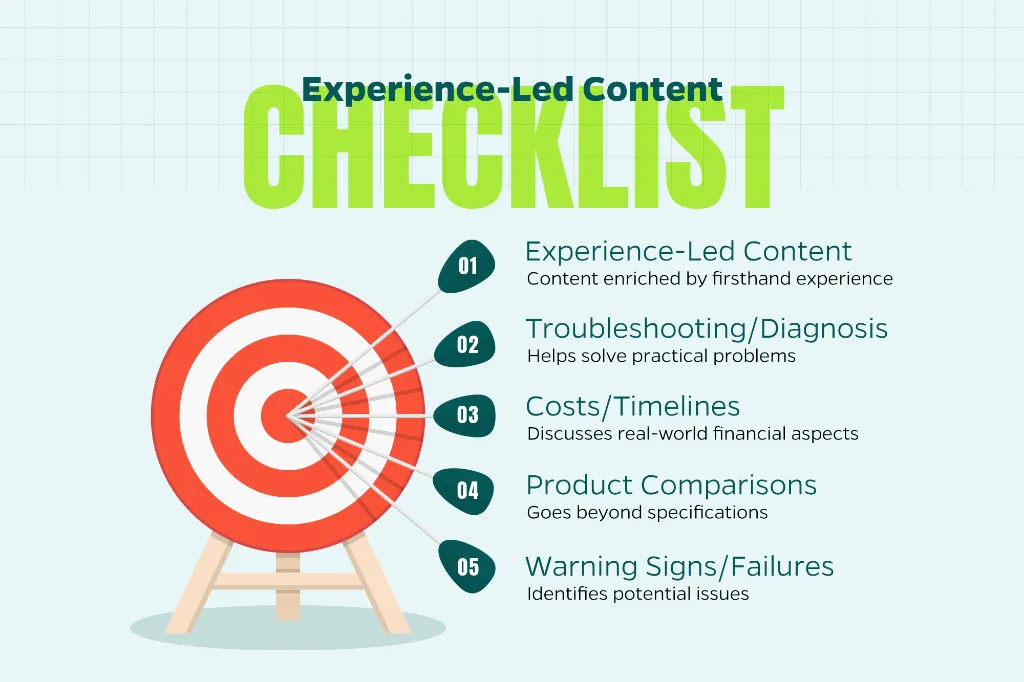
These pages address practical questions people ask while evaluating products and services. Their value comes from details that cannot be credibly invented or easily synthesized from competing content. Bringing those insights to the page gives readers and search systems something original to trust.
What Counts as Expertise When There Is No License?
Expertise is easy to recognize in fields built around professional licenses. It can be less obvious in manufacturing, industrial businesses, and the trades, where some of the most qualified people may not have a formal title after their names.
The standard, however, remains the same: Would a reasonable reader consider this person qualified to provide guidance on the subject? As Bob explains, the answer may come from several forms of industry-specific authority:
The standard doesn’t change. The question you should ask is, would a reasonable reader say that this person is qualified to tell me what to do here? An unlicensed field, that shows up as certifications tied to specific training needs. That can mean whatever in your industry, that could be OSHA safety, NFPA, welding, what have you. Involvement in the standard itself, or sitting on a committee, or teaching the certification that everyone else takes, is obviously really helpful. Scale and duration, how long they’ve actually been in the field, how much work they’ve done. We’ve been installing ACs for 18 years, we’ve had 400-plus installs. You know, some… stats like that are very helpful for quantifying experience.
Relevant manufacturer, safety, or technical certifications can demonstrate expertise, as can participation in standards committees or teaching certification courses that others take. Authority may also come from responsibility for inspections, safety, or compliance. Someone who signs off on the work carries real consequences for being wrong, making that responsibility a particularly strong trust signal.
Outside recognition can add further support. Trade publication bylines, conference presentations, peer citations, and recognition from respected industry organizations all show that others value the person’s knowledge.
Experience should also be quantified whenever possible. “Twenty years in the industry” says less than “400 installations completed over 18 years.” Time served is not the same as sound judgment; someone can spend decades repeating the same outdated process. Strong evidence shows not only how long a person has worked in the field, but how much they have done, the decisions they are trusted to make, and the accountability they carry.
How Writers Can Use SME Knowledge Without Claiming It as Their Own
Writers don’t need to perform the work themselves to create experience-led content. In many cases, a professional writer interviewing a subject matter expert (SME) produces a stronger page than either person could create alone. The writer brings structure and clarity; the expert brings firsthand knowledge.
It’s important that a reader should always be able to easily understand whose knowledge they’re getting on a page. A writer interviewing a technician usually beats a technician writing alone. That’s fine, as long as the source stays visible. You can easily attribute that inside the copy, not just in the byline. So, for instance, you can say, hey, John Smith, our lead tech, has swapped out 200 of these. He says it almost always shows up at this specific time, this issue. Then you can make the byline honest. It’s by writer’s name with subject matter expert’s name, field operations manager, or what have you. It takes two seconds to read, and it settles the question.
Keep that source visible through quotes, video clips, and clear attribution within the copy. Avoid an ambiguous “we” when the writer did not personally perform the work, and use an honest byline such as “written by” and “featuring insights from.” Readers should always understand who shaped the article and whose experience supports its claims.
How to Make Case Studies and Testimonials More Credible
A case study doesn’t lose its value simply because it features your company or one of your customers. The problem is not the relationship; it is failing to disclose it or turning the story into an advertisement.
Skip vague claims such as “great results” or “best-in-class service” and show readers what actually happened. Use measurable results, real timelines, and specific performance data. Explain the situation, the approach, and the conditions that influenced the outcome. Those details give readers something concrete to evaluate and make the story more useful than a list of accomplishments.
“I think it’s important to be upfront in case studies as well about where things went right, where things were challenging, what the situation was, what was hard and what you would do differently.”
Senior SEO & GEO Strategist | SEO & GEO Authorship Expert
Acknowledging obstacles also makes the story more believable. You don’t need to spotlight every setback, but explaining what was difficult and what you would do differently shows how your team solves problems instead of simply claiming success.
The same principle applies to cost and timeline content. Companies don’t have to make rigid promises when every project is different. They can provide realistic ranges and explain which factors may raise or lower the final cost or extend the schedule. That transparency answers the questions readers are already asking and helps them decide whether the solution fits their needs.
When a Page Needs More Than One Contributor
Some pages make more than one kind of claim. A page may explain an industry standard, describe how it plays out in the field, and offer recommendations with real consequences. In those cases, one person may not have all the qualifications the content requires.
Bringing in several contributors does not mean everyone should rewrite the page. One writer should remain responsible for its structure, voice, and central argument. SMEs provide firsthand knowledge, while qualified reviewers check the claims that fall within their areas of responsibility.
Before the review begins, establish what each person is responsible for checking. A clinical expert might review medical accuracy, while a compliance specialist verifies that the content reflects applicable regulations. They do not need to weigh in on every sentence or stylistic choice.
Reviewers must also have the authority to require corrections. Otherwise, their name becomes a stamp of approval without a meaningful review behind it. Be specific when crediting their work, too. “Reviewed by” says very little; “Reviewed for code compliance by” tells readers exactly what was checked and why that person’s involvement matters.
Credibility comes from giving each contributor a clear and relevant role, not from placing the most names on the page.
What to Do When No One Is Qualified to Cover the Topic
Sometimes a promising keyword falls outside the company’s true area of authority. The search volume may be high and competitors may already rank for it, but that does not mean your business should create a page about it. Before moving forward, ask whether the topic genuinely belongs in your lane and whether anyone involved is qualified to support the claims the page needs to make.
As Bob explains, chasing an adjacent topic simply because it presents a traffic opportunity can create more risk than value:

That can happen when you’re just looking at keyword data, and you see that there’s an opportunity to rank for this keyword, which is a high search volume, a high CPC, and we can reasonably target that when it’s maybe less feasible from an authority perspective. Is it something you really do, or is it an adjacent issue that maybe you could siphon some traffic off of? If you’re looking at that in a self-serving way and not authentically asking yourself if that’s a realistic target. You may find yourself in circumstances where you’re trying to create pages you aren’t really qualified to write. The objection is always the same. Competitors rank for it. They rank for pages that are a liability. Maybe those pages are great, maybe they’re thin, or on a consequential topic, and they can pull down the rest of the site. You don’t want to open up liability where it doesn’t need to happen. Just… just be realistic about what your lane is and stick to that in a way that is… that builds trust.
If no one inside the company is qualified to cover the topic, work through the options in order:
- Decide whether the page needs to give advice. Many pages can answer readers’ questions without telling them what to do.
- Narrow the scope. Reframe the page to explain the topic or share relevant experience rather than make recommendations.
- Interview a qualified outside expert. Build the content around their knowledge and clearly attribute their contribution.
- Commission a meaningful review. The reviewer should have the authority to identify errors and require changes, not simply lend their name to the page.
- Be willing not to publish. If the page cannot be created with the appropriate authority, leaving it unpublished may be the most credible choice.
Competitor rankings do not make a topic relevant to your business or safe to pursue. Staying within your area of authority builds more trust than stretching into a subject your company cannot credibly address.
Trust Signals Extend Beyond the Author Bio
A relevant byline can strengthen a page, but visitors may question the business long before they look at who wrote the content. If a phone number is hard to find, the contact form does not work, or basic company details conflict across the site, an impressive author bio will not repair that loss of trust.
Start with the basics. Make it easy for visitors to understand who you are, where you operate, and how to reach you. Include clear contact and customer service information, an accurate address, and an About page that identifies the people behind the business. Keep names, addresses, and phone numbers consistent throughout the site.
Content should also show genuine signs of being current. An undated page can leave readers wondering whether the information still applies, while automatically changing the “last updated” date without making meaningful revisions may raise even more questions.
Claims need evidence, too. Phrases such as “industry-leading” or “trusted by thousands” carry little weight without support. Awards should name the issuing organization and year, and policies should be easy to find and consistent with the rest of the site.
Broken forms, missing policies, and contradictory information may seem like small issues, but together they can make a legitimate business look unreliable. Trust begins with getting the commercial basics right, well before visitors evaluate anyone’s credentials.
How to Prioritize an E-E-A-T Content Audit
If your site has hundreds of pages, do not treat every URL as equally urgent. Prioritize by consequence: start with pages people already visit and where inaccurate or unsupported claims could cause the most harm.
Bob recommends narrowing a large site to a manageable group of high-priority pages:
Rather than focusing on bulk page count, focus on consequence. Start with pages that actually have traffic on serious topics. That can usually trim down your priority list from about 300 URLs to maybe 10 to 30. I think that’s a much more manageable list to start with. And it’s where users are actually visiting. So, anything within those URLs making a recommendation, you should. Here are serving sizes or dosage sizes, here are the costs or safety involved, here’s compliance issues. Those are obviously high priority as far as addressing any gaps.
- Begin with high-traffic pages covering serious or sensitive topics, especially those making health, safety, cost, dosage, or compliance recommendations.
- Next, review pages that carry credentials and confirm those qualifications match the subject and the claims being made.
- Then audit service and conversion pages where visitors decide whether to contact the company. Even when the topic is not high stakes, an inconsistency at that stage can cost the business trust and a potential customer.
Lower-risk, general-interest content can wait unless it includes consequential recommendations. This approach can reduce an overwhelming audit of hundreds of URLs to a focused list of the pages that matter most.
Turn Internal Experience Into a Competitive Advantage
Businesses with more experience than credentials are not necessarily at a disadvantage. In many cases, they possess the more valuable and harder-to-replicate asset. A company can hire someone with a credential, but it cannot instantly acquire 20 years of experience using specific equipment, solving problems in a particular market, or working under local conditions.
The challenge is that experience does not announce itself. A credential appears in a title or bio, while field knowledge remains inside employees’ heads until someone captures it. As Bob explains, the work is often extraction rather than acquisition:
A title is visible from the outside. Field knowledge stays in someone’s head until you put it on the page. So the work is extraction, not acquisition. Interview your own people, get the detail on the page. It only turns into a disadvantage when they compete on the axis that they’re weak on. If you’re… if they’re writing perspective, standards interpreting content that nobody can stand behind, you don’t want to attribute them to that content. You want to portray them in a way that shows what their actual experience is. Use that experience to anchor your content and real-world experience. That’s something that really benefits both you as a brand and them individually as a subject matter expert.
Start by interviewing the people who perform the work. Ask about the problems they encounter, the decisions they make, and the details that would be difficult to learn through research alone. Attribute those insights clearly so the content strengthens both the company’s authority and the practitioner’s reputation as a subject matter expert.
This knowledge can also create an opening against larger competitors. National companies often produce content broad enough to apply everywhere, which removes the local details that make an answer useful. Smaller businesses can discuss regional regulations, building conditions, inspectors, supply issues, and other factors unique to their markets. They can also share actual costs, timelines, failure points, wear rates, and maintenance expectations.
That advantage does not come from outspending larger competitors. It comes from building a process for capturing knowledge they cannot easily reproduce. The most valuable content is specific enough that it could not have been assembled from competing websites or synthesized by AI without the experience behind it.
Does E-E-A-T Matter to Readers or Search Engines?
Bylines, titles, and contributor labels can help search systems understand who is responsible for a page. But those signals alone do not convince readers to trust the content. Most visitors will not study an author bio. They will notice whether the page contains specific, useful details that could only come from someone who has done the work.
As Bob explains, strong content serves both readers and search systems:
It registers for both readers and systems. The labels, the titles are for the system, the detail is for the reader. Readers mostly skip bios, but they absolutely notice detail that nobody could have researched. Real-world experience, quotes from experts, that really has an impact on building trust that generic content cannot do. They notice when content is overly generic, it’s easy to spot AI-generated content. If it reads like it was written by someone who’s never done the job, that can be a turn-off. That’s why empty trust signals fail twice. The reader doesn’t care about the byline, and then the system was never scoring a byline on its own. So, what you want to do is make sure that you’re providing a well-structured page, a content-complete page, which is something an SEO can really help with. But you also want to pair that with experts within your own organization to anchor that well-constructed page with real-world experience. That’s why… It’s trying to reward a good page, which you’d want either way.
Empty trust signals fail on both fronts. Readers gain little from an impressive byline attached to generic content, and search systems do not reward the byline in isolation. The page still needs to be comprehensive, well structured, and grounded in relevant knowledge.
That is where SEO strategy and subject matter expertise work together. SEO gives the page a clear structure and makes the information easier to find and understand. Practitioners provide the firsthand details, examples, and perspective that make it worth finding. The result does more than signal authority. It demonstrates it.
Turn the Right Knowledge Into Searchable Authority
E-E-A-T is not about decorating a page with bios, titles, and reviewer credits. It is about putting the right knowledge behind each claim and making its source clear to readers.
Google’s guidelines ultimately point SEOs toward the same goal readers already reward: comprehensive, useful content grounded in authentic knowledge. Strong SEO structure makes that knowledge easy to find and understand. Relevant experts and experienced practitioners make the page worth finding.
Match the contributor to the claim, use credentials when professional judgment is required, and document the firsthand details competitors cannot reproduce. The result will not merely look authoritative. It will earn trust, stand apart from generic or synthesized answers, and support visibility that lasts.
The strongest authority signal is not the most impressive name on the page. It is the right person sharing the knowledge only they are qualified to provide.