



Have you ever been in search of a new restaurant and you do the search for “restaurants near me”? As the page starts generating results, you pay attention not only to the offerings, but also the reviews. How many stars does this place have? How many people have commented and what have they said? Reviews coming from real people matter. It can also change how Google ranks your page on the SERP.
In my recent interview with SEO Reviews and Testimonials Expert Danny Barlas, he explains how reviews are often misunderstood in SEO, and how businesses don’t recognize the impact that reviews have beyond being a conversion lever for them.
“Google is observing that entire journey. Google watches which listings get clicked, which listings get ignored, how users behave before and after clicking, and which businesses consistently satisfy intent.”
Reviews are often treated as last-step conversion tools, but Google uses them much earlier and more broadly as long-term signals of trust, relevance, and real-world credibility. Despite this, reviews are still treated as secondary inputs in many SEO strategies not because they lack impact, but because they don’t behave like traditional optimization levers.
Why SEO Strategies Have Historically Undervalued Reviews
Reviews aren’t always top of mind when it comes to how a business will rank on Google. Barlas explains why SEO strategies treat them as nice to have instead of core ranking inputs.

Because reviews don’t fit neatly into traditional SEO playbooks. Like, you can’t crawl them like title tags, you can’t optimize them the way you optimize content, and you can’t fully control them. They live off-site, they’re user-generated, and they don’t respond to the typical levers, like I said before. That makes them uncomfortable for a lot of SEO strategies. But Google doesn’t prioritize what’s easiest to optimize, it prioritizes what’s hardest to manipulate. And reviews are external, they’re experiential and behavior-driven, which makes them extremely valuable signals. Ironically, the exact reason SEOs tend to sideline reviews is the same reason Google trusts them so much.
Google prioritizes signals that are hard to game, and reviews provide experiential, real-world validation. That authenticity is exactly what gives them algorithmic weight.
What Google Says (and Doesn’t Say) About Reviews
Google deliberately avoids checklist-style explanations of its ranking systems, preferring not to frame the algorithm as a series of boxes businesses can simply tick. Instead, it consistently emphasizes broader concepts like prominence, trust, and user experience, as these signals that reflect how a business performs in the real world. Within that framework, reviews function as pattern-based credibility indicators over time, helping Google assess sustained trust and relevance rather than isolated optimization efforts.
“At its core, Google is kind of like a risk reduction engine. Every ranking decision involves uncertainty. Reviews kind of reduce that uncertainty.”
Reviews help reduce uncertainty in Google’s ranking decisions by providing independent confirmation that a business is legitimate, consistent, and actively serving real customers. When multiple users describe similar experiences, Google gains confidence that the business delivers on its claims beyond what it says on its own website.
Direct vs. Indirect Ranking Influence Explained
This is where reviews are often misunderstood not as a single ranking factor, but as inputs that reinforce multiple systems Google already relies on. Reducing reviews to a simple “more reviews equal higher rankings” formula misunderstands how Google actually evaluates them and would make the system easy to manipulate. Instead, reviews feed multiple ranking and evaluation systems at once:

They influence local prominence, click behavior, engagement platforms, entity understandings and trust validation. That makes them more incredibly powerful, but also subtle. Reviews don’t cause rankings by themselves. They kind of go hand in hand and strengthen the signals that Google already relies on to decide who deserves visibility.
Reviews rarely trigger instant ranking jumps, but they create a durable competitive advantage over time. By influencing click-through rates, reinforcing engagement signals, and validating trust, reviews strengthen the systems Google already relies on to evaluate search results.
Reviews as a Local Ranking Signal
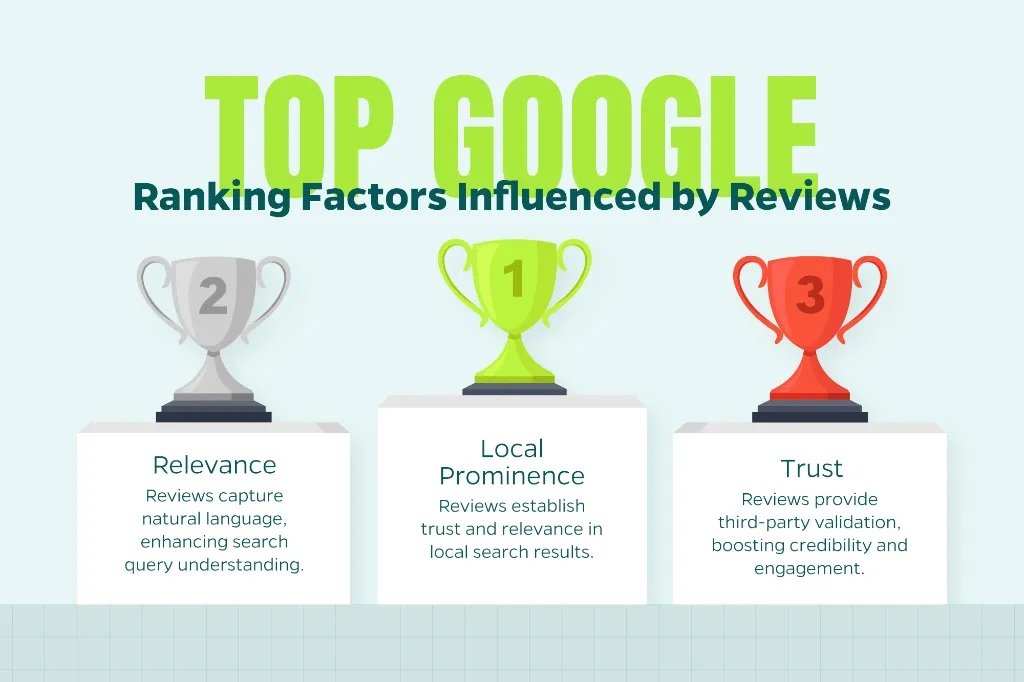
Local prominence is Google’s way of measuring how established, trusted, and actively chosen a business appears in the real world. Reviews play a central role in shaping that perception, particularly when they are consistent, recent, and detailed. A steady flow of authentic reviews signals that a business is active, relevant, and delivering real value to customers today. In competitive local packs, this sense of prominence often outweighs physical proximity, especially when multiple businesses are located close to the searcher.
“A business with consistent, recent, detailed reviews looks active, chosen, and just more relevant.”
Proximity, on its own, primarily determines which businesses are eligible to appear in local results, not how they are ordered. Once several nearby options qualify, Google relies on trust signals to decide which listings deserve greater visibility. Reviews frequently become that deciding factor, helping Google differentiate between similar businesses by revealing which ones customers consistently choose and trust. As reviews help determine which businesses rise to the top locally, they also shape what those businesses appear relevant for in search.
Reviews and Relevance for Local Queries
Reviews reinforce relevance by capturing the same natural language customers use when searching. Instead of polished marketing terms, reviewers describe real problems, specific services, urgency, and outcomes in their own words. This organic language helps Google better understand searcher intent, particularly for long-tail and service-specific queries.
Where reviews stand out is their ability to reinforce relevance without deliberate optimization. Because they’re written independently by customers, they add authentic context that marketing copy often can’t replicate, complementing on-page content rather than competing with it.
Review Quantity, Velocity, and Consistency
Review frequency matters because it reflects real-world demand and business health. A consistent flow of reviews signals ongoing customer engagement, which Google tends to value more than sporadic spikes that can appear campaign-driven or unnatural. Inconsistent patterns may quietly weaken trust by suggesting declining interest or manufactured activity.
Review velocity supports ranking stability by sustaining momentum over time. While slowdowns rarely cause sudden drops, they can lead to gradual visibility loss as competitors continue earning fresh engagement. Beyond how often reviews appear, what customers say within them plays an equally important role in how Google interprets a business.
Review Content as Semantic and Keyword Signals
By analyzing recurring themes, mentioned services, and described outcomes, Google can better understand what a business does and how customers experience it. This helps connect real businesses to real-world intent and align review language with how users search for specific solutions.
Barlas explained how Google reads reviews more like conversations:

So Google doesn’t read reviews like keywords. It reads them like conversations like you and I are having. It looks for recurring themes across many reviews, services mentioned, modifiers used, problem solved and outcomes described. That semantic understanding helps Google map real businesses to like real world intent. And that kind of causes far more accuracy than relying on just website review content alone pretty much.
Service and product mentions matter because they act as independent validation of a business’s own claims. When customers naturally reference specific offerings in their reviews, it reinforces accuracy and credibility without relying on self-authored content. Over time, this user-generated language strengthens topical authority by repeatedly associating the business with certain services or products, making those connections more trustworthy in Google’s eyes.
Reviews and Entity Understanding
Reviews shape what a business is actually known for at the entity level, beyond what it claims on its website or profile. This isn’t about trust; it’s about categorization. When certain themes, services, or outcomes appear consistently in customer feedback, they carry more weight than static lists of offerings and help Google associate the business with real-world experiences over time.
Both branded and non-branded language contribute in different ways. Branded mentions reinforce authority by confirming intentional brand recognition, while non-branded language expands relevance by linking the business to broader problems and services customers search for. Together, these signals help Google understand where the business fits, and user behavior then confirms whether that understanding aligns with real-world choices.
Reviews, Engagement, and Behavioral Signals
Star ratings influence SERP clicks by serving as immediate trust cues, especially when paired with strong review volume. Users naturally gravitate toward listings that appear more credible, and Google can interpret those consistent click preferences as signals of perceived quality and relevance.
Higher click-through rates help reinforce rankings by validating that a result satisfies user intent. Reviews also reduce bounce rates by setting clear expectations upfront, leading to more qualified clicks, longer engagement, and stronger conversion intent.
“That confidence leads to longer engagement, fewer bounce rates and higher conversion intent. Trust removes hesitation, and engagement reinforces that ranking stability.”
Reviews as Third-Party Validation
Reviews often carry more weight than on-site claims because they’re outside a business’s direct control. While websites are inherently self-promotional, reviews provide third-party, experience-based validation that’s harder to manipulate and more trustworthy to both users and search engines.

Google trusts external validation more than self-promotion or on-page content. Reviews provide that experiential proof that a business delivers what it claims because it’s coming from real users, real people who have experience there, their services or their business.
Beyond credibility, reviews act as powerful trust and consistency signals across the local ecosystem. They frequently confirm core details like NAP information, services offered, professionalism, and real outcomes, reinforcing accuracy across the local ecosystem. This alignment supports Google’s broader trustworthiness criteria, helping businesses appear more reliable and stable in search results.
Why Reviews Are Still Treated as “Reputation Only”
When reviews are handled reactively rather than strategically, they often become a missed SEO asset. Siloing reputation management from SEO efforts limits visibility into how reviews support rankings, engagement, and trust, resulting in lost long-term opportunities to build sustained search performance. That gap is less about ignorance and more about outdated assumptions around what reviews are actually doing in search.
Rethinking Reviews as an SEO Strategy
Reviews work best when treated as trust infrastructure rather than short-term campaigns. Sustainable systems that consistently earn feedback from real customers create steady signals of credibility, while ethical review generation ensures those signals reflect genuine experiences and not just artificial spikes.
Over time, earned reviews compound into a defensible advantage competitors can’t easily replicate. Authentic review profiles are built through real interactions and sustained performance, making them a durable asset that continues to support rankings, trust, and visibility long after individual campaigns end.
Why Reviews Matter More Than Most Businesses Realize
At this point, it’s clear that reviews aren’t a secondary SEO signal or a reputation layer that sits outside rankings; rather, they actively shape how Google evaluates performance in the real world.
In the final takeaway below, Barlas explains why reviews influence Google far more than most businesses realize. He also addresses why the brands that consistently win in local search don’t treat reviews as a tactic to manage, but as proof of performance they earn over time.

Reviews influence Google far more than most businesses realize because they sit at the intersection of trust, relevance, engagement, and just real-world validation. High-performing local brands don’t just collect reviews. They earn them consistently and allow that trust to compound over time. That compounding effect is one of the hardest advantages for competitors to pretty much overcome.
Reviews give Google something it can’t reliably manufacture: sustained, third-party confirmation that a business delivers real value. High-performing local brands don’t chase reviews in bursts or treat them as reactive reputation tools. Instead, they earn them consistently through real customer experience, allowing trust to compound over time.
As Google continues prioritizing real-world validation, reviews aren’t optional or peripheral. They’re foundational. Businesses that treat them as long-term SEO infrastructure, not short-term tactics, build advantages that last well beyond individual campaigns.