



Key Takeaways
- The best off-site SEO strategy builds authority not just backlinks.
- Google has shifted from counting links to evaluating credibility.
- AI search rewards brands that are recognized, cited, and trusted.
- Authority comes from multiple signals working together not one ranking factor.
- Focus on earning recognition first. Backlinks will often follow.
Imagine you’re searching for a cybersecurity consultant for your growing business. One company keeps appearing everywhere. Their research is cited in industry articles. Their experts speak on webinars. Their content answers your questions. And customers consistently recommend them. By the time you’re ready to reach out, the decision feels much easier because you’ve already built trust in the brand.
That’s brand traction. It comes from consistently demonstrating expertise across the places your audience discovers information. It doesn’t just happen on your own website.
That shift is redefining off-site SEO. As Straight North Off-Site SEO Expert Adam Rosenbaum explains, the conversation has evolved from chasing link volume to building credible visibility around a brand, its people, and its expertise. Links still matter, but they’re no longer the end goal. The bigger question is whether each mention, feature, or appearance helps the right audience and AI systems know your company better. It’s about building brand authority that search engines, AI systems, and customers can trust.
How Off-Site SEO Has Changed
Off-site SEO used to be a numbers game. Link acquisition was the primary goal, and success was measured largely by referring domains and anchor text. The more links you built, the better you were assumed to rank.
Today, the question is much bigger than whether a placement passes link equity. Does it help the right audience and AI systems understand who your company is, what it knows, and why it should be trusted?
Relevance, expertise, and credibility now matter more than simply increasing link volume. At the same time, discovery has expanded far beyond traditional search. Prospects may first encounter your brand through AI-generated answers, industry publications, reviews, podcasts, social platforms, or editorial mentions before ever visiting your website.
“Modern off-site SEO therefore blends everything together. Backlinks are a valuable outcome, but the objective is a constant and credible external footprint.”
Modern off-site SEO is no longer about acquiring as many links as possible. It’s about building a credible presence wherever your audience discovers information so search engines, AI systems, and potential customers consistently recognize your brand as an authoritative source.
Why Backlinks Are No Longer the Goal
The end goal isn’t to set link quotas for placements that exist for anchor text only. Instead, every off-site effort should answer a much more important question: Does it build credibility for your brand?
And an authority-first program begins with audience value and editorial legitimacy. Is the topic useful? Is the publication relevant? And does the client contributes something distinctive. For example, a strong guest article can build recognition, even if its link is nofollow or even omitted completely. The best work often earns natural links because it deserves reference. Links haven’t stopped mattering. That’s not what this is about. Google still uses link analysis, but credible third-party validation is the strategic objective. A backlink is one signal and one pathway within a much larger brand authority program.
Earning trust today means creating consistent signals that reinforce your expertise beyond your own website. Those signals have always influenced search, but AI is changing how they’re interpreted and used to determine which brands deserve visibility.
AI Has Changed How Authority Is Measured
When AI systems evaluate content, they’re no longer looking only at backlinks. They need evidence, not just marketing claims. While there’s no guaranteed formula for earning visibility in AI search, the same foundational SEO principles still apply. Content is more likely to be surfaced when it’s:
- Crawlable
- Clearly written
- Evidence-backed
- Consistently cited
- Useful enough to retrieve
As AI-powered search becomes a primary discovery channel, credibility extends well beyond backlinks. Platforms like Google AI Overviews and ChatGPT Search retrieve information from a wide range of trusted sources. They evaluate which brands consistently demonstrate expertise and cite those sources when generating answers.
“AI systems need passages they can retrieve and sources they can cite, not just a homepage claiming expertise. So original research quotes and relevant editorial coverage create a better evidence trail.”
Original research, editorial coverage, expert commentary, and other forms of third-party validation all reinforce a brand’s credibility. The more consistently your expertise is recognized across trusted sources, the more confidence AI has in surfacing your brand. In turn, it makes high-quality mentions far more valuable than simply earning another backlink.
Why Mentions Matter More Than Ever
If AI is looking for evidence that your brand is recognized beyond its own website, then how your brand is mentioned becomes just as important as where it’s linked. A backlink is only one way to demonstrate authority. Sometimes the strongest signal is simply being quoted, interviewed, or featured as an expert in a publication your audience already trusts.
Expert content supplies the substance behind that association that cannot be produced by rewriting existing articles. Google encourages clear authorship and asks publishers to explain who created content, how it was produced, and why it exists. That doesn’t make EEAT a single score, every mention a ranking factor, but it’s sound guidance for content people can evaluate. Mentions can drive recognition and citations even without a followed link. Quality is in the qualifier, a vague name drop on a low value page isn’t equivalent to a substantive quote, interview, or feature in a publication the audience already trusts.
Backlinks remain an important signal of trust and authority, which is why they became the foundation of off-site SEO for so many years. To understand why today’s approach looks different, it helps to first understand why links mattered so much in the first place.
Why Links Mattered Historically
Backlinks became the foundation of SEO because they gave search engines a practical way to understand which pages were worth paying attention to. Google’s original PageRank algorithm treated links much like academic citations. If a page earned links from other trusted websites, it was seen as more authoritative and valuable.
Links also helped search engines discover new pages. Anchor text provided contextual clues about the destination page, making backlinks an important signal of relevance and authority in early search algorithms.
For years, links were one of the strongest signals available because search engines had a much harder time understanding language, context, and intent on their own. But as Google’s algorithms became more sophisticated, they got much better at evaluating expertise, relevance, and content quality. Today, backlinks remain an important authority signal, but they’re only one part of a much broader picture.
Google’s Quality Updates Changed the Rules
For years, SEO tactics often focused on influencing ranking signals rather than creating something genuinely valuable. As long as a page had enough backlinks and the right anchor text, it could sometimes outperform stronger content.
Google’s quality updates gradually changed that. Panda targeted low-quality content, Penguin cracked down on manipulative link practices, and newer systems like Helpful Content and SpamBrain continue to reward original, people-first content while detecting large-scale attempts to game the algorithm.
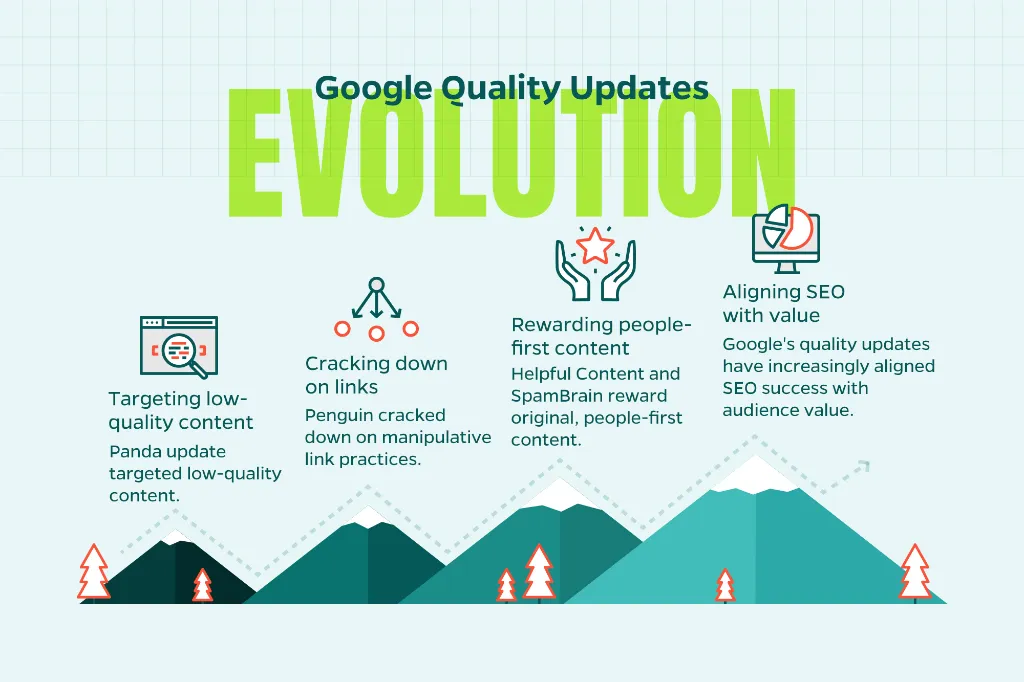
The takeaway isn’t that link building stopped working. It’s that shortcuts stopped working. Google became much better at identifying paid links, excessive link exchanges, automated link creation, and other tactics designed primarily to influence rankings rather than help users.
Instead, the updates rewarded something far more durable: genuine expertise, editorial relevance, and content that people actually find valuable. Those assets survive algorithm changes and continue attracting readers, while also earning natural citations and building trust over time. As Rosenbaum puts it, Google’s quality updates have increasingly aligned SEO success with audience value.
What Off-Site Brand Visibility Looks Like Today
Off-site SEO hasn’t abandoned backlinks. It has expanded beyond them. The goal is no longer to build as many links as possible but to build a brand that’s consistently recognized for its expertise wherever customers, journalists, industry peers, and AI systems look for information. The comparison below highlights how that shift has changed the way successful off-site strategies are built.
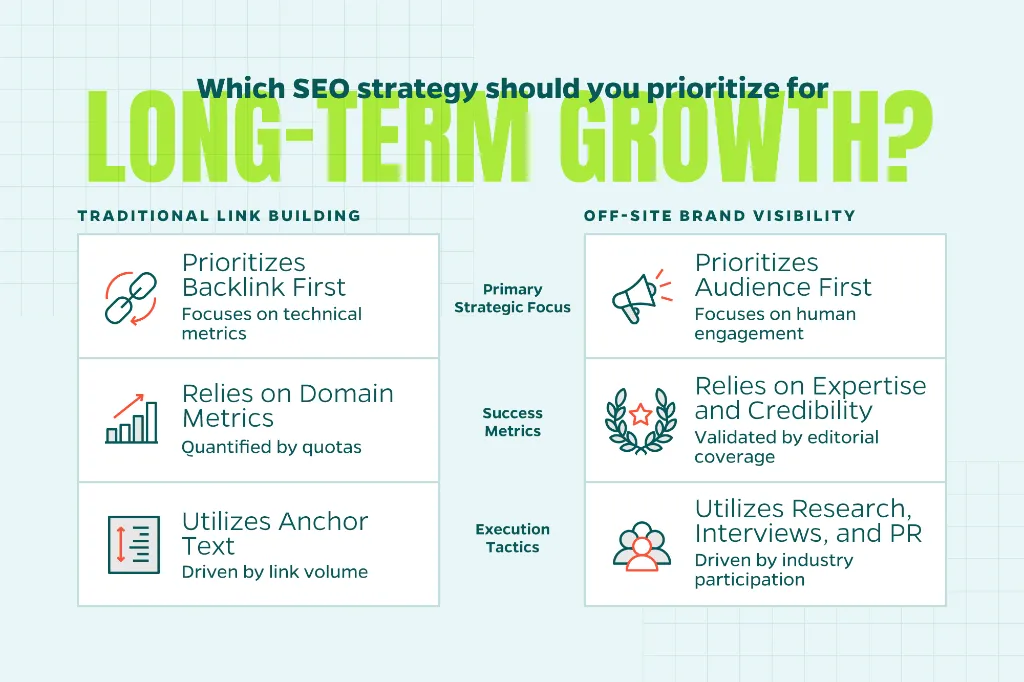
The comparison isn’t about choosing between backlinks and brand visibility; rather, it’s recognizing that authority has become cumulative. Every meaningful signal works together to reinforce your expertise, giving search engines, AI platforms, and potential customers more reasons to trust your brand.
Authority Is Built Through Multiple Signals
Not everything affects the AI ranking directly. Authority comes from convergence: Multiple independent sources give users and machines compatible reasons to recognize and trust the brand.
It’s reinforced by multiple touchpoints that work together to demonstrate expertise, credibility, and trust across the web.
- Expert content demonstrates your company’s knowledge and subject matter expertise.
- Editorial coverage provides independent validation and reinforces your credibility.
- Brand mentions strengthen your association with relevant topics, even without a hyperlink.
- Citations show that your research, insights, or content were valuable enough for others to reference.
- Customer reviews offer real-world proof of trust and customer experience.
- Accurate business profiles help search engines and AI systems consistently identify and understand your brand.
A cohesive digital footprint reduces uncertainty and builds confidence over time for prospects and AI.
Measuring Success Beyond Link Count
Backlinks remain an important signal, especially when they come from trusted, relevant sources. But link counts alone can’t measure the true impact of an off-site strategy. A meaningful editorial feature and a low-value directory link may both count as one backlink, despite delivering very different results.
“The question becomes not just how many links were built, but whether the external presence created discoverability, credibility, and actual demand.”
Because today’s search landscape extends beyond traditional rankings, your KPIs should too. The most meaningful measures of success include:
- Brand visibility
- Editorial placements
- AI citations
- Branded search growth
- Referral traffic
- Brand mentions
- Trust signals
- Qualified demand
Today, success is measured by a broader question: Did your off-site presence make your brand more visible and in demand?
Building an Authority-First Strategy
The best authority-building strategies are intentional, not reactive. Rather than chasing mentions or backlinks one opportunity at a time, start by assessing your current authority footprint and then create assets that naturally earn recognition.
You want to choose focused topics the organization can credibly own, identify any internal experts, capture that firsthand knowledge, and then invest in assets others will reference and participate in those publications and those communities, and the audience then builds that trust. You’re gonna want to accept that credible off-site work involves less control, which is hard for people to give up. You know, an editor may change a headline, qualify a link, or decline a pitch, and that’s okay. The work is cross-functional, and the experts all contribute evidence. When each activity reinforces a clear position, off-site visibility becomes a durable business asset, rather than just a collection of placements.
As search continues to evolve, the brands that stand out won’t be the ones with the biggest backlink profiles. They’ll be the ones that have built the strongest reputation across the web. That’s the real opportunity behind an authority-first approach.
The Next Era of Off-Site SEO
Off-site SEO didn’t stop being about link. It outgrew them.
The brands that win today are the ones that consistently prove their expertise wherever buyers look for answers. They publish original research. They earn editorial coverage. They contribute expert insights. They become sources worth citing not because they’re chasing backlinks, but because they’ve earned trust.
That’s the real shift. Visibility is no longer built one link at a time. It’s built one credible signal at a time.
As Google and AI search continue to evolve, the competitive advantage won’t belong to the brand with the biggest backlink profile. It will belong to the brand that’s easiest to trust, easiest to verify, and easiest to reference. Build that reputation, and the rankings, citations, mentions, and backlinks become the outcome instead of the objective.