



Key Takeaways
- Authority is no longer built through backlinks alone. It’s earned through multiple, reinforcing credibility signals.
- Subject matter experts and original research create validation competitors and AI can’t easily replicate.
- Editorial placements should prioritize valuable insights, with backlinks becoming a natural byproduct.
- Accurate business profiles, visual assets, and consistent brand information strengthen trust and discovery.
- Long-term visibility comes from building a diversified portfolio of authority assets that compound over time.
Off-site SEO used to be a numbers game. The conversation centered on how many backlinks you earned and how quickly you could build them. While links still matter, they’re no longer enough to establish authority.
Today, authority isn’t something a brand can simply claim on its website. It has to be demonstrated. The organizations that stand out consistently show their expertise through original insights, credible sources, industry recognition, customer validation, and meaningful mentions across the web. In other words, the strongest brands don’t just say they’re experts, they give people and search engines plenty of reasons to believe them.
As Straight North Off-Site SEO & GEO Expert Adam Rosenbaum explains, truly authoritative brands are able to make credible claims, back them with proof, and have those claims reinforced by trusted sources beyond their own website. That’s the new role of off-site SEO: not just earning links, but earning confidence wherever your audience discovers you.
Why Modern Brand Authority Requires Multiple Signals
No single tactic builds authority anymore. A backlink alone won’t establish credibility, just as a positive review or media mention won’t tell the whole story. Instead, search engines, AI platforms, journalists, and potential customers evaluate a collection of signals that work together to build trust.
Each signal answers a different question: Does this company truly know what it’s talking about? Have credible third parties validated its expertise? Do customers trust it? Is the business legitimate? Is it represented consistently wherever people encounter it? The stronger those answers become across the web, the stronger your brand authority becomes.
Editorial coverage shows that a credible third party is considered it worth featuring, and reviews reveal the customer experience. Accurate profiles then establish, you know, that the organization is real, current, and accessible. Referrals help people move from endorsement to a useful source, but no single signal can carry all of that weight. The combination also reduces dependence on one platform. A brand built only on rankings or social reach is vulnerable to change. It’s the complementary signals that create multiple discovery paths and reinforce the same identity. When assets share focused topics and consistent facts, their combined effect is stronger than unrelated placements.
Authority isn’t built through shortcuts. It’s earned by consistently providing support that your organization knows its subject, delivers value, and deserves to be referenced. That starts with the people behind the brand.
The six building blocks that follow show how modern organizations create credible evidence of their expertise from capturing original knowledge to earning editorial validation and maintaining a trustworthy presence across the web.
#1: Demonstrate Real Expertise Through Subject Matter Experts
The easiest content to replicate is content that’s based entirely on what’s already been published. AI can summarize it. Competitors can rewrite it. Before long, dozens of articles begin saying the same thing.
What can’t be replicated as easily is first-hand experience.
Subject matter experts (SMEs) bring insights that don’t exist anywhere else. They understand why certain approaches succeed, where common advice falls short, the trade-offs behind difficult decisions, and the patterns they’ve observed across real projects. That institutional knowledge is one of the strongest authority signals an organization can offer because it can’t simply be copied from another website.
“The expert can explain patterns from real projects, how decisions are made, where common advice breaks down.”
The best way to capture that expertise is through structured interviews. Instead of asking experts to define industry terms, ask about recent client scenarios, recurring mistakes, evolving perspectives, or advice they would challenge. Those conversations produce original insights that transform content from a summary into a resource worth citing.
The process shouldn’t end there. SMEs should review the final content to verify technical accuracy, refine nuanced points, and ensure it reflects their expertise and not just a writer’s interpretation. That collaboration creates content informed by genuine experience rather than simply decorated with an expert’s name.
#2: Earn Editorial Trust Instead of Chasing Links
Publishing thoughtful guest articles does far more than earn another backlink. It places your experts in front of new audiences while creating independent proof that others consider your perspective worth sharing.
A guest’s article creates value at several levels, while a standalone backlink mainly creates a technical and navigational signal. A strong article gives the publisher something useful, it introduces the client’s expert to an established audience, it associates the brand with a topic, and it creates an asset that sales and social teams can share. It can generate referral traffic, branded searches, more interviews and natural citations.
A well-written guest article benefits everyone involved. Publishers receive valuable content for their audience, readers gain practical insights from a credible expert, and your organization builds visibility by contributing meaningful expertise instead of simply promoting itself. Along the way, these articles can generate referral traffic, increase branded searches, spark future interview opportunities, and earn natural citations.
That represents a significant shift from traditional link building. Years ago, the backlink was often the primary objective, with the article serving as the vehicle to acquire it. Today, the article, not the link, should be the product. Topic relevance, audience fit, and original insights come first, while the backlink becomes a natural byproduct of contributing something worthwhile. A simple test is to ask: Would this article still be worth publishing if the editor removed the link? If the answer is yes, you’re building authority and not just chasing a ranking signal.
Over time, these contributions create far more than a collection of backlinks. They build a public record of expertise across trusted publications helping journalists and search engines consistently associate your brand with a particular subject. One article creates exposure, but consistent, high-quality contributions build the topical authority that modern search rewards.
#3: Create Original Research Worth Citing
Look at your industry and shifts in the market. Reach out to your audience with a survey and get insights into how people are responding to the latest trends in business. By answering unanswered market questions with real data, you position yourself as a topical authority and your survey research has a great opportunity to earn a citation. Journalists need evidence, and original research gives them something credible to cite.
The topic should be focused, the sample should match the population being discussed, and the report should disclose the sample size: the dates, you know, question, you know, the wording, recruitment, and meaningful limitations. Clear charts, a concise finding summary, and a stable URL make reference easier. And promotion matters as well. You want to offer journalists relevant angles and give partners shareable findings, connect results to expert interpretation. When it’s done well, a survey can be updated over time and used across articles, presentations, pitches, sales conversations. It’s citation potential, you know, really comes from being original, you know, credible and useful.
Proprietary Data Builds Defensible Authority
Original data is one of the few authority assets competitors can’t easily duplicate. While anyone can rewrite a blog post, they can’t recreate the insights hidden within your own research, customer trends, or industry data. That’s what makes proprietary data so valuable. It creates expertise no one else can claim.
The value, however, isn’t in the numbers alone. Raw data rarely tells a complete story. It becomes useful when experts provide context, explain what the findings mean (and don’t mean), and connect them to real business decisions.
Just as important, organizations should be transparent about how they collected the data, acknowledge any limitations, and protect customer privacy through appropriate aggregation. When original research is both credible and thoughtfully interpreted, it becomes a lasting authority asset that journalists, industry publications, AI systems, and prospective customers can confidently reference.
#4: Turn Expertise Into Visual Assets
Not everyone wants to consume information the same way. Infographics, charts, diagrams, and other visual assets make complex ideas easier to understand, remember, and share. They also give publishers, partners, and social teams a compelling way to reference your expertise.
The strongest visuals don’t replace written content. They reinforce it. A great infographic tells a clear story with accurate data, thoughtful design, and expert analysis, while the supporting page provides the context, methodology, and detail that search engines, AI systems, and readers rely on.
Repurpose and Refresh
Just as importantly, one visual shouldn’t be limited to a single use. A research report can become an infographic, individual charts can fuel LinkedIn posts or newsletters, process diagrams can support guest articles or presentations, and an expert walkthrough can be repurposed into short video clips.
The goal isn’t to publish the same asset everywhere. Adapt one researched idea for different audiences and channels while keeping the credibility consistent. That’s how a single piece of expertise can power dozens of touchpoints and reinforce your authority wherever your audience finds you.
#5: Reinforce Trust Through Accurate Business Information
One of the most overlooked authority signals isn’t content. It’s the accuracy of your business information across the web. Rosenbaum explains the importance of auditing these profiles regularly.

These profiles are often a customer’s first source of truth, yet they accumulate errors, locations move, phone numbers change, services evolve, employees leave, hours shift, so many things can happen. But an audit will identify which platforms matter, such as, you know, Google Business Profile, Yelp, Facebook, LinkedIn, X, all the most important, you know, directories and websites, and then you check ownership, naming URLs, contact details, and more. The goal is not to create a profile everywhere, it’s to make important profiles accurate, complete, and useful. Google explicitly advises businesses to keep business profile information current, and organization structure data can identify official external profiles. So the accuracy reduces customer friction, and it creates a consistent identity across the web.
For many customers, platforms like Google Business Profile, LinkedIn, Yelp, Facebook, and industry directories are their first interaction with your brand. Over time, phone numbers change, locations move, services evolve, and employee information becomes outdated. Regular profile audits help ensure the details people rely on are accurate, complete, and easy to verify.
Consistency matters just as much as accuracy. Your business name, address, and phone number (NAP) should align across every major platform, while descriptions can be tailored to each audience. Maintaining a single source of truth for these core facts reduces customer friction, strengthens entity recognition, and helps search engines and AI systems confidently associate information with the correct organization.
The goal isn’t to create a profile everywhere. Keep your most important profiles current and trustworthy. People and search systems should never have to wonder which information is correct.
#6: Build an Authority Portfolio That Compounds Over Time
No single authority signal tells the whole story. Buyers, search engines, AI platforms, and journalists all look for different types of trusted signals, which is why the strongest brands build a portfolio of complementary assets over time.
Each asset serves a different purpose:
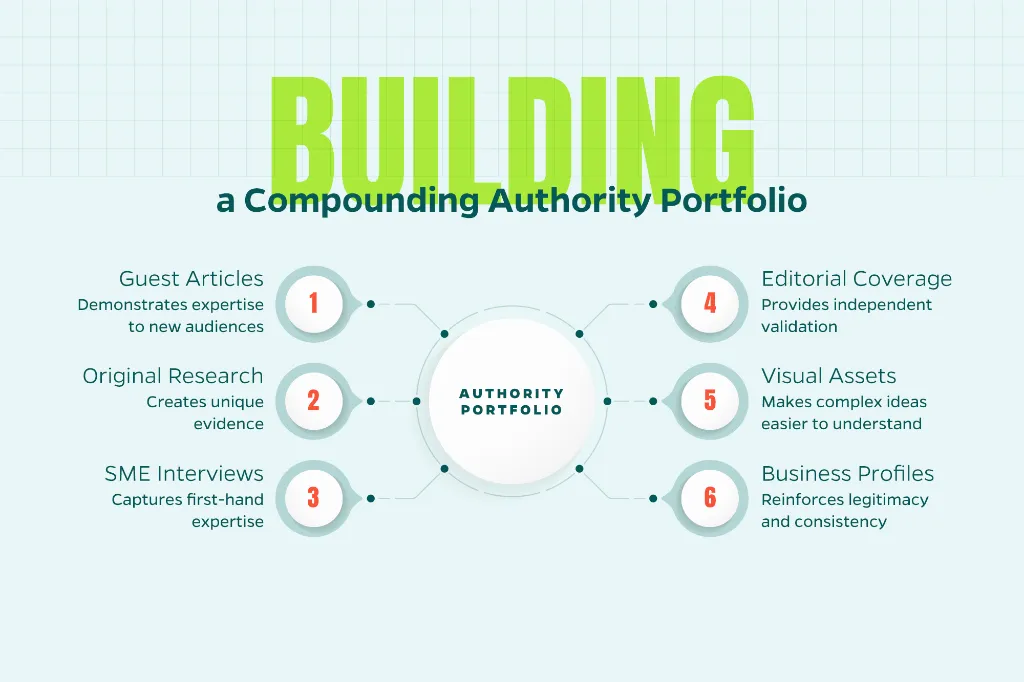
Together, these assets create multiple discovery paths while reinforcing the same message: your organization knows its subject and can be trusted.
Diversification also reduces risk. A press mention can generate awareness but may not demonstrate deep expertise. A research report can provide valuable insights but needs distribution to reach the right audience. Relying too heavily on any single tactic or platform leaves your visibility vulnerable as algorithms, buyer behavior, and discovery channels continue to evolve.
The right mix will change as your organization grows. A newer company may benefit most from establishing accurate business profiles and building expert visibility, while a more established brand may be ready to invest in proprietary research and national media opportunities. The goal isn’t to do everything at once. It’s to build a balanced portfolio that consistently reinforces your expertise and amplifies your authority over time.
Authority Is Built to Last
Backlinks still matter, but authority is no longer built through links alone. Every expert interview, research study, guest article, infographic, accurate business profile, and editorial mention adds another layer of credibility supporting your expertise. Individually, these assets create value. Together, they build a reputation that people and search engines can recognize and trust.
Each block creates an asset, a relationship, or a verified fact that can keep producing value after the campaign. So, an expert interview becomes a knowledge source. A guest article remains discoverable and can lead to another invitation later on. A survey may earn citations and become an annual benchmark. And an infographic travels across channels. A release preserves the official record of a milestone. Accurate profiles reduce ongoing customer friction. So, you know, when topics and facts are coordinated. Later work builds on earlier work instead of starting from zero, starting from scratch. So, a journalist who used the data may return for commentary, while a prospect who saw a guest article may recognize the name later. Compounding is not an automatic curve, it’s an expanding inventory of credible touchpoints, and lower friction for future opportunities. So, the maintenance remains necessary because links break, facts change, and research ages. But the long-term visibility comes from treating the portfolio as an operating system to review and continuously refresh.
That’s what makes modern authority so powerful. Every new asset reinforces the ones that came before it, creating a stronger foundation for future visibility, recognition, and trust rather than forcing you to start from scratch.
The organizations that succeed won’t be the ones producing the most content. They’ll be the ones consistently creating credible evidence of their expertise and treating authority as a long-term investment — not a one-time campaign.