


When someone searches “best HVAC company near me” from their phone while standing in their driveway, your business either shows up, or it doesn’t. That split-second result is driven by a combination of factors. Those considerations include your local citations, your online listings, and how well your website is optimized for mobile search. If any one of those pieces is out of alignment, you could be handing potential customers to a competitor.
Local mobile search has become the dominant way B2B and B2C buyers alike discover nearby service providers. With that in mind, here’s what you need to know about this important aspect of Local SEO.
What are Local Citations? Why Do They Matter?
A local citation is any online mention of your business’s name, address, and phone number. This is commonly referred to as NAP data. These citations appear on business directories, review platforms, social media profiles, and industry-specific listing sites. Google uses them to verify that your business is legitimate and to confirm that your location information is consistent across the web.
Inconsistent NAP data is one of the most common local SEO mistakes businesses make. If your address appears differently on Google Business Profile than it does on Yelp or your industry association’s directory, search engines can’t fully trust your listing. That uncertainty translates directly into lower rankings.
To get this right, start with an audit. Check your NAP data on:
- Google Business Profile
- Bing Places for Business
- Yelp, Apple Maps, and Facebook
- Industry directories and local chamber of commerce listings
Correct any discrepancies, then maintain the same exact formatting going forward — down to whether you abbreviate “St.” or spell out “Street.”
Claim and Fully Optimize Your Google Business Profile
Your Google Business Profile (GBP) is the centerpiece of your local search presence. It’s what populates the map pack — that cluster of three local results that appears prominently at the top of a mobile search results page. If your profile is incomplete or unclaimed, you’re leaving significant visibility on the table.
Claiming your profile is step one. After that, fill out every available field: business categories, hours of operation, service areas, photos, a business description, and a link to your website. Google rewards completeness because it gives users more confidence in the listing.
Don’t overlook the Q&A section or the Posts feature. Regularly publishing updates, offers, or announcements through GBP Posts signals to Google that your business is active. It also gives mobile users more information before they ever click through to your site — which can improve conversion rates even from the search results page itself.
Make Your Website Mobile-First, Not Just Mobile-Friendly
There’s an important distinction between a website that technically works on mobile and one that’s designed with mobile users in mind from the start. Google uses mobile-first indexing, meaning it primarily evaluates the mobile version of your site when determining search rankings. A sluggish, hard-to-navigate mobile experience will hurt your rankings regardless of how well the desktop version performs.
Key areas to focus on include:
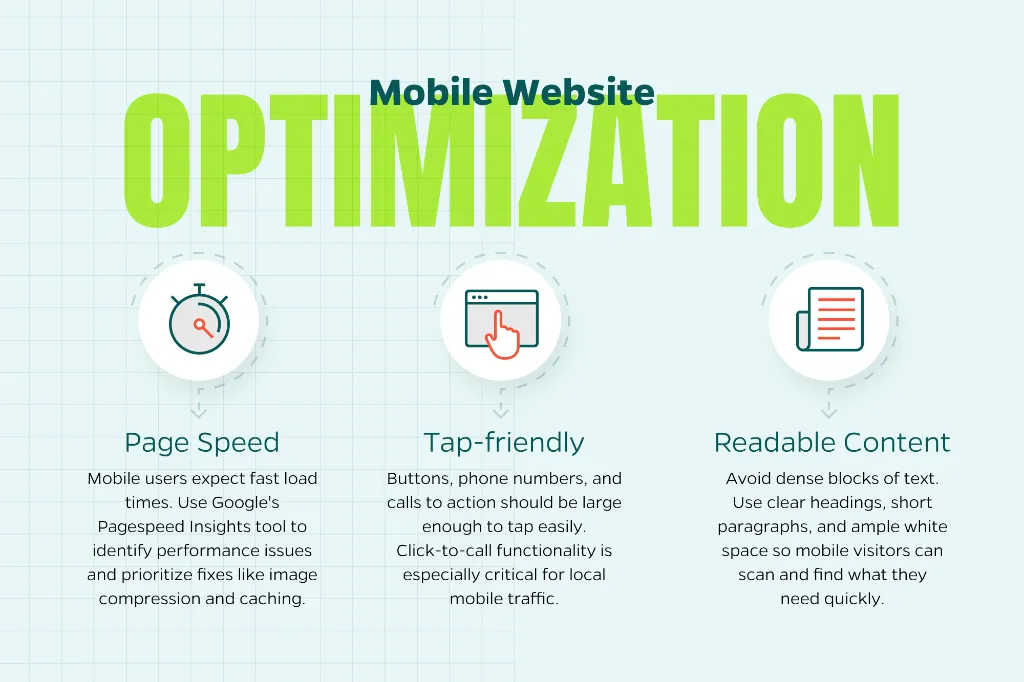
- Page speed. Mobile users expect fast load times. Use Google’s PageSpeed Insights tool to identify performance issues and prioritize fixes like image compression and caching.
- Tap-friendly design. Buttons, phone numbers, and calls to action should be large enough to tap easily. Click-to-call functionality is especially critical for local mobile traffic.
- Readable content. Avoid dense blocks of text. Use clear headings, short paragraphs, and ample white space so mobile visitors can scan and find what they need quickly.
Add Local Schema Markup to Your Website
Schema markup is structured data code that you add to your website to help search engines better understand your business information. For local SEO, LocalBusiness schema is particularly valuable. It explicitly tells Google your business name, address, phone number, hours, and service area in a format that search engines can interpret with high confidence.
When your schema is implemented correctly, it reinforces the same NAP data that appears in your citations and Google Business Profile. This consistency across your website and external listings builds trust with search engines. This trust translates to better local rankings. Depending on your business type, you may also be eligible for rich results like star ratings or FAQs directly in the search results, which can increase click-through rates from mobile users.
Create Location-Specific Content on Your Site
If you serve multiple areas or have more than one location, dedicated location pages are a powerful tool for local mobile search. Each page should speak specifically to that geographic area. By referencing local landmarks, service availability, and relevant details that differentiate it from a generic “Services” page. Thin or duplicated location pages do more harm than good, so invest in original content for each one.
Beyond location pages, your blog and content strategy can support local SEO by targeting location-modified keywords and addressing topics that matter to your specific market. A manufacturer in the Midwest searching for a digital marketing partner has different concerns than a healthcare practice in a major metro. When your content reflects that understanding, it resonates with users and signals relevance to search engines.
Build and Manage Your Reviews Proactively
Reviews are a ranking factor for local search, and they’re one of the first things a mobile user sees when your business appears in results. A strong review profile — with consistent volume, recent submissions, and high ratings — makes your listing more credible and more clickable.
The most effective way to build reviews is simply to ask. Follow up with satisfied customers and make it easy for them by sending a direct link to your Google review form. Responding to reviews, both positive and negative, signals to Google that your business is engaged and attentive. It also gives prospective customers a window into how you operate. This can influence their decision before they ever reach your website.
Go to the Next Level with a Consistent Strategy
Optimizing for local mobile search is an ongoing commitment to keeping your citations accurate, your website technically sound, and your listings active and complete. Each element reinforces the others, from schema markup to review management. When they work in concert, you build the kind of local search authority that puts your business in front of the right people at the right moment.
The businesses that show up consistently at the top of local mobile results aren’t there by accident. They’ve invested in getting the fundamentals right and keeping them right over time.
Need Help?
Ready to improve your local mobile search presence? Straight North helps businesses build and execute digital marketing strategies that drive real, measurable results. Contact us today to get the conversation started.