

Content marketing is a fundamental shift in how businesses connect with their audiences. Instead of interrupting people with ads, content marketing attracts them with information they want. It’s also popular. According to a 2024 study, 91% of B2B marketers use content marketing to reach customers.
At its core, content marketing is a strategic approach focused on creating and distributing relevant content. Its goal is to attract a desired audience to your brand while driving profitable action.
This guide gives you a strategic overview of content marketing. It helps you understand not just what content marketing is, but how to make it work for your specific business goals.
The Evolution and History of Content Marketing
Different forms of content marketing have been around for ages. In 1895, John Deere launched “The Furrow,” a magazine that offered farmers practical advice on agriculture. It didn’t overtly attempt to sell tractors; it sought to build trust by sharing useful information. Yet, it became a very popular publication lauded for the quality of information — helping John Deere to establish itself as a household name of agricultural excellence. This early example set the stage for content marketing as we know it, focusing on value over direct promotion.
If you fast forward to the 20th century, you see brands like Michelin getting in on the act. In 1900, they published the Michelin Guide, offering drivers tips on travel, maintenance, and dining — subtly promoting their tires along the way. Pioneers like John Deere and Michelin showed that educating your audience could create loyalty while positioning your brand as an authority.
The digital era opened the floodgates of content. The rise of the internet in the 1990s brought blogs, email newsletters, and search engines. By the early 2000s, SEO (search engine optimization) became crucial, helping content reach wider audiences organically. Social media platforms like Facebook (2004) and Twitter (2006) added new distribution channels, making content more interactive and shareable.
Today, content marketing is a powerhouse. Global revenue tied to content marketing is projected to surpass $100 billion this year. Plus, content marketing generates three times as many leads as traditional outbound marketing at a fraction of the cost.
Why Content Marketing Matters for Businesses
Let’s talk about what content marketing does for your bottom line.
When you consistently publish helpful, accurate content, you become a go-to resource. People link to your articles, cite your research, and think of you first when they’re ready to buy. This isn’t vanity — it’s positioning that translates to competitive advantage.
SEO and Lead Generation
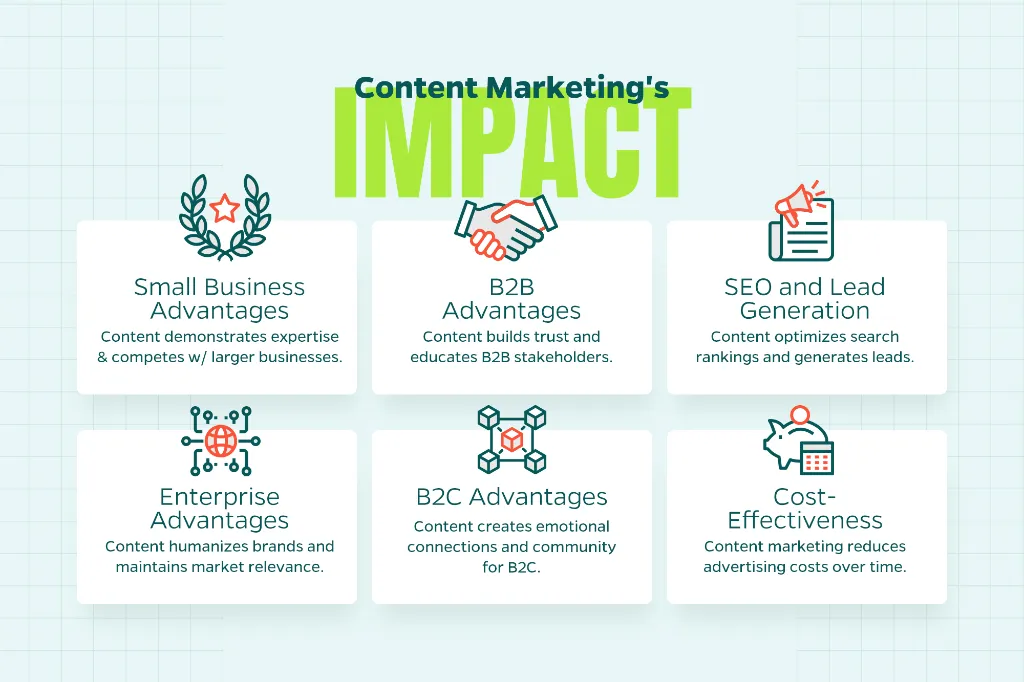
Google’s algorithm shows users the most relevant, helpful content. So, each blog post you publish is another indexed page and another opportunity to rank for keywords your prospects are searching. In other words, content marketing helps improve your SEO strategy. Unlike paid ads that stop working when you stop paying, organic traffic from content compounds over time.
Content marketing also works throughout the entire buyer journey. Educational blog posts attract strangers, in-depth guides capture leads, case studies overcome objections, and comparison content closes deals.
Cost-Effectiveness
Traditional advertising requires constant spending to maintain visibility. Content assets continue delivering value long after creation. A well-optimized blog post written today could drive leads three years from now. Your cost-per-lead decreases over time while your content library grows.
Business-Specific Advantages
For B2B companies, content addresses complex, committee-based purchasing decisions. Your content educates multiple stakeholders and builds trust necessary for high-value relationships.
B2C businesses leverage content to create emotional connections and community. Recipe blogs sell cookware and style guides sell clothing, for example — all without feeling like advertising.
Small businesses compete with larger competitors by demonstrating expertise that budgets can’t buy. Enterprises use content to humanize their brands and maintain relevance across diverse markets.
Key Components of Content Marketing
Successful content marketing requires a framework. Below are the essential components.
Audience Research
You can’t create relevant content without understanding who needs it. You should develop detailed buyer personas based on real data. What are their challenges and goals? What questions keep them up at night? Where do they consume information?
Use Google Analytics to see who’s visiting your site. Customer surveys reveal pain points. Sales conversations uncover objections. Social listening tools show what topics generate engagement.
Ultimately, the goal is empathy. You want to understand what would make someone stop scrolling and care about what you have to say.
Content Goals and KPIs
Effective content marketing starts with SMART goals: Specific, Measurable, Achievable, Relevant, and Time-bound. Define what success looks like for each piece and track accordingly.
- Increasing brand awareness? Track unique visitors, page views, and social shares.
- Lead generation? Monitor conversion rates and cost-per-lead.
- Supporting sales? Measure content-influenced revenue and sales cycle length.
Content Pillars and Topic Clusters
Content pillars are the 3-5 core themes that define your expertise. Every piece should ladder up to one of these pillars. Within each pillar, create topic clusters — groups of related content that comprehensively cover a subject.
A systematic hierarchy, like the one described above, positions you as an authority and signals relevance to search engines.
Distribution Channels
Creating great content is half the battle. You need to get it in front of people. Owned media, like your blog and email list, give you control. Earned media, like guest posts for other outlets, expand reach. Paid promotion provides predictable visibility.
Most businesses need a multi-channel approach. Here’s an example: publish on your blog, share across social platforms, include the content in email newsletters, repurpose it for video or podcasts. The key is consistency while optimizing for each platform’s unique format.
Types of Content in Content Marketing
Content marketing encompasses far more than blog posts. Understanding the spectrum helps you choose the right format.
Written Content
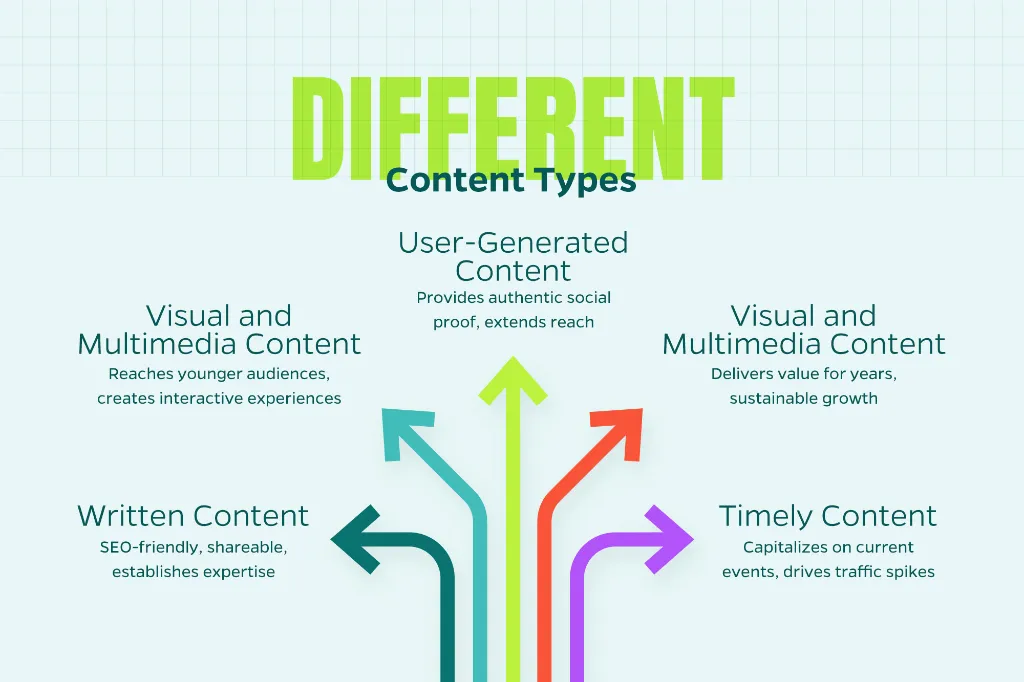
Long-form blog posts remain foundational. They’re SEO-friendly, shareable, and establish expertise. But written content extends to ebooks and whitepapers for lead generation, case studies for social proof, infographics that distill complex data, and email newsletters that nurture relationships.
You want to optimize for readability. Clear headlines, short paragraphs, subheadings, and bullet points are best. Your audience is skimming; make it easy to find value quickly.
Visual and Multimedia Content
Video has exploded. YouTube processes more searches than any platform except Google. Short-form video on TikTok and Instagram Reels reaches younger audiences. Webinars establish expertise while creating interactive experiences. Podcasts create intimate connections people consume while commuting or exercising.
Know where your audiences are and use the right platforms to reach them.
User-Generated and Interactive Content
Sometimes the best content comes from customers. Reviews provide authentic social proof. Social media posts from happy customers extend reach. The trick is making it easy and rewarding for them to create quality content about your brand.
Evergreen vs. Timely Content
Evergreen content addresses questions that remain relevant: “What is content marketing?” This delivers value for years. Timely content capitalizes on current events and trends, driving traffic spikes. Balance both — timely content for visibility, evergreen content for sustainable growth.
Building a Content Marketing Strategy
Strategy separates content marketing from random content creation. Here’s a systematic approach.
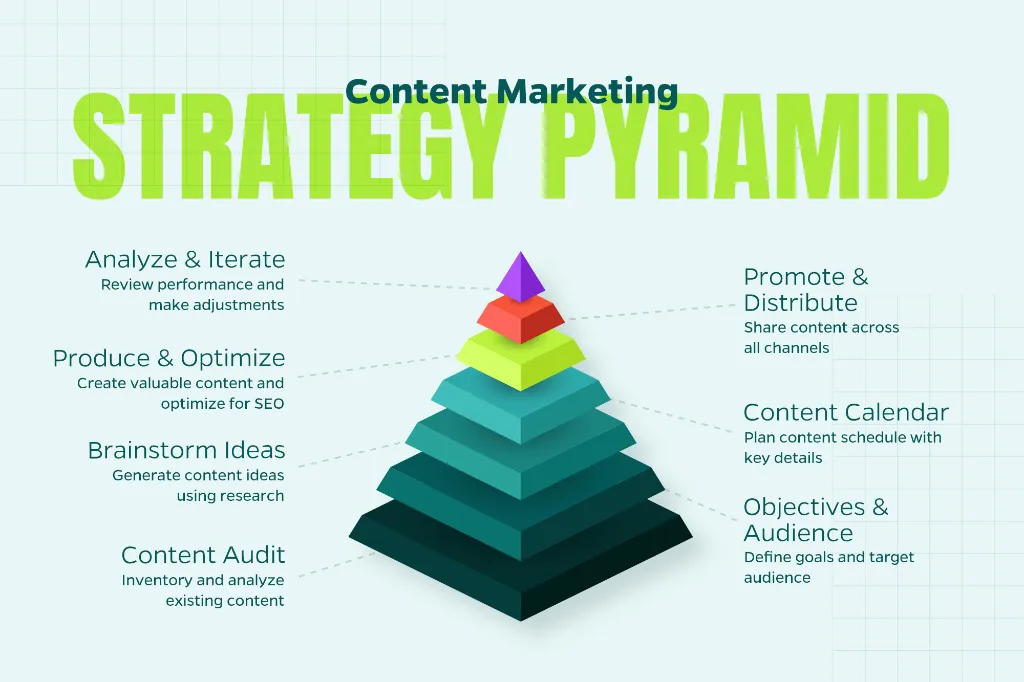
The Seven-Step Process
- Conduct a content audit – Inventory existing your content. Note the format, topic, and performance. Identify gaps and opportunities to update outdated pieces.
- Define objectives and audience – Get crystal clear on goals and who you’re serving. Document buyer personas and set specific goals tied to business outcomes.
- Brainstorm content ideas – Use keyword research tools to find what people search for. Monitor competitors. Survey customers. Create a backlog organized by content pillar and buyer journey stage.
- Create a content calendar – Plan ahead. Include topic, format, target keyword, responsible team member, and publication date. Consistency matters more than volume.
- Produce and optimize content – Deliver genuine value with thorough answers and actionable insights. Optimize for SEO: include descriptive titles, meta descriptions, header tags, internal links, and optimize for mobile responsiveness. Write for humans first, search engines second.
- Promote and distribute – Share across all channels. Email your list, post to social multiple times, reach out to people mentioned. Consider paid promotion for cornerstone pieces. Repurpose content into multiple formats.
- Analyze and iterate – Review performance monthly for tactical adjustments, quarterly for strategic shifts. Which topics drive traffic? Which pieces convert? Use insights to double down on what works.
Integration and Resources
The good news is that content fuels every marketing channel.
- Social media managers need content to share.
- Email marketers need value to deliver.
- Sales teams use content to educate prospects.
When it comes to allocating resources, you should budget for tools (analytics, SEO software), creation costs (writers, designers), and promotion.
Tools and Best Practices for Content Creation
The right tools multiply effectiveness. Here are essentials:
Key Tools
- Google Analytics and Search Console (free) for traffic and search performance
- Ahrefs or SEMrush (paid) for keyword research and competitor analysis
- Canva (free/paid) for accessible design
- Grammarly (free/paid) for error-catching and readability
- Trello or Asana (free/paid) for content calendar management
Content Creation Best Practices
Quality over quantity remains the golden rule. One excellent piece outperforms ten superficial posts. Provide genuine value with insights audiences can’t find elsewhere.
Storytelling makes content memorable. Even B2B content benefits from narrative structure and relatable examples. Originality sets you apart — add your unique perspective or proprietary research.
Mobile optimization is essential with over 60% of web traffic from mobile devices. Ensure proper display, readable fonts, and fast load times.
SEO Essentials
Include target keywords in title tags and make them compelling. Use header tags (H1, H2, H3) to structure content logically. Add descriptive alt text to images. Internal links should connect related content. External links should lead to authoritative sources that signal quality.
Common Mistakes and How to Avoid Them
Overlooking Audience Needs
Creating the content you want to write instead of the content your audience needs is often a problem.
Solution: Regularly review search queries, customer questions, and support tickets. Let audience needs drive your calendar.
Inconsistent Publishing
Starting strong and fading away undermines everything. Algorithms favor consistent publishers.
Solution: Start with a sustainable pace. Better to publish weekly without fail than daily for a month and disappear.
Ignoring Analytics
Creating content without reviewing performance is like driving with your eyes closed.
Solution: Schedule monthly review sessions. Track traffic and engagement (leading indicators) plus conversions and revenue (lagging indicators).
Producing Overly Salesy Content
When every piece is a thinly veiled sales pitch, you’ve missed the point.
Solution: Follow the 80/20 rule. Provide content that is at least 80% educational, only 20% promotional (at most).
Neglecting Promotion of Your Content
Publishing without promoting means even your best work reaches a fraction of its potential.
Solution: Spend as much time promoting as creating. Develop a checklist covering email, social posts, outreach, and paid amplification.
Scaling Challenges
Growing from startup to enterprise changes everything. Large organizations need processes and coordination.
Scale gradually: establish workflows, invest in automation tools, build style guides, create templates, and develop efficient approval processes. Consider agency partnerships for specialized needs.
Conclusion
Content marketing has evolved from a fringe tactic to fundamental business strategy. The brands winning today genuinely help their audiences by answering questions, solving problems, and providing value without immediate expectation of return.
Core principles remain constant: understand your audience deeply, create useful content, distribute strategically, and measure what matters. Success comes from consistency, quality, and genuine commitment to serving audience needs.
Whether building from scratch or optimizing existing programs, Straight North brings expertise in content strategy, creation, and performance optimization. Contact Straight North today to learn more about how we can help you elevate your content strategy.