



Local SEO only becomes useful when its impact can be clearly seen. A business may notice more calls, extra foot traffic, or a few new leads, but those signs do not explain which efforts are paying off or which ones are draining time and budget. For companies trying to achieve visibility in map results and nearby searches, performance tracking turns local SEO from guesswork into a practical decision-making system.
That starts with separating useful signals from vanity numbers. The right approach shows which metrics deserve attention, which tools can capture them, and how frequently the data should be reviewed. With that structure in place, local SEO performance becomes easier to interpret and improve. This article will give you an idea what you should look for.
Why Local SEO Tracking Looks Different
National or ecommerce SEO campaigns often center on broad keyword rankings and site-wide traffic. Local SEO is more granular. A business with multiple locations, or one serving a specific service area, needs to understand performance at the neighborhood or city level. That means tracking should account for things like map pack visibility, location-specific landing pages, and offline actions like phone calls and driving directions that never show up in standard web analytics.
This is why a local SEO measurement plan should combine several data sources rather than relying on one dashboard. A business with a single storefront and a business with ten locations across three states need different levels of granularity, but the underlying principle is the same: local performance should be measured close to the ground, where customers are searching, clicking, and calling.
Metrics That Matter
Not every metric deserves equal attention. These are the ones that give the clearest picture of local search health:
- Local pack rankings — where your business appears in the map results for target keywords, tracked by city or ZIP code since rankings can shift block by block
- Google Business Profile insights — how many people viewed your profile, requested directions, called your business, or clicked through to your website
- Organic traffic to location pages — whether your city or service-area pages are drawing visitors, and whether that traffic is growing over time
- Conversion actions — form submissions, phone calls, and requests for quotes that can be tied back to organic or local search
- Review volume and rating trends — reviews influence both rankings and consumer trust
- Citation accuracy — how consistent your business name, address, and phone number are across directories, which affects both rankings and customer confidence
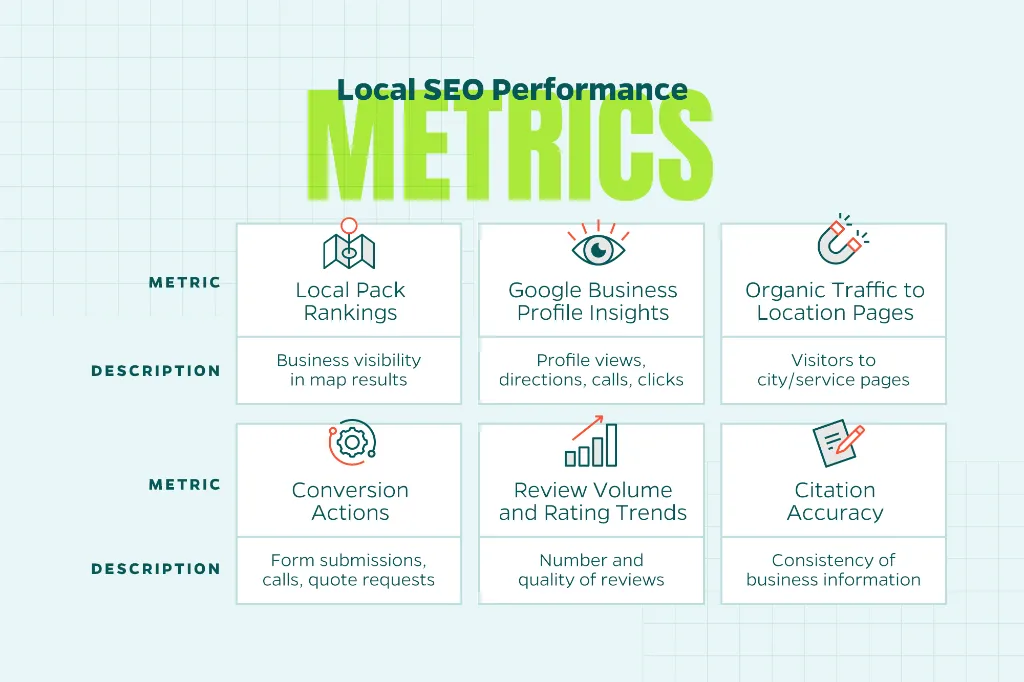
Tracking all six gives you a fuller picture than any single metric could on its own. A business might see strong local pack rankings but weak conversions, which points to a messaging or landing page problem rather than a visibility problem. Another might see plenty of website traffic but few directions requests, suggesting the Google Business Profile needs attention.
Tools Worth Setting Up
You do not need an expensive enterprise platform to track local SEO well. A few accessible tools cover most of what a local business needs:
- Google Business Profile Insights for direct visibility into how people are finding and engaging with your listing
- Google Search Console for organic search queries, impressions, and click-through rates on location-specific pages
- Google Analytics for on-site behavior, including which pages convert and how visitors move through your site
- A rank tracking tool that supports geo-grid tracking, so you can see rankings from multiple points across your service area rather than a single average position
- Call tracking software to attribute phone leads to specific campaigns or landing pages
Together, these tools close the gap between what happens in search results and what happens after someone clicks.
Set a Baseline Before You Judge Progress
One of the most common mistakes in local SEO measurement is expecting quick answers prior to establishing a starting point. Before drawing conclusions about performance, pull a baseline snapshot of rankings, traffic, and conversions. Without that reference point, you won’t know what improvement to expect on a month-over-month comparison.
From there, a consistent reporting cadence matters more than constant checking. Many agencies review local SEO performance monthly, since search rankings and organic traffic can fluctuate week to week. Reasons for these variations include a competitor’s algorithm-driven ranking swing, a seasonal dip in search volume, or a temporary Google update. Monthly reporting smooths out that noise while still catching trends early enough to act on them.
Common Measurement Mistakes to Avoid
A few habits tend to undermine even a well-built tracking setup. Here are a few mistakes to avoid:
- Averaging rankings across an entire metro area instead of tracking by specific location or ZIP code, which can hide poor performance in certain neighborhoods
- Ignoring Google Business Profile data in favor of website analytics alone, missing a major source of local visibility and engagement
- Treating traffic as the finish line rather than following the funnel through to calls, form fills, and booked appointments
- Skipping citation audits, which allows inconsistent business information to quietly undercut ranking potential
Turning Data into Decisions
The real value of tracking is not the dashboard itself, but the decisions it enables. If rankings are strong but conversions are weak, the fix might be a landing page redesign or clearer calls to action. If Google Business Profile views are high but calls are low, an updated phone number, hours, or set of photos might close that gap. If citation audits reveal inconsistent listings, cleaning those up can lift rankings without spending a dollar on new content.
When done well, local SEO measurement becomes a feedback loop. Each reporting cycle should inform the next round of optimization, whether that means refining keyword targeting, building new location pages, or adjusting review generation efforts. Businesses that treat measurement as an ongoing habit tend to see steadier and more predictable growth in local visibility over time.
It also helps to share results in plain language with everyone who has a stake in the outcome, not just the marketing team. A store manager or franchise owner may not care about keyword rank tracking, but they will care that calls are up 20 percent or that a new location page is generating quote requests. Translating raw metrics into business outcomes keeps local SEO grounded in results people can act on.
Need Help?
Getting local SEO measurement right takes the right mix of tools, a consistent process, and an understanding of which numbers reflect business impact. If you would like help building a local SEO tracking system tailored to your business, contact Straight North to learn more.