




If your business serves customers in a specific city, region, or neighborhood, local SEO should be one of the most important items on your marketing checklist. It determines whether potential customers find you when they search for the products or services you offer.
This guide walks through how local SEO works, what it takes to compete effectively, and how to build a strategy that drives real results for your business.
What is Local SEO?
Local SEO is the practice of optimizing your online presence so that your business appears in search results when people look for nearby products or services. When someone searches “plumber near me” or “Italian restaurant in downtown Chicago,” the results they see are shaped by local SEO signals.
Unlike traditional SEO, which focuses on ranking in organic search results broadly, local SEO is specifically designed to connect businesses with searchers in a defined geographic area. It encompasses everything from how your business is listed across the web to how your website is structured and how your customers talk about you online.
The goal is straightforward: when someone in your area needs what you offer, your business should be visible, credible, and easy to contact.
Why Local SEO Matters
Consumer search behavior has shifted dramatically in recent years. People turn to search engines the moment they have a need. Then they expect immediate, relevant answers. Local search queries have exploded in volume, and the intent behind them is often high. That’s because someone searching for a service in their area is typically ready to act quickly.
With this in mind, here are a few things to remember:
- Most consumers who perform a local search visit a local business they searched for within a day.
- “Near me” searches have grown substantially year over year across virtually every industry category.
- Businesses that appear in Google’s local pack — the map-based results at the top of many local searches — capture a disproportionate share of clicks and calls compared to those that appear only in the organic listings below.
If your business is not showing up prominently in local search results, you are likely losing potential customers to competitors who have invested in local SEO.
How Google Evaluates Local Search Rankings
Google uses three primary factors to determine which businesses appear in local search results. Understanding these factors is essential to building an effective strategy.
Relevance
Relevance refers to how well your business profile and website match what a searcher is seeking. If someone searches for “pediatric dentist,” Google needs to be confident that your practice is a pediatric dentist, not just a general dentist that occasionally treats children. This is why accurate, complete, and detailed information across your online presence matters.
Distance
Distance is exactly what it sounds like: how close your business is to the person searching or to the location they specified. While you cannot change your physical address, you can optimize for the areas you serve by being explicit about your service territory in your content and business listings.
Prominence
Prominence is a measure of how well-known and trusted your business is, both online and off. It is influenced by the number and quality of reviews you have, how consistently your business information appears across the web, the authority of your website, and how often your business is mentioned or linked to in other credible places. Prominent businesses tend to rank higher, which means building your online reputation is central to local SEO success.
The Building Blocks of a Strong Local SEO Strategy
Effective local SEO is not a single tactic. It is a combination of interconnected elements that work together to establish your visibility and credibility in local search.
Google Business Profile
Your Google Business Profile (GBP) is arguably the most important asset in your local SEO strategy. It is the listing that appears when someone searches for your business directly or finds you in a local search. It powers your appearance in Google Maps and the local pack.
A well-optimized GBP includes:
- An accurate and complete business name, address, and phone number.
- The correct primary and secondary categories for your business.
- A thorough business description that naturally incorporates relevant keywords.
- Current business hours, including holiday hours.
- High-quality photos of your location, products, or team.
- Regular posts and updates to keep your profile active.
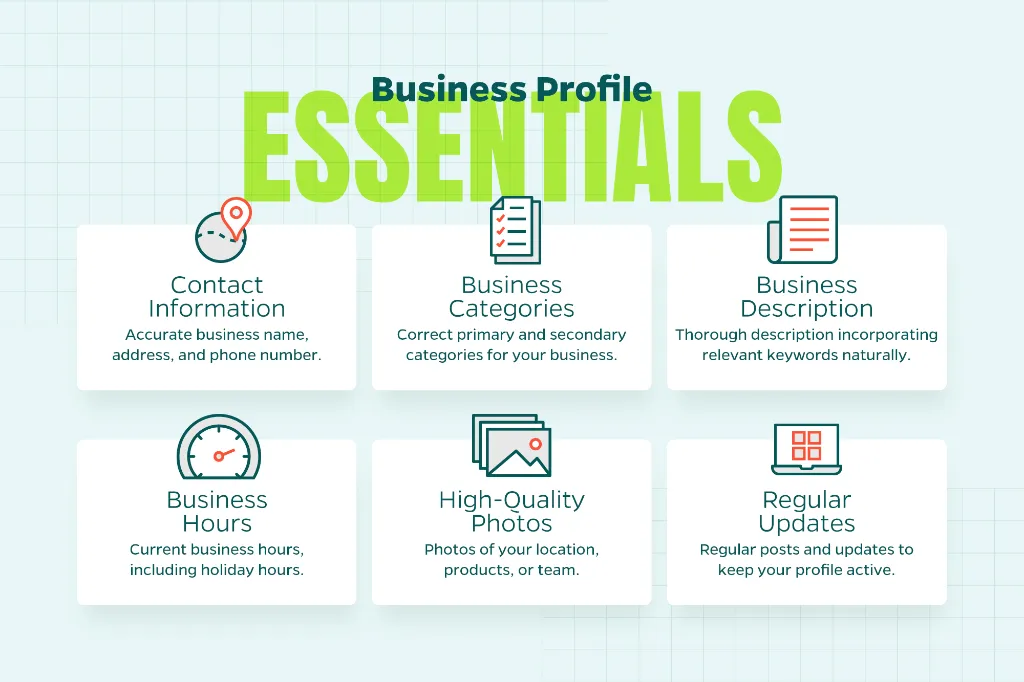
Many businesses claim their GBP and leave it partially filled out. That is a missed opportunity. Treating your profile as a living, regularly updated asset gives you a meaningful edge.
NAP Consistency
NAP stands for name, address, and phone number. Consistency in how this information appears across every online directory, listing, and platform is a foundational element of local SEO.
When your business name is listed slightly differently on Yelp than it is on your website, or your phone number has a formatting discrepancy on an industry directory, these inconsistencies send mixed signals to search engines. Over time, they can undermine your local rankings.
Conducting a NAP audit across major directories — including Google, Bing, Apple Maps, Yelp, and industry-specific platforms — and correcting discrepancies is one of the highest-leverage tasks in local SEO, especially for businesses that have been around for a while and have accumulated listings in various states of accuracy.
Local Citations
A citation is any online mention of your business’s name, address, and phone number. Citations on reputable directories help establish your business’s legitimacy and signal to search engines that your information is accurate.
Beyond the major general directories, citations on industry-specific and locally focused directories carry weight. A healthcare practice listed on Healthgrades or a restaurant listed in a regional dining guide all benefit from the context those platforms provide.
The goal is not to accumulate as many citations as possible, but to build a consistent, accurate presence on the directories that matter most for your industry and location.
On-Page Local SEO
Your website needs to send clear geographic signals to both search engines and visitors. This means going beyond simply mentioning your city name a few times. Effective on-page local SEO typically includes:
- Location-specific landing pages for each area you serve.
- Naturally incorporating city, neighborhood, or regional terms throughout your content.
- Embedding a Google Map on your contact page.
- Using structured data and schema markup to help search engines understand your business type, location, and contact information.
- Ensuring your NAP information appears in the footer of every page.
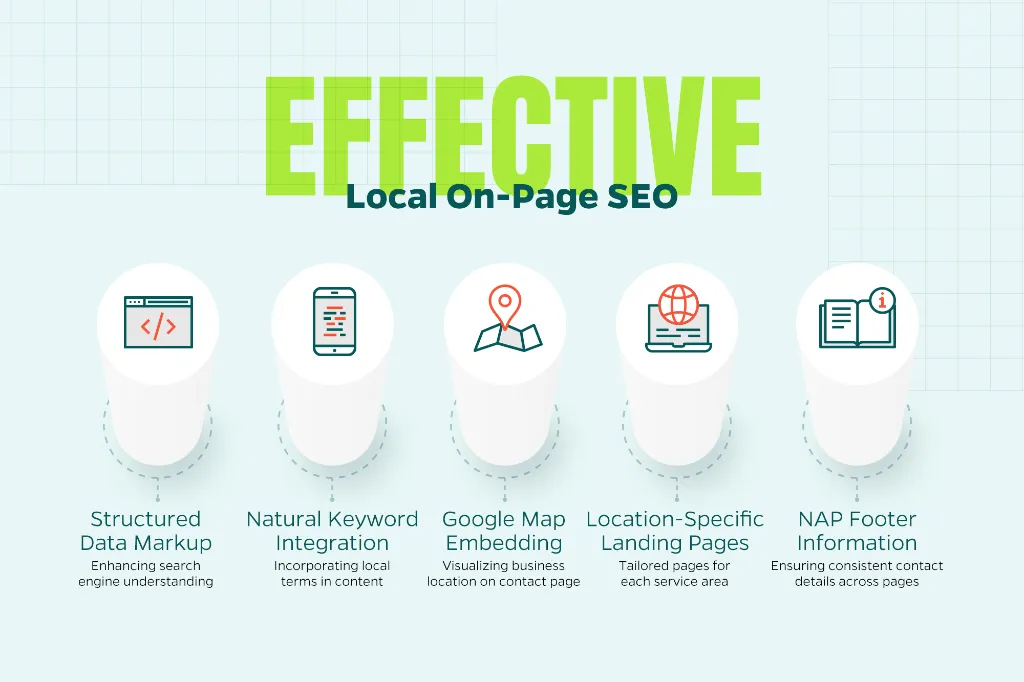
For businesses that serve multiple locations, dedicated pages for each service area are far more effective than a single generic page that simply lists cities.
Reviews and Reputation Management
Online reviews are one of the most visible and influential elements of local SEO. They affect your rankings directly and they affect whether someone chooses to call you over a competitor.
A strong reviews strategy involves three things: earning reviews consistently, responding to every review (positive and negative), and doing so in a way that reflects well on your business.
Asking satisfied customers for reviews is a necessary business practice. Unfortunately, most customers who have a positive experience will not leave a review unless prompted. Building a simple, frictionless process for requesting reviews can dramatically increase your review volume over time.
How you respond to negative reviews matters just as much. A thoughtful, professional response to a complaint tells prospective customers that you take your clients seriously and stand behind your work.
Local Link Building
Links from other websites to your site remain a significant ranking signal in local SEO. For local businesses, the most valuable links tend to come from other locally relevant or community-based sources.
Activities that can generate locally relevant backlinks include sponsoring local events, partnering with complementary businesses, earning mentions in local news outlets, and joining chambers of commerce and industry associations. The underlying principle is the same as any link-building effort: focus on genuinely useful relationships and activities, and the links tend to follow.
Mobile and Voice Search Considerations
A substantial portion of local searches happen on mobile devices while prospects are actively in the process of making a decision. A website that loads slowly or is difficult to navigate on a phone will lose visitors quickly, regardless of how well it ranks. Page speed, mobile responsiveness, and click-to-call functionality are baseline expectations for any businesses competing in local search.
Voice search is also worth considering. When people use voice assistants to search, they tend to use conversational, question-based queries such as “What is the best HVAC company near me?” or “What time does the hardware store close?” Content that naturally addresses the questions your customers are asking tends to perform well in both voice and traditional search.
Local Content Marketing
Content marketing is the backbone of any long-term SEO strategy, and local SEO is no exception. While optimizing your Google Business Profile and building citations establishes your foundational presence, local content is what allows you to compete for a broader range of searches and demonstrate authority in your market.
The most effective local content does two things simultaneously: it provides value to people in your area, and it reinforces your geographic and topical relevance to search engines. Here are a few formats that tend to work well:
- Location-specific blog posts that address questions, concerns, or topics relevant to customers in your area. For example, a roofing company could write about how local weather patterns affect roof longevity.
- Neighborhood or city guides that position your business as a knowledgeable resource within the community.
- Case studies or project spotlights that reference specific locations or service areas.
- FAQ pages built around the questions local customers ask, using their vernacular and voice.
The keyword research process for local content is worth approaching deliberately. Beyond the obvious location-plus-service combinations, pay attention to longer, more conversational queries. These are the kinds of things people type (or say) when they are trying to solve a specific problem. Longer-tail local queries are often less competitive and more likely to attract visitors with clear intent.
One principle that applies across all local content is write for the reader first. Search engines have become sophisticated enough that content designed purely to check keyword boxes tends to underperform compared to content that is genuinely useful. If your content helps someone make a better decision or understand something they didn’t before, it is doing its job. In the process, it performs well with both the reader and your rankings.
Local content also creates natural opportunities for the kind of internal linking that strengthens your overall site structure. A blog post about a specific service area can link to your dedicated location landing page. A project spotlight can link to the relevant service page. Over time, these connections help search engines understand how your content is organized and which pages matter most.
Local SEO for Multi-Location Businesses
Businesses that operate in more than one location face a distinct set of local SEO challenges. The strategies that work for a single-location business still apply, but the complexity scales quickly. Here are a few tips specific to juggling multiple locations.
Managing Multiple Google Business Profiles
Each physical location should have its own Google Business Profile. A single GBP listing for a business with five locations will not serve any of them well in local search.
Each profile needs to be individually optimized with location-specific photos, accurate hours, correct categories, and an address that matches how that location appears everywhere else online. Managing this across many locations requires a systematic approach, but cutting corners here will suppress rankings at the location level.
Be careful about creating duplicate listings, which can happen when a location has been claimed by different people at different times or when an old address lingers in Google’s system. Duplicate listings confuse search engines and split your review equity. If duplicates exist, they should be merged or removed.
Location Pages on Your Website
Each location also needs its own dedicated page on your website — and each page needs to be genuinely distinct. A common mistake is creating location pages that are essentially identical except for the city name. Search engines recognize this pattern, and it tends to produce poor results for every location involved.
Strong location pages include:
- Content specific to that location such as the team, the neighborhood, local client stories, or area-specific considerations.
- The full NAP information for that location, consistent with the GBP listing.
- An embedded Google Map for that specific address.
- Local schema markup identifying the location as a distinct entity.
Think of each location page as a mini home page for that specific location. The more useful and specific the content, the better it will perform.
Reviews Across Locations
Review management for multi-location businesses requires an organized process. Each location should be actively earning reviews, so it’s a good idea to always have someone monitoring and responding to them. A location that goes months without a new review — or worse, accumulates unanswered negative reviews — will underperform in local rankings and lose customer confidence.
Building a consistent review request process that can be executed at the location level, whether by local managers or a centralized team, is one of the more important operational decisions for multi-location businesses investing in local SEO.
Tracking Local SEO Performance
You cannot improve what you do not measure. Tracking performance across a handful of key metrics will help you understand what is working and where to focus your efforts.
Important metrics to monitor include:
- Google Business Profile insights: views, clicks, calls, and direction requests.
- Local keyword rankings: how you rank for your most important search terms in your target geography.
- Organic traffic from local searches, tracked through Google Analytics.
- Review volume and average rating trends.
- Citation accuracy across major directories.
Setting a consistent review cadence makes it easier to spot trends and respond before small problems become significant ones. It’s a good idea to track these trends either weekly or monthly so you can respond and adapt to them.
Common Local SEO Mistakes to Avoid
Even businesses that invest meaningfully in local SEO sometimes undermine their own efforts. Here are a few of the most common pitfalls:
- Claiming a Google Business Profile and then neglecting it.
- Using inconsistent business information across directories.
- Creating multiple GBP listings for the same location.
- Ignoring negative reviews or responding defensively.
- Building service area pages with thin, duplicated content.
- Neglecting technical issues like slow load times or broken mobile experiences.
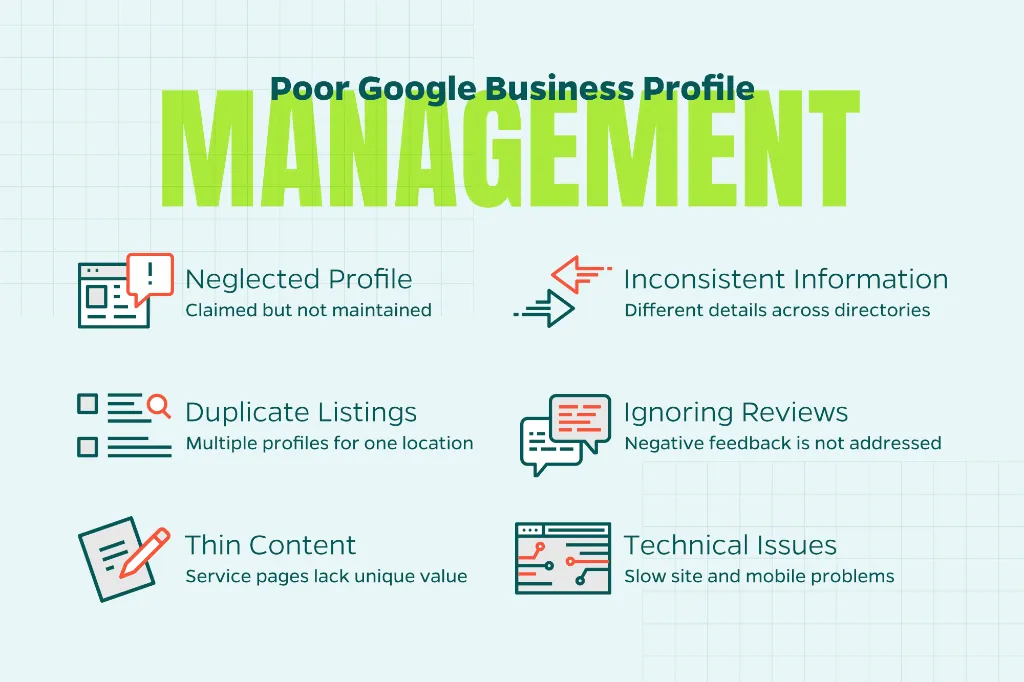
Many of these mistakes are easy to make and, fortunately, relatively straightforward to fix once identified. A structured audit of your local SEO presence will surface the issues with the most impact.
Local SEO as a Long-Term Investment
Local SEO is not a campaign with a defined end date. It is an ongoing practice that compounds over time. A business that consistently maintains its listings, earns reviews, produces relevant local content, and builds community relationships will continue to strengthen its local presence month after month.
The businesses that dominate local search in competitive markets are almost never there by accident. They have built their visibility through sustained, deliberate effort. They maintain it by treating local SEO as a core part of their marketing operation rather than a one-time project.
That sustained effort is what separates businesses that occasionally appear in local results from those that consistently occupy the top positions when it matters most.
Next Steps
Local SEO is both technical and human. It requires attention to detail across dozens of signals, from how your business is categorized in a directory to how you respond to a one-star review. But at its core, it is about making it as easy as possible for people in your area to find you, trust you, and choose you.
For most local businesses, the best starting point is a thorough audit: understand where you stand today across the key ranking factors, identify the gaps, and prioritize the fixes with the most potential impact. From there, it is a matter of building good habits and maintaining them consistently.
The businesses that win in local search are the ones that make it a consistent priority.
Need Help?
Ready to strengthen your local SEO? Contact Straight North to talk through your current presence and how we can address your biggest opportunities.