




Most businesses think of FAQ pages as a customer service tool that prevents representatives from having to answer common questions. But when it comes to local SEO, a well-built FAQ page can be one of the more underutilized assets in your digital marketing strategy.
Search engines are increasingly built around questions. People type queries like “how much does HVAC repair cost in Chicago” or “do I need a permit for a bathroom remodel in Austin.” If your FAQ page answers those questions clearly and in a locally relevant way, you have a real shot at appearing in search results for them. This article will outline some best practices.
Why FAQ Pages Work for Local SEO
FAQ pages tend to perform well in local search for a few reasons that are worth understanding before you start building one.
- FAQs naturally align with how people phrase local search queries. Voice search and mobile search have pushed conversational, question-based language to the forefront. FAQ pages are structured around that kind of language.
- FAQ content is highly eligible for featured snippets or AI overviews. When a search engine can pull a clean, direct answer from your page, it often will. That visibility can drive meaningful traffic even if you’re not ranking in the top organic position.
- FAQ pages give you a structured way to incorporate local keywords without forcing them awkwardly into your main service pages. Questions can reference your city, service area, or neighborhood in a way that reads naturally because prospective customers ask questions that way.
How to Build a FAQ Page That Drives Local Traffic
Building an FAQ page for local SEO requires some intentionality. A generic list of questions with vague answers won’t do much. Here’s what works:
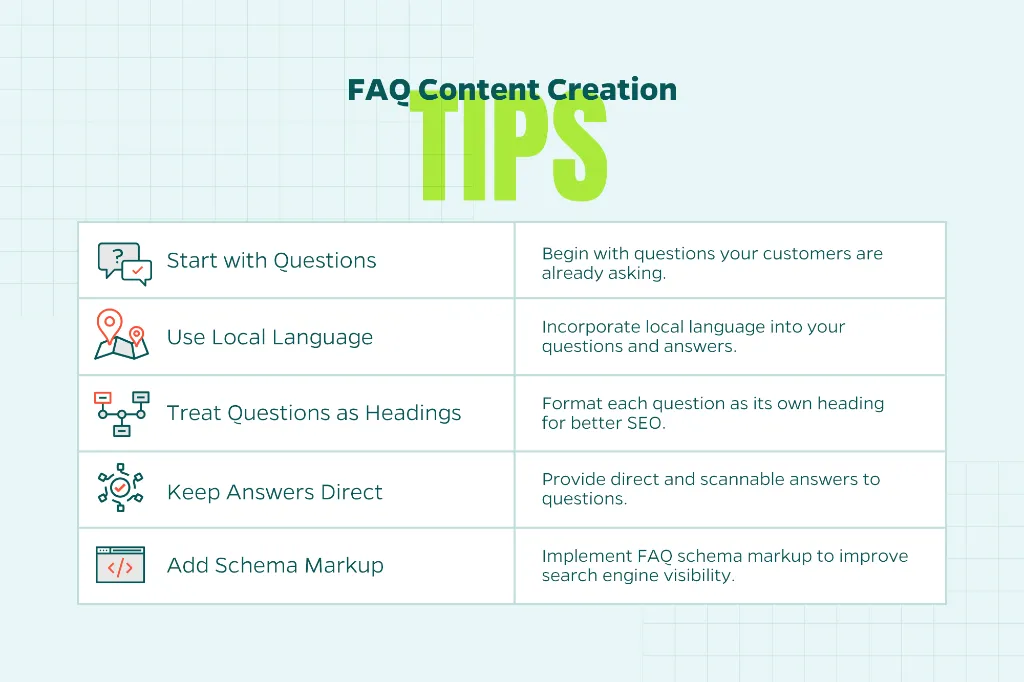
- Start with questions your customers are already asking. Talk to your sales team, look at your Google Business Profile Q&A section, and review any intake forms or chat logs you have. The best FAQ content reflects what real people want to know.
- Use local language in your questions and answers. Instead of “How long does a roof replacement take?” consider “How long does a roof replacement take in the Houston area?” The answer can then reference local weather patterns, permit timelines, or material availability. This adds relevant local context while naturally working in geographic keywords.
- Treat each question as its own heading. Formatting questions as H2 or H3 tags signals to search engines that each question is a distinct topic. This structure also improves the chances of your content being pulled into featured snippets or AI overviews.
- Keep answers direct and scannable. Aim to answer the question in the first sentence or two, then add any necessary detail. Long, rambling answers may dilute the SEO value and will likely lose readers. If a topic warrants more depth, link to a dedicated page rather than expanding the FAQ answer indefinitely.
- Add FAQ schema markup. FAQ schema is structured data that tells search engines your page contains question-and-answer pairs. Implementing it can unlock rich results in the SERPs, which increase your listing’s visibility and click-through rate. Your web developer or digital marketing partner can handle implementation.
Connecting FAQ Pages to Your Broader Local SEO Strategy
An FAQ page works best when it’s woven into the larger structure of your website and local SEO efforts.
Internal linking matters. When your FAQ answers reference specific services, link to those service pages. This passes authority between pages and guides users toward the information they need to make a purchasing decision. If someone lands on your FAQ page asking about pricing, they’re often a step or two away from becoming a lead. Make it easy for them to take the next step.
You can also create service-area-specific FAQ pages if your business covers multiple locations. A plumbing company that operates in three cities might maintain separate FAQ pages for each one, tailoring the questions and answers to local conditions, regulations, and customer concerns. This approach is more work upfront, but it can generate targeted local traffic that a single generic FAQ page simply won’t.
It’s also worth keeping your FAQ page fresh. Your FAQ content should reflect evolutions in services, local regulations, and new customer questions. A consistent review cadence keeps the page accurate and competitive.
What Makes a FAQ Page Fall Short
Even with the right intentions, FAQ pages can miss the mark. Below are a few common pitfalls to avoid:
- Questions that no one is searching for. If you’re writing questions based on what you wish customers asked rather than what they’re typing into Google, the page won’t perform. Use keyword research tools to validate your question ideas before committing to them.
- Answers that are too vague. “It depends” is not a helpful answer. Give specific context that helps users make sense of their situation.
- Stuffing keywords unnaturally. Local keywords should appear where they make sense. Forcing your city name into every sentence reads as spam to search engines and is an off-putting experience for users.
Done well, a FAQ page becomes a quiet but consistent source of local search traffic. It answers the questions your prospective customers are asking, positions your business as a knowledgeable local authority, and moves people further along the path to reaching out. That’s a lot of value from a page type that often gets overlooked.
Need Help?
If you’d like help building or optimizing FAQ pages as part of a local SEO strategy, the team at Straight North is ready to assist you. Contact us to start the conversation.