




Most local businesses understand that they need to show up online. What fewer realize is that showing up in local search results depends heavily on the content they publish. Search engines want to see that a business is connected to its community and market. The way to demonstrate that connection is through well-crafted local content.
This is more than just a local SEO exercise. Done right, local content builds trust with potential customers before they ever pick up the phone. It answers their questions, speaks to their specific situations, and positions your business as the obvious choice. This article will break down how to approach it strategically.
What Makes Content “Local”?
Local content marketing is not simply content that mentions your city name a few times. That approach is transparent to both readers and search engines. True local content is rooted in the specific concerns, conditions, and context of the communities you serve.
Think about what differs from one market to the next. An HVAC professional in Phoenix faces different seasonal demand patterns than one in Minneapolis. A healthcare practice in a rapidly growing suburb has different patient concerns than one in a rural county. These nuances are exactly what local content should surface.
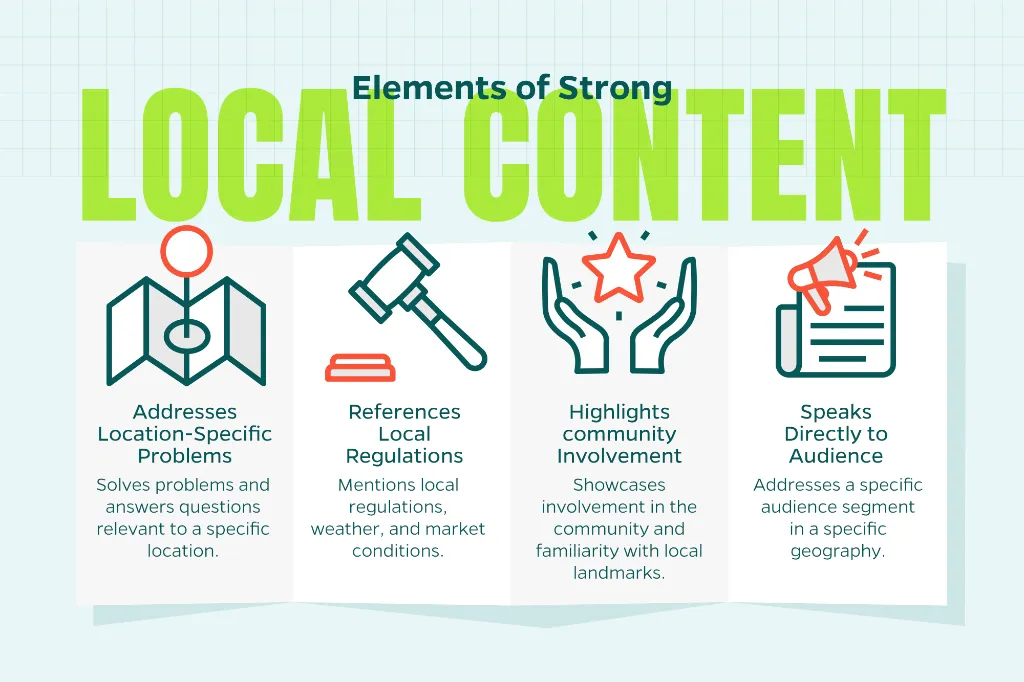
Strong local content typically does one or more of the following:
- Addresses location-specific problems or questions your customers ask
- References local regulations, weather patterns, or market conditions relevant to your industry
- Highlights your involvement in the community or your familiarity with local landmarks and neighborhoods
- Speaks directly to a specific audience segment in a specific geography
Start With Keyword Research Grounded in Local Intent
Before you start writing, it’s best to understand what people in your area are searching for. Generic keywords like “HVAC repair” will put you in competition with every national aggregator and major directory. Local intent keywords — phrases like “furnace repair in [city]” or “best HVAC company near [neighborhood]” — tell you exactly what your prospective customers are typing into Google.
Tools like Google Search Console, Google’s autocomplete suggestions, and the “People Also Ask” feature are good starting points. Pay attention to question-based queries. If people are searching “when should I replace my water heater in [city],” that’s a content opportunity with clear local intent and a reader who is close to making a purchase decision.
Map your keywords to specific pages or posts before writing. A targeted piece of content built around one primary local keyword will almost always outperform a broader article trying to chase multiple terms at once.
Structure Content for Both Readers and Search Engines
Good structure serves two audiences simultaneously. Search engines parse your headings, subheadings, and internal links to understand what a page is about. Readers scan before they commit, so a well-organized article with clear headers keeps them engaged long enough to absorb your message.
Include your primary local keyword in the page title, the H1, and naturally throughout the body copy. Avoid keyword stuffing. If a phrase sounds forced, it probably is. Aim for natural usage that would read just as well to someone unfamiliar with SEO.
Your meta description matters too. It’s not a direct ranking factor, but it influences click-through rates from search results. A meta description that mentions your city and speaks to a specific pain point will draw more clicks than a generic summary.
Write Content That Reflects Real Local Expertise
Google’s quality guidelines place significant weight on Experience, Expertise, Authoritativeness, and Trustworthiness (E-E-A-T). For local businesses, demonstrating expertise means going beyond surface-level advice to offer insights that only someone with real on-the-ground experience would know.
A roofing company in the Pacific Northwest might write about how persistent rain and moss growth impact shingle lifespan in that climate. A financial advisor in a college town might address the specific retirement planning concerns of university employees. This kind of specificity is hard to fake and hard to replicate. That is why it performs well.
If you’re pulling from staff knowledge or client conversations to inform your content, that’s a strength. The most valuable local content often comes from answering the same questions your team fields every week.
Build for Conversions, Not Just Traffic
Ranking well is only half the goal. A blog post that draws thousands of visits but generates no leads is not doing its job. Every piece of local content should have a clear path for the reader to take the next step.
Consider where the reader is in their decision-making process. Someone searching “what causes low water pressure” is in an early research phase. Consequently, educational content with a subtle call to action works well during that stage. Someone searching “emergency plumber in [city]” is ready to act. That page should lead immediately with contact information and social proof.
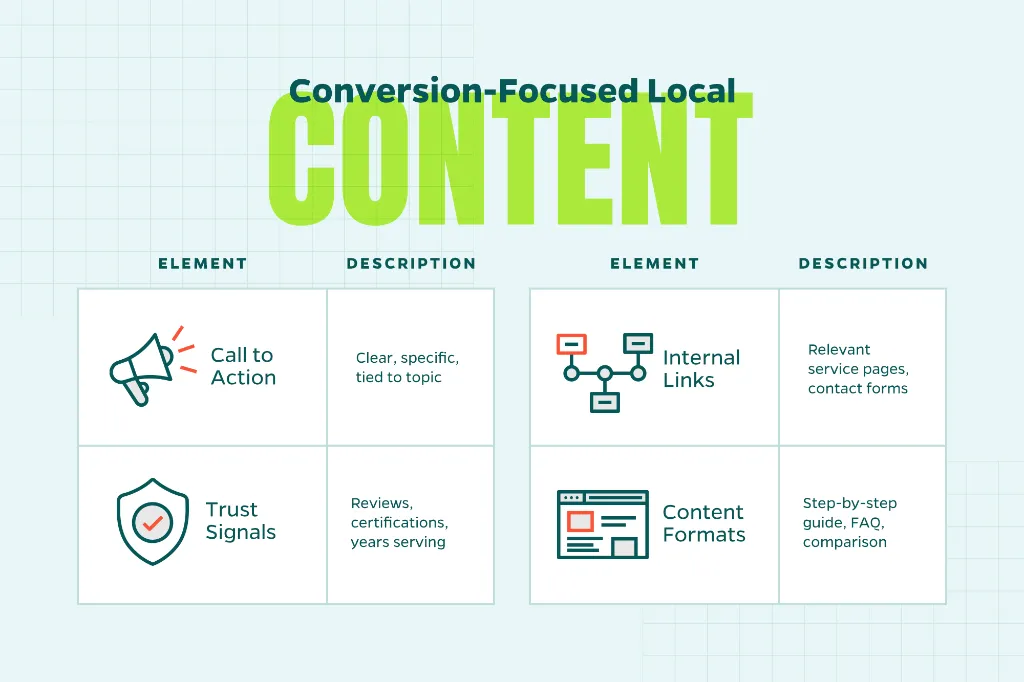
Conversion-focused local content incorporates elements like:
- A clear, specific call to action tied to the topic of the page
- Trust signals such as reviews, certifications, or years serving the local market
- Internal links to relevant service pages or contact forms
- Content formats that match the reader’s needs, whether that’s a step-by-step guide, an FAQ, or a comparison of options
Maintain Consistency Across Your Local Content Strategy
One well-optimized post will not move the needle on its own. Local SEO rewards businesses that consistently demonstrate relevance and authority over time. A content calendar that produces two or three targeted local pieces per month will build far more momentum than sporadic publishing.
Think about the topics your business could credibly cover over the next six to twelve months. Seasonal considerations, common customer misconceptions, local market trends, and service-specific guides all make strong starting points. Over time, a library of interconnected local content strengthens your overall domain authority and makes it easier to rank for new terms.
Consistency also applies to your brand voice and messaging. Readers who encounter your content across multiple pages or visits should get a coherent sense of who you are and what you stand for. That coherence builds the kind of trust that eventually converts browsers into buyers.
Need Help?
If you’re ready to build a local content strategy that drives real results, contact Straight North to learn how our team can help.