




If your business depends on customers in a specific city, neighborhood, or service area, local SEO keyword research is one of the most important things you can do to improve your online visibility. It is not the same as general keyword research. You are not trying to rank nationally for broad terms. Your goal is to show up for the specific searches people near you are making when they are seeking services like yours.
Local keyword research connects you to high-intent customers who are close to making a decision. Here is how to approach it in 2026.
Understand What Makes Local Keywords Different
Local keywords signal geographic intent. Some do this explicitly, pairing a service with a location name like “HVAC repair Columbus” or “family dentist in Green Bay.” Others carry implicit local intent. Someone searching “emergency plumber” or “open late dry cleaner” is clearly looking for something nearby, even without typing a city name.
In 2026, search behavior leans increasingly conversational, especially with voice assistants and AI-driven search changing how people find local businesses. A user might type “plumber Fort Lauderdale” in a desktop search, but ask their phone, “Who is the best plumber near me open on Saturday?” Your keyword strategy needs to account for both.
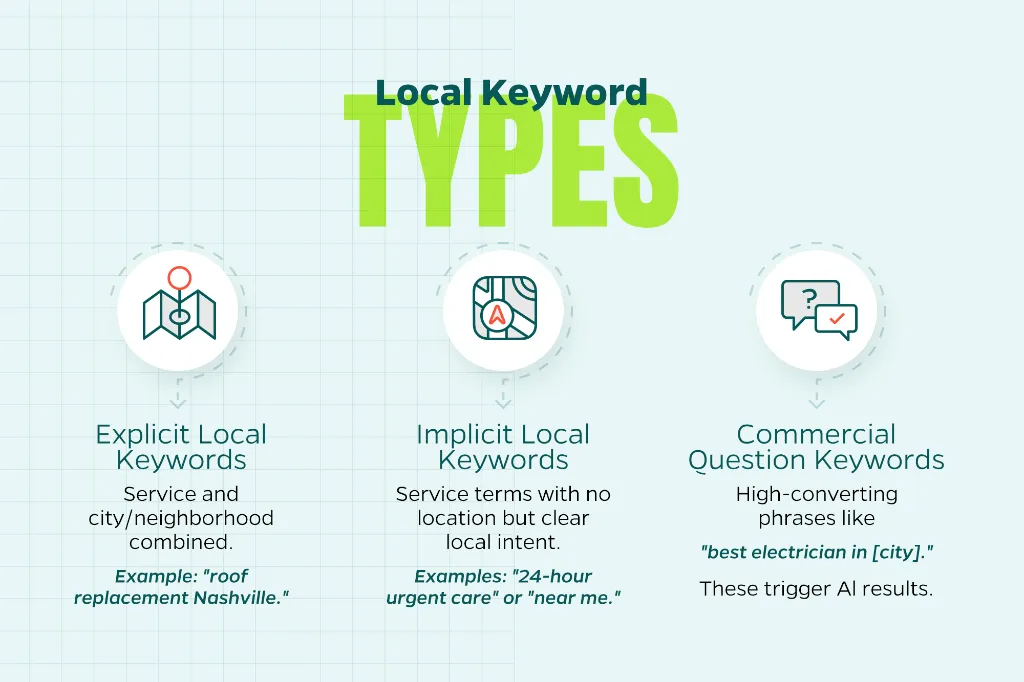
To cover your bases, here are a few key categories to focus on:
- Explicit local keywords: This consists of your service as well as city or neighborhood. An example of this would be “roof replacement Nashville.”
- Implicit local keywords: These are service terms with no location but clear local intent. Examples could be “24-hour urgent care” or “near me” searches.
- Commercial question keywords: These are high-converting phrases like “best electrician in [city]” or “top-rated landscaper near me.” These frequently trigger AI-generated results and map pack listings.
Start with a Seed Keyword List
Begin by listing every core service or product your business offers. Then pair each one with the geographic areas you serve. This includes cities, neighborhoods, zip codes, or counties. This combination is the foundation of your local keyword strategy.
For a painting contractor in Chicago, seed keywords might include “exterior house painters Chicago,” “interior painting Lincoln Park,” or “commercial painting services Chicago Loop.” Even if some of these have modest search volume of only 100 to 300 searches per month, they can drive valuable leads if the intent is strong and competition is manageable.
Do not limit yourself to city names. Neighborhood and suburb-level keywords often face less competition and attract users who are closer to choosing a local provider. These more granular terms can be some of the highest-value keywords in your entire strategy.
Mine Your Own Data First
Before opening any keyword tool, check Google Search Console. Filter your search performance report to find queries already bringing traffic to your site, or queries where you are getting impressions but ranking on page two or three. These are your “sleeping giant” keywords. You are already on Google’s radar for them, and targeted optimization can move them up the page faster than building entirely new content from scratch.
Pay close attention to queries you did not plan for. Users often phrase their searches in ways that do not match your assumptions, and those organic phrases can spark new page ideas and reveal gaps in your current content.
Use Keyword Research Tools Strategically
Tools like SEMrush, Ahrefs, BrightEdge, and Google Keyword Planner are essential for expanding your list and evaluating the competitive landscape. Here is how to get the most out of them for local research:
- Enter your seed keywords and filter results by location to see local search volumes.
- Use competitor analysis features. Enter a rival’s domain and look for local keywords they rank for that you do not.
- Look for long-tail phrases with lower competition. These often convert better because they capture users who are further along in the decision-making process.
- Note terms that trigger map pack results in the search engine results pages. Those are strong signals of local intent and indicate where you can gain high-visibility placement.
Do not get too fixated on high search volume. A keyword with 150 monthly searches but high purchase intent may deliver more qualified leads than a broader term with 2,000 searches and mixed intent.
Think in Keyword Themes Instead of Isolated Keywords
One shift that has become essential in this era is moving from a keyword-by-keyword mindset to a keyword theme approach. Rather than targeting a single phrase in isolation, build your content strategy around a core service and consider the full range of contexts, questions, and scenarios a customer might search around it.
Take a residential HVAC company. The core service is heating and cooling. From there, keyword themes might include:
- Specific problems: “furnace not turning on,” or “AC blowing warm air.”
- Urgency: “emergency HVAC repair near me,” or “same-day AC service.”
- Cost and comparison: “how much does furnace replacement cost,” or “best HVAC company in [city].”
This approach creates a more logical site structure, and it aligns with how both users and AI systems process and present local search results. It also gives you a clear content roadmap rather than a fragmented list of random phrases.
Map Keywords to the Right Pages
One of the most common mistakes in local SEO is targeting the same keyword on multiple pages. When two pages on your site compete for the same term, search engines have a harder time deciding which one to rank, and both pages can suffer as a result. Each keyword — or tightly-related keyword cluster — should have one dedicated destination on your site.
Service pages should target your primary local keywords. Supporting blog content handles question-based and informational queries. If you serve multiple cities or regions, location pages should target area-specific keyword variations, going beyond swapping out city names to include local context that makes each page useful in its own right.
Optimize for Voice and Conversational Search
Voice search usage continues to grow, and the queries it generates are longer and more natural than typed searches. Instead of “plumber Austin TX,” a voice query might be “Who is the best plumber in Austin for a slab leak?” AI-powered search tools like Google’s AI Overviews and conversational assistants process queries in full sentences, focused on intent rather than isolated keywords.
Include conversational, question-formatted phrases in your content, especially on FAQ pages, service pages, and blog posts. Think about what a potential customer would say out loud when describing their problem, and make sure your site provides a clear, direct answer. Semantic relevance is the key. That kind of content is exactly what AI search systems surface in response to natural language queries.
Treat It as an Ongoing Process
Local keyword research is not something you do once and set aside. Search behavior shifts. Competitors adjust their strategies. New services get added to your business. Google’s algorithms continue to evolve, and AI-driven search is changing how results surface and how users interact with them. Businesses that treat keyword research as a one-time task tend to lose ground over time.
Set a regular cadence to revisit your keyword data, look for new opportunities, and check how your target terms are performing. Focus your measurement on what matters most: phone calls, form submissions, direction requests, and conversions. Traffic is useful context, but conversions are the real measure of whether your keyword strategy is working.
Want to Strengthen Your Local SEO Strategy?
Local keyword research is a critical first step, but it is just one part of a comprehensive local search strategy. If you want expert guidance on identifying the right keywords, structuring your site, and turning local search traffic into real business results, contact Straight North.