


Duplicate business listings are among the most common and overlooked issues in local SEO. When left unaddressed, duplicates can gradually weaken your visibility in local search results and confuse the customers you are trying to reach. Below we’ll explain what duplicate listings are, why they happen, and how to restore your business to a single, reliable source of truth online.
What Counts as a Duplicate Listing?
A duplicate listing happens when two or more profiles exist for the same business location across a directory like Google Business Profile, Yelp, Bing Places, or Apple Maps. Sometimes the duplicate is an exact copy. More often, it’s a near match with small but meaningful differences. This could include a slightly different business name, an old phone number, or a suite number that no longer applies.
Search engines don’t always know which version is correct. Consequently, they may split your reviews, your search ranking signals, and your online authority between listings instead of consolidating them into one strong profile.
Duplicates also spread across the smaller, lesser-known directories. Those secondary listings are often the ones businesses forget to check. A profile that’s been sitting untouched on a niche directory for years can still influence how search engines perceive your business, even if you never visit that site yourself.
How Duplicates Sneak into Your Listings
Most business owners don’t set out to create duplicate listings. They tend to show up because of:
- Multiple people or agencies claiming the same listing over the years without coordinating
- A business move or rebrand that generated a new profile instead of updating the old one
- Data aggregators pulling outdated information from public records and republishing it
- Manual entries created by well-meaning employees, franchise partners, or even customers
- Platform glitches during a merger, acquisition, or bulk import of location data
Once a duplicate exists, it tends to multiply. Aggregators scrape it, other directories pick it up, and before long you’ve got a small mess spread across the web.
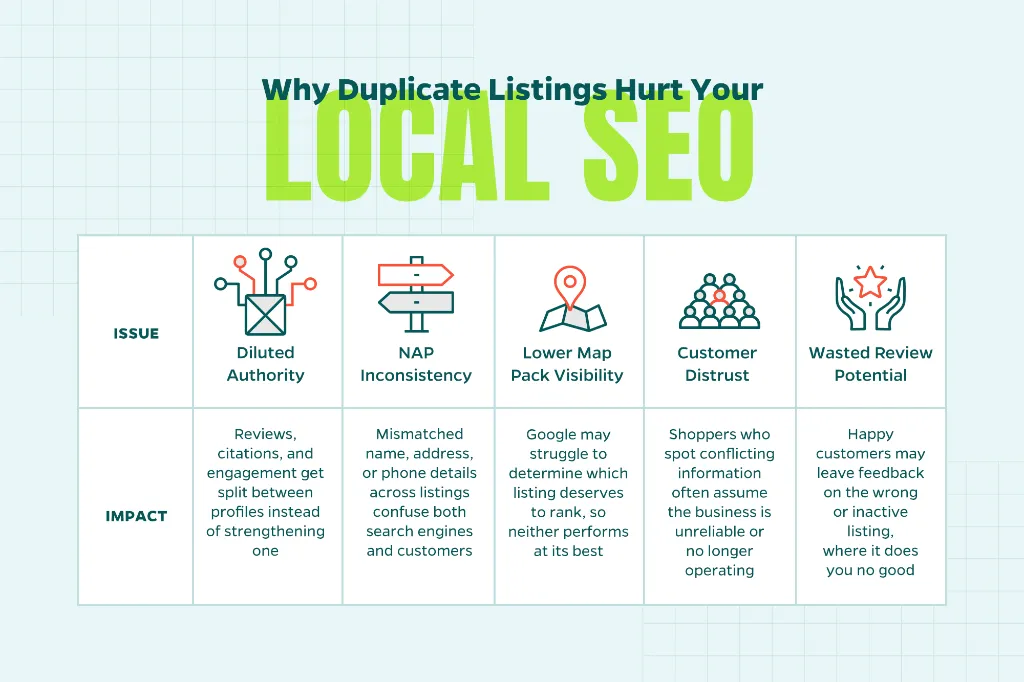
Why Duplicate Listings Hurt Your Local SEO
This is more than a tidiness issue. Duplicate listings create real ranking and trust problems, including:
- Diluted authority: reviews, citations, and engagement get split between profiles instead of strengthening one
- NAP inconsistency: mismatched name, address, or phone details across listings confuse both search engines and customers
- Lower map pack visibility: Google may struggle to determine which listing deserves to rank, so neither performs at its best
- Customer distrust: shoppers who spot conflicting information often assume the business is unreliable or no longer operating
- Wasted review potential: happy customers may leave feedback on the wrong or inactive listing, where it does you no good
How to Find Your Duplicate Listings
Before you can fix the problem, you need a full picture of it. Here are a few reliable ways to track down duplicates:
- Search your business name, address, and phone number in Google, and check the map results for more than one pin
- Search variations of your business name, including old names, abbreviations, and common misspellings
- Check major directories individually, such as Yelp, Bing Places, Facebook, and industry-specific platforms
- Use a listings management tool or local SEO audit service to scan dozens of directories at once
Keep a simple spreadsheet as you go. Note the platform, the URL or listing ID, and what’s wrong with each one. That record will save you time once you start making corrections.
How to Handle Duplicates Once You Find Them
The right fix depends on the platform and the type of duplicate you’re dealing with, but the general process looks like this:
- Claim every listing you find: You can’t merge, edit, or remove a listing you don’t control. Claim ownership of each version first, even the ones you plan to delete.
- Identify the listing to keep: Choose the profile with the most reviews, the strongest engagement, or the longest history, and treat it as your primary listing going forward.
- Merge or request removal of the rest: Google Business Profile allows you to report duplicates for merging directly through its support tools. Other directories may require a removal request through their help center.
- Update information on the surviving listing: Once consolidation is complete, double-check that your business name, address, phone number, hours, and website link are current and consistent.
- Recheck in a few weeks: Duplicate removal isn’t always instant. Some platforms take days or weeks to process changes, so a follow-up check helps confirm the fix took care of the problem.
Keeping Duplicates from Coming Back
Cleanup is only half the job. Here are a few habits can keep new duplicates from forming:
- Assign one person or team to manage listing updates instead of leaving it open to anyone
- Update every directory promptly after a move, rebrand, or ownership change
- Monitor your listings on a regular schedule, not just when something feels off
- Use a consistent NAP format across your website, directories, and marketing materials
A Note for Multi-Location Businesses
If you manage more than one location, duplicate listings tend to multiply faster and hide better. A regional chain might have five accurate profiles and three stray duplicates scattered across directories nobody remembers signing up for. By reviewing listings on a location-by-location basis, you can probably catch more. It also helps to keep a master list of every claimed profile per location, so future updates can be made everywhere at once instead of location by location, directory by directory.
Duplicate listings might seem like a minor technical hiccup, but they send mixed signals to both search engines and the people searching for you. A little routine maintenance goes a long way toward keeping your business looking sharp, credible, and easy to find.
Need Help?
Ready for a cleaner, stronger local presence? Contact Straight North today to learn how our local SEO experts can audit your listings and help your business show up right, every time.